To avoid these ads, REGISTER NOW!

Below 265 SQ/FT Tiny Tokyo Shop

All workspaces below 265 squarefeet.

wasfast

Well-known member
Joined
Apr 10, 2014
Messages
874
Location
San Diego CA
You sir are nearly unstoppable and obviously highly motivated against some serious hurdles. Just the trash episode would have stopped most of us. I'm also hooked on reading your generously typed entries. Very interesting!
 
To avoid these ads, REGISTER NOW!

gbh

Well-known member
Joined
May 2, 2012
Messages
611
Thanks for sharing. Subscribed!
I live in Nagoya and can empathise with what you're dealing with. Very interested to see your workshop progress!
 
OP
B

Bakafish

Well-known member
Joined
Feb 7, 2017
Messages
477
Location
Tokyo
You sir are nearly unstoppable and obviously highly motivated against some serious hurdles. Just the trash episode would have stopped most of us. I'm also hooked on reading your generously typed entries. Very interesting!

Great write up! Its fascinating to see a build in a country with even less space than the little spec of planet I call home! [emoji1179]

I'm along for the ride and will be silently cheering you on!

Niels

Thanks for sharing. Subscribed!
I live in Nagoya and can empathise with what you're dealing with. Very interested to see your workshop progress!

Thanks guys!

Pictures on page 2 are not showing up :-(

I’ve checked this from a couple of proxies and other locations and they show up for me. I’m in Japan and these are hosted on an NTT Gigabit fiber connection, so you might be running into firewall rules, or some kind of Adblocker plugin that doesn’t like my server… PM me if you have more detailed information on what is preventing you from seeing these.

What are the rules for DIY there? Are there inspections and permits required?

DIY

Japanese culture reveres the craftsman and the concept of professional specialization. It seems to me that, to the Japanese, the idea that someone would attempt to do something outside the scope of their role in society is at minimum eccentric, but deep down it is unsettling to them. The whole society is set up as a smoothly running machine with each part specialized for its role. The benefit to this is the quality of workmanship and the level of service is exceptional. Japanese are some of the most demanding customers in the world, and the local market provides them with that sort of quality. This is one of the first cultural shocks to western companies and people as they interact with this marketplace. The obvious downside of this is cost. But in a closed system if everyone pays and earns top dollar, it all is a wash. It doesn’t really raise any red flags unless you are an outsider who has a better global perspective of what things should cost.

Almost everyone has a hobby, or something that they like to do apart from their actual work, but the tendency for Japanese is to go incredibly deep and focused. Someone who does a lot of things is looked at as indecisive or a dabbler. Again, this is not a bad thing, as you get these people who will put their heart and soul into preserving some obscure classic car or building vacuum tubes by hand. The effort and care that Japanese hobbyists possess is maybe unequaled, but again, it is uncommon for someone with such obvious skill and mastery to do the unthinkable and change a valve in their faucet. They are going to call the plumber.

I’m prone to exaggeration and using a broad brush. I’m sure in the farming communities and more impoverished areas, and possibly generationally, a more independent culture of DIY exists, but where I come from (California) there is expectation that a man can fix stuff. <— That is a sexist statement, I’m not saying that it is right or that I agree with it, it is just my perception of the way I was raised. It may be because I grew up poor and on a farm, your experience may differ. In Japan there is little social pressure or expectation for men to be handy.

But back to the question, there are no direct equivalents of shops like Lowes or Home Depot, a Japanese DIY store is closer to a hardware store, with a big garden center and consumer focused products. There are some professional specialty businesses, my local favorite being Beaver Pro, but when the best (broad spectrum) professional supply is substandard to any Big Box DIY store in the US, it is really frustrating. As with the professional specialism I spoke of, the same applies to stores that specialize in serving the needs of a very specific workman or product. Finding such esoteric places, and convincing them to do business with a dilettante non-professional (who’s a foreigner) is not likely to succeed though. The prices are crazy high at such a place as well, Amazon here in Japan has been a godsend.

So even as I paint this dark picture, the culture seems to be moving (slowly as it does here) towards embracing a more DIY lifestyle. There are more and more stores and online businesses that are catering to the slightly weak sauce concept of Japanese DIY. I order my wood and wallpaper online from such places, and “Renew” rather than rebuild is becoming a much more commonplace as people try harder to save money. But we will never see a market like the US/Canada. I’m not worldly enough to know if we (North America) are the exception here, but Australia and Europe seem to have easy access to some good stuff.

I want to go a little deeper on how this ‘professional only’ culture really negatively impacts the serious DIY’er over here. Due to localized adoption of electricity, and no expectation of national integration, the country is now operated with two parallel power grids. One grid (where I am) runs at 50Hz and the other at 60Hz, both of them using an unusually low 100v/200v split phase system. It means that many power tools not specifically made for Japan do not run optimally, or sometimes not at all. Paying hundreds of dollars to import something that may not even work is kind of frightening to be honest. Without a hyper competitive Semi-Pro DIY local market there is little reason for manufacturers to provide cutting edge tools at anything approaching the price or selection you get in the US (and I assume other regions.) If you look at Makita, a domestic manufacturer I’m fond of, the sliding miter saws in the US are far more advanced, updated more regularly, have much bigger blades and are fraction (30-50%!) of the price! This sort of tool is only bought by a professional here so there is little opportunity to amortize the costs by the manufacturer due to demand. There is little outside competition due to regulatory restrictions and power differences. And so, the expense is simply passed on to the customer and helps provide a protective barrier of entry to anyone thinking of nailing up some trim for themselves.

One of the ways I have gotten around this problem is to embrace LiON tools, as I can buy or build a domestic charger and then buy every tool I want from the US, bypassing the whole voltage problem altogether. But for big tools I dream of, like a lathe, milling machine, or even a decent table saw, I’m forced in to the most rarefied end of the professional market intended and sized for industrial applications and with commiserate costs (oh, and 3-phase power which you can’t have in a residential building.) So I envy the casual way most of you can drop by the Big Box DIY store and take home a sophisticated Bosch Reaxx table saw, a portable surface planer, 12” miter saw or even a good drill press. Shopping for most power tools over here is super depressing…

Building Permits

Disclaimer: I tried and failed to understand the copacetic way to do this, but couldn’t find anyone who understood what a building permit was, or where you would apply. I think the deal is that this work was probably illegal as hell. My guess is that you have to be certified and licensed to turn a screw here in Japan, and as far as requesting a permit, there doesn’t seem to be any public way of doing so. This system is set up to service professionals and as I unsuccinctly explained above, normal people never do this sort of thing, so there isn’t any need to provide them the means to do so legally. The converse is, as far as I’m aware, very little awareness or suspicion that someone would attempt anything that would require a permit in the first place, so no one is looking. The work I did to replace the window was very externally obvious, but I timed it to happen on a very significant local holiday and wrapped it up as quickly as possible, so as not to tempt the gaze of Sauron. I try to keep things on the down-low and not disturb my neighbors or attract undue attention. But if I disappear you can assume I was either arrested or miswired something important :)

I don’t really want to die or kill anyone though, so I’m careful about -at minimum- complying with US building and electrical codes, which I think are pretty good and are at least in English. I actually tend to over spec everything by a significant margin as the costs are not my primary concern, and I’m saving money by doing myself anyway right? When I start talking about the electrical work that was done to the house, let’s all just assume I am documenting a certified electrician’s handiwork. Same goes for the plumbing and engineering. Deal?
 

HCNDM

Well-known member
Joined
Oct 20, 2015
Messages
682
Location
Netherlands (tiny little country in western Europe
Fascinating....

The average Dutchman or women isn't much of a dyi person either. Certainly not at the scale of the average North American. That said we have code. Not much mandatory permit and inspection work. When in doubt call the municipality and they have someone on staff to inform you.

Much more of a policy of you are responsible to make sure you do it right and know when to outsource to a pro. If you get it wrong you are not only liable but also uninsured.

Seems to me you are educating yourself where needed, doing the work as safely as possible, and applying due diligence all they way! That's good enough in my books.

We are certainly not a culture of singular focus and excellence like the Japanese. Whilst dyi is not frowned upon I certainly get some strange looks from my colleagues at work. At my pay grade I'm expected to hire someone. I could but I like tinkering and it's a lot cheaper which means I can afford a lot of things I couldn't otherwise.

We have big diy stores. I would not say they are at a US level but they suffice. Hand tools aren't so much a problem as far as I am concerned. Between the big box stores, all the German brands we do well enough. I even found a snappy driver recently willing to sell to me.

We do pay a premium for power tools compared to the US. 30-50% more sounds about right. We can get everything though. Mostly online when it comes to the better stuff. My sister lives in San Francisco and I also follow the route of buy USA through her and get a charger here.

Industrial tools like the lathe you mentioned are a lot more difficult. Between a lack of shop space or garage on most residential properties, and a very limited expensive secondhand market, this is a pipe dream for me too. Maybe someday when I find a different property.


Sent from my iPhone using Tapatalk
 
Last edited:
OP
B

Bakafish

Well-known member
Joined
Feb 7, 2017
Messages
477
Location
Tokyo
So you may be wondering, "How long did all this take?", and "How did you bathe if all you have is a giant hole in the floor and your old bathroom is in pieces on your driveway?"

Good questions.

My wife had similar concerns.

*Digression Alert!*

Like many of the things I like to detail in this thread, Japanese washing machines are different. The Japanese certainly embrace them, but until recently, they never really took to the clothes dryer. In fact, most Japanese still hang dry their clothes even when their machines are (nominally) capable of drying. A separate washer and dryer is highly unusual over here, instead the washing machine will serve both functions. By incorporating a condenser rather than venting hot air and moisture to the outside, they can be installed in most rooms. The best ones actually integrate an active heat pump dehumidifier as they recirculate the air, but they still take hours and wrinkle the hell out of your clothes. There simply isn’t any space in the typical Japanese home for a separate unit, and the ones that are available are typically very underpowered at 100v/15A (a gas line is even less likely to be available than a 200v socket.)

For the Japanese, the standard drying method is to hang everything in the fresh(?) air on long horizontal aluminum or stainless steel poles on the veranda. They will hang their bedding out the bedroom window to air out as well. It is still common to see high rise buildings and luxury apartments dotted head to toe with multicolored laundry flapping in the breeze. A unit bathroom will also have poles for hanging cloths to dry, and some additional technology I will detail later. As a consequence, every couple of weeks the news will report that some creepy ***** snatcher has been caught stealing some poor girl’s intimates. It’s a strange world I live in.

On my first extended visit to Japan, after being mystified by the primitive thing they used to wash clothes in their backyard, my girlfriend’s mother generously offered to wash my clothes. She used the original style of top load Japanese washing machine (still widely used) that has a little open agitation drum and a smaller spin basket side by side.

http://hereandtherejapan.blogspot.jp/2007/05/new-old-fashioned-washing-machine.html

She carefully hung all my clothes out to dry, and when I tried them on afterwards they had stretched to gargantuan size. I’m not kidding, they were huge. I was so shocked that all the shirts I had brought to wear for the next 3 months were hanging down to my knees, I actually started crying. (I can admit that to you guys, right?) In a panic I called my Mom, who calmly explained that cotton shirts sold in the US were intended to be dried at high temperature. :confused: With my host family leading the way, we marched off to the nearest coin laundry and with $30 in change and the help of an industrial sized dryer, restored everything back to normal.

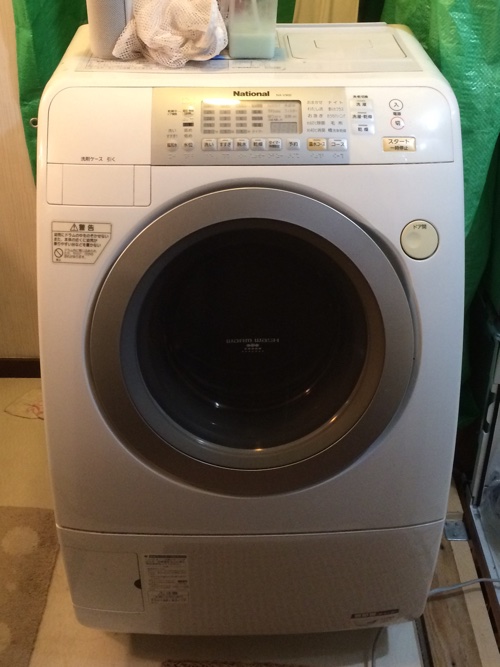
Literally the first thing I bought after moving here was this top of the line National (Panasonic) Washer/Dryer.

Washer.jpg


Best money I ever spent. :)

It is common for the washing machine to be located outside on the veranda, close at hand to the poles where you hang your clothes. But if you are lucky enough to have space inside, they always have a plastic washing machine pan with about a 3 inch lip to can catch any overflow or leaks. Typically only a cold water supply is provided to washers via a quick disconnect valve, although the expensive washing machines can heat the water themselves if required.

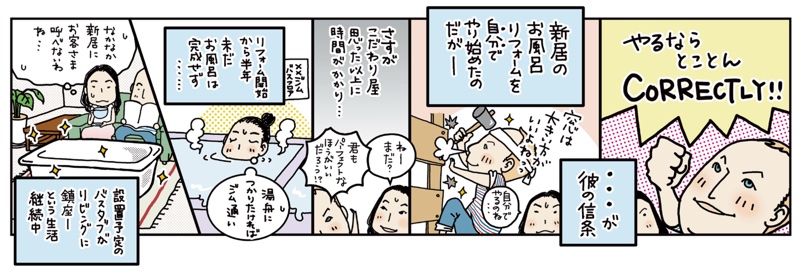
So by plumbing a hot water line to a new hot/cold hookup, lining the alcove with waterproof plastic and a shower curtain, splicing a quick release to a hand held shower head, we had a little shower stall. You had to squeeze past the washing machine which was now sitting in the middle of the tiny washroom, but it all worked. It took me 9 months to build the new Unit Bath, with the new bathtub residing in the middle of our living room the whole time. This was all very entertaining to a Japanese fashion magazine, who chose to immortalize my wife’s displeasure in Manga form (no translation required I think…) :(

Comic.jpg


Yes, I did want it done correctly, but there were other reasons it took so long…
 

Dennis Cavallino

Well-known member
Joined
Sep 22, 2010
Messages
139
Location
The Netherlands
@HCNDM: Lathes and other industrial tools can be found easily on Dutch 2nd hand websites (like Marktplaats, which currently has 1520 items for sale in the 'draaibanken' section) and specialized traders. There are more lathes for sale than there are buyers.

BTW, I also like to see a thread from Japan.
 

HCNDM

Well-known member
Joined
Oct 20, 2015
Messages
682
Location
Netherlands (tiny little country in western Europe
@HCNDM: Lathes and other industrial tools can be found easily on Dutch 2nd hand websites (like Marktplaats, which currently has 1520 items for sale in the 'draaibanken' section) and specialized traders. There are more lathes for sale than there are buyers.

BTW, I also like to see a thread from Japan.


Dennis you are right, I was trying to convey that the selection price range isn't quite as broad as the US and space is for the time being a premium.


Sent from my iPhone using Tapatalk
 

Tokyem

New member
Joined
Feb 14, 2017
Messages
1
Subscribed. Proud owner of Japanese domestic market Toto Washlet smuggled home to Texas.
 

Jacko

Well-known member
Joined
Jul 29, 2009
Messages
64
Location
the thunderbox, Sydney, Oz
Fascinating. Having been half a dozen times to tokyo and other areas of japan (mainly ski areas) your description of building codes means I can make sense of some of the buildings i've seen over the years in tokyo. :eyecrazy:

One thing the west could learn from japan is how to do a good truck stops. The truck stops on the expressway are fantastic - super clean toilets and often freshly cooked meals that are very tasty.

and of course, being a aussie, beer in vending machines. Best thing ever. :bowdown: Shame it would never work here....
 

Bib Overalls

Well-known member
Joined
Dec 4, 2006
Messages
3,318
Location
Jonesboro, Arkansas
Garage Journal members are drawn here because we are self reliant people and this is one of the places we gather. Not withstanding Home Depot and Lowe's, we are a minority in today's western society. Most men can mow the lawn but when it is time to sharpen the blades they have to buy a wrench and watch a couple of YouTube videos to get them off. Then they carry them to mower sales and service center to be sharpened. In the mornings I eat breakfast at a local cafe that caters to the trades. Every one of my carpenter, plumber, electrician, and HVAC technician table mates can, on cue, rattle out an almost never ending list of terrible, dangerous do it yourselfed work that they have been called in to fix or simple calls where the man of the house is incapable of fixing something minor like a tripped breaker or a plugged up toilet. The simple truth is that self reliant men are a small percentage of out national demographic. The rest can't, don't want to learn, know it already and don't need a refresher, or simply disdain the smell of sweat that comes from honest work and the self satisfaction that comes with it.
 

Bruce 993 SEA

Well-known member
Joined
Oct 22, 2016
Messages
1,033
Location
La Conner, WA
One thing the west could learn from japan is how to do a good truck stops. The truck stops on the expressway are fantastic - super clean toilets and often freshly cooked meals that are very tasty.

This also applies to Europe for the automobile travellers....the places to stop are awesome and truly have good food.

Cheers!
 

matt_i

Well-known member
Joined
Mar 14, 2008
Messages
10,719
Location
SE Michigan
Great thread, love learning about other lines of thinking about "life" from other cultures perspectives. Please keep the updates coming :) Looking forward to seeing the shop space :D
 

BBChevro

Well-known member
Joined
Jan 24, 2014
Messages
2,235
Location
Brisbane, Qld., Australia
Great thread Bakafish, it's interesting to note the challenges that you face as a DIYer in a non-DIY environment.

I'm definitely no expert in electrical supply issues, but have you considered an inverter for the larger power tools?
We sometimes put inverters in trucks to run 240v appliances (normal household voltage in Australia) from the 12v batteries.
There's probably a few dozen good reasons why that won't work in your situation, but I was just wondering. :dunno:


Keep digressing, it's all interesting. :thumbup:
 

Radix2

Well-known member
Joined
May 28, 2014
Messages
1,853
Location
the thumb!, MI
Thank you for setting the stage with your description of the state of DIY Japan.

If it is not too much prying, perhaps a bit about your background/training and what brought you to reside in Japan...

great adventure, and great to see your wife is must be a co-conspirator!
 
OP
B

Bakafish

Well-known member
Joined
Feb 7, 2017
Messages
477
Location
Tokyo
Christmas came early!

Lixil (like all Japanese housing suppliers) doesn’t sell directly to consumers, and their resellers are not interested in selling something without being paid to install it. Obviously they do not want to get their business relationship dissolved over some idiot incorrectly installing a $30,000 bathroom and trying to get warranty support, or a million other liability scenarios. Luckily, my wife’s uncle owns a small tile distribution company, and was able to order anything from the Lixil catalogue. He thought I was crazy to undertake this and made me promise to not involve his company in any way, but agreed to place the order for us.

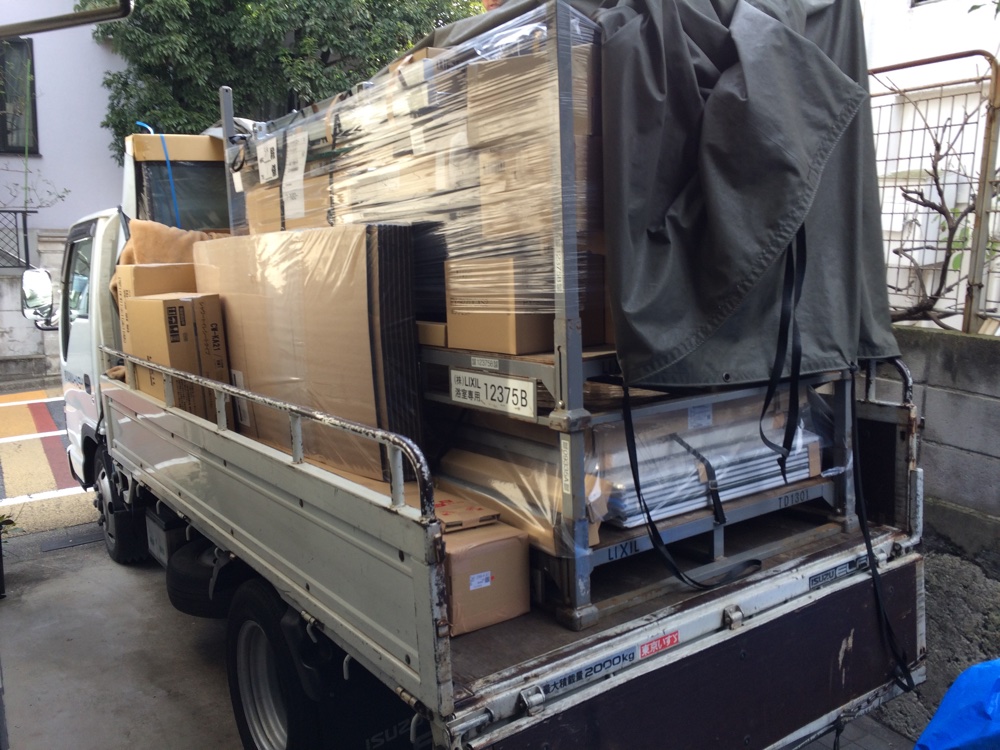
On Christmas Eve our Unit Bath finally arrived.

Delivery.jpg


Yep, that’s all for me. The Japanese have a tendency to over-package and over-document everything. I once made the mistake of trying to buy a “pound” of coffee at a Starbucks, and after waiting a suspiciously long time with no sign of activity and a growing line I saw the entire staff in the back pouring over their employee manual, calculator in hand, converting my Western slip of the tongue into grams. I tried to get their attention to correct my order into a half-kilo, but they were focused on the book and completely ignored me. My receipt ended up being itemized into 100, 10 and 1 gram increments of House Blend. They apologized for not being able to sell me .592 grams and rounding up. I had an equally bizarre experience at a snack shop where I was in a rush and tried to buy a Ham and Cheese sandwich that they insisted must be heated. It had a sticker on it that said “Hot” they insisted, there was no arguing with the manual, it was clearly stated in section #3 they explained, looking at me piteously like I was some mentally challenged child. I ended up being late for my appointment, but at least the sandwich was hot…

So the delivery guy, highly confused about where the actual construction site was and disappointed that a team of young carpenters wasn’t there to unload his truck, grimly started helping me unload the endless number of boxes, styrofoam packing, strapped panels and such. Together we maneuvered the bathtub up the stairs to its new home in our living room. After he left, visibly shaking his head as he buttoned up his truck, I started rummaging through the boxes, expecting to find some form of tome or binder detailing the parts and assembly procedure. All I found though was the multipage packing list itemizing line after line of internal part numbers and quantities. No explanation of what the actual part did, just a short part number and how many should be there. There were so many parts, but no actual instructions to be found…

We know Japan doesn't support DIY or non-specialized labor, so it’s not like I thought it would be easy. I’m not really sure why I expected documentation, I just assumed it had to have it. How could a builder possibly put it together without instructions? I was still in denial at that point, I figured they must have some internal guide or manual, maybe you had to order it separately? Did I miss it in one of the boxes or online somewhere? I wasn’t going to go back to Uncle and say, “Oh, hey, is there an instruction manual?”

Finally after escalating through the various confused staff members at their factory showroom, wondering what tis crazy American was asking about and insisting that I must pay to have the Unit baths installed, and that I couldn’t buy them directly, I got the answer. They actually have specialized 6 -9 week courses, restricted to certified builders, plumbers and electricians from their authorized dealers only, where they train them step by step through assembly of the different series of units. No single individual received training in all the aspects of the build, as “Why would a plumber need to know about the electrical system?” (Again, piteous child look.) They refused to even confirm if there was documentation provided in these classes, let alone inquire if I could have access to it. I was going to have to reverse engineer the purpose every part and screw.

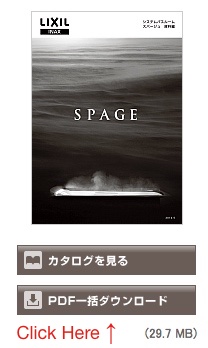
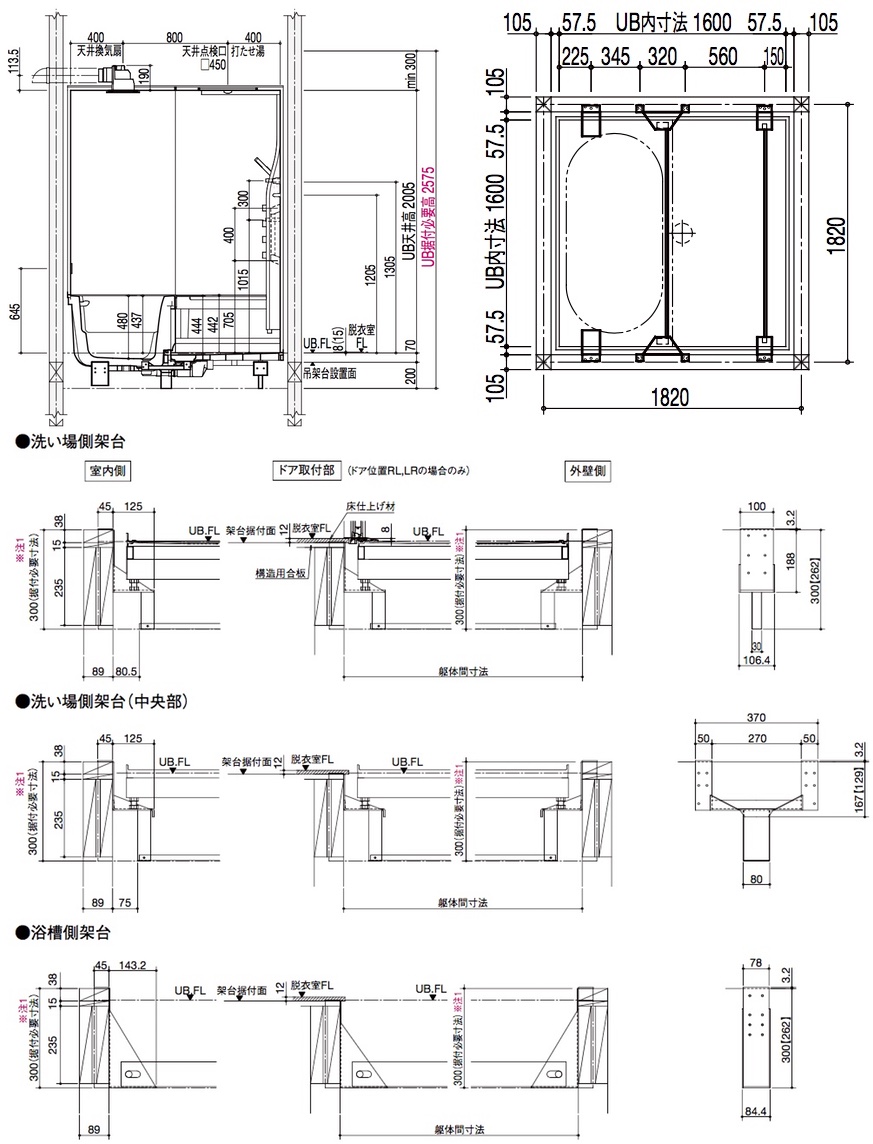
It wasn’t as hopeless as it sounds, some of the stuff was obvious, and some of the stuff could be gleaned from the sales and provisioning brochures. The latter was intended for an Architect to properly provision the space and specify water, electrical and drain hookup locations for the unit their customer selected. This document in PDF form allowed me to deeply zoom into the technical drawings which were vector based from their internal design diagrams, and I could often solve the mystery of a certain bracket, or the orientation of a reenforcement. But this was going to be the most challenging 3 dimensional puzzle I have ever had to confront. This effort to understand how to put it together combined with the fact it wasn’t intended to be retrofit was a lot of the reason it took me so long.

I can’t deep link it, but follow this link and click the button shown in this image if you want to get a taste of my pain:

Architect Guide


I regret not taking pictures of all the parts spread out, neatly arranged and aligned, like one of those cool mechanical autopsies, but frankly I think I was just afraid it would just be documenting my looming failure. I didn’t have the space either, there were just so many parts. Hundreds of them, all wrapped, barcoded and numbered in little bags and boxes. 20 different sizes and lengths of self adhesive weatherstripping. Various silicon sealants, epoxies and adhesives. Brackets, bars, plates, screws of every size and material. Several metal controller boxes, wired remotes, custom multi-lead cables, precision bent copper tubing with brazed fittings, LED lighting, pumps, check valves, endless numbers of molded plastic and rubber parts who’s purpose was completely inscrutable, steel panels, insulation, shower pans and the bathtub, plumbing parts, drains, PVC pipe and fittings, masking tape, protective plastic sheeting to keep the area clean. I can’t knock them, they actually provided everything you could possibly need down to the minutest detail. I needed to just dig in and start from somewhere…

The PDF I linked to above covers the Lixil Spage series of unit baths, which has 5 highly differentiated product lines, (PZ PX CZ CX and BX) each of which is available in ~5 different sizes, and include a ridiculous amount of optional color/material combinations and add ons. There are several other series of Unit baths from them as well, the amount of choice is overwhelming, and that’s just from one manufacturer.

My Japanese reading skills are about as good as yours (assuming you can’t read it at all like me :) ) so it took a lot of time just figuring out which drawings in the design guide applied to my specific model. But once my unit was identified, I could find the outline of the optional steel support substructure we ordered in relation to the 2x4 framing. There were 6 brackets that attached to the new cross joists that I installed. I knew I would have to notch the front 2x12 to allow clearance for the door and the suspension bracket on that side. This is basically an example of the diagrams (compiled from different pages of the document) I was working from for this step:

Frame.jpg


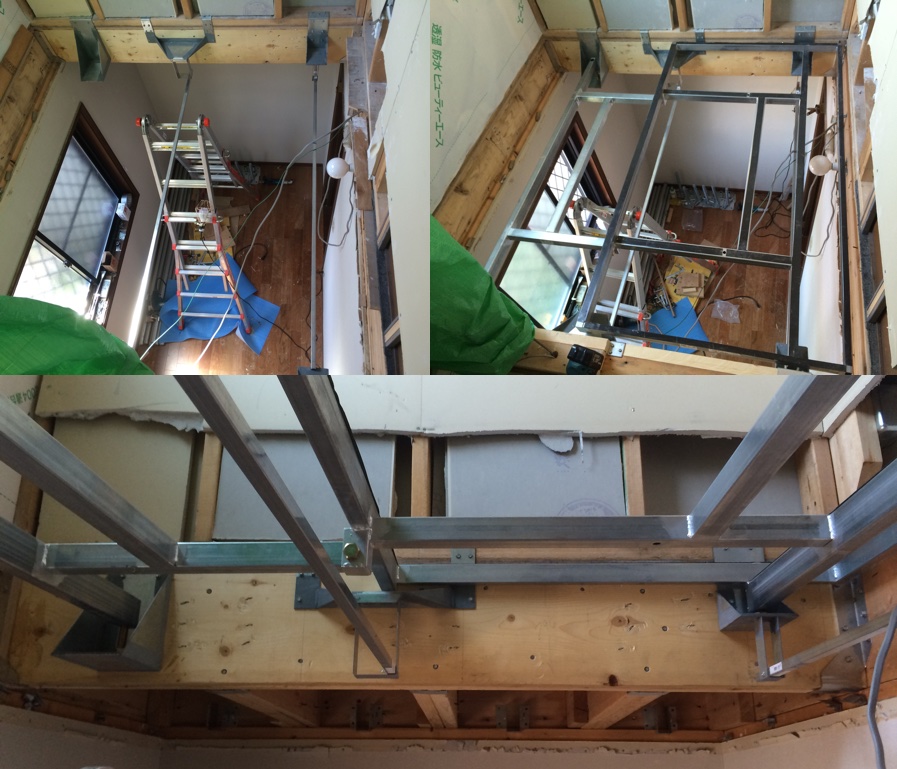
I started marking out my mounting points and bolting the pieces of steel together in the most logical orientation to match the drawings and the parts they appeared to mate with. It was a small amount of progress, just 10 or 20 of the hundreds of pieces I would have to assemble, but it was a start. The frame had 6 long bolts that extended from it, which rested on the large steel brackets lagged to the joists. Based on the unit I removed, I would use the bolts to level the floor pan then use the epoxy provided to permanently fix it in place. You can see the U shaped tongues that extend from the smaller two brackets. These were tied to the opposite partner with a section of square stainless tubing, providing a tension link to increase rigidity. The top of the shower pan frame was identifiable as it had a rubber mating surface applied to it. The tub side of the steel frame was bolted to it with the two largest bolts in my bolt pile, clearly this allowed them to easily provide a different sized unit for the larger model (with a bigger bathtub/swimming pool.)

Frame_Installed.jpg


It was progress, but was about to run into a wall, somewhat literally...
 
OP
B

Bakafish

Well-known member
Joined
Feb 7, 2017
Messages
477
Location
Tokyo
Garage Journal members are drawn here because we are self reliant people and this is one of the places we gather. Not withstanding Home Depot and Lowe's, we are a minority in today's western society. Most men can mow the lawn but when it is time to sharpen the blades they have to buy a wrench and watch a couple of YouTube videos to get them off. Then they carry them to mower sales and service center to be sharpened. In the mornings I eat breakfast at a local cafe that caters to the trades. Every one of my carpenter, plumber, electrician, and HVAC technician table mates can, on cue, rattle out an almost never ending list of terrible, dangerous do it yourselfed work that they have been called in to fix or simple calls where the man of the house is incapable of fixing something minor like a tripped breaker or a plugged up toilet. The simple truth is that self reliant men are a small percentage of out national demographic. The rest can't, don't want to learn, know it already and don't need a refresher, or simply disdain the smell of sweat that comes from honest work and the self satisfaction that comes with it.

Great thread, love learning about other lines of thinking about "life" from other cultures perspectives. Please keep the updates coming :) Looking forward to seeing the shop space :D

Thanks for the support guys! It will take a little while to get there. I hope people don’t get tired with all the lead up, or be let down with the Tiny Shop when I finally open the kimono.

I personally got so much enjoyment out of the epic sakurama thread that I’m trying to provide what I hope is a little inspiration to my kindred spirits out there. (And a little guilt alleviation for stealing all his ideas!)

Great thread Bakafish, it's interesting to note the challenges that you face as a DIYer in a non-DIY environment.

I'm definitely no expert in electrical supply issues, but have you considered an inverter for the larger power tools?
We sometimes put inverters in trucks to run 240v appliances (normal household voltage in Australia) from the 12v batteries.
There's probably a few dozen good reasons why that won't work in your situation, but I was just wondering. :dunno:


Keep digressing, it's all interesting. :thumbup:

This has been a serious focus of mine that I intend to detail at a later date. But just for a taste some of the things I have been researching:
  • The cost of a specialized high amperage 50Hz -> 60Hz phase change inverters.
  • How the synthesized waveform would affect high amperage power tools, and conversely how said tools would affect (or destroy) the inverter.
  • The specific tools I would not be able to obtain over here, or the cumulative cost difference of the ones I can. (I’m looking at you Festool.)
  • How well those tools would actually perform just using the domestic voltage.
    • Many 120v/60Hz motors will run fine, just 20% slower.
    • It’s possible that 230v/50Hz European and Australian tools may not die on only 200v/50Hz…
  • Some of the bigger stuff runs on 3-phase anyway or are easier to swap with a domestic motor.

Anyway, I’m thinking about this and many other implementation factors. There will be follow up!

Thank you for setting the stage with your description of the state of DIY Japan.

If it is not too much prying, perhaps a bit about your background/training and what brought you to reside in Japan...

great adventure, and great to see your wife is must be a co-conspirator!

I’m a self trained software engineer working in a related field. Some day I might detail the challenges of a degreeless American moving to Japan, getting a visa, and finding a job. But that’s just way too off topic for now. I realized at some point that the adverse situations I had struggled through were not something to be overcome and left behind, but the actual conditions under which I got the best out of myself.

I’m really just a very lazy person by nature, and if I don’t have problems driving me forward, solutions to create, and frustrations that must be overcome, I would be very happy staying in bed all day with a nice whiskey and my iPad watching Abom79 on YouTube. (Who am I fooling? That's what I'm doing right now!)

Invading Japan was a safe way to push myself with a lot of potential (and now realized) upside. These people (who I love, don’t get me wrong) are batty and do the most inexplicable things. Something as simple as ordering some Takoyaki can instantly turn into, “Okay, now what the hell am I going to do with 6 boxes of these… I’m pretty sure I was saying 6 pieces…”

I can’t speak well enough here to be clever or outsmart anyone, or even appear very intelligent. So I had to use my atrophied soft-skills, something I stopped doing in the states once I realized I could out-think and intimidate people to get things done. I think I'm a better person having come, which was the main purpose.

This was the short answer... :D
 
To avoid these ads, REGISTER NOW!

Bib Overalls

Well-known member
Joined
Dec 4, 2006
Messages
3,318
Location
Jonesboro, Arkansas
Abom79 is one of the few YouTube personalities that I follow with a subscription. He is an exceptionally talented old school machinist and an all around good guy. I've grieved over his dog, ate Christmas dinner with his family, shared his frustrations with the carport company and just today we made a run over to Gulf Shores for an oyster shooter and a beer. Along the way I have seen him do some remarkable machining while sharing the hows and whys of every step. Another self reliant guy. Small world.
 
Last edited:

cros13

Well-known member
Joined
Sep 29, 2014
Messages
496
Location
Sydney, Australia
Wow mate, i just read through your entire thread!

It makes me happy and sad at the same time.

I spent 2 months in Japan last June/July for my honeymoon.

All your stories, make me happy as it reminds me of all my experiences i had, and sad as I'm not there now! I must say, i recommend everyone MUST experience Japan at least once in their lives:

As much as i don't want to hijack your thread, i can see you like telling a story, so i think you might get a kick out of some of the experiences i had while there as a typical white boy.

So I'm from Australia, so Japan was such a culture shock. My wife is 1st generation Filipino Australian, we have been to the Phil's many times, and to be honest, its so Americanised, its pretty much like home.

I had to laugh about the toilet situation, we love them. For me, it was weird, using the Bidet at first, Oh what is this warm water? ooohhhh this feeling.... DAM! I've been cleaning myself like a god dam knuckle dragging caveman for the last 29 years! where has this been all my life? And It was hard, my... my... masculinity.... i shouldn't be enjoying this so much! I'm a grease monkey by trade, a forklift mechanic, I'm used to being down and dirty, stuck in a brick yard in 45°C heat beating down on my face covered head to toe in hydrolic fluid.... this... warm water gently cleaning my nether regions, i feel like royalty!

At first i Didn't know or understand the controls, the hotel room we stayed at on the first night at Narita Airport didn't have english instructions.... But i'm a man! lets push all buttons until we get some action... well i did get it, FULL WATER PRESSURE!!!! <-- i think i had my first enema that day.....

And yes, once back home in Australia, i also did research for a washlet, and yep, in the future i might install one in the main bathroom!

Funny you mention about the shower situation with the "cube in the floor"
So we had rented a apartment for 1 month of our stay that would be in Tokyo, In Nippori. One of those "only for foreign passport holders" deals, But it wasn't Sakura house, it was a smaller one.
To be honest, once we got there, the "self catered apartment" wasn't really what was advertised, it seems their photo's were 20 years old. The place was real run down. Same deal in the toilet, a hole cut in the side of the shack with one of those fans shoehorned in. a round peg in a square hole deal. Also, same type of wet room like you mentioned.

I swear i tried for 1 hour to figure out how to start the shower, ANY of them, the one in the cube or the one in the wet room section. I ended up getting a dribble out of one of the taps, grabbed a cup and used the Filipino "traditional" method we were accustomed to from the relo's place. "Tabo" pretty much washing myself with a cup... yeah!

As much as i wanted to embrace the "traditional" way of living, on the first night we woke up at about 2am itching all over. The bed was infested with bed bugs, we had both been bitten all over. Now my wife is a bit of a princess at times, but even i drew the line there. Booked hotels for the rest of the trip, and lucky the landlord gave us a full refund the next day, Extremely apologetic.

It's funny how sometimes Japanese structures don't "accommodate" to westerners. For me and my wife, we are fine, as im 5'4 and she is 5'2. We were staying in a APA hotel, as you probably know, they have HUUUUGGGEE room... "cough" 9 square meter apartment anyone "cough"

Now one night while doing the laundry behind the front desk in the lobby, i struck up a conversation with a big burly Icelandic bloke who was also doing laundry. This guy was at least 6'5 and built like a brick **** house. So he asked me, "how are you finding the rooms? accommodating? Not to be rude, but your small, Japanese size! do you find it comfortable?" Sure! apart from having to crawl on my hands and knees under the desk to get access to my suitcase, i cant really complain!

So he was on a budget, and was travelling with his best mate, Also his size! they had rented a 1 single bed room to share between the 2 of them! 2 guys that looked like world strong men! He said when he used the bathroom, he sat on the toilet, had one leg in the bath tub, and the other out the bathroom door, he couldn't even close the door!

My BEST experience, which i must share however, a memory which will stay with me until i'm old and grey, perfectly sums up the hospitality and generosity of the Japanese people and their culture:

We went to the samurai Museum in Shinjuku, Tokyo. It was nice, they have original samurai armour there some that dates back 800 years. we did a tour, we watched a demonstration and it was all around a good day. I then went to buy a some souvenirs at the gift shop.
In Japan everyone loves to hear where your from, what you do and what are your plans are in Japan. So i got talking to the Owner of the museum and one of his workers. I say I'm a mechanic, we are going to Nagoya for a tour of the Toyota forklift factory organised by upper management back home. Turns out the other worker was also a mechanic who worked for RE Amemiya. I show him pics of my Datsun 260z im restoring, he pulls out his phone and shows me pics of his Mazda Cosmo he is restoring. Then the Museum owner shows me his old Cressida, he loves vintage cars, amazed that someone from Australia loves Japanese cars and loves how i am restoring mine. We all end up talking for about 1 hour in the gift shop.

Then the owner invites my wife and I out to dinner. He takes us to his favourite restaurant, orders for us, we ate like kings, and when it came time to pay he said, you are my guests, its my shout. We were blown away, we couldn't believe the kindness and hospitality of him. Nicest guy ever. Turns out his life long dream was to open this museum, he is a one man show, not some government run museum, he had been buying the pieces for the last 30 years slowly, then took the plunge 10 months ago and opened the museum.

Then to top it all off, he walked us back to the train station, a good 20 minute walk, made sure we got on our correct train back to our hotel, waved us goodbye from the platform! I don't know where he lived, for all i know, once we exited the restaurant, instead of going to the left with us, he would normally go right. Don't know how far away his home was, especially after a gruelling day at work, i just want to go home asap, but he still took us out, walked us home... total legend!

We would NEVVVEERRRR get that kind of service back home in Australia.

So if anyone is in Tokyo, go visit my friend Mr Koyano at the Samurai museum and say Hi!

Oh man, i have so many more stories, but i thought you might like those ones!

Looking forward to the rest of your build! Subscribed!!!!

Rudi.
 
OP
B

Bakafish

Well-known member
Joined
Feb 7, 2017
Messages
477
Location
Tokyo
Wow mate, i just read through your entire thread!

It makes me happy and sad at the same time.

...

As much as i don't want to hijack your thread, i can see you like telling a story, so i think you might get a kick out of some of the experiences i had while there as a typical white boy.

...

Rudi.

Great stories! No worries about any hijacking, I'm a big fan of Japan and the hearing about the kindness of its people :)

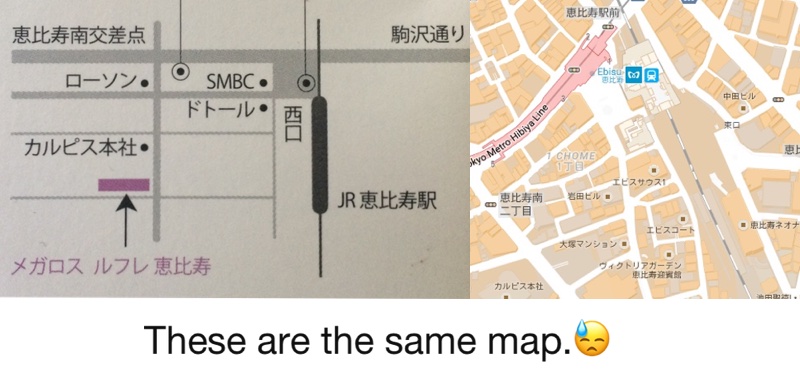
That hotel sounds like it had one of the unit baths typically found in micro apartments like the one I stayed in my first couple of years here. I never took photos, and don't want to steal someone's image, but if you go to item #5 in this guy's list you can see something similar. Mine was so small the sink actually overlapped the toilet and the tub, and you can see how the same spout is used to fill the bath.

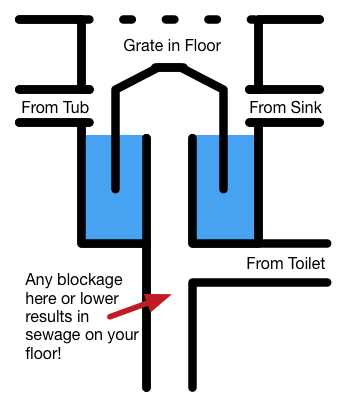
As mentioned in the link above, everything including the toilet, shares the same gas trap in one of those units. It is a suboptimal design in my humble opinion. For the plumbers out there, Japanese gas traps are typically a bit different than ours, using an inverted cup or dome over the drain pipe nested inside a larger cylinder. This results in a much more compact unit, but they require much more maintenance as flow isn't concentrated in one place, and all that surface area needs to be cleaned regularly. They are all designed to twist apart by hand, I sketched a quick cross section.


Gas_Trap.png
 
OP
B

Bakafish

Well-known member
Joined
Feb 7, 2017
Messages
477
Location
Tokyo
Deadly pitfall, neutralized.


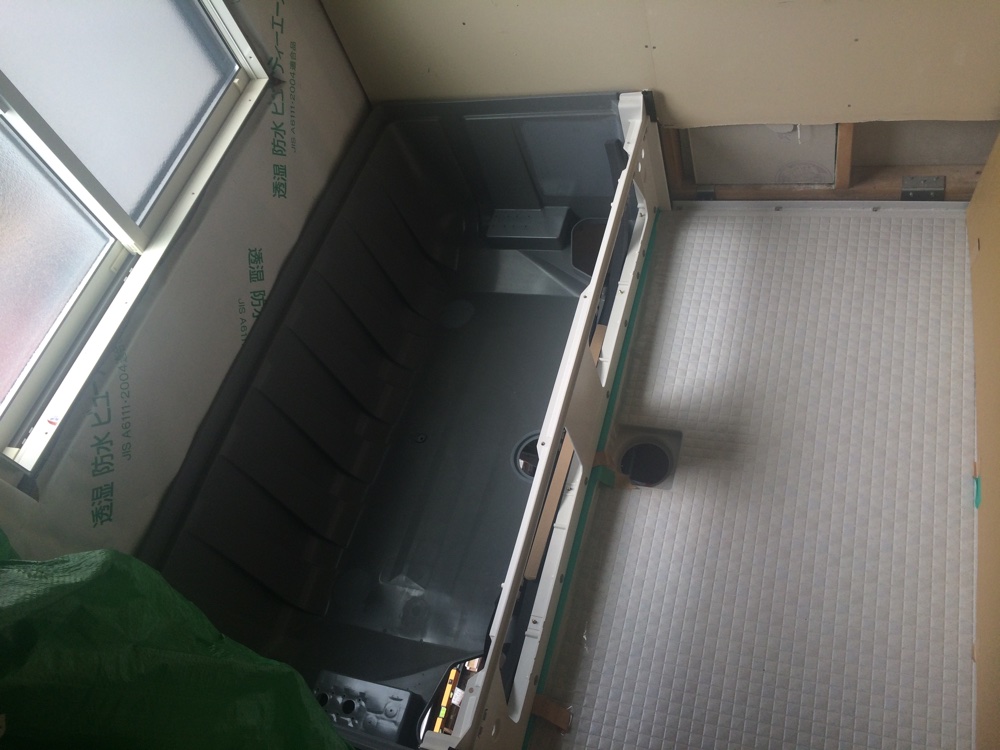
The shower pan/floor section and bath liner went in next, giving my wife the much needed illusion of progress. The way they mated together was very challenging because it was clear that several specific adhesive foam strips would need to be put into place, but there were about 20 different widths, lengths and resiliencies provided. I had to figure out what strip went where or I would be dealing with leaks into the ceiling of my shop… The vertical white tub support you can see between the floor and the tub liner was part of that multi-layer sandwich all fastened by brass hardware with various sized washers and some elongated nuts. Japanese precision helped a great deal as the foam strips were precisely cut to length. By looking at their width and compressibility I could lay them down and see which ones best matched the areas that seemed to require a gasket. I could move the tub out of the living room now, but it wasn’t actually fastened in, just resting on the liner.

Shower_Pan.jpg


Now I had to figure out how the hell the wall panels were attached. The floor panel had a lip around the edge, but no clear pointing points. The old system I had removed had a very clear channel where the wall panels were recessed into and were sealed with silicone. They were made of cement board adhered to a 1/4” square stock frame and they were primitively attached to each other with steel clips and screws.

The new panels were much more delicately designed, consisting of a thin coated steel sheet reenforced with 9.5mm of gypsum and another smaller galvanized sheet on the back. All the edges had a complex angular fold with lips that were designed to engage with a wasp waisted steel C channel and be locked into place with a plastic sealing strip that was inserted in the seam. But it was unclear which end of the pre-drilled C channel was up, and how the two roof panels of the unit tied into the walls. It was also unclear how the C channels tied into the pan and tub, and door, and… I was at an impasse.

I had 4 very clearly corner channels, and 3 unambiguously mid-wall channels, but there were 5 additional channels that were inscrutable, one of which had to deal with the transition from the door to its adjacent panel. Their length didn't really match to anything, and their shapes were not as complex. It was possible that some of these were part of the roof structure, or they were intended to reenforce the unit in other areas, but the drawings offered no clues. If I could only look at a system that had already been assembled… oh wait, I have!

Back I went, to the showroom, with my wife in tow to act as a lookout. They had row after row of fully constructed demonstration units, and inside each unit is a ceiling mounted maintenance panel that only required a screwdriver to pop off. Bringing in a foot stool would obviously raise suspicion, but the ubiquitous little wash stools they had scattered about would probably support my weight long enough for me to take some covert snapshots of key areas with my iPhone. Because of our work schedules, we had to go on the weekend, which is typically very busy. This both helped and hurt the cause as we wouldn’t be dogged by a helpful attendant, but we had to fight for access so I could close the door and disassemble their floor model in secret. My wife, an imposing woman to many of her fellow Japanese, camped in front of the door, ready to give the signal if we were sussed out. I quickly grabbed the… oh ****. No wash stool in here. :(

Take two.


Balancing precariously in my socks on the slippery plastic stool I had smuggled from the adjacent bath (no shoes allowed in the displays.) I popped the two fasteners, snaked my arm into the opening and attempting to point it towards the strategic areas I knew would provide answers, proceed to take about 50 rapid photos.

Digression time! Yeah!

Here in Japan, by law, phones must create a very loud shutter click when taking a photo. This is embedded into the firmware of an iPhone, even with the volume of and in ‘manner mode’ it is still going to CLICK, CLICK, CLICK! “Why?”, you may ask? Because creepy guys like to photograph under girl's skirts on stairs and escalators here. It’s a super common problem that this law has done little to impact. Really, that’s why... No joke. :dunno: So given that these showroom models are built side by side in a massive space with just a little stub wall and the top open to the ceiling, the sounds coming from the the unit were pretty obvious, I was just hoping it was so busy it wouldn’t be noticeable.

Okay, we’re back.

Victory in my heart, I locked the panel back into place, laboriously retied my shoelaces for the second time and we nonchalantly moseyed to a less trafficked area to count up the loot. We had several thumbs, a couple in focus close up shots of sheetrock, several washed out flash reflections of a key area, a random screw left over from construction, several shots of the electrical junction boxes, and the rest were completely out of focus shots where even the orientation was unclear…

Take three.

By now the attendants seemed to be paying more attention, “There is something odd about those two.” “Do you think they are stealing the fixtures?” “Hey, Isn’t he the mentally challenged man-child who came in asking us all those ridiculous questions?” But I had nothing to lose. This time I turned off the auto-flash setting and lingered much longer in each area so the autofocus had a chance to work. I took less photos, but I was hoping I would actually be able to get what I wanted this time. I was tempted to ask my wife to boost me so I could get my head into the ceiling, but even she has her limits, and I was already pushing things with her as it was. Then, in a stroke of genius, although probably obvious to my good readers, I realized that a video might actually capture much more.

The photos did come out better, but the video was the winner. I had the opportunity to go over it -frame by frame- on many a winter’s eve. Some of the discoveries it provided were:
  • A torn page from the assembly instructions left haphazardly on the ceiling (remember those? The ones they wouldn’t even admit even existed?)
  • A better shot of that stray screw (it actually was useful to see what type it was.)
  • Clear cable locations and how the control boxes were mounted.
  • A shot of how the LED light bar joined the ceiling panel to the wall panel. (Explaining why one of the ceiling panels seemed about 5cm short…)
  • The way that the ceiling was rigidly tied to the walls using what had seemed to be an excessive supply of “plumbers tape” (I doubt I would have guessed this one.)
  • The correct vertical orientation of the two types of C channels.
  • And lastly, the bemused faces of several attendants grouped at the counter watching as my hand and iPhone swept back and forth, clearly visible above the wall until I fell off the stool.

They were polite enough not to make any comment as we left, it was only on viewing the film that I would fully come to appreciate their decorum.

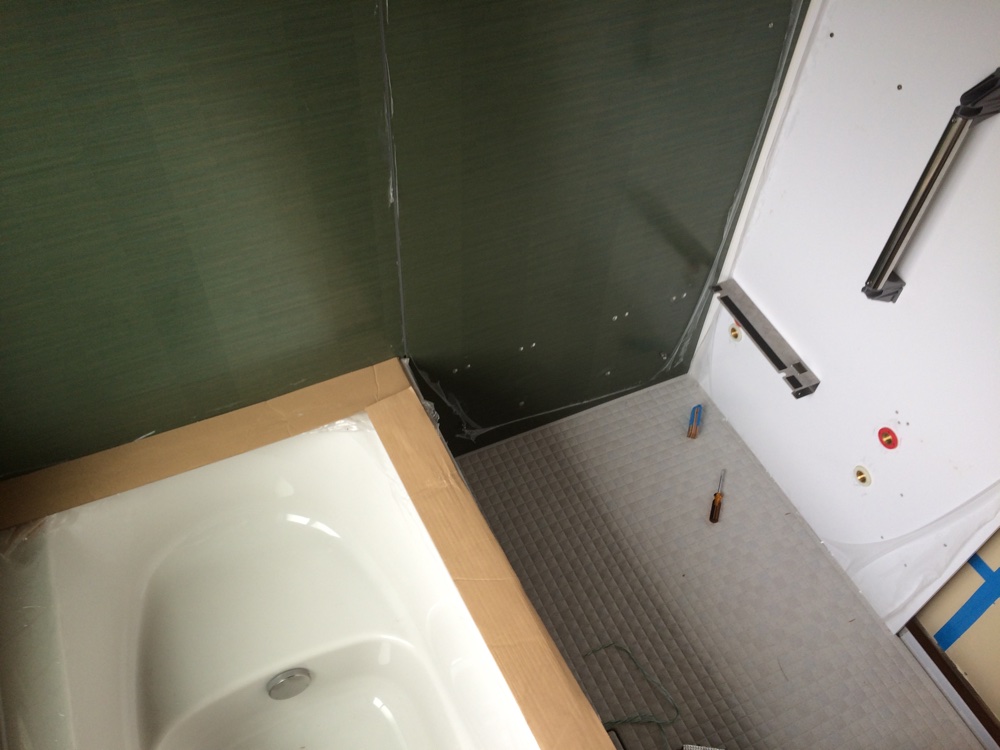
So now I had these 7 plastic wrapped panels in two different lengths (and colors) to deal with. Several of them had been pre-drilled to accommodate the various plumbing penetrations, safety hand bars and the seat reinforcements, but it was clear that there would be a lot of additional drilling on my part for the mirror and optional baskets and towel rods we had spec’ed out. The existing holes provided enough information to identify which panel was located in each location, which was a start at least. The precision bent copper tubing was wrapped in little insulated covers and mounted to the back of the panel, with the brazed brass fitting penetrating through and fastened with colored plastic threaded rings. Several stainless back plates and brackets were all easily located based on the hole pattern and sealed with clear silicone. I drilled out the remaining holes and inserted the white plastic expansion nuts. Again, the precision of the Japanese helping me to derive the correct hardware easier as they would package exactly the correct count of an item in each bag, and used about 5 different lengths of the same kind of screw where one length would have worked fine everywhere. By matching hole counts to screw counts and seeing what made sense where, the number of puzzle pieces were slowly being reduced. I temporarily wedged a few key panels into place using cardboard shims.

First_Panels.jpg


As I had feared after receiving them, but did my best to ignore for as long as possible, there was no pre-cut hole for in the panels for the window. I had assumed that was the whole point of ordering the window as a package option and all the tight dimensions the Architect Guide insisted I meet, but it was clear I’d be cutting these irreplaceable panels myself. I ordered some expensive bimetallic blades for the jigsaw from Amazon and pondered my life choices.

I was hoping they would be backordered...
 
OP
B

Bakafish

Well-known member
Joined
Feb 7, 2017
Messages
477
Location
Tokyo
I’m not projecting, you’re projecting…

The problem I had was, how do you project a large hole onto two irreplaceable panels across a ~10-20 cm gap accurate to a couple of mm, when you can’t see or reach behind them and you only have one shot at putting them into place? By that I mean, that the plastic seal that wedges the panels into the C channel was clearly non reusable, and they were heavy panels that needed to be held at precisely the right height and angle to mark where to cut. Remember, these were not particularly transparent (at least to the frequencies that my eyes work at) and I had a limited set of options available to me. The thought occurred to have my wife hold them up while I stood outside on a ladder holding a small laser pointer tight into each window corner and marking the backside. But I was still trying to avoid neighborly attention, and I was never comfortable up that high with that crazy ladder angle. Also, the floor level and actual location of the unit within the space was still unknown, and that would obviously affect the location of the hole. I was waiting until the very end to epoxy the long bolts extending from the steel sub-frame to the supports anchored to the joists since I only had a few millimeters of clearance in one of the axis and the other axes governed where the door penetrated the wall.

To compound the problem, even though I had a better clue about how the top was done, there was no way for me to see the bottom connections, and it was looking like I was going to have to do some irreversible drilling to make the bottom attachment work in any sensible way. These ‘Window’ panels actually mounted to an aluminum flange riveted to the tub itself, which was different than the way the floor mounted panels seemed to attach. That meant that the tub had to be permanently installed first, which meant the drain pipe had to be set, which depended on the walls being in place so the door could be mounted, so the final X and Y location could be known, which affected the location of... the drain pipe. :headscrat You can see the circular dependancies there. I was used to dealing with those as a programmer though, the trick is to pin the variable that is easiest to change and don’t iterate past your limits.

So, plumbing it is!

As a DIY’er I have -I think- a better grasp of how hard it is to be a professional tradesman. You have to answer to your customer, some clueless nitwit who is trying to call the shots and ignore all your experience. You have to do things as quickly as possible to efficiently use the limited time you have to make money. You need it to last and look good, so you don’t get call backs. And you have to hold your tongue when you see some obvious and ridiculous bodge the homeowner did (before relenting to the wife and calling you (present company obviously excluded!))

They have a much harder life than someone like me who is non-profit, always under budget (right honey?), 24x7 on-site, considers his own nit-wittery “profound!”, and has all the time in the world. I even have the ability to profess to the wife, “Honey, you know my Japanese isn’t good enough to call a pro. Give me more time!”

Despite that, when I see things like this done by a pro, I get a bit disappointed.

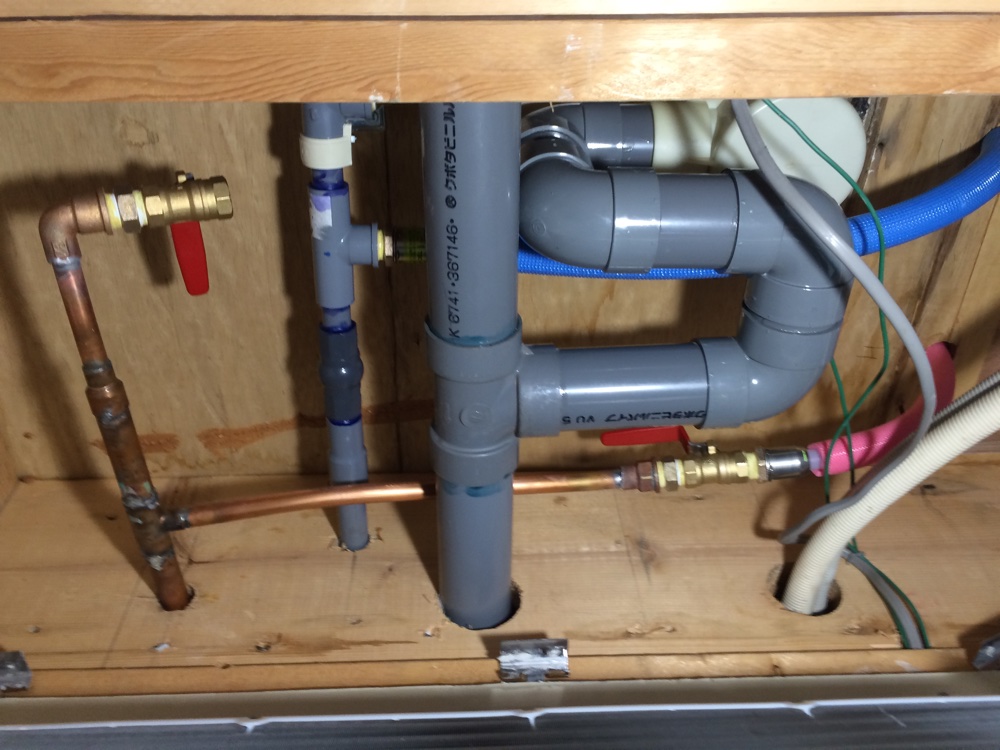
Rat_King.jpg


That large bumblef**k of elbows you see there is connected to the gas trap (see diagram earlier in thread) for the washing machine pan (which is actually acting as our shower at this point.) The water has to go through 6 hard right angle bends within a space of about 10cm. Can you imagine trying to snake that?! Madness I say!

Anyway, I made the decision to go with PEX, and I didn’t do it with a lot of enthusiasm. At the time, plumbing parts and supply were very difficult for me to get as I had not discovered the Professional Beaver store. Yes, I said it. Beaver Pro. I love that place. Anyway, copper pipe and fittings are very difficult to find here and PVC was going to be a mess. The complex route the supply lines had to take spooked me a bit as well. And I'll admit I was a bit seduced by the advanced tool-less fittings available. I’m not dumb enough to have put them in non accessible locations, hopefully that will protect me from bad juju, but I’m expecting they will last long enough to not matter.

I eventually replaced that drain with a straight shot and added a cleanout T that could snake the main pipe, but the work I did at this point was to add shutoff valves (already in place in that pic) and get the primary Unit Bath drain in place so I could mount the tub, and start progressing again.

The drain of the new system has a specially designed hair trap system that swirls the water in such a way that it doesn’t get tangled in the drain and is easily disposed of. I thought it was a stupid marketing point that wouldn’t make any difference, but my wife sheds bales of long hair and this actually works exactly as advertised. For that swirling action to work though, they are super specific about the slope and number of bends the drain takes within the first couple of meters from this unit. So the path had to be carefully planned, had to avoid the steel sub-frame, had to penetrate the new joist as close to center as possible, had to use the existing holes already made in the old joists, and finally had to be built from the middle out.

By that I mean, it is really easy to join PVC from point A to point B as you can just add segment by segment, twisting your fittings in along the way. But when you are joining between two fixed points you will eventually need to have enough flex to pop your female couplings over both sides of the pipe and rotate it (for the best mating.) If your pipe is 50cm and running through doubled 2x10’s every 30-40cm, you really don’t have a lot of give in that system, so choosing that final join is key.

In theory I could have mounted the large cream colored drain box/gas trap section last, building out from the junction seen above and finally rotating it into place, but it has two large diameter precision flanges with rubber seals that have to perfectly align with the Floor and Tub liner simultaneously. They actually needed to be inserted perfectly parallel or it would get stuck… not something you want to be fiddling with while your solvent is curing.

There’s one more problem. That pale yellow, pink ringed drain contraption has three little letters embossed on it, you may even be able to spot them, “ABS.” The thing about ABS is that it isn’t PVC, which is the only kind of drain tubing that is sold in Japan. Is that a big deal? Well, according to US code it is. You are not supposed to join ABS to PVC unless you use a special ‘Transition Cement’ which happens to be a wonderful shade of turquoise. Given that Japanese don’t even bother with using PVC primer you might not be surprised to hear that they just wack PVC to ABS without any f**ks given. I decided I would get the right stuff shipped over from the US and sleep well at night.

Working with 3 dimensional tubes over 3-4 meters of slope and various compounded angles, offsets and fittings and a labyrinth of questionably positioned holes is really, really hard. I can almost comprehend how a poor soul could be driven to glue up five or six elbows just to show the world, “I exists! I shall be remembered!”

I myself was close to throwing my hands in the air and slapping in the emergency piece of costly PVC flex pipe I had bought, just in case. But that was weakness my friends... the siren song of a flexible tube swung in the hands of a child. It was also very soft and had translucently thin walls between the ribbing that looked like it would last about a week, so there was that.

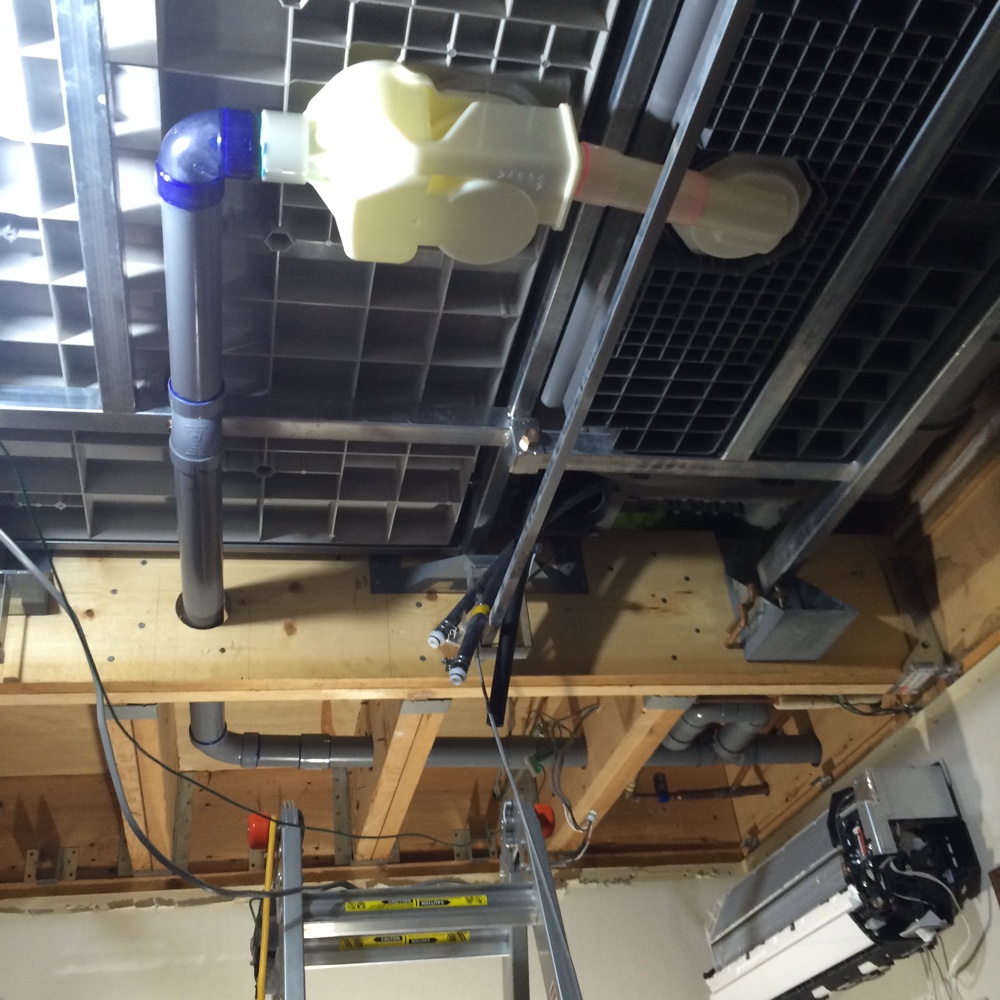
The end result of a lot of paper sketches, measurements and online angle calculators (I’ll learn A360 at some point) was this.

All_Downhill.jpg


We were finally (hopefully) locked into position and could start cutting the window hole in the panels…
 

jalbrecht55

Active member
Joined
Jun 5, 2011
Messages
41
Location
Silverdale, WA
Really enjoying your thread. As I read it I'm reminded of the culture shock I experienced while visiting my wife's family in India (although Japan and India have quite different ways of doing things.)

It's been about 25 years since I took Japanese back in high school, but I seem to recall baka means fool or idiot, right? ;). We used to call each other that along with all manner of made up words like kuso-atama
 
OP
B

Bakafish

Well-known member
Joined
Feb 7, 2017
Messages
477
Location
Tokyo
Really enjoying your thread. As I read it I'm reminded of the culture shock I experienced while visiting my wife's family in India (although Japan and India have quite different ways of doing things.)

It's been about 25 years since I took Japanese back in high school, but I seem to recall baka means fool or idiot, right? ;). We used to call each other that along with all manner of made up words like kuso-atama

I haven’t made it to India yet, but my work has taken me to Penang and Kuala Lumpur recently and I ate as much Indian and local cuisine as I could. :thumbup: I love Indian food.

But yeah, the one thing that is so easy to take for granted is how lucky we are in North America. I think it would be such a better place if more people went out into the world, found out that foreign people are cool and wonderful, and came home realizing just how much is available to them at so little cost.

Baka does indeed mean fool or idiot :) I have a matching avatar, but I guess these boards don’t show them until we get some seniority.

great thread. How long have you been in Japan for?

I traveled here often before immigrating, but it will be 11 years that I've lived here next month. It doesn’t feel like that long, but I can see the passage of time when I look in the mirror :eek2:
 

rmack898

Well-known member
Joined
Jan 23, 2007
Messages
3,140
Location
Honu Grove NE Florida
I'm really enjoying this thread. Not only is it really entertaining ( I love your diversions), the cultural education is amazing. It really makes me appreciate some of the stupid **** that we take for granted (bitching about the big box stores).

I can't wait to get to the shop part of the story but I can wait, because the road to get there is pretty cool and I don't want to miss anything along the way.
 
OP
B

Bakafish

Well-known member
Joined
Feb 7, 2017
Messages
477
Location
Tokyo
TFW

(Sorry for the delayed posting. I’ve been working on the house! This is still legacy stuff here, but we are getting closer to catching up to realtime.)

You know that feeling when you realize you have made an irreversible mistake? Just that cold sweat, stomach clenching dizziness as your mind starts to come to grips with a reality that you could have, so clearly now in hindsight, avoided with a little more attention, a little more caution? Two of my more memorable recollections of this feeling were when, as a novice sysadmin, I ‘rm -rf /*’ the company web server (someone saved my *** with a backup I didn’t realize existed.) A second time, many years later and with far more experience under my belt, instead of sending a profanity laden, snarky take on my slave driving CEO’s company wide email to my co-worker, I “Reply All’ed” by accident. As soon as I hit send, I realized what I had done. Oh. My. God! I was sitting there thinking of exactly how to resign when it occurred to me it was 3AM and given the late hour and my root access to the company mail server, was able to bring the system offline and purge the document before anyone actually opened it… Near miss there.

So I was being super careful and measuring everything three times before I took my jigsaw to the two wall panels that needed to have the window opening cut out of them. It was a bit tricky as I mentioned before, projecting the actual cut lines, but I realized that a line type laser level on an adjustable tripod could be set to align with the window opening, then placing the panel in place I could mark the cut lines. I would then need to transfer them to the back of the panels, since a jigsaw blade’s teeth cut on the up (pull) stroke meaning your good surface should be on the bottom. The first panel went in great, so when I was bringing in the second panel and I looked at the two, I was unprepared for the shock I experienced. The cut looked to be 10cm too low. I just set the panel down near the door and started to try and think about what the hell I was going to do to save this.

The reality actually was that the cut was fine, but the white bathtub, white wall and the backlighting all contributed to make it appear I had miscut the panel. For about 3 hours I contemplated what I was going to do to fix this. I could try to somehow order a replacement panel (no Idea if that was really a possibility) but that would involve my wife's uncle in an unfortunate loss of face… Just an awful feeling of hopelessness. When I finally got enough courage to go back to the room and see exactly how far off I had hacked it, maybe I could fabricate some extended trim... I was so happy and relieved to find that when in place it was fine. This whole rollercoaster of pain, emotion and joy happened over a few hours in the little isolated bubble of DIY. Sometimes you really are alone out there. I never told anyone about it (as it is a perversely anticlimactic story) and there is no clear lesson here other than maybe, “Don’t panic” (and know where your towel is.)

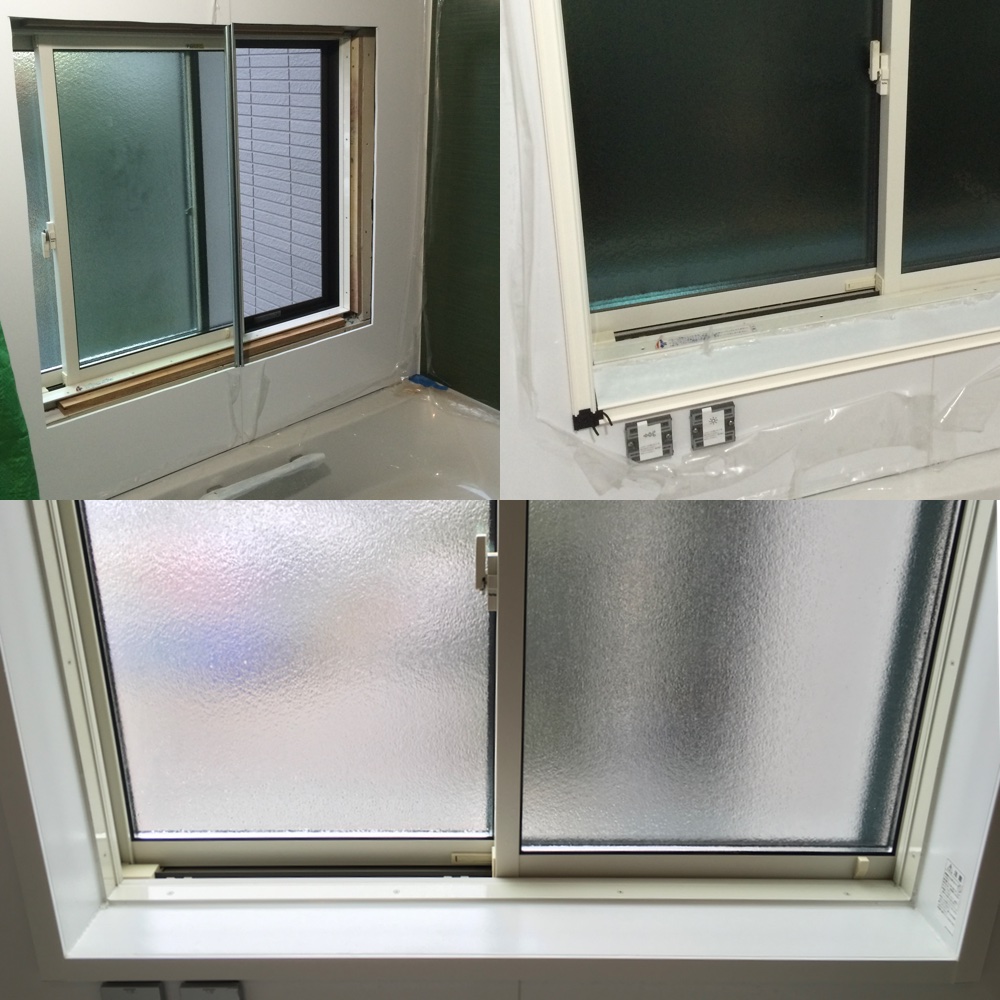
Window.jpg


So here are the panels in place, prior to cutting the central steel support U channel that holds the panels together. They cryptically provided several strips of wood in different widths and lengths that I finally realized were intended to support the plastic window trim. This trim needed to be cut to the correct depth, then assembled to these finicky little corner pieces with tiny little foam threads that needed to align to seal the edges. The entire structure then slid into place in one piece.

Lastly, everything needed to be screwed in and then carefully calked, which I find painfully tedious as it almost never comes out perfect (no matter what tricks I use…) You can also see the two wired remotes being roughed in without their covers in place and everything still has the protective plastic on it which makes it look funky.

After this was done, I installed the rest of the wall panels and the glass door. The door frame is made from aluminum and went in as one piece. This all involved intuiting the purpose of numerous brackets and plates, I'll spare you. The door itself had to have the outer aluminum frame drilled to accept the optional towel bar which was a little nerve wracking, but it used very clever little nuts that inserted into the hole with a small external flange, then when the screw was inserted, the nut rotates to provide a threaded hole and slides along two rails on the flange, clamping it very securely. Very clever!

The tubing for the towel rack was very thin walled and was bent within a month, so I replaced it with a sturdier piece of stainless steel which has been very robust. Lastly I sealed up the entire unit bath ‘box’ by attaching the two roofing panels, first cutting one of them to accept the environmental control unit.

Modern Bathroom Air Management

In an earlier post I alluded to the fact that your unit bath can be an ideal place to ‘line dry’ your undergarments without some creep using a fishing pole to snag them off your veranda. This is achievable by the sophisticated heating and ventilation systems that the Japanese use. These systems act as a central ventilation system for the entire bathroom suite (up to 4 rooms), meaning the separate unit bath, toilet room, and washroom, each have dedicated vents and remote switches. The system is located in the space above the Unit bath, typically at least 20cm, so they are built low and wide with squirrel cage fans and various servo flapper valves to control the airflow.

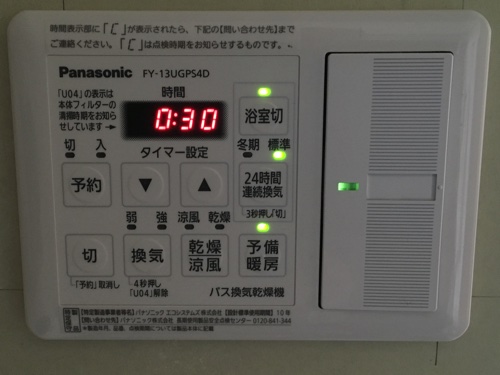
In addition to simple ventilation (low speed 24 hour ventilation with summer and winter modes) they also provide high volume evacuation, recirculated heating for the Unit Bath, and a special clothes drying modes that dehumidifies the room, all with independent timers. The unit my wife actually wanted had a steam mist generator that required an additional cold water supply and a 200v supply, but I wasn’t prepared to tear out the sheetrock all the way to the wiring panel (at that time) to get a 200v line installed. So we ended up with a pretty straight forward Panasonic model designed to support one additional room, the remote can be seen here. I chose the remote model with the light switch integrated into it.

Air.jpg


The exhaust section was routed to the old vent location, but since that was a 200mm vent and the new one uses a 100mm vent I fabricated a simple stainless steel flashing for the outside and had to repair the vapor barrier and sheathing for the smaller exhaust port. Then I used as much silicone sealant and low expansion foam as I could fit in the old space and attached corrosion resistant flex tubing. The main ventilation unit itself has a separate frame that you mount into the hole cut in the coated steel ceiling panel, sealed with foam tape. As the unit can accept the secondary vent from different directions, this frame also holds the blanking panels that cover those slots, and the flange for the additional vent. You then wire the power, ground and remote wires and It slides into that frame, engaging the ports for intake and exhaust. It also has a spring loaded damper to prevent backflow from wind and the external vent has a thermal fuse as seen before, to deal with fires. The system is quite effective for quickly heating the room, and venting out all the steam and moisture on a hot day or when you are finished. My wife doesn’t seem to miss the sauna function of the more expensive units.

Next was figuring out the pump and three controller boxes...
 
OP
B

Bakafish

Well-known member
Joined
Feb 7, 2017
Messages
477
Location
Tokyo
A Series of Tubes

So I already discussed the air management unit, it’s probably time to explain why there are three controller boxes and two wired remotes. The competitive market and cost for these bathrooms make configuring these systems similar to custom ordering a new car. There are a number of tiers of the overall quality of materials and features, then sub-categories allowing you to chose the shape and style of the bathtub and the finish of the other materials. Then you have the option to choose colors and textures of the wall panels, flooring and even the tub itself. Minor features like lighting type (LED or Halogen) and number and location are all customizable. You can add a waterproof TV, Bluetooth Audio or various types of water jet systems. All of these systems use a dedicated controller box mounted in the ceiling and use pre-wired multi-pin cables to link to the subsystems and remotes.

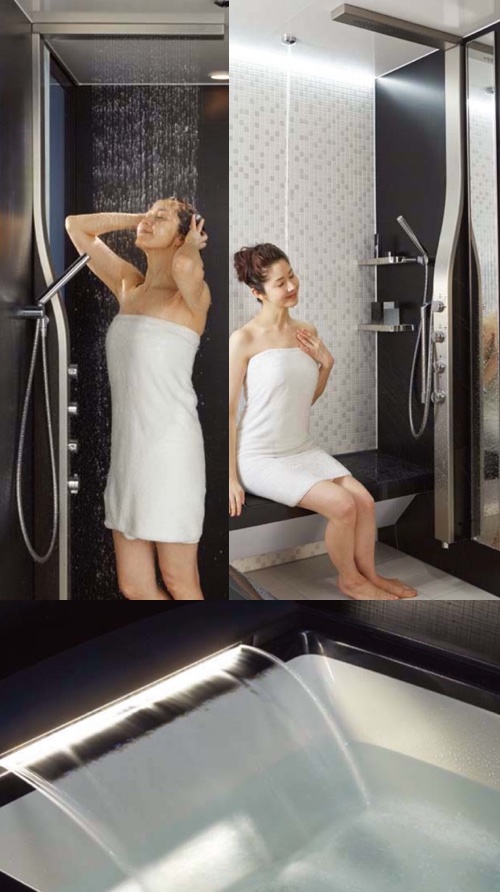
For our system we got the full air-jet/waterfall recirculation system, that has an LED illuminated head rest that delivers a gentle sheetlike waterfall of bathwater over your shoulders and two high velocity bubble-jet massagers (like a Jacuzzi) to your back. This system used two controllers, one for the water pump and the other operates the valves to control the different modes and functions. The third controller is for the lighting system, which is dimmable and has multiple modes that control different lighting groups depending on the effect you are trying to achieve. I chose a single entry light over the door and the light bar that goes along the opposite wall, but you can also add a reading light, floor lights, shaving lights etc… Here are some glamor shots from the catalogue so I don’t have to force my wife to model for you guys. :lol:

Glam.jpg


Since we are discussing the options, there were 9 different flooring choices, 60 different wall finishes (which you can mix!) and 10 or so different color combinations available for the tub body, tub trim and the shower seat and pads. There was the option of 5 different shower heads for the hand shower, and my system uses the Aqua Tower that controls the separate ceiling mounted pulse massager and rain style overhead shower seen above. All three showering systems can be run simultaneously if you really want to go crazy.

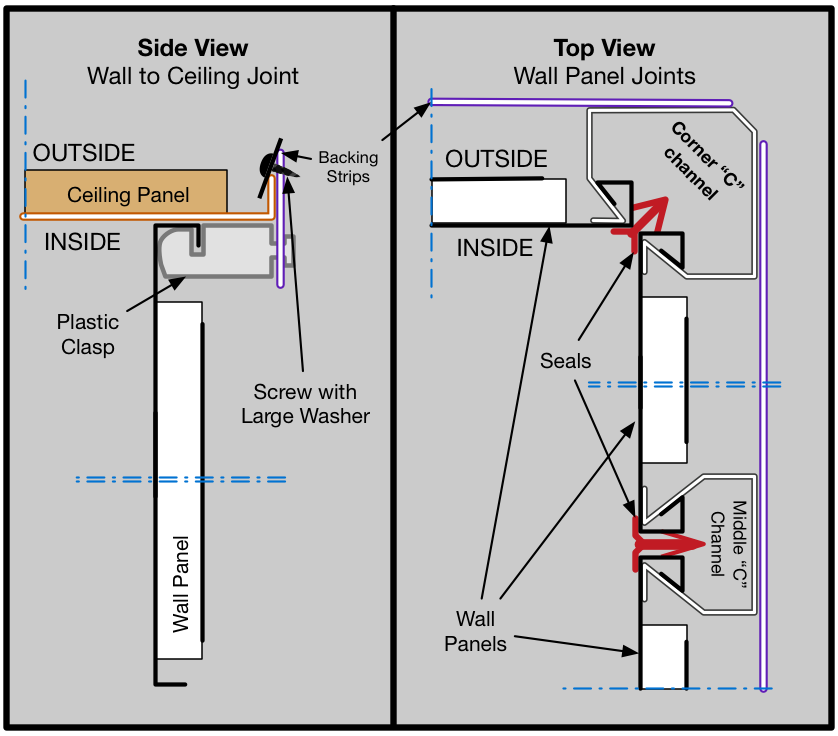
All of this stuff needed to be assembled once the ceiling went in. I think I mentioned I was surprised by the way the ceiling tied into the walls and provided the unifying structure. Given the parts I had, and no clear method and had finally discovered how it was done in my embarrassing recon mission to the factory showroom, but I was dubious of how well it would actually work. The wall panels seemed solid, they were held together by locking them into a C channel with thin T shaped plastic seals (with a colored rubber surface.) The top of the wall panels had a simple L profile lip that engaged with some plastic clasps. These clasps locked into these very flimsy backing strips of metal that spanned the width of the room and were attached to the backsides of the vertical C channels, tying them together. The roof panels were simply laid on top of the edge of the wall panels as they were bigger and overhung the walls. These ceiling panels also had a lip that was pinched to the backing strips by machine screws with large washers.

Wall Details.png


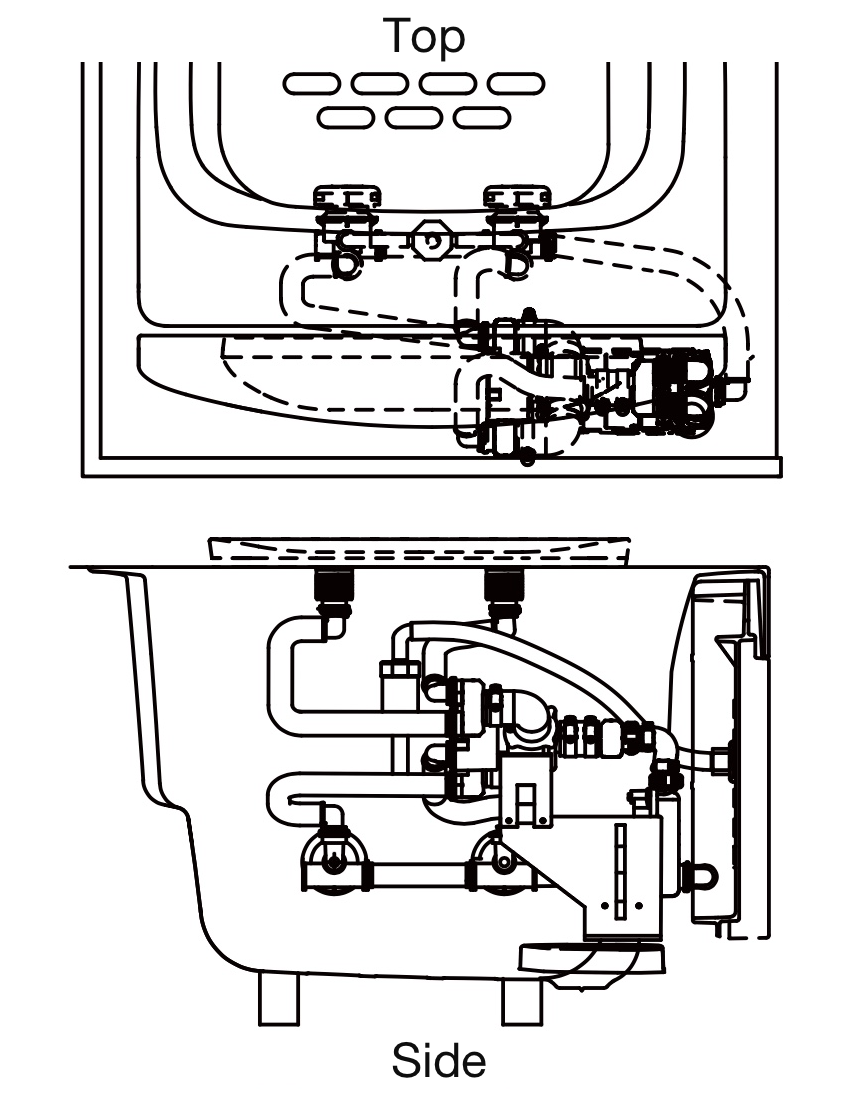
As I started fastening these washered screws around the perimeter everything started getting very rigid, and when I was done the whole thing was solid as a rock. I then applied silicone calk to all the roof seams (the wall seams are self sealed by the strips that wedge them into place) and mounted the control boxes to the ceiling panels with special clips. I then pulled out the box containing the pump and all the custom molded rubber tubes, electric valves, check valves, caps, clips, junctions and various other barbs and bobs. The only guide I had was the following this image, extracted from the Architect’s guide.

Jet.png


To compound the difficulty it is all mounted underneath and behind the tub via a small cramped opening. This area is shared with an odd little energy recovery system unique to Japan. As I said earlier, Japanese reuse their bathwater for bathing several times (or at least for several family members) but there are two other ways that they typically reuse it. One is an optional small filtered intake port at the bottom of the tub, connected to a hose that is run to a hookup in the laundry area for a Japanese washing machine. These washers have a fitting with a built in pump that will pull the water from the tub to provide heated water (as it is unusual to have a hot water feed to the washer) or just to reuse the gray-water after everyone is done with it. Washers include a long hose with a filter at the end that you can just put directly in the tub which serves the same function, but I’ve never used mine.

Anyway, the second recycling method is more interesting. As you may know, hot water tanks are very unusual in Japan as there are space limitations and the whole evolution of hot water use in Japan is so different that instant heaters are the norm. These heaters use a separate loop for the bathtub which allows it to recalculate and reheat the bathwater, but the newest ones have another trick. Modern bathtubs are fully insulated, and Japanese use covers (also insulated) to keep the heat between uses. You can let the water sit for a day, and it will still be warm! So what these heaters do is use this hot water reservoir as a kind of hot water tank. But it doesn’t push gray-water through your fresh water system, it instead it pulls the hot water from the tub, routes it through a heat exchanger in the heater to pre-heat the fresh water you have requested (thereby cutting energy consumption) and then sends the gray-water back to the tub. But instead of dumping the cold water back in the tub, it switches a 3-way valve located behind the tub and that water is routed to the drain instead. My heater is too old to have this capability, but I pre wired and plumbed this valve as I wanted to be able to take advantage of this when the 20 year old heater finally kicks the bucket.

Here is a shot of the pumping system, which was far more complex than I would have expected something like this would need to be, but it works very quietly, with a perfect unbroken waterfall effect and powerful jets.

Pump and Control.jpg


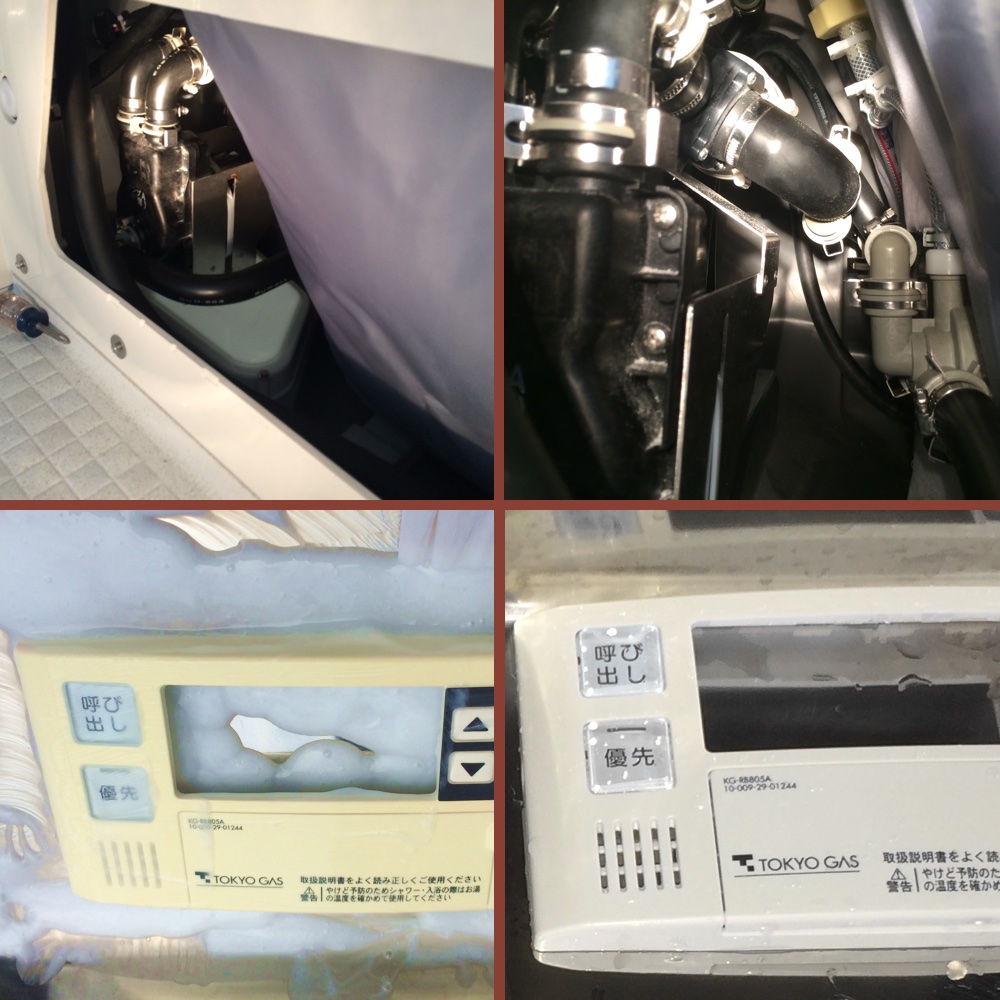
The bottom images are the results from using Hydrogen Peroxide and sunlight (UV) to restore the yellowed plastic of the bath heater remote. This is a great trick for restoring old computers and parts that can no longer be sourced.

With that complete, I filled the tub, checked for leaks and let my wife take her first bath in her new system!
 

SilverBullitt

Member
Joined
Feb 27, 2015
Messages
10
Very good thread and very interesting to see how different things are in Japan. I look forward to following your continued renovations.
 
OP
B

Bakafish

Well-known member
Joined
Feb 7, 2017
Messages
477
Location
Tokyo
Shocking limitations

As a break from the Unit Bath (and to give me some time to clean it up for the glamor shots) let me talk a bit about electrical power over here. One of the more frustrating and unusual aspects of Japan is that it uses an incompatible power system with every other country in the world. Not satisfied with that level of iconoclasm, they decided to even be incompatible with themselves, creating two separate power grid standards. The Japanese typically divide the country into East/West, but when you look at it on a normal map, it seems way more North/South in my opinion. Historically the two power centers of Japan were Edo (the usurper, now known as Tokyo 東京 these Kanji literally meaning East-Capital, dominated by Samurai and the Shogun) and Kyoto (the original Imperial seat, in Kanji 京都 meaning Capital-City.)

It seems we’re already abroad the Tangent Train, so lets see what’s at the first stop…

This feud between power centers seems to have acted like a magnet pulling the compass needle of the Japanese consciousness out of whack. In Japanese maps, the convention of orienting North to be up is regularly ignored. They might put a North indicator somewhere, but they tend to make maps that appeal to their artistic sensibilities or trying to fit into the space they have. The culture is perfectly fine with North being in any ****** direction that fits best in the space provided which can get you very lost very quickly (speaking from experience.) In college our Japanese teacher spent 30 minutes confusing the hell out of everyone by drawing the map of Japan completely horizontally and asking us to name places. This is commonly done to some degree or another over here, below is typical representation, Hokkaido and North be damed.
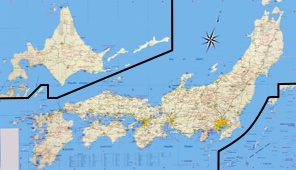
Japan Map.jpg


Property is traditionally handed down to the eldest son of a family, and because of high inheritance taxes one is often forced to subdivide the property to pay for them. This practice has led to a completely chaotic, drunken spiderweb of property lines where the choice parts of a parcel was retained and odd bits sold off. Land is in such limited supply that every sliver is utilized. These impossible plots result in tiny houses called Kyosho Jutaku, which are abundant all over Tokyo. And this leads to our next stop on this crazy train, street addresses.

The Japanese, having no real rivals for Japaneseiness, tend to compete with themselves. So when it came time to create a system of issuing addresses they decided that first come, first served made sense. A predefined sequential system with odd numbers on one side and even on the other would never work when property lines look like an iPhone screen recently acquainted with the sidewalk. This results in a system where addresses correspond to when things were built and properties subdivided, not where they are actually located. Sometimes they don't even bother to change the address when splitting the parcel, with several houses using the same number.

Oh, and those streets are typically nameless, as only the biggest thoroughfares are ever named or numbered. Instead of naming their streets they instead number the 'blocks' the bigger streets circumscribe, which are then subdivided again by smaller block numbers and finally the pseudo-randomly distributed addresses. Until computer navigation, the only reliable way to find someone's house was to go to the nearest police box (located everywhere) and have them give you detailed directions (a service they still admirably provide without complaint.) And if that doesn’t blow you away, get this, car navigation systems have phone number to address mapping built in. Seriously, you can put someone’s home number or a business line into the Nav and get a route to their door.

As a side effect of this chaotic address system, every business is expected to provide a sort of stylized map to their location, which again, sacrifices accuracy for a sort of Japanese interpretation of where something is. They use big thick lines and a few thinner ones, everything stripped of any curvature or detail, forced into a rectilinearity that only exists in the fever dreams of its creator. A couple of 24 hour convenience stores or the local police box are sometimes scattered in to give a rough ability to triangulate, but any relation or representation to North is often left out, replaced by the stilted geometry of the local train tracks to orient you. Here's the first thing I grabbed off my wife’s desk.

Maps.jpg


Oooh, we’ve arrived at the next station!

Navigating in Japan is more than strange maps and nonsensical addresses. This may be apocryphal, but because the Samurai in Edo wanted to be able to draw their swords as rapidly as possible to confront an opponent facing them, all pedestrian traffic in the Tokyo area flows opposite of the US. So when Westerners visit bustling Tokyo, they often end up standing on the wrong side of escalators and walking the wrong way into the stream of pedestrian traffic flow. This is further complicated by involuntary behaviors we rarely are conscious of. An American would automatically avoid colliding with someone by dodging to the right, but Japanese here naturally dart to their left creating a crazy harmonic feedback loop of syncopated lateral lunges culminating in a confused Japanese person wondering why, despite their best efforts, you intentionally ran into them. Whenever I return to the US I do the same thing for a few days before I get my bearings back. You might think that this pedestrian convention is because Japanese drive on the wrong side of the road (like the Brits), but in Western Japan, they walk on the opposite side like in the US. This region was once dominated by the merchant classes who, it is told, wanted to keep the valuables held in their right Kimono sleeves away from the oncoming flow of potential sneak thieves.

Anyway, despite going far, far off into the weeds, our little train has now returned us to the departure point, Japanese electrical service.

As I was saying, the country is split between 50Hz power in the East (North) and 60Hz generation in the West (South.) These two primary grids are linked by three frequency conversion stations that allow power transfer between them, but all residential power conforms to the grid it is attached to. Standard residential voltage is 100 volts. Not 110, 115 or 120 but an actual 100 volts. In Tokyo and some of the other larger markets, a 200v single phase 3-wire system has been implemented that has 2 100v legs and a common neutral, so higher power heat exchangers (details later) and induction ranges are becoming more common, but not yet widespread across all of Japan.

So, strange voltage, 50Hz power some places 60Hz in others, that's all you are dealing with right? No, this is Japan, it can always differentiate itself further. You see, when they started modernizing their wiring (much more recently than you might expect) they adopted a very good safety mechanism in a very limited way. Sharp eyed visitors to Japan might notice that, although they use standard NEMA 1 two prong outlets (like the US) they are typically non-polarized and lack any ground. The reason for this is that, at the electrical entry point there are two protection devices. The primary one is an oversized Ground Fault Interrupter for the entire service. That means if something trips the single GFI, all the power to your house goes out. By implementing it this way, all the legacy ungrounded/unpolarized wiring could be protected at the lowest cost. But since everything is GFI protected there little incentive to implement grounded outlets (except in a few places like the laundry hookup or the toilet outlets which are typically wired to a pathetic little grounding stake about a foot in length somewhere in the yard.)

Obviously, GFI protection is a proven and worthwhile way to provide safe power, but I would have preferred circuit-by-circuit protection (and a decent grounding path, I'm old fashioned that way) so that a misbehaving appliance doesn't force me to binary search through my breakers in total darkness while trying to isolate what is responsible for knocking me offline. I’m also concerned that my shop tools, TIG welder, etc. is going to shut off some critical system or CAM process mid-stream. I guess UPS’s on most of my key electronics makes sense anyway. But, let me get to the other device at the service entry I mentioned which they call a 'Power Limiter.'

The Power Limiter is just a big circuit breaker, but it's owned by the power company. It is connected just before the GFI and your baseline electricity charge is calculated on the basis of this breaker’s capacity, so you can request the size based on your requirements. Maybe you have a tiny apartment and use gas appliances, why not save a few bucks every month and get a smaller one? Seems reasonable, right? In the US people get by fine an old house without the 200A service required in new construction, a 100A or 150A panel works fine for most people, right?

What if I were to tell you that in Japan a 20A service is standard for most apartments and 40A for detached houses. But, you can just pay for a larger service right? It might be expensive, but if you want 200A you can just pay the fees, right? Unfortunately, at least here in Tokyo, the maximum residential Power Limiter you can get from the power company is 60A… I'm serious, that's it.

40A Service.jpg


So, suffice to say, high amperage equipment is going to require additional attention. And like the single point of failure GFI, a 60A breaker can take the whole house offline by using the wrong tool when your wife is making some tea.
 
Last edited:
OP
B

Bakafish

Well-known member
Joined
Feb 7, 2017
Messages
477
Location
Tokyo
Sorry for the slow response. I didn't want to bump my own thread, so I was waiting to have an update before replying to you guys...

I'm really enjoying this thread. Not only is it really entertaining ( I love your diversions), the cultural education is amazing. It really makes me appreciate some of the stupid **** that we take for granted (bitching about the big box stores).

I can't wait to get to the shop part of the story but I can wait, because the road to get there is pretty cool and I don't want to miss anything along the way.

Absolutely fascinating! Thank you for sharing!

Very good thread and very interesting to see how different things are in Japan. I look forward to following your continued renovations.

Thanks for the support! It’s nice to think that people might be interested in my pretty mundane junior construction stuff, and I wish I could spend more time actually vetting my wild views on this country and its history. But as long as you guys give me a grain of salt or two, I can hopefully provide an at least partially accurate and unique perspective of this strange land. :)
 

Silostang

Member
Joined
Oct 13, 2010
Messages
6
Keep the updates coming. Here is a pic of the restroom at my hotel, pretty cool to have a whole room as a shower.
1eb300e21aefc6fa508477355710c5a8.jpg


Sent from my iPhone using Tapatalk
 

Attachments

  • 1eb300e21aefc6fa508477355710c5a8.jpg
    1eb300e21aefc6fa508477355710c5a8.jpg
    157.8 KB · Views: 12

Brian_WK

Well-known member
Joined
Jun 30, 2015
Messages
1,177
Location
NE South Dakota
Shocking limitations

As a break from the Unit Bath (and to give me some time to clean it up for the glamor shots) let me talk a bit about electrical power over here. One of the more frustrating and unusual aspects of Japan is that it uses an incompatible power system with every other country in the world. Not satisfied with that level of iconoclasm, they decided to even be incompatible with themselves, creating two separate power grid standards. The Japanese typically divide the country into East/West, but when you look at it on a normal map, it seems way more North/South in my opinion. Historically the two power centers of Japan were Edo (the usurper, now known as Tokyo 東京 these Kanji literally meaning East-Capital, dominated by Samurai and the Shogun) and Kyoto (the original Imperial seat, in Kanji 京都 meaning Capital-City.)

.............................................

You my fine Sir are literary Gold I like when I come across threads on here that can tell a story of building something and make it sound like construction poetry.
Keep it up :thumbup:

Brian
 
To avoid these ads, REGISTER NOW!
Top Bottom