To avoid these ads, REGISTER NOW!

Below 265 SQ/FT Tiny Tokyo Shop

All workspaces below 265 squarefeet.
OP
B

Bakafish

Well-known member
Joined
Feb 7, 2017
Messages
477
Location
Tokyo
AC Eyepiece1.jpegAC Eyepiece2.jpeg

This eyepiece isn't supposed to be removed, the previous owner delved inside there and left it lose (requiring a lot of subsequent cleaning.) The factory C-mount adaptor replaces this entire front plate. I used a light to show some of the reticule marks. When in actual operation the light isn't uniformly projected on this plane in a way that a macro lens can pick it up, at least I was unable to get that to work. Pretty sure additional optics are required, and again it seems like more effort than it's worth as I can get most of what I need with the iPhone mount.

What was the name of the shop you worked at? I was a manufacturers rep(tile) on the west coast when I was young.
 
To avoid these ads, REGISTER NOW!

Old tool guy

Well-known member
Joined
Apr 13, 2023
Messages
3,155
So lets say it is in between the 17 and 18 minute marks, you turn the micrometer knob until the 17 minute ticks frame the line and read the value on the knob, for example 35.5 seconds, and you know the line moved to 17' 35.5".
That answers my next question. You don’t need to estimate the position of the cursor between tick marks, the knob gives that value.
 

Grant Gunderson

Well-known member
Joined
May 17, 2013
Messages
2,312
Location
Bellingham, WA
AC Eyepiece1.jpegAC Eyepiece2.jpeg

This eyepiece isn't supposed to be removed, the previous owner delved inside there and left it lose (requiring a lot of subsequent cleaning.) The factory C-mount adaptor replaces this entire front plate. I used a light to show some of the reticule marks. When in actual operation the light isn't uniformly projected on this plane in a way that a macro lens can pick it up, at least I was unable to get that to work. Pretty sure additional optics are required, and again it seems like more effort than it's worth as I can get most of what I need with the iPhone mount.

What was the name of the shop you worked at? I was a manufacturers rep(tile) on the west coast when I was young.
That makes it a bit more clear. The shop was called Photo World. we only sold used equipment. I miss those days.
 
OP
B

Bakafish

Well-known member
Joined
Feb 7, 2017
Messages
477
Location
Tokyo
Quick update, after doing more testing today I discovered the fancy Gimbal turned out to have a loose pivot shaft, likely the reason the Sony lab got rid of it. The whole top assembly could be tilted back and forth with little effort, not by much, but it didn't need much to to throw everything off. I did some analysis and identified a potential adjustment on the bottom, a small circular plate that threaded into a collar. It had a pair of small holes for a pin spanner, but it did.not.budge. A bit more disassembly and examination later there was nothing obvious holding it in place, I was still convinced this was the droid I was looking for, so the little nylon dead blow was used to persuade it to turn, which it finally did, exposing the bottom unit of a pair of nice ball bearings. After cleaning the threads of rock hard congealed grease, I reinserted the disk which was designed to press on the outer race and remove any play in that shaft. By applying a bit of extra preload it tightened the whole assembly up quite nicely, so I believe that was the issue I was seeing with the inconsistencies. I will do some confirmation tests tomorrow. I really want to be able to use it as there are some situations where two mirrors are really helpful.
 
OP
B

Bakafish

Well-known member
Joined
Feb 7, 2017
Messages
477
Location
Tokyo
A little bit of a gear change. Yesterday was my lovely Waifu's birthday, and I made her a cheesecake and a batch of Chocolate chip cookies. Making Cheesecake over here is problematic because Graham crackers are basically unheard of unobtanium at local stores, and it may come as a shock but so are chocolate chips. So whenever I visit the US, along with Mezzetta's peppers, Tom's toothpaste and Mendocino mustard, I always get a box of Graham crackers and a couple bags of semi-sweet chocolate chips. (I'd give you a picture of the cookies, but I had to put them away because I can't stop eating the damn things.)


cheesecake.jpeg

But today we got a delivery from our friends in Kyoto. I didn't mention the wonderful dinner our patrons made us last time we were down there, the star being fresh Shiro-Mirugai (my wife corrected me, these are Milky-Mirugai, the white type exists as well, but is less desirable and more common. These are the rarest, my poor Japanese strikes again) sashimi, a rare 'white' subspecies of Japanese Mirugai clams. I saved the shells from that meal as I intended to post about it at some point. The "Mirugai" in the US is typically the big American Geoduck variety from Washington state, and are very good, but much bigger and bolder in flavor compared to the Japanese variety. Any clam sashimi can be a challenge for the unfamiliar, the crunchy texture and stronger flavor compared to fish can be unsettling at first. But if you have a good sushi place, mixing in some nice clam adds variety and interest to the meal, and I really recommend it, although you may want to start with the milder (and cheaper?) Akagai (red clam) or Hokkigai (surf clam.)

White Mirugai.jpeg

White Milky (ミルクイ) Mirugai is special though, and I must admit I've rarely seen it here, and never even heard of it when I was in the US. It is smaller and more subtle in flavor than even the normal Japanese Mirugai which are closer in taste to the American subspecies. If you've ever seen an American Geoduck, you would know how small this is in comparison. As always, they sent us way more than we could eat, but it makes it easier to share the extras to bribe our favorite local place to prepare them for us.
 
Last edited:
OP
B

Bakafish

Well-known member
Joined
Feb 7, 2017
Messages
477
Location
Tokyo
I've not seen mirugai or akagai offered in the US for years, May be I don't get out enough,
I was in the SF Bay Area, and had some pretty nice Sushi options, so I don't really know what is on offer elsewhere (or currently.) I'm sure there are good domestic alternatives as well, US seafood is pretty good too. Dungeness crab and Hog Island oysters are both well missed.
 
OP
B

Bakafish

Well-known member
Joined
Feb 7, 2017
Messages
477
Location
Tokyo
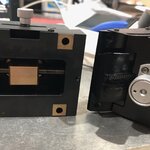
I was unhappy with the tilt adjustment on the AC stand that I had put together. The Goniometer stage I had chosen was a worm drive type, and had more than 20° of pitch adjustment in both directions, but suffered from lack of granularity in the adjustment and a lot of backlash which made dialing in the 'zero' a bit of a pain. It wasn't unusable, but I was devising some sort of fine adjustment block, which would only make the stack up even higher. I figured I would see what was out there and found a reasonable price on another Chuo Goniometer stage that uses a jackshaft mechanism rather than the wormdrive. This trades adjustment range that I didn't really need for finer adjustability and far less backlash.

Chuo_tilt1.jpegChuo_tilt2.jpeg
New unit on the left.

It also was even lower profile, shortening the stack which helps as the closer the AC is to the base the easier setting up everything is. The new stage works so much better, both in the effort needed to adjust and the ability to just lock in on the crosshairs. It has the same feel as the horizontal adjustment now.

So with that swapped out and having done some preliminary testing with the tightened up gimbal, I did a full test for repeatability using the sine plate to lift it off of and return it to the 1mm Cerablock multiple times, with zero drift. And then to replace it with the 0.999 - 0.991mm blocks to evaluate the precision. I did this by picking them by random, taking the measurement on the AC then reading which block I had just measured in order to do a sort of blind test so I wouldn't be tempted to hit the numbers. Even on my home built wooden bench, not a massive granite surface plate like I should be using, it was dead easy to read accurately down to 1 micron. I mean not even hard at all, just center the line and read the micrometer dial.

I then took a quick reading on the preliminary scrape I had done on the 500mm straight edge I had rescued. This confirmed what I already suspected, I had ended up with about a 15 micron convex bow in it. This was because I had been printing it on the long edge of my granite square, but the square is only ~480mm long (my Granite surface plate is 300x450 and even using the diagonal I would be short) and it is a big no-no to print with a shorter reference than the work piece. A pro can do it, but it is really easy to end up doing what I did, and I knew I had done it since the hinge point remained close to the center of the straight edge. By that I mean, when placing a flat item on a reference surface and rotating it around the center axis from one end, if it is flat it will actually pivot on a point close to 1/3rd it's length opposite from where you are pushing it. If it is convex it will pivot on the edge, concave pivots in the center, and I was seeing center pivoting when I was scraping it in despite doing my best to compensate for the shorter reference surface. I clearly do not have the skill to use a shorter reference, and I've yet to find good documentation on how to compensate for it, but this was just a rough scrape to remove damage and get some practice so I won't beat myself up about it.

Now I can validate the bigger 750mm* 1 meter straight edge with the AC, since it still has the factory scrape marks I'm assuming it should still be pretty accurate, a lot can happen in the 60+ years it has been around, so I didn't want to assume anything (oh let me be honest, I didn't want to pull the beast out of its box. It's a heavy mofo.)

*Holy bad memory Batman, I've been thinking this thing was 750mm for a long time now, and only going back to look for a link have I discovered that it is actually a meter long. That explains the massive weight (and size :rolleyes: ) disparity between it and the 500mm unit, it seems obvious to me now, but I would have sworn to you it was 750mm if I hadn't read the old post, despite the fact that just thinking about it, it is clearly bigger than 750mm. Crazy. Well, I need to pull it out and measure it's flatness now...
 
OP
B

Bakafish

Well-known member
Joined
Feb 7, 2017
Messages
477
Location
Tokyo
I may have injured my back (not kidding), but it was for science. I did a quick AC measurement of the big straight edge flatness. It went quickly and effortlessly thanks to the stand and the laser alignment assist.

OK AC results.jpeg
OK AC measurements.jpegstacking SE.jpeg

After crunching the numbers, I wish I had taken multiple passes and reversed it, just to make sure the numbers were consistent. But I already repackaged and put away the beast, I'll do it again when I start scraping the little guy for better accuracy. The results indicate a 14 micron maximum deviation, but the middle was for the most part pretty consistent. It started life as an A grade, meaning it should have a maximum deviation of 6 microns (it likely would have been 1-2 as they are always way better than spec) so 14 is way off, but it is still less than the B spec of 24 microns, and I did a sanity check with a hardened I beam type straight edge and couldn't see any light leaking through using a high powered LED, so it may be better than what I measured.

SE check with SE.jpeg
 
OP
B

Bakafish

Well-known member
Joined
Feb 7, 2017
Messages
477
Location
Tokyo
I've mentioned a few times about the elusive Swiss made Biax power scrapers that I've managed to obtain. They make the job of shaving microns off of cast iron (primarily) reference surfaces in order to true them to near perfect flatness much easier than the traditional hand scraping process. Because they are specialized tools and use a surprisingly complex and hard to replicate adjustable stroke mechanism, they sell new for well over $4000 (which is crazy, but if you are in the machine restoration or manufacturing business is likely inconsequential.) I'm really lucky to have gotten mine, and need to practice more and get better at using them.

I don't think I mentioned that they make a special variant that is used for an even more specialized task called a power flaker. Some of the challenges with machine ways is keeping lubrication in place between the large flat surfaces that grinding or scraping creates. The ways oil is under a great deal of pressure and movement between the surfaces creates shearing forces that encourage the oil to be displaced. This leads to stiction, where the two surfaces start to bind, causing issues with the operation of the machine. Oil grooves alone are inadequate to properly resolve this, and the solution is, after working extremely hard to get everything super flat with the scraper, you gouge the surface with a bunch of specialized oil pockets that hold reservoirs of oil and keep it from squidging out. This is called 'flaking' the surface.

Biax HM2.jpeg
Looks almost identical to the scrapers, but the non-angled shoe is a hint that this one is different.

The power flaker is designed to make what they call a 'half moon scrape' but is really much more of a crescent shape, a pattern popularized by the Moore machine company, the manufacturer of the worlds most accurate machines. The Biax HM 2 and 10 (HM stands for half moon) use different geometry blades from the scrapers, as the motion of the unit's spindle is more complex than the scraper (although surprisingly the mechanism is simpler!) Recently one became available at auction (always happens when I'm going out of town or otherwise engaged) but I was lucky enough to win it without any counter bids. It came with a wide assortment of the specialized blades and holders, and was in pretty good shape, I got a great deal on it. Due to scarcity and the high cost of new units, these are some of the most resalable items in my collection, so I feel okay investing a bit in obtaining them.

As I said, flaking is pretty specialized, there's not much reason to apply this treatment to normal precision reference surfaces as the scraping pattern itself has enough surface variability to reduce stiction as they are not experiencing the high loading of a machine bed. But, there's another usage of these flakers, and that is to apply frosting, which is essentially a decorative pattern applied to a surface just for appearance. In the old days master scrapers had their own special patterns they would apply as a finishing touch to the scraped surfaces, most of which are undocumented and lost to time. Given the terminology used, it is hard to gather information through all the cakes. Even without special treatment, a properly scraped surface is a thing of beauty to my eyes, but flaking can raise that up a notch if done well.

OK 125.jpeg
This is a hand scraped surface, it could be argued that this pattern is a traditional form of frosting as it is uniformly applied after the block has been precision ground and scraped into trueness.

I cleaned and lubricated the unit, and replaced the thrust bearing that was showing some wear, but overall it seems in good condition. So what does the flaking of my new machine look like? I don't know yet :LOL:, I need to sharpen and hone the blades and prepare the test surface I just got for experimenting.
 
OP
B

Bakafish

Well-known member
Joined
Feb 7, 2017
Messages
477
Location
Tokyo
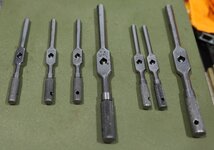
Someone was selling a bunch of used Starrett tap wrenches, which are rare over here, very cheaply. One of those impulse buys where the cost is so low that you can't pass it up, but you have no idea what you are going to do with a bunch of these. It has become clear that my wallet's immune system is ill prepared for such situations.

Starrett 91ab.jpeg

They arrived this morning, and were a little rougher than I expected. Not that they were unusable, I've just been spoiled with a lot of tools that look like hell when they come, but clean up to near new condition. These were well used, and needed about 6 hours of attention to get them all fully functional again.

The Starrett No. 91 tap handle is a classic tool, it comes in A, B and C sizes (these are A's and B's) and the tear drop opening, subtle curves and assremetric handles give it a sort of art deco feel to me. Starrett is a company I want to love, US metrological equipment with a long history, but their stuff is not consistently good, there are some real fishing weights in their lineup. Mitutoyo has been my go to brand, compounded by the fact that it is vastly cheaper and more available here. But I see Starrett stuff from time to time, some of it worth getting at the right price, and I've really enjoy using the little 91A I've had for a while.

Starrett 91a open.jpeg

These are put together pretty simply, the knurled handle is a threaded tube that pushes on a cone shaped bearing at one end of a spring loaded rod, the other end has a little 90° fish mouth ground in it. Tightening that handle moves the rod so it pinches the rectangular shank of the tap against the pointy end of the teardrop hole. There is a very small pin that runs in a slot hidden under the knurled handle, and it retains the rod and keeps the little mouth from rotating when you tighten the wrench, so it will always be in position to clamp a tap shank easily.

Several of the wrenches had significant wear and deformation of the fish mouth section of the moving rod, it has the least amount of surface area, seems softer than the body and thus takes the brunt of any damage. One of the great things about Starrett is they offer replacement parts, so these rods can be replaced, but the costs and time encouraged me to spend today repairing the damage rather than replacing the parts. To disassemble these, you fully unscrew the knurled tube, then remove the small pin with some really thin needle nose pliers which frees the plunging rod. Simple.

But if you have very old, damaged wrenches, you will find that the tiny pin will not be compliant about relocating and will remain steadfast in its little hole. The slot is about 1.5mm wide, so you aren't going to be able to get any kind of real grippers in there, and the pin has no lip or other features that can be leveraged. I found that the best way to deal with this is to use a Dremel with a thin conical rasp (my Nakanishi Evo with a CBN bit) to grind down the pin flush with the rod, thereby releasing it. Once the rod is out, you will find that the hole is cross drilled at the factory so you can tap the remaining fragment out from the backside and be able to replace it with a new 0.062" or 1.6mm pin.

Due to the damage and mushrooming of the end of the rod where it contacts the tap, several of them were unable to be removed through the bore they were located in, so I also had to grind the end down enough for them to freely pass through it. Once they were out I used small diamond jewelers files and die makers stones to correct and reshape the fishmouth on the ones that needed it. I did a deep clean and removed any rust and grime in the bores and ordered some locally sourced stainless steel pins to replace the ones I removed.

I have a nice set of buffing wheels and could cold blue the knurling and get them looking new again, but honestly I kind of like the patina. I think I will keep my commonly used tap sizes pre-mounted in them and make a little rack. Currently tapping (or more often chasing threads in 3D prints) involves a lot of fiddling in drawers and boxes, and I do it enough that just grabbing a ready-to-go tap is pretty appealing.
 

LeonardY

Well-known member
Joined
Apr 16, 2011
Messages
5,020
Location
Southern California
Nice find. I have looked around for a used set of 91s on and off. Sort of one of those tools that I would like to have but don't need.

cold blue the knurling and get them looking new again, but honestly I kind of like the patina.
If they aren't rusting then I leave them. The added bonus of the patina is it looks like you use them. That always impresses the chicks.
 
OP
B

Bakafish

Well-known member
Joined
Feb 7, 2017
Messages
477
Location
Tokyo
As a "Junk" junky, I recognized that a $50 pen style Kanetec demagnetizer was probably a safe bet since I expected it to be fairly simple windings with some sort of AC circuit. These things are ridiculously expensive, specialty tools from name brands like this often are, but when it arrived I was pretty surprised how simple it actually was.

wand_demag.jpeg

Under the plastic probe end, which easily unscrews from the nose piece, resides a paddle with two neodymium magnets glued and secured with heat shrink tubing. The paddle is routed through a miniature bearing to a small DC motor that just spins it, creating the alternating flux that is used to demagnetize the residual magnetism your tool might build up. As far as the 'junk' situation, the set screw fixing the paddle to the motor shaft was loose, so the motor was just spinning and it didn't rotate. Trivial fix, but I figured I'd replace the internal rechargeable Ni-Cad batteries with fresh NiMH cells and see the rest of the construction.

The pictures I took did little to elucidate how this thing was put together, but it was clearly designed by someone with very little thought on how it would actually be assembled. The motor button was soldered in place through a little window machined into the side of the tool, and covered with an adhesive backed plate. The two AA batteries were held in place in the oversized bore of the handle with a piece of foam. I had to remove the shrink tubing and desolder every wire to disassemble it, and reassembly required an extremely fiddly order of operations making sure to pre-place shrink tubing on very short wires and working on everything in place. It was a bear.

The worst thing was the motor mounting, which was tethered to the body by two short leads, and had a tiny Phenolic brace that supported and located the back side while having to fit into a precision machined slot deeply recessed in the nose piece and simultaneously being pinned there by two fingers from the base. Getting all that to sandwich together was nearly impossible. From a design standpoint I get what they were trying to do, but it is just so abstracted from actual manufacturing it is astonishing to me that there wasn't pushback at some stage of the design. I'm not even talking about serviceability, the actual initial assembly must be gruelling just due to poor understanding of how things are actually manufactured. It's no wonder they want $800 for these stupid things, but it could all be done so much cheaper (which is why I'm posting this for you 3D printer guys who might want a little side project.)

While I was there I replaced the barrel type connector on the base with a custom 3D printed jack using the same style DC charging connector I've been using on all my projects as the Imax B6ACv2 RC battery charger I have (very handy!) uses that connector natively.
 
OP
B

Bakafish

Well-known member
Joined
Feb 7, 2017
Messages
477
Location
Tokyo
As always, nice explanation.

You are tempting me with a carrot. :ROFLMAO:
Yeah, I've seen rotating magnet style demagnetizers before but expected more complexity given the cost. I guess they aren't any more crude than a big AC coupled coil, both types work, so who am I to judge? But my main calipers have been magnetized for months and I keep forgetting to bring out the big unit (which is almost too powerful, it's a little unpleasant to use.) The little wand worked a treat!

Since your in the future, Happy Thanksgiving. Do you still celebrate?
The Japanese have never embraced turkey for a multitude of reasons, lack of real ovens being the most obvious one. The unpopularity makes getting one a bit of a slog, usually requiring renting a car to go to Costco. So I do it every couple of years. I think I've done a full spread Thanksgiving only once in the 20 years I've been here. Covid's anti-socialization implications has been a convenient excuse to allow clutter buildup (compounded by my equipment hoarding) to the point where having people over isn't logistically comfortable. Cleaning criticality is fast approaching, but I'm still trying to ignore it... nature abhors a vacuum and I fear space will only tempt me further.

Speaking of which, this happened...

ac_stand.jpeg

Sometimes I feel like the time between my learning about the existence of some impossibly rare thing and it showing up at a local auction priced as "junk" can be measured in weeks. I sincerely believe that if I somehow obtained the Arc of the Covenant, three more would show up at auction in better condition or with some rare accessory I didn't have.

And yes, the stand came with yet another Autocollimator, which despite being in poor condition I was able to repair and clean into fully working condition within hours of receiving it. Interestingly enough, these two items are subtly different than the factory items, the model (3063) isn't recorded anywhere, it uses a different non-tinted diffuser and the stand height is increased ~100mm to accommodate a jig on the base which has non-standard mounting holes. So I believe this was some dedicated tool made by Nikon (possibly at a customer's request) to make specific measurements based on small modifications to the existing product. Anyway, I will spend Thanksgiving disassembling and reconditioning the stand. Kind of my favorite thing to do, for which I'm thankful.
 

LeonardY

Well-known member
Joined
Apr 16, 2011
Messages
5,020
Location
Southern California
My first Thanksgiving in Japan. My girlfriend whispered to me, "Does the turkey taste fishy?"
We think that they feed turkeys fish meal. Hahaha.
 
OP
B

Bakafish

Well-known member
Joined
Feb 7, 2017
Messages
477
Location
Tokyo
My first Thanksgiving in Japan. My girlfriend whispered to me, "Does the turkey taste fishy?"
We think that they feed turkeys fish meal. Hahaha.
More likely that the oven was used for broiling fish at some point :) a flavor that seems to permeate everything once established. [Adding: I've never seen a domestically raised turkey here, everything I've seen was a mid-tier frozen US import.] As you know, even the largest readily available ovens over here are a tight fit for a small turkey, and are basically glorified microwave combo ovens. Even these are biased for fish grilling, with special top mounted IR tubes. The big stand alone oven range like we have in the states is almost unheard of, most houses have a combination rangetop/fish broiler and a separate toaster oven/microwave. The broiler is tiny but quite effective for grilling fish (and I suspect possibly broiling a steak if not for the fish essence.) This will be a challenge if/when I ever get to the kitchen remodel as I will need to pay through the nose for an esoteric imported oven or possibly a restaurant grade unit (unfortunately often 3-phase.) Not just for turkey, I like to bake things, a problem for another day though.

Enjoy your Thanksgiving everyone. Leave a heart eyes :love:if you agree that the stuffing is the best part, angry face :mad: if you disagree (Candied Yam, Pumpkin or Pecan pie advocates can have a legitimate objection...)
 
To avoid these ads, REGISTER NOW!
OP
B

Bakafish

Well-known member
Joined
Feb 7, 2017
Messages
477
Location
Tokyo
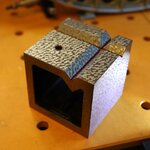
Last night I couldn't sleep, and as I often do in the stillness of night, I mulled over items on my internal 'ponder list.' Problems I haven't solved, questions I haven't answered. One of the things that has been troubling me was how to properly use the optical square to measure perpendicularity. The square itself is a pentaprism mounted in a cast iron block, carefully machined on all sides for accuracy. The issue I was having was, even assuming the sides of the block were perfectly square to the prism surfaces, how does that really help when there are so many other unknown variables?

Penta_Square_useage.png

This is the image from the AC manual*, and perhaps you can see what was confusing me. The optical square is kind of floating in space and the mirror and AC placement seems to be doing a lot of work, despite us not knowing how square to the measured surfaces any of this really is. Normally this sort of planar measurement is all relative to the arbitrary starting point. We place the mirror sled at one end of the span we want to measure, then true up the crosshairs to some initial 'zero' position, then move it in sled length intervals and record how many arcseconds it deflects for each interval. This doesn't require the mirror to be precisely 90° to its sled base, because we are just measuring the relative changes of angle, and the relationship between the mirror and base is fixed, so just being close to 90° is fine, any error is applied equally to all measurements and is invisible. When we measure the B1 surface, more often than not the AC isn't perfectly parallel as our first reading where we set the zero is unlikely to be parallel, and this too isn't an issue as this error is linear and part of the calculations we do at the end is to remove that baseline error.

So for example, when I measured the straight edge, the closest end was set to 'zero' and by the time I reached the far end, the cumulative rise over the 1 meter length was 95.4 microns (see the chart in this post), this was due to that first mirror placement where we set the zero actually sloping downward relative to the mean centerline of the straight edge so our initial angle was not parallel to the true plane of the full surface. Creating an ideal plane that goes through the average of the measurements and indicating the deviations from that plane is how a surface is properly mapped. But how does that translate to measuring a perpendicular plane? It gets a lot harder... some of the starting assumptions:

  1. We don't know if the mirror is a perfect 90° to the sled base, but that doesn't normally affect us as the errors are the same in all measurements and zero out.
  2. We know that the AC is unlikely to be parallel to the surface being measured, it also is generally not an issue as it can be averaged out.
  3. Reorienting the sled to a perpendicular angle and measuring it through a pentaprism seemingly untethered in space seems like it shouldn't work and melts my brain.
Before I obtained the Pentaprism, I had given a great deal of thought as to how I would solve this issue with the tools I had at hand, and this was also the source of a lot of why I was having so much trouble conceptualizing the solution. What I planned to do was use my granite reference square and a pair of mirrors, one fixed and the other gimbaled. After establishing the fixed mirror's zero point on the surface plate, it would be (precariously) relocated to the top of the granite square facing down and the gimbaled mirror would be positioned at the base and then dialed in until the reflection of the fixed mirror was reestablished at the zero point. This would establish the gimbaled mirror at a near perfect 45° angle. As long as the gimbal angle wasn't disturbed this would give me accuracy roughly as good as the square being used, good enough for my purposes anyway.

But this was where I was getting confused with the usage of the prism, because any change of the angle of the mirror to its base, or placing the base itself on a surface that isn't parallel is going to be reflected (no pun intended) in an angular change on the AC. Even though we have a mirror that is at 45° and could theoretically allow us to measure squareness, placing it on an uneven surface will introduce catastrophic error, the placement requires the machine be true on the B1 surface directly below the B2 for it to work properly. So Nikon showing the prism floating out in space, untethered to either plane, felt very hand wavy and frustrating. Surely the prism had to be aligned to something, what was the procedure to get it referenced?

But my mental model was all wrong! The mirror solution I had been conceptualizing required very critical placement and pre-calibration of the 45° turning mirror, and just substituting the prism caused me to overlook the fact that the prism doesn't reflect light like the mirror, it refracts it. The machined surfaces are not critical for orientation and don't actually need to be referenced because the light coming out of the prism was always going to be 90° to the incoming light, even if the facets or external surfaces of the prism weren't perfectly perpendicular to the surface being measured!
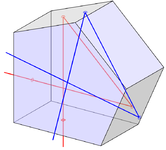
Pentaprisum_modified.png

The Wikipedia entry for a pentaprism based optical square shows an idealized path in red, where the light enters perpendicular to the prism face, which is a totally accurate representation but buries the lede. The blue path I added is also correct, and most importantly it shows how the prism preserves the angular relationship of the incoming and outgoing light. What that means is, it doesn't really matter if the prism is sitting perfectly square to the B1 or B2 surfaces, the light entering and exiting are always precisely 90° to each other even if the prism isn't perfectly aligned. Well, as precisely as the prism was manufactured to be anyway, and according to Nikon that's two arcseconds or less.

So that simplifies things a great deal, the reason they were showing it floating out in space is because it may as well be doing so, but we're not out of the woods yet. We can use the mirror sled to map a surface B1 but there is likely to be some parallelism error of our initial zero point due to wear or just baseline error. Again, it is easy to compensate for this if we were just measuring the surface flatness of the entire B1 surface, but once we start taking measurements of the B2 surface we will need to adjust those measurements relative to the compensated B1 surface. We could avoid this error by either using a known flat surface for B1, like if instead of being a machine ways it was actually a calibrated surface plate or straight edge that we know is parallel to the surface in question, then when we zero we know the mirror base is parallel and our readings will be relative. But in the real world we have some well used machine that we need to get as square as we can, so were going to have to compensate for a lot of error.
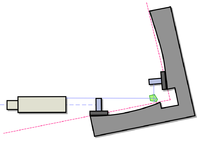
Optical Square Wallered.png

This exaggerated image is from the perspective of the AC's initial 'zero' position on a well worn machine (similar hollow profile to the straight edge I measure in the previous post.) As we make a sequence of measurements to the base, the mirror appears to climb up a hill as if the machine is tilted, but it's all just perspective and due to the initial zero point not being parallel to the average (or ideal) level. I show the prism at a random angle to the AC and the machine, and the important point is that it's always going to be redirecting the AC's view by 90° so the key to here is to get the AC aligned to the machine bed first or to properly characterize the slope and compensate for it with the second set of measurements on the perpendicular surfaces.

At least I know what to do now, one less thing on the list.

*I must admit that next to the figure in the manual is the text, "Penta-prism refracts the light exactly perpendicular. Angle of the incident light ot the incident surface of this prism does not affect the angle of the light refracted by this prism." Which is a complicated way of saying that the prism body doesn't need to be square, but it just didn't click for me at all.
 
OP
B

Bakafish

Well-known member
Joined
Feb 7, 2017
Messages
477
Location
Tokyo
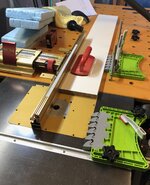
I promised my wife a little bit of progress on the home improvement front as it has been at a pretty glacial pace as of late. In the bathroom where I worked on the door surround, that unfinished wall also has a large opening where I intended to put an inset shelving unit, using all the space possible. Many months ago I picked up a real Festool System32 kit (as opposed to my home built solutions) and went about retrofitting it for my Makita routers. I mentioned I picked up yet one more router so I could use the 8mm shanked 5mm boring bits from the Festool system. Was that the cheapest way to solve that? No. Was it an excuse to get more tools. Yes.

FestoolSys32.jpeg

My thoughts on the Festool vs my system is that the Festool worked quite efficiently. I laid everything out so that all the shelf holes were referencing from the same edge (bottom) of the two side panels. For the optimal efficiency you would actually reference each side from the opposite end because they are mirrored so that you don't have to do as many adjustments, but that seems to be asking for trouble even if the two sides are within tenths of mm in length. I don't know, I'm not making multiple units here, if I was I would do it their way. The one glaring shortfall with the tool as shipped is the little offset arms are too short. The design is great, they have a mm scale marked on the 14mm aluminum hex stock, this is zeroed out to the centerline of the router with the provided slots in the plate, and then you can easily dial in a precise offset. But in order to fit snugly in the box, they are woefully short. Immediately my thoughts went to one of the fiber marking lasers, and making extended sections. But I actually had other ways of skinning that cat and just dealt with it for now.

The router table I made is designed to attach to the main workbench on any side, but it has remained where I first attached it. The only significant limitation has been when processing longer panels, as the wall limits the length I can process in the tables current location. The Incra fence system was modified to use the MFT pattern mounting system, and it's a little tight, but with the Jointer fences removed the arm can be oriented perpendicular to the normal direction and this allows me to use much longer panels without much fuss.

Incra Long.jpeg

Here is my setup for doing the rabbet for the shelving back panel, still love the Feather Bow units. As a massive Bessy fan, must say I'm really disappointed with the Magnesium KLI series Kliklamps which over a very short period of time, no longer hold pressure worth a damn. I certainly didn't abuse or over tighten them, the alloy is just too soft to do what they are doing with them. Avoid.

Adjustable shelving has more challenges than just getting the holes aligned, even if that is one of the hardest. The 5mm holes are still a sloppy fit for most of the shelf pins out there, and good luck finding accurate dimensions prior to purchase or consistency after it. So how the shelf itself interfaces to the pins needs to do a lot of heavy lifting if you want it optimal. Basically you want to keep the pins in place so they can't work themselves out, as well as secure the shelf from just sliding off of them. In the past I did very careful bullnosed slots that pocketed the pins, securing the shelf and making sure the pins were captured. But you have to get the depth spot on, or you ruin all the work with getting the holes aligned in the first place (although if they are not, you can compensate here if you have a row offset, don't ask me why I bring this up.) but for this simple bathroom shelf I didn't want to deal with that, and this melamine material is going to last longer in a moist environment, the less penetrations you make, having exposed wood in the pin slots may lead to delamination down the road.

So instead I used pins with a small raised section in the middle, this allows the edge of the shelf to keep the pin in place. But the shelves can still slide out on the almost frictionless pins, so I 3d printed some little clips that snap to the front pins and secure the shelf in place.

Clips_Archive.jpeg

Download the above image and unzip it for the STL model hidden inside. This is what it looks like in place, the pin is an example, you would have installed it in the hole before snapping the shelf in place. (Look at that cheeky monkey in the back trying to work its way out, LOL.

Shelf Clip.jpegsecured shelf.jpeg

Honestly, this is not a fine furnishing solution, but it's practical and feels very secure. While I was thinking about this, a far more complex, but hidden, professional and highly repeatable solution occurred to me, but it requires me to purchase a couple hundred dollars of Festool accessories, so it will have to wait.
 

Old tool guy

Well-known member
Joined
Apr 13, 2023
Messages
3,155
The offset bars that are too short ... in the first picture, is the silver bar in the foreground, just above Festool … is that it?

The bessey clamps. I bought a pair about 20 yrs ago for light clamping. More than a spring clamp but less than a traditional c-clamp. Light weight, easy to operate. Worthless. No matter how careful I am to get them aligned … getting the pads flat on the surface … and no matter how tight I get them … and they can get pretty tight … doesn't take more than 1 min of jigsaw vibrations to completely loosen them. I’m surprised they are still sold.
 

Old tool guy

Well-known member
Joined
Apr 13, 2023
Messages
3,155
Had a thought … I think. If you reverse the clip so the open side faces the back, and if you put them on all 4 pegs, you could insert the pegs in the sidewalls, lay the shelf on top slightly too far forward, you could push the shelf back into position and engage all 4 pegs.
1702594284122.jpeg
 
OP
B

Bakafish

Well-known member
Joined
Feb 7, 2017
Messages
477
Location
Tokyo
The offset bars that are too short ... in the first picture, is the silver bar in the foreground, just above Festool … is that it?

Yes, sorry. They can give you about a 110mm offset from the edge, which is great if you are flipping the panel and are always just working from the nearest edge to the column of holes. But that means you are setting your offset reference edge from two opposing edges (one row from the top, one row from the bottom or referencing from a different stop on the same edge*) and that just feels like asking for misalignment. It really doesn't take much error to create a shelf that rocks, so I'm not super enthusiastic of doing it the way they suggest and would prefer to keep the same reference and layout. That would require longer arms though, or an alternate column offset method, which I have but it's more complex than just longer arms.

The bessey clamps. I bought a pair about 20 yrs ago for light clamping. More than a spring clamp but less than a traditional c-clamp. Light weight, easy to operate. Worthless. No matter how careful I am to get them aligned … getting the pads flat on the surface … and no matter how tight I get them … and they can get pretty tight … doesn't take more than 1 min of jigsaw vibrations to completely loosen them. I’m surprised they are still sold.

Yeah, this.

*Actually, thinking this through referencing from a different stop but on the same edge is probably safe given the closer tolerances of this factory track. A lot of my thinking around this is using my own solution, and with that I always wanted to work from the same direction as any hole to hole spacing errors would be kept the same across all columns. I'll try it their way on a non critical project.
 
OP
B

Bakafish

Well-known member
Joined
Feb 7, 2017
Messages
477
Location
Tokyo
Had a thought … I think. If you reverse the clip so the open side faces the back, and if you put them on all 4 pegs, you could insert the pegs in the sidewalls, lay the shelf on top slightly too far forward, you could push the shelf back into position and engage all 4 pegs.
1702594284122.jpeg
The way I have this set up, the shelf goes in tilted up with the back higher than the front. The front clips are snapped in place and then the back rotates down and is a press fit with the rear panel, which effectively locks the shelf in place. It cannot move forwards or back, and to remove it you just push up on the rear of the shelf from underneath and then unsnap the front clips. Two clips are easier to install than four, and positioning them in the way you suggest means the only thing keeping them from sliding out is the spring clipping force (which isn't much) compared to how I have it, which would require tearing out the pins (the clips here are working in compression, backed by a stainless steel screw that extends past the pin diameter. The pin will fail first.)

The only concern I had with this two clip design was that a very forward load (pulling a heavy bottle off the shelf for example) could cause the shelf to rotate around the front pins and flip the other contents off. But I tested it with a 2kg block of tungsten carbide (I knew it would come in handy for something) and there just isn't enough overhang to cause an issue. Aesthetically the clips are not really noticeable in practice, I'm highlighting them here where the lack of symmetry is more of an issue. But there's nothing stopping anyone from using them in the way you suggest, it may work better than I think.
 

Old tool guy

Well-known member
Joined
Apr 13, 2023
Messages
3,155
. Two clips are easier to install than four,

a very forward load (pulling a heavy bottle off the shelf for example) could cause the shelf to rotate around the front pins and flip the other contents off.
2 are easier to install than 4 … but if the builder was adept at working to fine tolerances … :}

A heavy forward load could cause the shelf to tip even without the clips.

Using 4 clips would keep all the pins in place, preventing the sagging back pin in one of your pictures. But I thought of a deal killer to using 4 pins … it could be very difficult to disengage the clips to remove the shelf. You would have to insert a prybar between the shelf and the back of the cabinet to lever it forward.
 
OP
B

Bakafish

Well-known member
Joined
Feb 7, 2017
Messages
477
Location
Tokyo
2 are easier to install than 4 … but if the builder was adept at working to fine tolerances … :}

A heavy forward load could cause the shelf to tip even without the clips.
Yes, but your 4 clip suggestion would actually be much more resistant to tipping. If it had been an issue with the two clips, a top clip that used the rear shelf holes above the shelf could be made to secure it from tipping though. Good to think through the solution defensively.

Using 4 clips would keep all the pins in place, preventing the sagging back pin in one of your pictures.
It wasn't actually saging, I hadn't installed it properly as I was in a rush to get the shot. In order to get that angle I had it sitting in a dark stairwell and didn't notice that the pin wasn't set until I brightened the image and cropped it. The small raised ring around the pins (and tight shelf tolerances) keep this type of pin quite secure, assuming you install them properly to begin with.

But I thought of a deal killer to using 4 pins … it could be very difficult to disengage the clips to remove the shelf. You would have to insert a prybar between the shelf and the back of the cabinet to lever it forward.
The snap is pretty subtle, like I said not really much resistance or holding power there, it wasn't even needed. Mainly designed it for being satisfying to use. But that's why I think your 4 unit suggestion it wouldn't be secure, at least with this design. A bottom entry clip would be better.
 
OP
B

Bakafish

Well-known member
Joined
Feb 7, 2017
Messages
477
Location
Tokyo
I like to use this style. The hole in the 90 degree portion allows for a small cabinet screw to secure the shelf to the pins.
These are very sturdy, and since the edge of the shelf blocks them in, they don't pull out. I used this type quite a bit in the US. But they require more space between the shelf and the sides, or very fiddly reliefs. Being a perfectionist I do like tight fitting shelves. They are also quite hard to find over here, especially in 5mm size. Overall a good solution though, especially if you need strength.
 
OP
B

Bakafish

Well-known member
Joined
Feb 7, 2017
Messages
477
Location
Tokyo
Update on the Bessey clamps. Just got an unexpected call that a salesman will bring replacements for all 6 units on Monday. I will question him on any design changes (I suspect there won't be any) and will just use the replacements as sparingly as possible. Better than a poke in the eye with a sharp stick, but I'm still doubtful about this model. Can't complain about the service though.
 

nicholam77

Well-known member
Joined
Dec 18, 2016
Messages
2,655
Location
Minneapolis, MN
Edit: Just noticed your fine print, but keeping the post anyways!

Yes, sorry. They can give you about a 110mm offset from the edge, which is great if you are flipping the panel and are always just working from the nearest edge to the column of holes. But that means you are setting your offset reference edge from two opposing edges (one row from the top, one row from the bottom or referencing from a different stop on the same edge*) and that just feels like asking for misalignment. It really doesn't take much error to create a shelf that rocks, so I'm not super enthusiastic of doing it the way they suggest and would prefer to keep the same reference and layout. That would require longer arms though, or an alternate column offset method, which I have but it's more complex than just longer arms.

Interesting to hear your take on the LR32 w/non-Festool router. I got mine set up and only used it once as a test, but it worked well.

In regards to doing an 'unbalanced panel', have you tested flipping the rail around (so it uses different end stop) but referencing the same cabinet gable edge? That's what I did in my test — referenced both rows of holes from the cabinet bottom, but flipped the rail. I just checked with a square, not assembled a full cabinet with shelves, but it seemed spot on to me. I have seen many people do it this way and I'm pretty sure that's why they give you two end stops.

However if you want some ideas... there are those who have purchased longer hex bars for the parallel stops.

I've also seen it done to attach the parallel stops backwards on the rail, like this.

My gut feeling is even without the stops, you could simply draw a layout line for your second (middle or back) row of holes, and line up the router bit to the line on both ends. I agree that getting the holes aligned with the end stop is critical, but many don't even use the parallel guides in favor of homemade jigs like this or this. I did not buy the full kit so I don't have the parallel stops and will have to do something along those lines.

Also, if you're doing a bunch of panels with the same offsets, you could consider something like this on your MFT:

lr32-4.jpg

Once you determine the set back with the parallel bars, they are no longer needed until you change the offset, so no taking them on and off a bunch and no weird clamping of the rail.

Just some ideas from stuff I've come across, not sure if they will be useful to you or not!

P.S. I like the 3d-printed shelf pin retainers
 

Firstram

Well-known member
Joined
May 16, 2017
Messages
1,390
You guys are killing me! I use a piece of pegboard as a guide for a spring loaded shelf pin bit. Pick the grid you want and enlarge the needed holes to fit the bit pilot.
 
OP
B

Bakafish

Well-known member
Joined
Feb 7, 2017
Messages
477
Location
Tokyo
Edit: Just noticed your fine print, but keeping the post anyways!
Sorry, was thinking it through again to make sure I was explaining it right and came to the same conclusion of referencing the same surface with a different stop as I wrote it. Kept the post for the same reason :cool: keep the knowledge flowing.

Interesting to hear your take on the LR32 w/non-Festool router. I got mine set up and only used it once as a test, but it worked well.

In regards to doing an 'unbalanced panel', have you tested flipping the rail around (so it uses different end stop) but referencing the same cabinet gable edge? That's what I did in my test — referenced both rows of holes from the cabinet bottom, but flipped the rail. I just checked with a square, not assembled a full cabinet with shelves, but it seemed spot on to me. I have seen many people do it this way and I'm pretty sure that's why they give you two end stops.

However if you want some ideas... there are those who have purchased longer hex bars for the parallel stops.
Longer 14mm Aluminum hex stock is already in a shopping cart, what's stopping me is the fear it will make me buy a fancy fiber marking laser to get perfect scales on them.

I've also seen it done to attach the parallel stops backwards on the rail, like this.

My gut feeling is even without the stops, you could simply draw a layout line for your second (middle or back) row of holes, and line up the router bit to the line on both ends. I agree that getting the holes aligned with the end stop is critical, but many don't even use the parallel guides in favor of homemade jigs like this or this. I did not buy the full kit so I don't have the parallel stops and will have to do something along those lines.
As I alluded, I have a number of solutions already. I just didn't think it was fair to point them out as they were unlikely to be something anyone else had since I made them 😅 I was trying to evaluate it as a set, and the short offsets seemed restrictive, but now I'm almost convinced that just flipping the work is safe. (I really drummed into my head the single reference because of my fear the my custom rail holes might not be perfect.) One of the things I have that is commercially available is the Festool Parallel Guide Set (203160) which I did test and seemed to solve the issue with some additional setup and fiddling. But I had my own custom, 300mm length parallel stops from my homemade system, and they are what I ultimately used.

Also, if you're doing a bunch of panels with the same offsets, you could consider something like this on your MFT:

lr32-4.jpg

Once you determine the set back with the parallel bars, they are no longer needed until you change the offset, so no taking them on and off a bunch and no weird clamping of the rail.

Just some ideas from stuff I've come across, not sure if they will be useful to you or not!
All good suggestions!

P.S. I like the 3d-printed shelf pin retainers
Thanks! I have a far more complicated solution I'm drafting, something more high quality, but it will be some time before I can test its viability.

More than the offset created by the center ring in your pins?
I believe so, yes. The ring is 0.80mm thick, and I try to cut the shelves with about 1mm of total clearance. The rings only extend 1.1mm from the pin surface, so they kind of wedge into the space and deform the edgebanding a little, but that's what keeps them secure. The shelves end up with zero play in any direction and satisfactorily tight edge gaps (hard to measure, but ~0.5mm according to my eyecrometer) since such a small contact area isn't really enough to splay out the sides or change the gap visibly, just a small local dimpling on the bottom edge of the shelf. My clips were the laziest way (I could think of) to optimize these pins for my needs.

As I said, putting a relief for those L type so the shelf can fit flush gives you the same look and extra strength, but with more work. I like them, but they are a different solution.
 
OP
B

Bakafish

Well-known member
Joined
Feb 7, 2017
Messages
477
Location
Tokyo
Bessey Update.

Two young men showed up with a van full of clamps and with much bowing and apology, replaced my 6 suspect clamps with new units. The serrations stamped in the bars seemed a little more pronounced on the new ones, my older ones were little used, and the jaws are soft magnesium, so the rails weren't worn. But it may just be that they are shiny and it makes them look better defined.

With some introspection, I wonder if in my effort to prevent over-stress I may not have been applying enough clamping force. I use these clamps for light duty, glue-ups and such, so I don't often tighten them more than 3-4 clicks. It's possible that it was enough to cause slippage and wear, whereas if I had tightened them more they would have held up longer (or stayed in place.) On all the videos, people gronk them to max clamp lever travel. I will be marking and using a couple of these new ones with more force to see if it makes a long term difference.
 

Old tool guy

Well-known member
Joined
Apr 13, 2023
Messages
3,155
I hope so … but probably not. I crank mine down to max pressure. I even get an initial grip with one clamp, then add one adjacent and get it tight then remove the first. Doesn’t make a difference.
 
To avoid these ads, REGISTER NOW!
Top Bottom