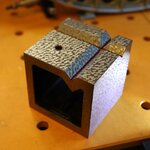
Last night I couldn't sleep, and as I often do in the stillness of night, I mulled over items on my internal 'ponder list.' Problems I haven't solved, questions I haven't answered. One of the things that has been troubling me was how to properly use the optical square to measure perpendicularity. The square itself is a pentaprism mounted in a cast iron block, carefully machined on all sides for accuracy. The issue I was having was, even assuming the sides of the block were perfectly square to the prism surfaces, how does that really help when there are so many other unknown variables?

This is the image from the AC manual*, and perhaps you can see what was confusing me. The optical square is kind of floating in space and the mirror and AC placement seems to be doing a lot of work, despite us not knowing how square to the measured surfaces any of this really is. Normally this sort of planar measurement is all relative to the arbitrary starting point. We place the mirror sled at one end of the span we want to measure, then true up the crosshairs to some initial 'zero' position, then move it in sled length intervals and record how many arcseconds it deflects for each interval. This doesn't require the mirror to be precisely 90° to its sled base, because we are just measuring the relative changes of angle, and the relationship between the mirror and base is fixed, so just being close to 90° is fine, any error is applied equally to all measurements and is invisible. When we measure the
B1 surface, more often than not the AC isn't perfectly parallel as our first reading where we set the zero is unlikely to be parallel, and this too isn't an issue as this error is linear and part of the calculations we do at the end is to remove that baseline error.
So for example, when I measured the straight edge, the closest end was set to 'zero' and by the time I reached the far end, the cumulative rise over the 1 meter length was 95.4 microns (see the chart in
this post), this was due to that first mirror placement where we set the zero actually sloping downward relative to the mean centerline of the straight edge so our initial angle was not parallel to the true plane of the full surface. Creating an ideal plane that goes through the average of the measurements and indicating the deviations from that plane is how a surface is properly mapped. But how does that translate to measuring a perpendicular plane? It gets a lot harder... some of the starting assumptions:
- We don't know if the mirror is a perfect 90° to the sled base, but that doesn't normally affect us as the errors are the same in all measurements and zero out.
- We know that the AC is unlikely to be parallel to the surface being measured, it also is generally not an issue as it can be averaged out.
- Reorienting the sled to a perpendicular angle and measuring it through a pentaprism seemingly untethered in space seems like it shouldn't work and melts my brain.
Before I obtained the Pentaprism, I had given a great deal of thought as to how I would solve this issue with the tools I had at hand, and this was also the source of a lot of why I was having so much trouble conceptualizing the solution. What I planned to do was use my granite reference square and a pair of mirrors, one fixed and the other gimbaled. After establishing the fixed mirror's zero point on the surface plate, it would be (precariously) relocated to the top of the granite square facing down and the gimbaled mirror would be positioned at the base and then dialed in until the reflection of the fixed mirror was reestablished at the zero point. This would establish the gimbaled mirror at a near perfect 45° angle. As long as the gimbal angle wasn't disturbed this would give me accuracy roughly as good as the square being used, good enough for my purposes anyway.
But this was where I was getting confused with the usage of the prism, because any change of the angle of the mirror to its base, or placing the base itself on a surface that isn't parallel is going to be reflected (no pun intended) in an angular change on the AC. Even though we have a mirror that is at 45° and could theoretically allow us to measure squareness, placing it on an uneven surface will introduce catastrophic error, the placement
requires the machine be true on the
B1 surface directly below the
B2 for it to work properly. So Nikon showing the prism floating out in space, untethered to either plane, felt very hand wavy and frustrating. Surely the prism had to be aligned to something, what was the procedure to get it referenced?
But my mental model was
all wrong! The mirror solution I had been conceptualizing required very critical placement and pre-calibration of the 45° turning mirror, and just substituting the prism caused me to overlook the fact that the prism doesn't reflect light like the mirror, it refracts it. The machined surfaces are not critical for orientation and don't actually need to be referenced because the light coming out of the prism was
always going to be 90° to the incoming light, even if the facets or external surfaces of the prism weren't perfectly perpendicular to the surface being measured!
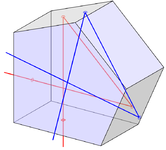
The Wikipedia
entry for a pentaprism based optical square shows an idealized path in
red, where the light enters perpendicular to the prism face, which is a totally accurate representation but buries the lede. The
blue path I added is
also correct, and most importantly it shows how the prism preserves the angular relationship of the incoming and outgoing light. What that means is, it doesn't really matter if the prism is sitting perfectly square to the
B1 or
B2 surfaces, the light entering and exiting are always precisely 90° to each other even if the prism isn't perfectly aligned. Well, as precisely as the prism was manufactured to be anyway, and according to Nikon that's two arcseconds or less.
So that simplifies things a great deal, the reason they were showing it floating out in space is because it may as well be doing so, but we're not out of the woods yet. We can use the mirror sled to map a surface
B1 but there is likely to be some parallelism error of our initial zero point due to wear or just baseline error. Again, it is easy to compensate for this if we were just measuring the surface flatness of the entire
B1 surface, but once we start taking measurements of the
B2 surface we will need to adjust those measurements relative to the compensated
B1 surface. We could avoid this error by either using a known flat surface for
B1, like if instead of being a machine ways it was actually a calibrated surface plate or straight edge that we know is parallel to the surface in question, then when we zero we know the mirror base is parallel and our readings will be relative. But in the real world we have some well used machine that we need to get as square as we can, so were going to have to compensate for a lot of error.
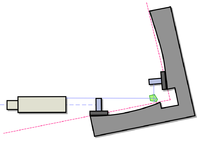
This exaggerated image is from the perspective of the AC's initial 'zero' position on a well worn machine (similar hollow profile to the straight edge I measure in the previous post.) As we make a sequence of measurements to the base, the mirror appears to climb up a hill as if the machine is tilted, but it's all just perspective and due to the initial zero point not being parallel to the average (or ideal) level. I show the prism at a random angle to the AC and the machine, and the important point is that it's always going to be redirecting the AC's view by 90° so the key to here is to get the AC aligned to the machine bed first or to properly characterize the slope and compensate for it with the second set of measurements on the perpendicular surfaces.
At least I know what to do now, one less thing on the list.
*I must admit that next to the figure in the manual is the text, "Penta-prism refracts the light exactly perpendicular. Angle of the incident light ot the incident surface of this prism does not affect the angle of the light refracted by this prism." Which is a complicated way of saying that the prism body doesn't need to be square, but it just didn't click for me at all. 


 ) disparity between it and the 500mm unit, it seems obvious to me now, but I would have sworn to you it was 750mm if I hadn't read the old post, despite the fact that just thinking about it, it is clearly bigger than 750mm. Crazy. Well, I need to pull it out and measure it's flatness now...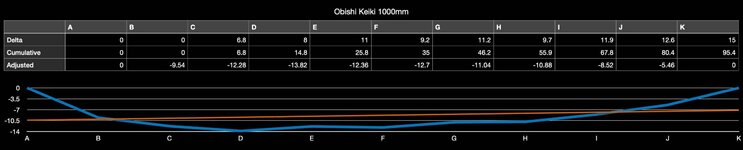




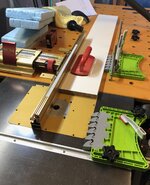


 I was trying to evaluate it as a set, and the short offsets seemed restrictive, but now I'm almost convinced that just flipping the work is safe. (I really drummed into my head the single reference because of my fear the my custom rail holes might not be perfect.) One of the things I have that is commercially available is the Festool Parallel Guide Set (203160) which I did test and seemed to solve the issue with some additional setup and fiddling. But I had my own custom, 300mm length parallel stops from my homemade system, and they are what I ultimately used.