I picked up a couple of used Mitutoyo digital readouts cheaply that I'm hoping are a good fit for my little Proxxon FF230 micro-mill, and so I pulled it out to start figuring out how to fit them, and one thing lead to another... I picked this mill up from a guy returning back to the US. We call it a "Sayonara Sale" when people return back to the US and unload all the junk they bought here that isn't worth the high cost of shipping back, and usually there is nothing but cheap housewares. But he was selling a Miller TIG welder, unobtanium over here, and when I went to pick that up I saw this tiny mill and a little lathe and bought both of them too. He hadn't advertised them, both were in need of repair, and I got the feeling he wanted to get them working better so he could charge more than I was offering, but his wife gave him a look and he relented. They were my first metal working machines over here and I did my best to clean them up and get them working again.
The mill was suffering from the quill return spring not properly engaged, and the Saddle and Table were both very inconsistent in travel and would stick or become very loose over their range of motion. Lots of sloppy backlash from the lead screws as well. I cleaned it, oiled it, adjusted the ways as best I could, and repositioned the set screw for the quill spring which made the unit functional again, but I knew I'd need to do more work to get it back to fully working condition.
That was like 6 years ago, so I guess it was time to really look critically at the machine. The #1 issue for me has been the gibs just never could be adjusted well, I was constantly having to adjust them, even during cuts to get them to slide but not to have excessive slop. It was unusable at the ends of travel, you basically had a small sweet spot in the middle that kind of worked. I tried to only move in one axis at a time, locking the other two to prevent any unwanted movement, and the locks doubled as one of the gib adjustments so locking it meant blowing up any of the finicky adjustments that were made before. It was a real pain in the ***, and it lead to me not using the machine as much as I would have wanted to.
Disassembling it once again, and looking at it with far more experience and knowledge than I had when I first opened it up several years back, it was clear that the gibs (small strips of metal used to adjust the fit of a dovetail sliding joint) looked home made out of mild steel. They were crudely built, and showed very small contact patches of wear at the edges, which explained why they were so inconsistent it their movement. They were also way too thin and narrow, so they were only supported by the set screws on one side and the sliding surface on the other, with no other faces helping with registration. Total garbage.
The good thing was that the factory machined surfaces seemed intact and showed little wear. I used one of my smaller hand scrapers and some bench stones and carefully matched the factory surfaces of the two dovetail slides, just knocking down the worst of the high points to help improve the feel. Then I ordered some 3mm brass stock to make some new gibs. The main complication being the chicken and egg situation where I need the gibs to work so I can use the table to make the new gibs... The only solution to that was that they had to be made by hand.
Brass is actually a really nice material to work with. If you've ever enjoyed
Clickspring's YouTube channel, you can see how wonderful it can be manipulated. For my needs it is a decent material for gibs as it is softer than the cast iron so it reduces wear, and it is naturally pretty low friction. Bronze is harder and stiffer, making it better suited for this purpose, cast iron is another great material, but both are more difficult to find in the appropriate basic size, and harder to work by hand. I figured I would start with Brass and hopefully make something good enough to use to make the more difficult materials if needed.
The stock I got was oversized, 15mm x 3mm and the first thing I needed to do is cut it to length. Some time ago I saw that knifemakers have a tool called a "filing guide" which is a little clamp that sandwitches the part between two parallel straight edges that are made from Carbide. This Carbide surface is too hard for a steel file to cut, so it allows you to file the workpiece down to the point where you clamped, giving you a precision edge with simple hand tools. I haven't built one of these (yet!) but I did buy a bunch of surplus square Carbide inserts very cheaply. These big flat, perfectly square chunks of Carbide are not commonly used anymore, so they are sold very cheaply, I got 20 of them for about $10, but they are super useful for all sorts of things. Getting to my point, I clamped one, aligning the edge to the scribe line of the brass stock and used it as a guide for my hacksaw to quickly cut clean and accurate lengths.
A high quality "Engineering" hand file is surprisingly flat, but using it to establish an angle, especially along a long edge of a piece of metal, requires a lot of skill and experience. As you should well know by now, I like to substitute hackery for this kind of craftsmanship whenever possible. No disrespect for the guys who spent 40 years perfecting their techniques, but I am going to hit the easy button if I can. Entering from stage left, one of my recent acquisitions, a Magnetic Chuck. These big lumps of metal have the cool ability to turn on and of their strong magnetic fields, and are primarily intended for surface grinders and other machines that need as unfettered access to ferrous parts, they hold firmly without getting in the way. I picked this up to ease my ability to hold small parts (like the mill's Saddle and Table) for scraping, it's really easy to reposition and remove them, something that is constantly required. But it also worked great to hold these files in place so that the part itself can be manipulated, making it much easier to establish the bevels and flatten the faces. It is a lot easier keeping a small part flat and properly registered to a big file, than vise versa. This only makes sense for soft non-magnetic materials like brass or aluminum, but it sure helped me keep everything true.
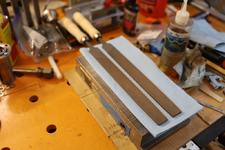
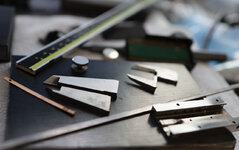
The Proxxon uses a simple gib design, which is supposed to be shaped like a parallelogram in cross section. Larger machines often use "tapered" gibs, which add a taper to the entire length that matches the taper machined into the backside of the sliding dovetail, that allows a single adjustment to loosen or tighten the gib. This helps to simplify the adjustment as the gib wears, but makes all the parts more complex due to all the compound angles involved. Fortunately I didn't need to deal with that complexity, but I still had to hand file 60 degree angles on the top and bottom, and get the heights dialed in. You can see the crappy steel ones incorrect shape next to the Brass parts I made in comparison.
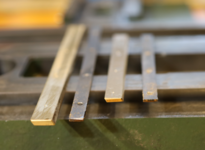
One unexpected surprise was that the gibs were actually very different dimensions. The garbage that was there before were both made from the same piece of steel, so I had assumed they would just be different lengths of the same cross section, but the smaller gib was 0.5mm thinner and 2mm shorter than the other one, requiring a lot of time getting it filed down to the right thickness. I have to say, fitting them in place for the first time, even without the adjustment screws in place, it really impressed me with how well this little machine could slide with properly fitted parts. It made such a big difference, it is just rock solid and smooth across the entire range and adjusting it is easy now.
With that out of the way, I moved to the next thing on my list which was the gib locks. As I said before, the design used one of the adjustment screws to also act as a lock. This meant that any setting for it was lost as soon as you used it, that it could potentially drift since it wasn't fitted with a lock nut, and it required a Hex wrench (of a different size to the adjustment grub screws) to manipulate it. The obvious solution was to drill an additional hole for a dedicated lock, and use one of the adjustable lever type screws so it could be locked by hand.

One of the things that always pokes at my OCD is measuring the distance between holes. It is something that I do a lot of, and there are some tricks that you can do, measuring to the outside of the holes and subtracting the width of the hole, and so forth, but it always feels inaccurate. Trying to line up the calipers with the imaginary center or edge of a small hole, when they are at some odd angle where it is hard to see straight on, it just drives me up the wall. It is especially frustrating when I get a measurement that isn't a clean distance, was it manufactured poorly, or am I measuring wrong? I ended up getting a special caliper that is made with conical tips that automatically find the center, and an adjustable jaw in case they are different diameters or on a different plane. Game changing! Now I could lay out the new holes for the gib locks and be sure they were well centered and looked good.
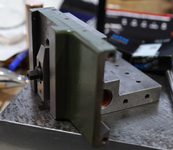
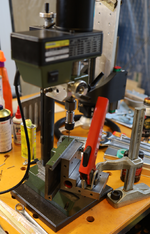
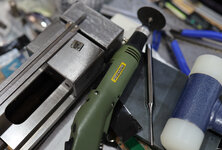
In order to drill the holes, I could do some 'self surgery' where the Proxxon could machine its own parts. I fixtured the saddle to my JAM angle plate and clamped the whole thing in place. One of the issues with the Proxxon is I got it with only one of the proprietary collets that it came with originally. They only make 3 sizes, and fortunately I had the most useful 10mm and a matching drill chuck, but the other ones were quite expensive to replace so I had instead made my own adaptors to use ER11 and ER16 style collets. I rarely used the chuck because it seemed to have a lot of runout (wobble where the drill bit it is holding doesn't rotate straight along its axis.) But I had noticed that the ER adaptors I made seemed to be bad as well, which I at first attributed to their cheap origins, but after carefully measuring them in isolation, I started to suspect the Proxxon's spindle itself. So before I drilled these new holes I did a runout measurement and found that the issue was as I had feared, the spindle was over 0.15mm of runout. I drilled the holes I needed undersized, and hand reamed them to size before tapping them, but after installing the two orange locks successfully I would need to tear into the heart of the machine.

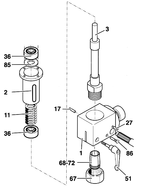
The spindle cartridge is a pretty simple affair, an outer tube (
#2) that supports two deep groove ball bearings (
#36, real precision spindles use angular contact ball bearings, often in multiple sets, but it requires a more complex design in order to control the preload they require and I don't object to the simple design they used here given the intended use.) The Spindle itself (
#3) runs through the two bearings, and is threaded at the top to allow a multi-groove belt pulley (not shown) to screw on, clamping the spindle between the bearings. Inside that tube, a large spring (
#11) surrounds the spindle, and is engaged by two screws (
#17,
#86) that poke through two slots (
#2), which create the return force, so the spindle cartridge can act like the quill of a drill press, and automatically return to the top when the precision height adjustment (not shown, an optional part that covers screw #17) and quill lock (
#51) are disengaged.
This return spring was one of the original issues the machine was suffering from when I originally got it. I had discovered that the two screws were somehow engaged at the middle of the spring instead of the bottom, limiting the quill travel and making strange springy sounds when moved. I was able to quickly fix it and it gave me no trouble at all since that time. But when I disassembled the spindle for inspection I saw some really bad damage. This is after I filed all the big gall marks, keep in mind this is a hardened steel shaft.

The guy I bought it from said he got it from his job because it was broken, I had assumed he meant the quill spring issue, and later suspected his company had junked it because the gibs didn't work, but now I saw evidence of some serious 800lbs Gorilla action. The
#17 screw that engages the quill return spring, is a set screw to provide clearance so it can fit under the optional precision down feed, which hides it. There is nothing limiting its depth, and what had apparently happened is that the screw had either worked its way further into the spindle, or someone not understanding its purpose had over tightened it, and it had come into contact with the inner spindle shaft itself. This is not a super powerful machine, and even minimal contact would have brought the machine to a stop. So the only thing that could have torn out the big chunks I found was that someone had proceeded to 'free' it by brute force, rotating the spindle with a wrench until the screw carved enough of a groove in the shaft to free it up. This seems to have happened several times, as the depth of this groove is quite significant, and the multiple tracks showed a couple such events. The torque required to free it in this way, likely caused the spindle to bend or twist, causing the excessive runout I was seeing. The bearings were of course shot as well, but replacing them had little effect on the wobble.
One of the good things about the Proxxon brand is that they do have parts available, even for older machines like this one. But the proprietary collet is a real limitation, there is already limited Z height and having to put another chuck in only compounds the issue, so my decision is to replace the spindle with an ER16 chuck. The threads for the pulley are an unusual fine pitch M10x1.0 but I already have a die for that. I was able to order a 12mm hardened steel shaft that is custom configured with the correct overall length, 10mm shoulder area where I can thread it and machined flats on the other side for the collet's set screws. All for about $20 delivered which is very cool. I already had the ER16 collet chuck that fits a 12mm shank, so I will thread the new spindle and permanently mount the chuck to it with retaining compound when it arrives. Even though they are deep groove bearings, I paid a little extra to get high precision P5 rated ones, as every little bit helps.
More to come...







 I also started computers with the Apple II, I just wasn't into drafting at that stage. I did do a lot of 16 color graphics on it, it's hard for me to imagine it being a very satisfying CAD experience.
  My first Mac 128, bought as soon as they became available, completely solidified my love of computers. It's unfortunate my impostor syndrome delayed my career in IT until much later in life... hindsight, but I still got in early enough that it all worked out well.











 JUNK
JUNK and the photos showed it stuck in an obvious error mode, but this machine just needed a lot of cleaning and someone who could read the manual. The error code it was throwing was because it was in the default mode that required a PT100 thermal probe to be plugged in, changing the mode by holding down the button in the knob (which was loose and needed to be remounted to actually depress properly) when powering up allowed it to use the sensor built into the heat plate. Here it is happily vortexing some warm water it had heated.
 ! So I can use it for more than just heating liquids, it should make a great circuit board SMD soldering plate as well. I have a total of $70 invested in it including the probe, and it is being sold new for about $1000.