To avoid these ads, REGISTER NOW!

Below 265 SQ/FT Tiny Tokyo Shop

All workspaces below 265 squarefeet.

Half-fast eddie

Well-known member
Joined
Jul 10, 2021
Messages
1,479
Location
Virginia
An on-line forum title “Practical Machinist” … sounds like an oxymoron.

Reading about all the tools you are collecting, i’m thinking ahead 30-ish years to when you go to the big machine shop in the sky … wondering who will have the unenviable task of selling off your cache and will it go to someone who can appreciate it.
 
To avoid these ads, REGISTER NOW!
OP
B

Bakafish

Well-known member
Joined
Feb 7, 2017
Messages
477
Location
Tokyo
An on-line forum title “Practical Machinist” … sounds like an oxymoron.

I originally went there to get some advice on starting scraping, as the most famous guy (I won't mention his name) is a regular over there. I asked what I thought were some straightforward questions that were as far as I could tell undocumented anywhere, and he proceeded to accuse me of being someone else and blocked me after some kind of unhinged ranting. I honestly think he didn't know the answer and was unwilling to admit that, but who knows? Looking back through his self aggrandizing posts I figured I was better off without his disjointed and cryptic advice, and just started reading the old Connelly tome "Machine Reconditioning and Hand Scraping" dedicated to machine restoration that covers scraping pretty well. We'll see if I'm any good at it soon enough.

Reading about all the tools you are collecting, i’m thinking ahead 30-ish years to when you go to the big machine shop in the sky … wondering who will have the unenviable task of selling off your cache and will it go to someone who can appreciate it.
30 more years would be nice, I'd settle for 15! :cool: Sadly I don't have anyone (yet) to hand it down to on this side of the world. I am waiting for an affordable marking laser (I hate stickers, but maybe they are a better choice) so I can put tiny QR codes on everything that are linked to a database of descriptions and rough prices for my wife, so she at least has the info to sell it (although I bet she just dumps it somewhere, not that I will care at that point!) Even if I had a Kohei, the sheer volume of what I have would overwhelm the average Japanese living space by a lot. If I actually figure out a business model, maybe it could be sold off or handed over to employees to manage. It's a conundrum, but it will work itself out somehow. A lot of my most treasured items came to me by way of fate, I suspect they will find someone who loves them after I am gone.
 

ilya

Well-known member
Joined
Jul 9, 2008
Messages
108
Location
Santa Monica, CA
Just got back from the Mitutoyo museum virtual tour. It's done so well, I was kind of expecting to be able to click the green button on the model railroad and see the train go. I love the wealth of cultural and technical knowledge and details shared in this thread!
 
OP
B

Bakafish

Well-known member
Joined
Feb 7, 2017
Messages
477
Location
Tokyo
Just got back from the Mitutoyo museum virtual tour. It's done so well, I was kind of expecting to be able to click the green button on the model railroad and see the train go. I love the wealth of cultural and technical knowledge and details shared in this thread!

Yeah, the VR is really well done and the resolution is high enough that most of the display cards can be read. There's a lot more than just Mitutoyo loveliness to see, Switzerland and Germany are well represented and it's worth one's time if they are into old machines. It is located in Kawasaki, a short train trip from Tokyo if you ever visit. Direct links for others below:

Mitutoyo Measurement Museum Numata Memorial Hall
Mitutoyo Measurement Museum Measuring Equipment Museum

I picked up a used pair of these Bessey BAS C10-6, I guess you'd call them finger clamps, and one of them was missing the little cast aluminum foot.

finger_clamp.jpeg

The foot is gently retained by a pair of springed ball bearings, once any pressure is exerted by the clamp it is transmitted directly from the tip of the finger arm through a matching recess in the foot. So the balls are just there as a pivot and retainer, they don't hold on very tightly and these feet likely are lost within a few days of usage at a busy shop. So they sell replacement feet in 4 packs... for about $30... in Germany... Again a situation where they are unobtanium locally and even sourcing them from the US seemed problematic, very few sellers and more expensive than from Europe.

pad_render.png

This is where my 3D printer once again heroically steps up. It is really fun for me to reverse pattern a part in Fusion 360, I have a set of Starrett curve gauges (that look like little stainless steel duckies) and they let me easily grab all the edge radii and other features. I printed them with 100% infill, the Carbon fiber filled PLA works really well in compression and for my needs is actually a bit better than the Aluminum as it is less likely to mar the softer materials I tend to work with. They printed well and popped right on, swiveling freely and seating under pressure just like the factory part, maybe better.

As with anything I model, files available on request.
 

RickP

Well-known member
Joined
Jan 15, 2013
Messages
1,547
Location
Annapolis, MD
I discovered your thread recently (from a comment by @zanyad on @GeddyT's thread), and I've just caught up to present day. You have a great writing style -- very entertaining! I'm looking forward to seeing the finished CNC and mag drill.

Summer heat is here, but I've been trying to get off my *** and do some of the long abandoned tasks that have been piling up. Our second story balcony floor was painted at some point with a thick rubberized coating that I think was applied incorrectly as it had massive bubbles everywhere and was very unpleasant looking or to walk on. Last year my wife and I spent a day getting half of it stripped off, but it was such a tedious job (a heat gun and scraper to get the main layer off, then scrubbing with IPA to get the slimy uncured under layer) I gave up before finishing. Removing it exposed a sturdy hand laid fiberglass pan, and once I knew that the water wasn't penetrating it went much lower on the priority list. But it still needed to be done, so I contorted my old limbs and proceeded to slowly get it all stripped.
I feel your pain on painted fiberglass decks! I have three of them on the upper floor of my house, and I've spent far too much time stripping and refinishing them. My 50+ year old knees were not happy with how long it took, and doing the work in full sunlight is like staring at the sun... If you'd like to hear what worked (and what was a disaster), I'd be happy to share (maybe offline to avoid veering even further away from your shop thread?). I'm reviewing final details now for new surface-mount railings, and something like that might work for you.

Share away. You're not going to upset anyone here by oversharing your journey into madness. 😉
+1 ^^^ (and if this is a journey into madness, I'm happy to don a straight jacket and join the trip)
 
Last edited:

bdbecker

ALLIANCE MEMBER
Joined
Nov 18, 2015
Messages
5,542
Location
Iowa
I asked what I thought were some straightforward questions that were as far as I could tell undocumented anywhere, and he proceeded to accuse me of being someone else and blocked me after some kind of unhinged ranting. I honestly think he didn't know the answer and was unwilling to admit that, but who knows?

I'm sure you know this already, but take solace in the fact that you are not the only one who has had an experience like that on PM. I don't have an account there, but lurk from time to time to see what I can learn. A good percentage of threads seem to devolve into digital ******* matches where one person can't admit they might not be completely correct about a topic. Out of curiosity, I tracked down your scraping thread and see that the mods are starting to crack down on this and removing those types of posts from threads. Good for them. They needed to do something because a few years ago, it was getting pretty rough, especially on the new guys who were innocently looking to learn.
 
OP
B

Bakafish

Well-known member
Joined
Feb 7, 2017
Messages
477
Location
Tokyo
I'm reviewing final details now for new surface-mount railings, and something like that might work for you.
I need to add railings to the 3rd floor patio and a small 4th floor observation deck, and have limited solutions for doing so. There is actually a 200mm stub wall capped by extruded Aluminum flashings, I need to do some probing to see if directly tieing into them and reflashing or modding the existing stuff is worth the risk, but my first choice is building a large frame out of steel to support a deck and have stanchions directly bolted to that. Seeing how you solve it may open up some possibilities.

As for the storage cabinet, I bought a bunch of 70mm diameter by 4mm thick Stainless steel plate laser cut offs very cheaply. I recently picked up a real Mag-Drill, an Alta Ace FA-35, it was missing the coolant tank (cheaply and easily replaced with factory parts) and the power feed circuitry needs some love, but the manual feed is still a-okay and the price was great. Fixturing with Mag-drills when you aren't drilling the same surface you are stuck to leaves a lot to be desired though. I managed to use some steel plate and a Bessey clamp to pin the puppies down.

anchors2.jpeganchors.jpeg

The 18mm broach made quick work of the plates though, cut like butter, and I managed to keep the water soluble oil coolant from getting everywhere with some pig matting. It was the first time using the drill in anger, and it was mostly uneventful, but the controller board has me worried. I will need to do a cap replacement on it and hope that's all that is wrong. Although the drill was barely used, it is still about 20 years old, and while the board looked very clean, it is clear that something is wrong with all the current sensing motor interlock logic, hence no power feed. I think it is designed to do the whole feed and return automatically, really a fantastic unit that I want to restore to full operation.

And as much as I appreciate the superior qualities of stainless steel, the stuff is a bear to work with. It work hardens really easily, and this is the non-magnetic flavor, so cleaning up all the swarf without the help of my cleaning magnets is a super big pain. At least with Aluminum the metal shavings don't immediately penetrate to bone when you step on them. These plates still needed to be countersunk to allow the bolts to fit flush, the mag drill is ill equipped to do that operation, so the Franken-Drill was put into action. In fact I actually have a morse adaptor that lets me use the mag-drill broaches with this drill (or with my lathe tailstock) but I wanted to check on the mag drill's manual mode, hence the two different operations.

frankendrill.jpeganchors3.jpeg

The Franken-drill has continued to be modified, I replaced the large handle with a 3D printed switch box that incorporates an industrial [momentary-off-on] switch, a quick disconnect power cord and a sturdy power relay. I rewired the drill's universal motor so it can now reverse (useful for power threading with the Morse Taper threading attachment I have) and the removable power cord helps ease spinning the heavy lump onto the threads of the pipe fitting mount. I reengineered that part as well, using a simpler design to bring the drill body closer to the backing plate and allow for more positions.

You may also notice it is mounted to a Proxxon XY table and stand, I picked those up for a song from someone who bought but never used them. The idea behind the Franken-drill has always been modularity, I can in theory configure it in a lot of different ways. Time will tell if this is as handy as it sounded in my head. The Mag-vise plopped up there adds a lot of mass to the little JAM vise I used to hold the disks in place for the countersinking, keeping the whole thing from dervishing about under the load of the Ilix countersink. There was a lot of smoke and drama, but the countersinks got sunk.

Anyway, the end result is a pair of sturdy anti-corrosive disks to give some surface area for the flush mounted M12 bolts that I will JB Weld to the fiberglass pan.

anchors4.jpeg

I'm hoping it will be enough (along with the toggle bolts connecting to the wall behind it that I fitted at the top of the unit) to keep it in place when Typhoon season comes. I expect it will have several hundred pounds of tools in it, but I can still picture it sliding around if I don't get this right. I expect the Stainless hardware to arrive today (along with an unrelated bargain I will show later), I should have the cabinet fully anchored and filled with tool clutter by the end of the week! Then having shaved every last Yak in all of Japan, I hope to get back to finishing the pantry.
 
Last edited:
OP
B

Bakafish

Well-known member
Joined
Feb 7, 2017
Messages
477
Location
Tokyo
I'm sure you know this already, but take solace in the fact that you are not the only one who has had an experience like that on PM. I don't have an account there, but lurk from time to time to see what I can learn. A good percentage of threads seem to devolve into digital ******* matches where one person can't admit they might not be completely correct about a topic. Out of curiosity, I tracked down your scraping thread and see that the mods are starting to crack down on this and removing those types of posts from threads. Good for them. They needed to do something because a few years ago, it was getting pretty rough, especially on the new guys who were innocently looking to learn.
The thing is, it's not like I'm new to this game. It's just the support and comradery of GJ lulled me into thinking I could proactively manage any of the hostility. I was ill prepared. It wasn't the scraping thread that went off the rails, it was the thread I created to keep the scraping thread on-topic that brought out my snark monster and some flame warrioring that returned from my early days on the front lines of the merciless Macintosh wars of the late 80's.
 

bdbecker

ALLIANCE MEMBER
Joined
Nov 18, 2015
Messages
5,542
Location
Iowa
The thing is, it's not like I'm new to this game. It's just the support and comradery of GJ lulled me into thinking I could proactively manage any of the hostility. I was ill prepared. It wasn't the scraping thread that went off the rails, it was the thread I created to keep the scraping thread on-topic that brought out my snark monster and some flame warrioring that returned from my early days on the front lines of the merciless Macintosh wars of the late 80's.

Out of curiosity, I had to track that thread down as well... pretty spicy! Definitely brought out a side of you that we haven't seen on GJ. (In case anyone is wondering, Bakafish can throw down when pushed.) That thread epitomizes why I will never participate on that forum.

One thought that occurred to me while reading through the thread, it would be kind of funny to make a Bayesian network art piece based on the posts/feedback. Start with wanting to build a small format CNC machine and the only logical conclusion is to move out of Japan.
 
OP
B

Bakafish

Well-known member
Joined
Feb 7, 2017
Messages
477
Location
Tokyo
Out of curiosity, I had to track that thread down as well... pretty spicy! Definitely brought out a side of you that we haven't seen on GJ. (In case anyone is wondering, Bakafish can throw down when pushed.) That thread epitomizes why I will never participate on that forum.

One thought that occurred to me while reading through the thread, it would be kind of funny to make a Bayesian network art piece based on the posts/feedback. Start with wanting to build a small format CNC machine and the only logical conclusion is to move out of Japan.
I think it is really hard to internalize the constraints of living over here unless you actually have a chance to do it. A Lot of it is subtle and defies logical explanation, but I got pretty fed up with getting mansplained about things in the place I live by people who have likely never even crossed the date line. I certainly lived in a bubble for a long time in the US, and it was easy to just assume that things work the same, just with a different language in other first world countries.

Anyway, the fact that community can be so toxic is sad, as there are some really knowledgeable people about the specifics of the field. I did get some advice that reenforced some of the concerns I had and helped push me in a better direction for some of the structural components. I'll detail it more as I start cutting stuff up.

I picked up my Nakanishi secondary high speed (50k rpm) spindle a week ago, it will be pressed into service first in order to make the final high strength parts to mount the relatively massive main spindle.

HES510.jpeg
 
OP
B

Bakafish

Well-known member
Joined
Feb 7, 2017
Messages
477
Location
Tokyo
So the reason I pathologically refresh a gaggle of custom search queries every five minutes on my domestic used market websites is with some frequency I am rewarded with finds like this.

sys32.jpeg

My gentle readers may recall that I spent a good deal of effort to attempt to replicate the functionality of the Festool SYS-LR32 you see above. I was mostly satisfied with my home built solution, but there were fiddly aspects that I wondered if the official solution was more adept at addressing, and really wanted to do a comparison. When this appeared out of the blue for ~$200 I literally clicked buy before all the pictures on the for sale page had loaded. I've seen empty Systainer boxes sell for more than that :)

I will need to mod it to accept my Ryobi router (now marketed here as Kyocera with a deep red color scheme, a JDM only line of power tools I went into some depth about as they sold the Ryobi name to the Chinese a few years back.) As Festool stuff is all 8mm shank, I may have to use one of the big Makita's. I have an 8mm collet for the Ryobi, but it is aftermarket and due to the narrow spindle of the trim router there is not a lot of surface contact, so I fear it may not grip well. Especially with the big 35mm hidden hinge boring bit.

I also need to precision machine the required indexing holes in one of my rails, and that will be a fraught task to get perfect. Festool doesn't actually sell this product here, they don't even sell their track saws, routers or Kapex, so the special drilled rails are not available (they would likely cost crazy money if they were.) Fortunately the Makita rails are cheap, readily available and good, and if I screw one up it won't be the end of the world.
 

LeonardY

Well-known member
Joined
Apr 16, 2011
Messages
5,020
Location
Southern California
I think it is really hard to internalize the constraints of living over here unless you actually have a chance to do it. A Lot of it is subtle and defies logical explanation, but I got pretty fed up with getting mansplained about things in the place I live by people who have likely never even crossed the date line.
I've tried to explain to close friends and even family (If you haven't guessed, I'm of Asian descent.) what it's like to live in a foreign country. While I had been indoctrinated in the culture, I didn't know how things worked there. My father gave me me the best advice, "There is a reason why we live on this side of the world. You'll find out soon enough. You'll be a guest there. Even if you don't look like it."
When I returned back to the US, I found that the best explanation of the living in Japan was, "It's just different."
I said the same when I returned from living in Paris too.
It's cool that you are living there now. There are a lot of things that I miss. Seeing what your going through to do you hobby reminds me that I need to appreciate my situation. I will admit, I'm a little jealous of your finds there.
Keep up the sharing!
 

RickP

Well-known member
Joined
Jan 15, 2013
Messages
1,547
Location
Annapolis, MD
So the reason I pathologically refresh a gaggle of custom search queries every five minutes on my domestic used market websites is with some frequency I am rewarded with finds like this.

sys32.jpeg
Score! That Festool bling looks so nice -- it may not have lasted much more than 5 minutes before somebody else snagged it.

I cannot imagine how you're going to handle the tolerances needed for that 50k rpm spindle. But I'm looking forward to seeing how you conquer it.
 
OP
B

Bakafish

Well-known member
Joined
Feb 7, 2017
Messages
477
Location
Tokyo
I cannot imagine how you're going to handle the tolerances needed for that 50k rpm spindle. But I'm looking forward to seeing how you conquer it.
Yeah, it will be a challenge. As I said before I'm trying to use as much surplus and used parts as possible, and that NSK spindle is designed to be used as a retrofit tool to allow an existing machine spindle to run high speed tooling. So they make that unit in a wide assortment of machine arbor types. This showed up on the auction site as 'likely new' at a deep discount, and sure seems to be unused. I have been waiting for a more conventional NSK spindle, but I didn't want to pass up such a nice unit. They were offering both an HSK-A63 type and a much larger bodied, but same motor BT-50 compatible unit. I opted for the more modern and compact HSK type with the intention of making a suitable fixed HSK mount for it to socket into. I have to admit that's pretty ambitious given the tools I have on hand and the precision required to do it right. I have some ideas how to do it, but it is likely I will need to remake it several times in progressively stronger and more precisely as I get the machine capable of rebuilding itself. HSK taper (a German open standard) isn't very common over here (or at least there isn't the same variety of used tooling available), but if I ever obtain to a new machine the chances are high that I can order it with an HSK spindle and this Nakanishi will be useful for that too.

On the Festool front, the Ryobi/Kyocera router would have required me to modify the collet nut as well, as it only has a 7mm bore there. I figured that it just doesn't make sense to push my luck with kludging this, and just ordered a bare Makita RT51DZ which is the little 18v brushless trim router that is well regarded. I already have the plunge base for it, I have a simple removable adaptor sleeve that I use so the Ryobi could utilize it. The Makita has a full length 8mm collet, and I'll feel a lot better about using that with the Festool bits and centering mandrel. I have my own 5mm (6mm shank) bits and centering mandrel, so none of this is really required, I guess just an excuse to add to my router collection.

For the Rail, I actually found a company in Osaka that is Authorized to sell Japanese Festool but additionally imports locally unobtainable stuff from Germany. Their price on the 1400mm unit wasn't ridiculous, so given the cascade of things that need to be done before I drill my own rails I figured it was better to just get an official rail and kick that DIY project of making a second (or third) unit down the road. I need to be more pragmatic with my time, and the dependency chains really add up.
 

nicholam77

Well-known member
Joined
Dec 18, 2016
Messages
2,655
Location
Minneapolis, MN
Wow, that’s an amazing deal on the LR32! I was hoping for a deal like that, but as you probably remember I just bought the baseplate and end stops on their own. Looking forward to hearing your review. The front stops seem like the part with the most potential for error, but I don’t have those so can’t comment. Since you have an MFT, I’ve seen some clever setups using bench dogs etc to batch the rail position on a set of panels without having to put the stops and and off for each one.

I have to say I was really looking forward to see how you would put holes in a Makita rail! Something I wanted to do but didn’t have the skills or tools to do it well. So hopefully you still do that like you mentioned. But… I think buying the Festool rail is probably a good idea if it was an acceptable price. There are other things you can do with it besides shelf pins. I’m planning on using it next time I need an MFT top to drill the hole grid for example.
 
OP
B

Bakafish

Well-known member
Joined
Feb 7, 2017
Messages
477
Location
Tokyo
I have to say I was really looking forward to see how you would put holes in a Makita rail! Something I wanted to do but didn’t have the skills or tools to do it well. So hopefully you still do that like you mentioned.
I plan to, I'm not sure how easy my plan will be to replicate without some kind of precision drill press or milling machine though. I suspect I will need more precision and repeatability than a 3D printed jig would allow. But I will surely detail the process here.
 
OP
B

Bakafish

Well-known member
Joined
Feb 7, 2017
Messages
477
Location
Tokyo
After considering a lot of different 3D printed adapter plates, I opted for simplicity and just drilled a pair of 6mm holes (74mm center to center) in the Festool sliding plate to utilize the pair of M5 holes provided by the Makita plunge base.

LR32_holes.jpeg

The 8mm shafted centering mandrel was a really tight fit in the Makita's collet, I had to give it a bit of polish with emery cloth before it cooperated. Centering the router with the mandrel was effortless, just waiting on the rail now. My first usage of this setup won't be for shelf pins, it will be for the concealed cabinet hinges for the long suffering pantry doors, so that will be an adventure.
 

Trapps

ALLIANCE MEMBER
Joined
Feb 10, 2017
Messages
1,992
Location
The Detroit Zoo
Love this. I drilled holes, enlarged really, in my Bosch router adapter to fit a Porter Cable Router.

You could use the LR32 rail as an index to drill holes in a fresh new Makita rail....ahhh, wait.....what?
 

nicholam77

Well-known member
Joined
Dec 18, 2016
Messages
2,655
Location
Minneapolis, MN
@Bakafish I think drilling through the LR32 sled like you did is the best solution (instead of 3D printed adapter) since your router accommodated it. I couldn't get my full size DeWalt plunge base to fit, but the adapter does work just fine, just lose a small amount of plunge depth.

I'm using an Amana 1/2" --> 8mm collet reducer adapter and the Festool centering mandrel was extremely tight with that setup. So much that I didn't put it on all the way for fear it would get stuck. I saw someone on FOG make a 3D printed centering mandrel which might be a solution for me, or maybe I will give the polishing a try like you mentioned.

I don't have the 35mm hinge bit, but curious to see how that works out with your doors!

@Trapps making a DIY holey rail by using an official LR32 rail and sled has been done before... it still looked tricky to set up but I know I came across it once.
 
To avoid these ads, REGISTER NOW!
OP
B

Bakafish

Well-known member
Joined
Feb 7, 2017
Messages
477
Location
Tokyo
I'm using an Amana 1/2" --> 8mm collet reducer adapter and the Festool centering mandrel was extremely tight with that setup. So much that I didn't put it on all the way for fear it would get stuck. I saw someone on FOG make a 3D printed centering mandrel which might be a solution for me, or maybe I will give the polishing a try like you mentioned.
Yeah, I have a 3rd party cone style centering mandrels used for templating guides that work fine in this plate, I just wanted to use the factory part if possible. I measured the arbor and it was a few hundredths of a mm oversized, maybe not an issue with the Festool collets but needed touch up for the Makita.
I don't have the 35mm hinge bit, but curious to see how that works out with your doors!
It is very sharp, router speeds with such a big tool makes me nervous. I have the Kraig unit as a backup, I will test the Festool on some scrap first.
 
OP
B

Bakafish

Well-known member
Joined
Feb 7, 2017
Messages
477
Location
Tokyo
Well it was a bit of a 💩 show, but it is done. As I mentioned, I've been trying to finish a long abandoned home maintenance issue to reseal one of the outside verandas. Stripping and preparation was difficult as the elastomeric coating someone had previously applied had degraded and was blistered and gooey, and the area itself was narrow and exposed to the beating sun. There was a lot of material that needed to be removed from hard to access areas under the flashings and sliding glass door jams, so a lot of tedious cycles of scraping and scrubbing with IPA to get down to the crazed but still effective fiberglass underlayment.

Balcony_before.jpeg

I then filled the worst cracks and divots with polyester auto body filler, and did a quick sanding to take off the worst high spots and give it some tooth for the primer. The paint (and primer) I chose is a two part epoxy, but is highly water soluble during the application for easy cleanup. It is formulated for cement floors, so I was a little worried about adhesion, but the fiberglass surface was rough enough and with the matching primer applied first I hoped it would be a good long term solution. I am hoping to put an Ipe wood deck over it which will help preserve it even more, although it is intended for outdoor flat roofs and balconies, so it should hold up either way.

The clear primer applied quickly and easily and seemed to have a great bond and just the right amount of tackiness which encouraged me, so I decided to wake up very early the next day to put down the first coat of paint. I had checked the weather, and although we were in the middle of a heat wave, there were some signs that a summer storm might be brewing, so I wanted to get the first coat laid down over the primer and have time to cure before any rains came. So up at 5AM, had good light and a nice breeze and thankfully the sun wasn't beating down on me as it had been the last several days when I was cleaning the surface. The paint went down easily with a roller, self leveling into a shiny attractive finish. I jumped into the shower, as even that early the heat and humidity was getting oppressive and during that short time a freak thunderstorm apparently came out of nowhere and dumped on the fresh paint for no more than a minute or two and then was gone, leaving a soupy mess of paint and even worse the strong rain had splashed this paint all over everything. I had zero expectation of rain, so the two sliding glass doors were wide open and paint was all over the floor inside, covered the doors, covered the screens, the trim... it was just everywhere, and the sun was now beating down on it to dry everything in place.

You can hopefully forgive me for not documenting this disaster with some photos. So I broke into the Covid prepper paper towel reserves and started sopping up the mess. The paint, true to its claim was very water soluble, and quick action (although it covered me in paint) did allow me to get the majority of the paint off of the most critical areas. It was $50 of paint literally down the drain, but it seemed recoverable, if I had just been less of an early bird I would have avoided the only precipitation we saw for days. A few hours later, I noticed that the downspout had a previously unknown crack that made itself obvious by vomiting a giant estuary of paint on my driveway, advertising to all the neighbors what I had been dumping into our sewer system :cry:

This blood stain was quite dry by this point and my pressure washer had little effect, I had to go at it with a wire brush on an angle grinder to try and clean up the crime scene, only got about 90% of it off though. ****.

So I started watching the weather like a hawk, trying to calculate the safest windows for paint application, making sure that the cure and recoating times had enough buffer to complete if sudden summer storms materialized. During this time our first Typhoon blew through, but that gave me a good opportunity as clear weather follows for a few days and I could get my two coats down.

Balcony_after.jpeg
Happily it seems to be no worse for the weather, it has a glossy thick finish that does a good job of reflecting a lot of the heat off of it (the previous surface was a foot burner to be sure.) I don't know when I will start on the decking as it is low on the priority list, and I will want to do the 3rd floor patio at the same time, but having this done is a big relief just because I've had so little progress on anything else.
 
OP
B

Bakafish

Well-known member
Joined
Feb 7, 2017
Messages
477
Location
Tokyo
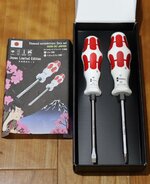
A wise choice, the Wera diamond drivers are nice and the tips grab really well.
Yeah, I have a set of the regular Blue Diamonds and really liked them, so when I saw these I had to get them. Keeping these that pretty white is going to be a struggle, but tools are for using...
 

gearhead1960

ALLIANCE MEMBER
Joined
Mar 21, 2019
Messages
1,792
Location
Manassas, VA, a small blot in history
I love how these Weras have the ability to use a combo wrench on them if you need more power/torque to the application. I have a set of snap-on drivers like that and it has come in handy more than a few times. Oh and I just noticed they are "limited editions".....exclusive tools for your use.....
 
OP
B

Bakafish

Well-known member
Joined
Feb 7, 2017
Messages
477
Location
Tokyo
3D Printer Content Warning!

tldr; The Creality Ender 3 S1 Pro has everything documented below, out of the box with zero effort. This is me being cheap and using the whole animal.

I've been pushing the limits of my original model Ender 3 for several years now, making basic modifications to keep it somewhat up to date, the most major changes being a Big Tree Tech SKR Mini v1.2 controller to get silent stepper drivers and replacing all the fans to help quiet it down. When I first started I used a lot of PETG filament, and it is good stuff with a nice resilience, but found that carbon fiber filled PLA had better rigidity, a nice look and feel, and less stringing issues and clean up. The carbon fiber is abrasive though, and it really does eat through soft metal parts, so I switched to a hardened steel nozzle (which is much less thermally conductive and does affect print quality slightly.)

But most Creality printers until very recently did not use an 'all metal' hot end, instead they utilized the PTFE bowden tube all the way to the nozzle. This actually works much better at the lower temperatures of most common filaments, so it makes a lot of sense for them to use that method. With a bowden tube design the extruder motor is remotely located and pushes the filament through the long PTFE tube and low friction is critical. But the drawback is that PTFE needs to be kept below about ~240-250C unless you want to generate super toxic fumes, so some of the more high temperature filaments are unusable with that design. It honestly hasn't been an issue for me, PLA is actually stronger than a lot of the high temperature stuff, but the one downside is that it can't handle being used in high temperature environments like the inside of a car or to mount hot motors and so forth.

The go-to material for hot environments is ABS which is actually one of the classic printer materials, being what most people used before PLA became common. ABS has its own challenges, and although it will print on a teflon lined hotend, it is borderline as many formulations really like ~260C, so you are really pushing the safe limits. It is also very sensitive to environmental temperature fluctuations, requiring an enclosure of some sort to stop thermal stresses and ideally 50C+ air to keep the natural shrinkage from badly distorting the part or causing loss of bed adhesion. It also can give off some objectionable fumes by itself, which again an enclosure can help deal with.

I basically didn't want to deal with all that ABS drama, and until a couple days ago I avoided even trying. But my friend has been having ongoing issues with a classic (otherwise outstanding) Anova sous vide immersion heater he uses in his pub. Under daily use (it's admittedly a consumer machine), the plastic holders keep cracking, and even though they happily replace them every time, the fact that they have not changed the materials, and the inconvenience of replacement has just become a nuisance. So I've been wanting to make him an Aluminum holder for a long time, it was a key project for the CNC I'm attempting to build, but his holder is broken yet again, so I want to get him something that will work for now, and I can modify once I have more advance metal processing available.

To make this possible, a 3D printed part is required to bind the simple Aluminum parts that can be fabricated with my current tools. But using PLA or PETG in a hostile kitchen environment, especially for a heater mount, seemed to be asking for failure, so I decided to stuff some cardboard around the Ender and wired up a 30W PID heater to get a 50C chamber temperature, and gave some eSun ABS+ a try. The results were disappointing, lots of layer adhesion issues where the print would come apart like a stack of pancakes.

On closer examination I started to suspect the print environment wasn't the issue, it really looked to me like under extrusion, something that's been plaguing me off and on for a while. Clogged nozzles (something that carbon fibers can exacerbate) will create back pressure and cause the extruder to slip, and for a while I was running with the extruder gear grub screws not properly tightened 🤡, so those were the first things I checked. But everything was clean and correctly attached. Doing some basic tests, marking a 100mm length on the filament with a pen and extruding that amount made it clear that it was slipping badly. My old eyes aren't any good, and the extruder gear is located in an awkward spot for inspection, so I pulled the whole motor out and sure enough, the abrasive CF had worn a difficult to see groove in the brass gear teeth that grip the filament, allowing it to slip under moderate load. The fix was simple, just offsetting the gear so a fresh area was exposed to the filament, but I'd had enough and it was time to upgrade this system to a dual gear direct extruder and all metal hot end.

There are a lot of good hot end replacement solutions out there, some harder to obtain over here than others, but the unit I chose was the new Creality Sprint Pro upgrade kit, as it ticked the right boxes feature wise, and was likely to be less fiddly to adapt than the more professional offerings for generic retrofitting. It was also available for next morning delivery from Amazon, which thanks to instant gratification, is often the deciding factor for me. The kit is intended to bolt on to the newer Ender series printers, and although it was adaptable to my original model, it wasn't intended for it, so I had to make a lot of little tweaks to get it mounted properly. The Sprint is an all in one direct drive unit, meaning that the extruder and heat block are mounted together. This places the extruder motor on the print head, which potentially adds a lot of moving mass, a bad thing, and so to minimise that issue they use an undersized lightweight stepper motor and gearing to give it enough torque to properly extrude.

As mentioned, the Sprint comes from the factory on the new Creality Ender 3 S1 and S1 Pro, the Pro version being 'all metal' which as I mentioned trades off a little bit of print quality for higher 300C temperature support. The kit version comes with a new mounting plate and the ribbon cable with a quick connector to properly retrofit it to an older Ender, they also sell the unit a little cheaper without these parts for newer machines that use compatible mounts and cabling, make sure you order the right unit if you get one. It has a built in mounting location for the BLtouch (and their clone the CRtouch) automatic bed leveling sensor, but doesn't include the little Molex 5-pin PicoBlade jumper cable required. I ordered one for a few bucks from RS-Electronics, but cobbled together a workaround patch cable to get everything running while it gets delivered from overseas.

The geometry of the new print head is very different, and it required a number of changes. The new mounting bracket had clearance issues at the extreme travel positions that required taking about 5mm off of the mounting bolts. A while back I got an Irwin (Made in USA) metric tap and die set that uses hexagonal dies, which I was a bit ambivalent about as most dies use standard round sizes and this gimmick felt like lock-in, but this does come in handy for quick bolt cutting.

bolt_cut.jpeg

I thread the bolt into the die, which itself is easily clamped in a small vice. Cut the bolt to length, give it a few whacks with a file, then unthread it and have the die clean up the threads as it comes off. A normal nut can do the same thing, but not nearly as well. That's your hot Irwin Tools tip-o-the-day™️.

I also countersunk the screws of the X axis belt tensioner to free up even more travel. This wasn't really required for the nozzle to reach the edge of the bed, but was needed to allow the BLtouch to access it, as it is mounted far to the left of the nozzle. While everything was torn apart, I thought it opportune to investigate the cause of occasional X axis layer shifts I've been experiencing. These were usually subtle, but occasionally were bad enough to ruin prints. They were only in the X axis and when the head was moving to the right, so I knew it was some movement issue. After some fiddling around with it, I suspect it was the toothed timing belt engaging with the aluminum extrusion near the lower side of the motor pulley. The belt runs inside the v-way slots of the extrusion, and on the tensioning side the roller is large enough diameter to keep it parallel clear of the edges and interference free, but the motor side seemed to have a smaller diameter pulley and that presented the opportunity for the belt teeth to grab at the sharp edges of the extrusion. I thought of trying to smooth out those possible engagement points, but instead chose to simply put a half twist in the belt between the lower carriage mount and the motor pulley. This causes the belt to be twisted perpendicular through that danger zone and have ample clearance without any obvious negative effect.

The new print head mounting bracket had an extension of the stamping to engage with the X axis home end stop, but it was too long for the location on my machine so that it prevented the nozzle from reaching the left edge of the print bed, losing about 10-15mm of precious printable range. I relocated the end stop by rotating the X motor mount 180 degrees and flipping the end stop switch which increased the offset and this greatly increased the range, but this meant the home position for the nozzle was now about 10mm off of the bed, but at least this was something I could resolve in the firmware.

Speaking of firmware, it had been a long time since I compiled a new version of Marlin for my machine. Once I have a working version, there is little reason to upgrade it, it tends to be pretty stable, but getting everything synced, sorted and compiling clean is always a trudge. All these changes certainly required an update, and every time I need to go through and validate all the customizations to the default configuration headers to support the somewhat outdated and memory constrained board I upgraded to. There has been a lot of iterations of change, compile, load and test as I got all the new offsets and limits dialed in to support the different geometry and performance of the new print head.

So after all that, what do I think? It's not bad honestly. I changed from the industry standard 0.4mm to a 0.6mm nozzle, that's kind of the new ideal size and is more carbon fiber friendly. I've just finished printing a dimensional calibration print with the end of a spool of very old and moisture laden PLA, and although there is some expected stringing from the moisture, it printed just fine. Time to crunch the numbers and compile the FW with the corrections.
 
To avoid these ads, REGISTER NOW!
Top Bottom