To avoid these ads, REGISTER NOW!

Tips for drilling metal

bmxdad

Well-known member
Joined
Feb 18, 2014
Messages
2,539
Location
Puyallup, WA
For what it's worth, here is a trick you might try. As shown in the image below, with a fine grinding wheel, kiss the cutting edge so the edge is flat (parallel to drill body). You should only kiss it so the line is maybe .010 wide or less. This will give you an edge that will resist chipping and grabbing.

Also, make sure the split on the web is equal on both lands. Even factory splits can be off.

A high sulfur cutting oil makes a big difference, but anything is better than nothing.
 

Attachments

  • Drill.jpg
    Drill.jpg
    28.5 KB · Views: 76
To avoid these ads, REGISTER NOW!

pstemari

Well-known member
Joined
Jan 7, 2012
Messages
903
Location
Seattle
For what it's worth, here is a trick you might try. As shown in the image below, with a fine grinding wheel, kiss the cutting edge so the edge is flat (parallel to drill body). You should only kiss it so the line is maybe .010 wide or less. This will give you an edge that will resist chipping and grabbing.

Also, make sure the split on the web is equal on both lands. Even factory splits can be off.

A high sulfur cutting oil makes a big difference, but anything is better than nothing.
That's a good trick for brass, but not for drilling steel.

Sent from my Nexus 6 using Tapatalk
 
OP
S

Sugarfryz

Well-known member
Joined
Mar 13, 2016
Messages
452
What everyone else said, also, I'm just going to throw it out there and I doubt it is the case, but are the bits that came with your extractors left hand? The nice snap on extractor set has left hand bits. Wouldn't be the first time I saw people running them in forward and not cutting at all! Just burns the tip.

To answer this I don't think so. I took a look at them because my master tech needed to borrow one, he said they were the same. And they cutting edge is the exact same as my other drill bits. I was pretty disappointed.
 

Wyoming09

Well-known member
Joined
Sep 24, 2014
Messages
519
Location
Wyoming, MI
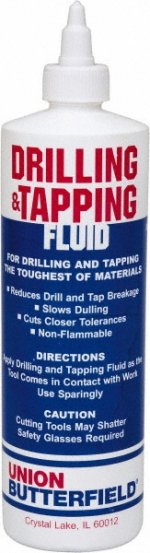
We use stainless exclusively and I find I have pretty good luck using Union Butterfield Drilling & Tapping Fluid. We also use Tap Magic but personally I prefer the thicker stuff. It seems to stay put better.
 

Attachments

  • drillfluid.jpg
    drillfluid.jpg
    95.3 KB · Views: 29

jimmy-ray

Well-known member
Joined
Apr 3, 2017
Messages
49
How was every drill too fast?
Ive had the same drill bit index at work for 3 years. Very rarely do i need to sharpen my bits.
I mostly drill mild steel from 1/8th to 5/8 thick, but also gr8 bolts, stainless.
I get many many many uses from one bit.
Ill try multiple gr8 bolts though see what happens! Im curious


If using a cordless basically apply as much pressure as you can.
Your breaking the bit by not applying pressure. Just dont use a 6ft snipe on a drill press

Im not sure how there were all to fast. Even with the hss bits all our drills would do nothing except the slow 1/2 inch snap on. Now if we used the same bits in the drill press where we could slow the speed down they work ok.

Im no expert, i dont drill often, it could be a technique thing but ive never really gotten more than a few uses out of a bit before they needed to be sharpened. Everyone in my shop has the same problem. We are usually drilling hardened fasteners though.

Ive heard motor oil works good also but ive never tried it

We had a good slow drill but it finally broke, another thing that ***** is all our drills are to fast to get a good cross hatch when finishing cylinders, even the 1/2 inch snappy one. You really gotta be pumping fast and the cross hatch still *****.
 
Last edited:

shockwave

Well-known member
Joined
Oct 23, 2012
Messages
2,125
Location
Marietta,ga
Definitely a strong automatic centerpunch to start with needing to up drill sizes it takes time thru metal and a drill doctor can be a good investment with bits

Even tougher if you break extractors since harder metals
 

bmxdad

Well-known member
Joined
Feb 18, 2014
Messages
2,539
Location
Puyallup, WA
That's a good trick for brass, but not for drilling steel.

Sent from my Nexus 6 using Tapatalk

Well, the guys I used to sharpen tools for didn't have any issues, and they were drilling in Steel, and Inconel and Titanium forgings. :thumbup:

The OP should try running about 60 SFM. Depending on the drip press he might not be able to drop the speed low enough. For a 1/4" drill that's about 900 rpm.
 

PugetDude

ALLIANCE MEMBER
Joined
Mar 13, 2013
Messages
22,278
Location
Superstition Mountains, AZ
At work I somewhat regularly have to drill out bolts that are rounded off, usually on a very rusty car.

The OP should try running about 60 SFM. Depending on the drip press he might not be able to drop the speed low enough. For a 1/4" drill that's about 900 rpm.

I want to see a picture of the drill press under the car...:D
 

CoyoteKyle

Well-known member
Joined
Apr 22, 2014
Messages
130
Location
KCMO
You don't drill much, do you? :lol_hitti

Drilling holes is part of my steady paycheck! You must not be using good bits!

Also motor oil is not a good lube for drilling. You are suppose to have metal on metal contact. The motor oil gets in the way.
 

ez-duzit

Well-known member
Joined
Jun 24, 2013
Messages
5,094
Location
Marina del Rey
You aren't suppose to drill a pilot hole. That actually wears the drill out unevenly stresses out the cutting edge. Drill bits are used to drill holes not expand existing holes.

Drilling holes is part of my steady paycheck! You must not be using good bits!

Also motor oil is not a good lube for drilling. You are suppose to have metal on metal contact. The motor oil gets in the way.

Pretty funny stuff.
 

M_George

Well-known member
Joined
Sep 25, 2016
Messages
966
Location
Eastern Pa.
I've always used Rapid Tap cutting fluid. That's another choice when you start searching for cutting oil.
 

6PTsocket

Well-known member
Joined
Mar 12, 2014
Messages
4,593
Drilling holes is part of my steady paycheck! You must not be using good bits!

Also motor oil is not a good lube for drilling. You are suppose to have metal on metal contact. The motor oil gets in the way.
Are you suggesting drilling dry? Motor oil might not be the best choice but it is better thsn nothing. I have never heard that the lubricant gets in the way of cutting. It keeps the bit from overheating and helps flush away chips. There is a right lube for different metals. In fact, in an industrial setting the geometry , alloy and coating of the bit are all optimized for the job, along with the lube and bit speed.

Sent from my SM-G900V using Tapatalk
 

CoyoteKyle

Well-known member
Joined
Apr 22, 2014
Messages
130
Location
KCMO
Are you suggesting drilling dry? Motor oil might not be the best choice but it is better thsn nothing. I have never heard that the lubricant gets in the way of cutting. It keeps the bit from overheating and helps flush away chips. There is a right lube for different metals. In fact, in an industrial setting the geometry , alloy and coating of the bit are all optimized for the job, along with the lube and bit speed.

Sent from my SM-G900V using Tapatalk

Yes, its better than nothing, so is spit and water. The main purpose of cutting lube is to keep the drill cool, not reduce friction on wearing parts like motor oil which can in some cases be counter productive.
 

CoyoteKyle

Well-known member
Joined
Apr 22, 2014
Messages
130
Location
KCMO
Pretty funny stuff.

Norseman - 800-328-4655
Any drill bit manufacture will tell you exactly what I'm saying. You're just wasting money on a pilot drill. And the "pilot hole" drill everyone keeps posting pics of isn't a "pilot drill" its a countersink.
 

Attachments

  • Drilling Pilot hole warning.jpg
    Drilling Pilot hole warning.jpg
    145.4 KB · Views: 63

6PTsocket

Well-known member
Joined
Mar 12, 2014
Messages
4,593
Norseman - 800-328-4655
Any drill bit manufacture will tell you exactly what I'm saying. You're just wasting money on a pilot drill. And the "pilot hole" drill everyone keeps posting pics of isn't a "pilot drill" its a countersink.
It is called a centering bit and commonly has a 60 degree angle outside the little center bit. I know of no flat head screw that matches that angle. I have seen 82, 90 and even 110 but nothing close to 60 and no reason to drill such a steep countersink angle. Eccept for the" tool experts" at HF, nobody calls it a countersink. Google: centering bit and you will get pages of them. They are commonly used on lathes to start a hole. Most big bits benefit from a starter hole to get them located. Somebody even makes a line of drill bits that has a little centering drill built into the tip.

Sent from my SM-G900V using Tapatalk
 

ez-duzit

Well-known member
Joined
Jun 24, 2013
Messages
5,094
Location
Marina del Rey
...the "pilot hole" drill everyone keeps posting pics of isn't a "pilot drill" its a countersink.

CK--now you're just making me feel sorry for you. Pathetic that anyone who "earns his living" drilling holes can't tell the difference between a center drill and a countersink, and doesn't understand the use of one.
 

CoyoteKyle

Well-known member
Joined
Apr 22, 2014
Messages
130
Location
KCMO
It is called a centering bit and commonly has a 60 degree angle outside the little center bit. I know of no flat head screw that matches that angle. I have seen 82, 90 and even 110 but nothing close to 60 and no reason to drill such a steep countersink angle. Eccept for the" tool experts" at HF, nobody calls it a countersink. Google: centering bit and you will get pages of them. They are commonly used on lathes to start a hole. Most big bits benefit from a starter hole to get them located. Somebody even makes a line of drill bits that has a little centering drill built into the tip.

Sent from my SM-G900V using Tapatalk

So why wouldn't they make the "pilot drill" 135 or 118 deg like the regular angles of drills?
 
To avoid these ads, REGISTER NOW!

6PTsocket

Well-known member
Joined
Mar 12, 2014
Messages
4,593
Yes, its better than nothing, so is spit and water. The main purpose of cutting lube is to keep the drill cool, not reduce friction on wearing parts like motor oil which can in some cases be counter productive.
https://en.m.wikipedia.org/wiki/Cutting_fluid. Not quite like what you are saying. Friction causes heat, Reduce the friction and the heat is reduced. The lube also carries away the heat. It is a coolant and a friction reducer. The article explains it better than I do.

Sent from my SM-G900V using Tapatalk
 

CoyoteKyle

Well-known member
Joined
Apr 22, 2014
Messages
130
Location
KCMO
CK--now you're just making me feel sorry for you. Pathetic that anyone who "earns his living" drilling holes can't tell the difference between a center drill and a countersink, and doesn't understand the use of one.

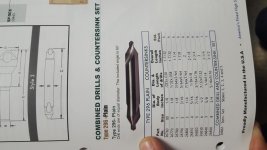
See picture. Just trying to help a noob not make the same mistakes as you. google center drill. Every link you go to off that calls this a drill & countersink combo
 

Attachments

  • Combined drill contersink.jpg
    Combined drill contersink.jpg
    137.9 KB · Views: 73

928'er

Well-known member
Joined
Jul 26, 2012
Messages
756
Location
Wine Country, CA
Wow!
Lots of contradictory information:

Go slow - drill fast
Light pressure, let the bit do the work - Press as hard as you can
Drill a pilot hole - don't drill a pilot hole

I was under the impression that you should go slow and let the bit do the work when drilling into steel (don't know why I was under that impression).

Watched a couple of videos the other day and most of the "presenters" were using the drill at an off angle to wallow out the hole to get started and then spinning the drill at high speed. Seemed to me to be a recipe for breaking and dulling drill bits...

What is the "best practice?"
 

bmxdad

Well-known member
Joined
Feb 18, 2014
Messages
2,539
Location
Puyallup, WA
The center drill is for a lathe center, but it's also used in CNC machines all the time, to put a center mark for a drill. The only true centering drill I'm aware of is a Nucon Drill. It had a special grind on the end. Very short flute length, and used just like a center drill. Also used for a shallow hole that would be bored or reamed to size for a tooling hole.

As for oil... your just cooling the bit, not making it slippery. Water based stuff, milk, is formulated to stick to the metal when hot and pull the heat away. It's why sulfur base oil works ... it sticks to the drill when it gets hot.


Nucon+Flyer+%28July+2016%29.jpg
 

pstemari

Well-known member
Joined
Jan 7, 2012
Messages
903
Location
Seattle
The center drill is for a lathe center, but it's also used in CNC machines all the time, to put a center mark for a drill. ...

"Spotting drill" is the magic search term. Lots of manufacturers: Keo, MA Ford, Lakeshore Carbide, etc .

http://www.kbctools.com/products/CUTTING TOOLS/DRILLS/SPOTTING DRILLS.aspx?category=Spotting+Drills

The problem with using a lathe center drill for spotting is that the pilot is fragile and can be snapped off easily. Also, the 60 angle is too narrow.

Sent from my Nexus 6 using Tapatalk
 

CoyoteKyle

Well-known member
Joined
Apr 22, 2014
Messages
130
Location
KCMO
Google "center drill images".

That's for CNC applications where they basically making a dimple. This guy is trying to drill holes with a hand drill or press. A center punch works fine for 118 deg and no need for one if you have a 135 deg split point. Never any need for a pilot drills that go's all the way through the piece of metal.
 

6PTsocket

Well-known member
Joined
Mar 12, 2014
Messages
4,593
So why wouldn't they make the "pilot drill" 135 or 118 deg like the regular angles of drills?
Because they are for locating holes, not deep drilling them. The fact that they match no screw means that they are not a countersink. It is those shallow bit angles that make accurate placement more difficult. It is called a centering bit because it accurately starts a bigger shallow angle drill bit. We all know what they are called and what they are used for. If you are happy calling them something else and know better than the professional machinists that use them, go for it . Do whstever you like.

Sent from my SM-G900V using Tapatalk
 

pstemari

Well-known member
Joined
Jan 7, 2012
Messages
903
Location
Seattle
So why wouldn't they make the "pilot drill" 135 or 118 deg like the regular angles of drills?
Spotting bits are available in 90, 120, and 140 degree point angles. Lathe center bits are 60 degrees, matching the end of most lathe centers.

Sent from my Nexus 6 using Tapatalk
 

ez-duzit

Well-known member
Joined
Jun 24, 2013
Messages
5,094
Location
Marina del Rey
...The problem with using a lathe center drill for spotting is that the pilot is fragile and can be snapped off easily. Also, the 60 angle is too narrow...

You guessed wrong on both accounts. The whole reason to use it is that the pilot is stubby and not likely to break, as that size drill bit might. And the 60* angle never touches the work, when spotting, only the pilot.

Large drill bits are otherwise difficult to start in a precise location, with only a center-punched divot to locate them. Hence the use of a pilot hole.
 
Last edited:

pstemari

Well-known member
Joined
Jan 7, 2012
Messages
903
Location
Seattle
You guessed wrong on both accounts. The whole reason to use it is that the pilot is stubby and not likely to break, as that size drill bit might. And the 60* angle never touches the work, when spotting, only the pilot.

Large drill bits are otherwise difficult to start in a precise location, with only a center-punched divot to locate them. Hence the use of a pilot hole.
The reason lathe center drills have a pilot is to provide clearance for the tip of the center. The 60 degree angle matches that of the center and provides the bearing surface when turning.

Actual spotting drills have wider point angles and no little pilot, which can and will snap off if mishandled, especially in the smaller sizes. You can use a lathe center drill for a spotting drill, but an actual spotting drill works better.


Sent from my Nexus 6 using Tapatalk
 

HARDBITS

Member
Joined
Apr 26, 2017
Messages
6
1. Drill slow
2. Go easy on the pressure
3. Use plenty of lubricant
4. Take breaks to prevent the bit overheating
Follow above rules and you will get best results for any drill bit

Treat yourself to a good set of cobalt drill bits
 
Last edited:
OP
S

Sugarfryz

Well-known member
Joined
Mar 13, 2016
Messages
452
1. Drill slow
2. Go easy on the pressure
3. Use plenty of lubricant
4. Take breaks to prevent the bit overheating
Follow above rules and you will bet best results for any drill bit

Treat yourself to a good set of cobalt drill bits

Kind of about to embarrass myself. The snap on bit I broke..... that my master tech told me was a right hand drill bit. I believed him because he knows a hell of a lot more than I do, I learned real quick not listening to him gets me in trouble.

Well the reason I broke it is because they were indeed left hand drill bits!! Makes sense because I bought them with the extractor set, I assumed left hand bits, I really wanted the bits more than anything.

I do have a set of hss cobalt snap on bits, and a few others that came with my hand drill as freebies. The hss cobalt is much better than the freebies,

Thanks for all the advice guys, hopefully I won't have to use it soon. I'm a mechanic so breaking out the drill gets me quite unhappy.
 
OP
S

Sugarfryz

Well-known member
Joined
Mar 13, 2016
Messages
452
Update, the snap on bits I broke were not left handed which I originally thought and traded them in for left handed ones. Secondly, the snap on bits were still terrible, and I broke most of them on the first drill. The advice on this thread helped a ton and I'm doing better. I'm only using a cordless drill, I'm a mechanic and when the drill comes out it's not a good time.

The snap on bits were going dull so quickly and breaking on the first or second use, so I got tired of them breaking and having no warranty at all. None. Pissed me off for how much I paid.

Bought a set of Irwin split tips off the Cornwell truck, had to break them out the other day and worked marvelously. The snap on bits just aren't any good. They will be kept as a back up, always good to have drill bits
 

PT Doc

Well-known member
Joined
Nov 12, 2010
Messages
3,197
Many tries with all sorts of bits. Best success with cobalt bits and cutting oil. Some oils or sprays will actually harden the bolt and then immediately dull the bit. Medium speed eith firm pressure should do it. And like the rest of us, practice practice practice.

Can you elaborate on the oils that will harden the bolt?
 

FSrepair&fabrication

Well-known member
Joined
Jul 28, 2017
Messages
908
Location
maryland
i cant believe the stuff people are telling you lol... seems like you found your problem, new sharp bits are always the way to go. i go thru a set of drillbits every month or so ive tried many brands and found what i like but i think proper procedure will get you results even with the cheapest chinese bits.

First off, bolts are alot harder than regular steel which makes them a pain to drill anyway.
next, always use a pointy punch to start yourself a spot to drill
start with a 1/16 bit lubed with some kind of grease, everyone who tells you to start with a 1/8 bit is crazy thats too much metal to try to take away at once. i go with 1/16 all the way thru the bolt on low speed with a cordless drill so i dont have enough torque to break off the drillbit in the whole when it binds. once i have a relief hole drilled i move up to 5/64, then 3/32, then a 7/64. Thats right! I use 4 bits before i even get to 1/8, stepping it up 1 bit at a time makes your bits last longer and work like they are meant to its almost effortless to cut thru the bolt. once I have a 1/8 to 5/32 hole i will either attempt an extractor if possible, or if im afraid i will break off an extractor i will continue drilling till im one size over the original bolt hole and tap the new hole to the next size bolt.

start small and work your way up, and dont push too hard on the tiny bits just let them eat at their own pace.
 

cherrybomb

Well-known member
Joined
Oct 18, 2016
Messages
887
Location
Near Madison Wi.
A lot of good info here,I also do the different sizes like FS repair does,but I have for taking out broken bolts a designated set.Do the punch,then I left hand center drill bit,left hand bits,increasing sizes as you go,to your size recommended for your removal tool.Good cutting oil,slo speed,get some chips,not blue,no chips creates heat,the hardest part is learning the hand feed vs.the speed.If the bit doesn't cut,change out,its telling you by color and chip.Certain sizes I have extra,costly I know.Cobalt,tough bit for a demanding job.Costly but you will see the value.Take your time,let bits cool a bit.Bolt removal is tough job,IMOO any old tool or technique will be a pita.Left handers help loosen as u go,makes removal easier.I also absolutely keep my left hand removal tools separate.I keep them in a eye glass case,clearly marked.You don't want to strike out on broken bolts.
 

pepi

Well-known member
Joined
Mar 27, 2013
Messages
2,883
Location
Woodstock, GA
The smaller the hole the higher the speed, within reason, and visa versa . Cutting oil is a must, quick down and dirty ACE hardware will work just fine, smokes easily. Tap magic is good, and many others, some research on your part will inform you.

Last but not least let the bit do the cutting, ******* a drill, makes the drill happy, not so on the bit... No gloves required, drill doctor a good accessory to have.

greg
 
To avoid these ads, REGISTER NOW!
Top Bottom