To avoid these ads, REGISTER NOW!

Tool quality.

Status
Not open for further replies.

JazzBlueRT

Well-known member
Joined
Jun 11, 2017
Messages
1,215
I see so many posts about tool quality. X brand has higher quality than Y brand and X country makes higher quality tools than Y county.

All the thousands of posts, yet not a single person has defined what they view as quality.

The Definition of quality is:
2 a :degree of excellence :grade
the quality of competing air service—Current Biography
b :superiority in kind
merchandise of quality

Using this definition, what makes one tool better quality than another tool? So when one says Snap On is higher quality, are they inferring 2.a or 2.b? All of us can judge a tool by the 2.a standard, look shiny. How many people here can judge by the 2.b standard and if they can, what do they use to judge ie.. alloy, stress testing, higher SAE or ASME standards?

Going by the 2.b standards, are any of the hard-line tool brands any different or better than the others?

I do not buy a tool based on how shiny it is, I buy a tool based upon what I need it for and at a value that I feel the tool is worth.
 
To avoid these ads, REGISTER NOW!

bcradio

Well-known member
Joined
Jan 30, 2012
Messages
6,017
Location
New Mexico
Quality has nothing to do with brand or what store the tools were bought from. It comes down to a tool by Tool basis. Brand X may make a really good wrench and brand y may make a really good ratchet. you have to evaluate each tool you get.
 
OP
J

JazzBlueRT

Well-known member
Joined
Jun 11, 2017
Messages
1,215
Did you not get your fill of tool arguing in the Snap On is a rip off thread? Or am I being arrogant? :lol:;)

Maybe a little of both. I am only interested in talking about what makes one tool, say a screwdriver, higher quality (as in superior) over another.
 
OP
J

JazzBlueRT

Well-known member
Joined
Jun 11, 2017
Messages
1,215
Quality has nothing to do with brand or what store the tools were bought from. It comes down to a tool by Tool basis. Brand X may make a really good wrench and brand y may make a really good ratchet. you have to evaluate each tool you get.

Agreed, but what is it that makes brand X better than brand Y.

The only tool I can find any information about the manufacturing process is from Wright.

http://www.wrighttool.com/why_wright_tool.asp

All Wright tolls use 4140 steel: https://www.azom.com/article.aspx?ArticleID=6769

But 4140 is CrMo and CrMo is not really suitable for chrome sockets where continuous forces would stretch the steel.

Most other tools, all I can find is marketing bs.

This is a list of all standardize alloys.

http://www.efunda.com/materials/all....cfm?m=ais&Page_Title=AISI 4xxx&ID_Low=AISI_4

Shows several standard alloys for CrV and CrMo steel.
 
OP
J

JazzBlueRT

Well-known member
Joined
Jun 11, 2017
Messages
1,215
The way it feels. Seriously, it's that simple.

That would be ergonomics, part of the equation for quality but not the only factor. Those cushion grip ratchets feel nice in the hand, but how long does the cushion hold up in an oil/gas soaked environment?
 

zktk01

Well-known member
Joined
Dec 22, 2016
Messages
809
Location
KY
The Wright chrome socket are CrMo so they are safe to use on impacts, and you don't have to worry about rust like normal impacts. What's not to like about that?


The above statement is a joke do not try that at home, leave it to the professionals.
 
Last edited:

plinker

Well-known member
Joined
Feb 28, 2007
Messages
4,286
Location
Northern Wi
I would think a part of being a quality ratchet/wrench/screwdriver/whatever is how it handles wear and tear. And that depends on the end user, some people baby their stuff, others beat the snot of of it.

Overall, preference and what the person is willing to pay win out. You can spec out what steel is used in construction and many other factors to define quality, but if I prefer certain tools from different brands, that's just that. Example, I have rebuilt a S-K 1/4 drive ratchet at least four times in the last 6-7 years, not from lack of quality, but normal constant use.

Cost would be a large factor to some, but as they say "buy once, cry once" among other sayings. Thing is you dont always have to spend an arm and a leg to get quality tools.
 

noid

Well-known member
Joined
Jul 15, 2010
Messages
1,341
I would say quality breaks down into a few sections:

Fit and finish - Aesthetic quality of plating or coating and more importantly the durability of the coating.

For chrome tools, we would want to quantify how often the chrome chips off relative to other brands.


Quality control and consistency - How many tools leave the factory with some sort of defect and how similar is the SKU from different manufacturing times?

Alot of ISO qualifications go into this, regarding manufacturing processes and the tools being checked and measured to be consistent and of high quality.

Some companies even display adherence to the specific ISO/DIN with each tool:
https://spaenaur.com/pdf/sectionN/N30.pdf

One company that takes it to another level is PB Swiss, they serialize every single screw driver, to trace back the exact batch of metal, machines and workers that worked on that screw driver in case of a failure.

Rated strength - Is the tool built to be ductile or strong but brittle? What does the company rate the tool to?

Steel alloy is the most important for determining ductility.

Many European and Japanese companies show the torque rating for their tools. It makes it easy to compare and select tools for specific jobs. For whatever reason most US based companies do not; its easier to not compete when you don't display this information.

Example, Stahlwille rating their wobble extensions:
http://www.stahlwille-online.de/ind...bb139&lid=2&mid=2&shid=&scmd=pdetail&pid=3956

Tool features - Patented and not, is there something tool company X is doing better then companies ZY?

One that comes to mind is the dual pawl design for the 120xp's; that design is patented by APEX (owner of gear wrench).

Ergonomics - I would break this down into two parts. First is personal ergonomic preference, and the second, actual musculoskeletal analysis ergonomic design.

Tolerances - How true to size is the socket/wrench/whatever to its described size? Are the tolerances consistent through the depth of each measuring surface?
 

Hiball

Well-known member
Joined
Apr 30, 2009
Messages
14,032
Location
Missery
All the thousands of posts, yet not a single person has defined what they view as quality.


Sure they do... But since there is No one size fits all in this world, there is always that guy next door that has different values in regards to quality who wants to argue to fit his beliefs.

I suspect if you go out and check your local eateries, you will see some people eating at Steak houses, Fast food and maybe around the dinner table at home. Ever Wonder why everyone isn't driving Fords? Chevys? Ferraris? Porsche's? Why some people rent movies versus going to the movie theater? The list goes on and on....

It doesn't matter how many times this community tries to cram everything tool related into a one size fit box, your never gonna get that lid closed. Yes.. People will buy based off Brand, Price, COO, Color and perceived Quality.
 

Ign

Well-known member
Joined
Jul 7, 2006
Messages
12,769
Location
Butte Peak ND
I think how well a company stands behind their stuff somehow comes into play with “quality.” Many will disagree but for me that’s true.

As I said in the Snappy thread we all know Snap-On stands behind their stuff. I’ve done a few Milwaukee warranty repairs & they make it painless, even providing a shipping label. Just boxed a drill today in fact.

Others will argue truly quality tools don’t need support or a warranty. I don’t believe that to be true.
 
OP
J

JazzBlueRT

Well-known member
Joined
Jun 11, 2017
Messages
1,215
I would say quality breaks down into a few sections:

Fit and finish - Aesthetic quality of plating or coating and more importantly the durability of the coating.

For chrome tools, we would want to quantify how often the chrome chips off relative to other brands.


Quality control and consistency - How many tools leave the factory with some sort of defect and how similar is the SKU from different manufacturing times?

Alot of ISO qualifications go into this, regarding manufacturing processes and the tools being checked and measured to be consistent and of high quality.

Some companies even display adherence to the specific ISO/DIN with each tool:
https://spaenaur.com/pdf/sectionN/N30.pdf

One company that takes it to another level is PB Swiss, they serialize every single screw driver, to trace back the exact batch of metal, machines and workers that worked on that screw driver in case of a failure.

Rated strength - Is the tool built to be ductile or strong but brittle? What does the company rate the tool to?

Steel alloy is the most important for determining ductility.

Many European and Japanese companies show the torque rating for their tools. It makes it easy to compare and select tools for specific jobs. For whatever reason most US based companies do not; its easier to not compete when you don't display this information.

Example, Stahlwille rating their wobble extensions:
http://www.stahlwille-online.de/ind...bb139&lid=2&mid=2&shid=&scmd=pdetail&pid=3956

Tool features - Patented and not, is there something tool company X is doing better then companies ZY?

One that comes to mind is the dual pawl design for the 120xp's; that design is patented by APEX (owner of gear wrench).

Ergonomics - I would break this down into two parts. First is personal ergonomic preference, and the second, actual musculoskeletal analysis ergonomic design.

Tolerances - How true to size is the socket/wrench/whatever to its described size? Are the tolerances consistent through the depth of each measuring surface?

This is an excellent post, I wish it could be pinned/stickied on the site.
 

redwrench60

Well-known member
Joined
Sep 10, 2011
Messages
6,075
Location
East Tennessee
Maybe a little of both. I am only interested in talking about what makes one tool, say a screwdriver, higher quality (as in superior) over another.

Well then, screwdrivers it is. The things I look for in a screwdriver are as follows:

1) Strength. The ability to turn or break loose a tight or seized screw without chipping or deforming and maybe even tolerate some abuse. I'm a screwdriver bender from way back.

2) Solvent resistance. At my work my screwdrivers will be exposed to and even soaked in oil, gas, diesel, ATF, grease along with various fluids and solvents. Having rubber or weak plastics means they swell, rot and disintegrate as well as being too slippery.

3) Handle design. I prefer a quad lobe design over a round or tri lobe design. I can really lay down some torque with one. This is pure preference and is not really part of the brand X vs. brand Y argument but to me it makes one better than the other.

4) Shank design. I like a chrome finish for rust protection, a hex bolster for using a wrench and vapor blasted tips for traction in a screw head.

5) Depth of product line. I like a brand that offers screwdrivers in long, short, stubby, extra long, torx, metric/SAE nut drivers, hex drivers, bla bla bla. I can't take a brand seriously that only makes simple phillips and slotted drivers.

P.S. My favorites are Classic Snap On hard handles and Proto Duratec screwdrivers. :bowdown:
 

Ole Slewfoot

Well-known member
Joined
Feb 22, 2016
Messages
5,098
Location
Freedom, CA
I don't give a hoot what its " rated for", a quality tool will not break in normal use.

Wearing down is a different factor. If you hammer on the bestest chisel long enough, it will be a short nub starting another mushroom at one end.

A quality tool will be free of any little thing that bugs you every time you use it.
ie. Hf torque wrench that allows one turn of the adjuster before the lock self engages=/=quality.

the moving parts operate smoothly with an appropriate amount of drag, and an adjustments hold.

Im not sure warranty is part of quality. One Crafty ratchet comes to mind where the lifetime warranty just meant I had to go to the store and exchange it on my lunch break every week or two.
 
To avoid these ads, REGISTER NOW!

noid

Well-known member
Joined
Jul 15, 2010
Messages
1,341
perceived Quality.

I think this is the point of this thread. To get away from perceived and to get into quantifying quality.

A tool is tangible and is purpose made for a job or set of jobs. The measure of its success therefore should be easy to measure relative to that job.

I think how well a company stands behind their stuff somehow comes into play with “quality.” Many will disagree but for me that’s true.

As I said in the Snappy thread we all know Snap-On stands behind their stuff. I’ve done a few Milwaukee warranty repairs & they make it painless, even providing a shipping label. Just boxed a drill today in fact.

Others will argue truly quality tools don’t need support or a warranty. I don’t believe that to be true.

You can quantify warranty regardless if its easy to use or not. How many times do you need to warranty a tool from company X versus needing to warranty a tool from company ZY?

As far as quantifying is concerned, the warranty is just a remedy to a problem, how often does a tool break from company X versus company ZY? Thats the real metric.
 
OP
J

JazzBlueRT

Well-known member
Joined
Jun 11, 2017
Messages
1,215
4) Shank design. I like a chrome finish for rust protection, a hex bolster for using a wrench and vapor blasted tips for traction in a screw head.

What phillips screwdrivers have the hex bolster. I only have one, 90's era Irwin I think and my Craftsman slotted have a hex shank. None of my phillips have one and there have been several times where I wished they did. Is it because the likelihood of stripping the screwhead?
 

plinker

Well-known member
Joined
Feb 28, 2007
Messages
4,286
Location
Northern Wi
What phillips screwdrivers have the hex bolster. I only have one, 90's era Irwin I think and my Craftsman slotted have a hex shank. None of my phillips have one and there have been several times where I wished they did. Is it because the likelihood of stripping the screwhead?

Snap-on does, Witte drivers have a hole in the handle for the same reason IIRC. Reasoning is to gain a bit more torque similar to a T handle.
 

redwrench60

Well-known member
Joined
Sep 10, 2011
Messages
6,075
Location
East Tennessee
What phillips screwdrivers have the hex bolster. I only have one, 90's era Irwin I think and my Craftsman slotted have a hex shank. None of my phillips have one and there have been several times where I wished they did. Is it because the likelihood of stripping the screwhead?

ALL my Snap On and my Mac/Proto Duratec drivers have them. Phillips or slotted. For me it's a requirement for consideration. They really make a difference on damaged or iffy screws.
 

Hiball

Well-known member
Joined
Apr 30, 2009
Messages
14,032
Location
Missery
I think this is the point of this thread. To get away from perceived and to get into quantifying quality.

A tool is tangible and is purpose made for a job or set of jobs. The measure of its success therefore should be easy to measure relative to that job.

It's 2017, Not 1975... The truth of the matter is that most tool companies have figured out how to manufacture tools that aren't going break just by simply looking at them. I believe most tool manufactures claim to produce tools that comply with ANSI standards across the board, so there is some measurability out there if that is what helps you sleep at night.

My idea of "quantifying quality" is buying from a company who has been in the business for more than a week or simply a rebrand with another color scheme. I could give a **** about ratings/reviews or PdF pages telling me how good there tool is. If it's a Brand that is readily available, It has a place in my box, I've had to evict very few tools over the last 10 years.
 

turnthewrench

Banned
Joined
Jan 19, 2017
Messages
163
Location
Winter Park, FL
I see so many posts about tool quality. X brand has higher quality than Y brand and X country makes higher quality tools than Y county.

All the thousands of posts, yet not a single person has defined what they view as quality.

The Definition of quality is:
2 a :degree of excellence :grade
the quality of competing air service—Current Biography
b :superiority in kind
merchandise of quality

Using this definition, what makes one tool better quality than another tool? So when one says Snap On is higher quality, are they inferring 2.a or 2.b? All of us can judge a tool by the 2.a standard, look shiny. How many people here can judge by the 2.b standard and if they can, what do they use to judge ie.. alloy, stress testing, higher SAE or ASME standards?

Going by the 2.b standards, are any of the hard-line tool brands any different or better than the others?

I do not buy a tool based on how shiny it is, I buy a tool based upon what I need it for and at a value that I feel the tool is worth.

Are you the wife on some GJ member trying to find out where the shoes budget goes?
 

PJNJ

Well-known member
Joined
Sep 20, 2013
Messages
1,047
Location
Iowa
Did you not get your fill of tool arguing in the Snap On is a rip off thread? Or am I being arrogant? :lol:;)
No he didn't get his fill apparently. I doubt he ever will.:lol:

Not this **** again :lol_hitti
Yes, yes this **** again for the one millionth time.:shocking:

Oh yeah! This **** again! Get your helmet and leathers on!
I would add flame-proof body armor. Incoming!! :uzi::rocketwho

What phillips screwdrivers have the hex bolster. I only have one, 90's era Irwin I think and my Craftsman slotted have a hex shank. None of my phillips have one and there have been several times where I wished they did. Is it because the likelihood of stripping the screwhead?

You have got to be kidding! Google hex bolstered screwdrivers and see how many different brands (including philips) that have them. Heck, even HF has them.
 

redwrench60

Well-known member
Joined
Sep 10, 2011
Messages
6,075
Location
East Tennessee
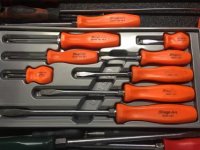
All threads need pics. Here’s the screwdrivers I keep in the shop at home. They meet or exceed all my personal requirements.
 

Attachments

  • 2EF75361-8AA5-4E18-A876-D9EF63422A86.jpg
    2EF75361-8AA5-4E18-A876-D9EF63422A86.jpg
    21.5 KB · Views: 34
  • 8AE1D0F7-F51B-4139-BD2C-1851B24FC835.jpg
    8AE1D0F7-F51B-4139-BD2C-1851B24FC835.jpg
    23.8 KB · Views: 33

Corndoggeh

Well-known member
Joined
Apr 2, 2016
Messages
1,198
Ergonomics - I would break this down into two parts. First is personal ergonomic preference, and the second, actual musculoskeletal analysis ergonomic design.

Tolerances - How true to size is the socket/wrench/whatever to its described size? Are the tolerances consistent through the depth of each measuring surface?

Probably the two most examined and cared about conditions, one of the main reasons I like Craftsman RP over any other design, being the gorilla I am I can put a ton of force on a wrench and the thinner designs of SO and even HF tend to dig into my hand when using it over the fatter design of the Craftsman RP. Does that make Craftsman better than the others? Obviously no, but if it feels good in the hands and my comfort using the tool can be just as important as the quality of the steel and tolerances. Hence why were seeing companies switching to comfort grips on nearly ALL of their hand tools. Second tolerances are important for obvious reasons :lol_hitti

I would also like to point out, 90% of perceived "quality" comes through marketing and history. Chances are, if dad or uncle bill used Snapon or Craftsman or Proto or whatever, chances are youll be more inclined to use that brand, im guilty of this and have no issue with it, its how companies build followers and thats how Sears was able to build such a massive reputation with their big brands in the past "my mom and dad used these and they were smart people, so that must mean these are good brands".

Second, we all see how snapon is regarded as the "best of the best, of the best" outside this forum simply because they always drive home the "quality" aspect of everything they put their name of regardless of actual quality or manufacturer. Coupled with companies like HF always comparing their tools to snapon also pins that notion that "snapon is as good as it gets, look how ours competes with the best!". These two reasons above is why we see used Craftsman and Snapon tools being sold as high as they are versus all other brands.
 
Last edited:

shawndp

Well-known member
Joined
Jun 25, 2017
Messages
243
Location
Toronto, ON
View media item 76223
All threads need pics. Here’s the screwdrivers I keep in the shop at home. They meet or exceed all my personal requirements.

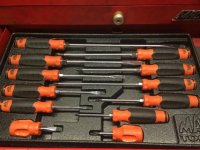
You have excellent taste in screwdrivers! I bought this set for home use at our new place...

7RiKa
 
Last edited:

Gmonkee

Well-known member
Joined
May 9, 2010
Messages
2,888
For me quality is defined by long term use on the job without failing or wearing out quickly.
No warranty required. Why do I want another to expect another failure?

COO has some bearing as does price point but neither is all defining. I have two dollar Asain screwdrivers with years of use and no notable wear or fails. I have expensive ratchets that after extensive use and abuse have never had a day as unusable. The list goes on.

Early on there were failed items, long ago tossed in the scrap iron barrel and forgotten. Live and learn, that you too will know quality as it fits your needs and with what you can get.
 

plinker

Well-known member
Joined
Feb 28, 2007
Messages
4,286
Location
Northern Wi
I do not buy a tool based on how shiny it is, I buy a tool based upon what I need it for and at a value that I feel the tool is worth.


FWIW, this pretty much sums up most people buying tools. Most of the people I have worked with are not tool snobs or fan boys (IE: buy brand x only), and most are informed buyers and will buy what they think is best for the need at hand.

I would also like to point out, 90% of perceived "quality" comes through marketing and history. Chances are, if dad or uncle bill used Snapon or Craftsman or Proto or whatever, chances are youll be more inclined to use that brand, im guilty of this and have no issue with it, its how companies build followers and thats how Sears was able to build such a massive reputation with their big brands in the past "my mom and dad used these and they were smart people, so that must mean these are good brands".
+1

Most people associate a brand name with quality, some brands more so then others, but it still boils down to preference for the most part. I doubt anybody is going to do a metallurgic analysis on who makes the best _______. An engineer might, but not the everyday DIY'er or mechanic. The internet debate will continue....
 

plinker

Well-known member
Joined
Feb 28, 2007
Messages
4,286
Location
Northern Wi
Thank you, I just did and read about 2,000 opinions on how hex bolsters are useless, especially for phillips, unless the shaft goes through the handle and terminates with a strike plate.

Because of you, I now know about a useless feature on screwdrivers and will use my cordless impact driver in those situations where I need that extra torque on a screwdriver even if it is inconvenient.

In summary, the quality screwdriver with a hex bolster must have a shaft that goes through the handle and terminates with a strike plate.

Get a hand impact driver, they work great for seized screws!
 

PJNJ

Well-known member
Joined
Sep 20, 2013
Messages
1,047
Location
Iowa
Thank you, I just did and read about 2,000 opinions on how hex bolsters are useless, especially for phillips, unless the shaft goes through the handle and terminates with a strike plate.

Because of you, I now know about a useless feature on screwdrivers and will use my cordless impact driver in those situations where I need that extra torque on a screwdriver even if it is inconvenient.

In summary, the quality screwdriver with a hex bolster must have a shaft that goes through the handle and terminates with a strike plate.

I'm surprised that you were able to fit that all in a few minutes. For your next trick Google wobble extensions and gives us your learned opinion in say, five minutes. :D
 
Last edited:

redwrench60

Well-known member
Joined
Sep 10, 2011
Messages
6,075
Location
East Tennessee
Thank you, I just did and read about 2,000 opinions on how hex bolsters are useless, especially for phillips, unless the shaft goes through the handle and terminates with a strike plate.

Because of you, I now know about a useless feature on screwdrivers and will use my cordless impact driver in those situations where I need that extra torque on a screwdriver even if it is inconvenient.

In summary, the quality screwdriver with a hex bolster must have a shaft that goes through the handle and terminates with a strike plate.

Instead of reading about it on the internet why don't you try one for yourself? Make up your own mind.
 

L5wolvesf

Well-known member
Joined
Dec 4, 2011
Messages
1,831
Location
Northern AZ
I would say quality breaks down into a few sections:

Fit and finish - Aesthetic quality of plating or coating and more importantly the durability of the coating.

For chrome tools, we would want to quantify how often the chrome chips off relative to other brands.


Quality control and consistency - How many tools leave the factory with some sort of defect and how similar is the SKU from different manufacturing times?

Alot of ISO qualifications go into this, regarding manufacturing processes and the tools being checked and measured to be consistent and of high quality.

Some companies even display adherence to the specific ISO/DIN with each tool:
https://spaenaur.com/pdf/sectionN/N30.pdf

One company that takes it to another level is PB Swiss, they serialize every single screw driver, to trace back the exact batch of metal, machines and workers that worked on that screw driver in case of a failure.

Rated strength - Is the tool built to be ductile or strong but brittle? What does the company rate the tool to?

Steel alloy is the most important for determining ductility.

Many European and Japanese companies show the torque rating for their tools. It makes it easy to compare and select tools for specific jobs. For whatever reason most US based companies do not; its easier to not compete when you don't display this information.

Example, Stahlwille rating their wobble extensions:
http://www.stahlwille-online.de/ind...bb139&lid=2&mid=2&shid=&scmd=pdetail&pid=3956

Tool features - Patented and not, is there something tool company X is doing better then companies ZY?

One that comes to mind is the dual pawl design for the 120xp's; that design is patented by APEX (owner of gear wrench).

Ergonomics - I would break this down into two parts. First is personal ergonomic preference, and the second, actual musculoskeletal analysis ergonomic design.

Tolerances - How true to size is the socket/wrench/whatever to its described size? Are the tolerances consistent through the depth of each measuring surface?


By far the best description of quality I've see here. :beer:
 
OP
J

JazzBlueRT

Well-known member
Joined
Jun 11, 2017
Messages
1,215
ALL my Snap On and my Mac/Proto Duratec drivers have them. Phillips or slotted. For me it's a requirement for consideration. They really make a difference on damaged or iffy screws.

Prompted by another post, I looked further into this and decided that it is not a feature that I would need. The stuck screws I encounter are usually on server racks and I use an impact driver on them.

Interesting discussion on ToolGuyd about screwdriver bolsters.

Would you consider a hex bolstered through shaft and strike cap screwdriver of higher quality than one without?
 
Status
Not open for further replies.
To avoid these ads, REGISTER NOW!
Top Bottom