To avoid these ads, REGISTER NOW!

Torque spec for weathered bolts

noid

Well-known member
Joined
Jul 15, 2010
Messages
1,341
There is substantial difference between the friction coefficient between a new bolt and a weathered bolt.

When working on cars for example, if you plan to reuse a bolt, its important to know that the torque spec you are using has to be adjusted based on the condition of the bolt.

This video shows pretty clearly just how much some light rust can affect tension (the ultimate end goal):

I've come to a personal conclusion that the best approach is to use heavy grease (anti-seize) and use a 0.7 factor against the recommended torque spec.

Ajax bolting (bolt MFG) recommends this conversion factor:
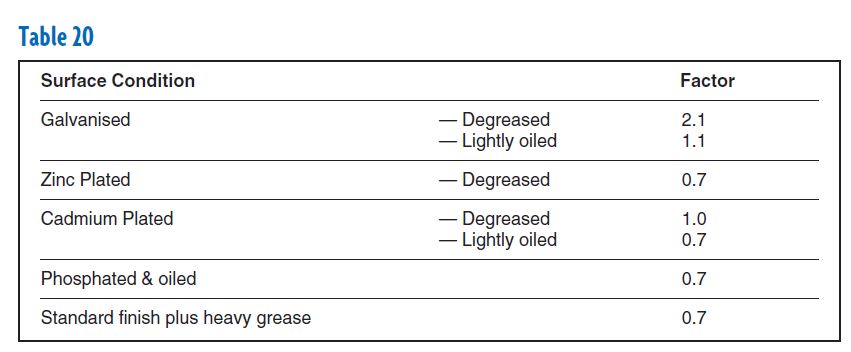
Heavygreasedtorquespec.jpg


https://rtstools.com/wp-content/uploads/2020/10/ajax-handbook.pdf

Basically use the recommended torque from here (multiplied by 0.7):
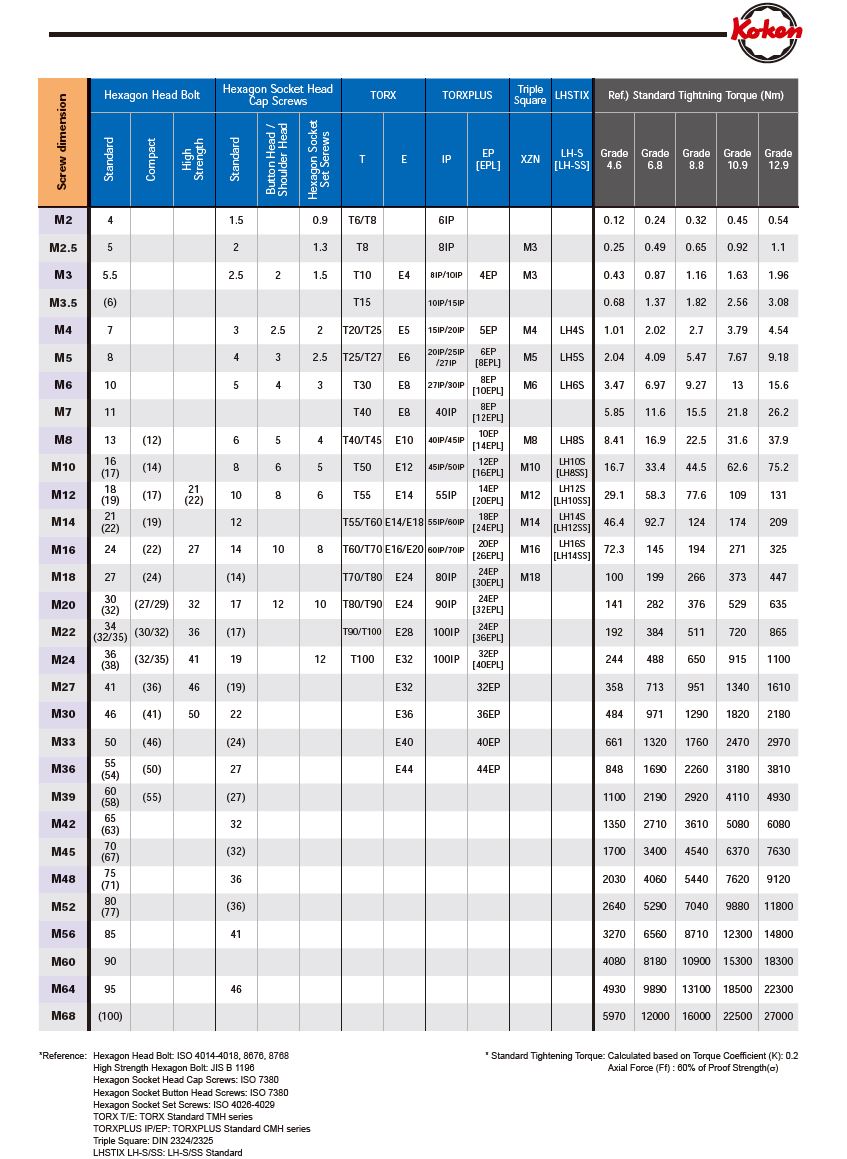
Recommendedtorquespec.jpg


If working with standard hex bolts, use this chart to convert head size to bolt diameter (otherwise pull bolt and measure threaded part with digital caliper):
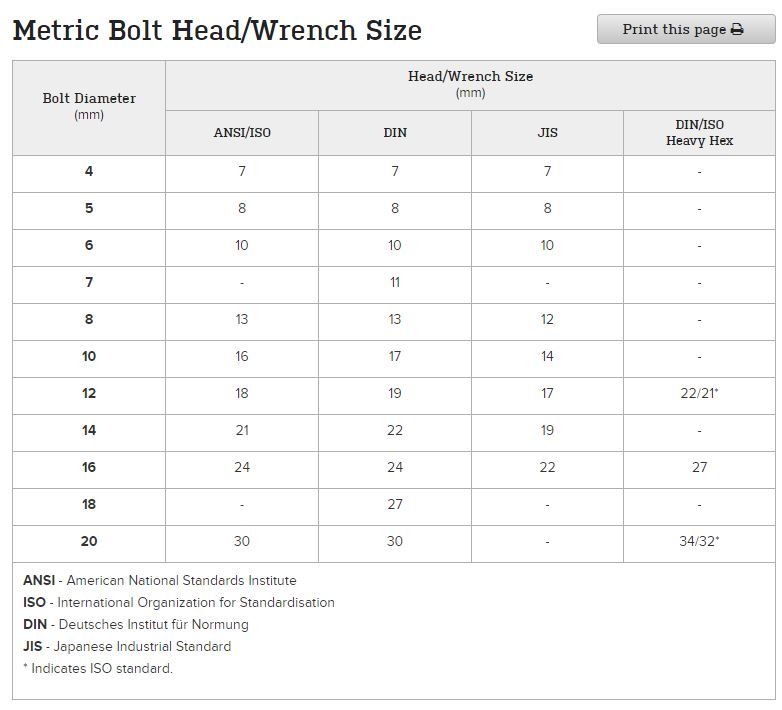
HeadboltWrenchtoboltsize.jpg


Apart from the ugga dugga; what kind of philosophy do you guys subscribe too?
 
To avoid these ads, REGISTER NOW!

Don1357

Well-known member
Joined
Apr 15, 2019
Messages
948
Location
Palmer, AK
I don't know about that... the torque spec is not for the benefit of the bolt, is for the holding requirement of the task at hand. Any bolt I see that is suspect of needing less torque is a candidate for replacement as it would be incapable of doing the job it is required to do.
 

LXCam

ALLIANCE MEMBER
Joined
Apr 23, 2013
Messages
19,093
Location
AZ
Apart from the ugga dugga; what kind of philosophy do you guys subscribe too?

If said bolt or nut is critical enough to warrant whipping out a torque wrench it either get replaced or run thru a thread chaser.
 
OP
N

noid

Well-known member
Joined
Jul 15, 2010
Messages
1,341
I don't know about that... the torque spec is not for the benefit of the bolt, is for the holding requirement of the task at hand. Any bolt I see that is suspect of needing less torque is a candidate for replacement as it would be incapable of doing the job it is required to do.

Torque is only a means to tension. This applies in both directions; if you go using anti seize and use the specified torque on a new bolt, youll way over tension the bolt (in some instaces past the point of elongation).

The friction coefficent is critical.

Apart from the ugga dugga; what kind of philosophy do you guys subscribe too?

If said bolt or nut is critical enough to warrant whipping out a torque wrench it either get replaced or run thru a thread chaser.

Of course some clean up is required; its however doubtful youll be able to get it back to as new; probably closer to 'job site' quality like in the video.

Lubrication (eg anti seize) gets you to a much more predictable range relative to dry torque spec than cleaning alone.
 

Wrench97

Well-known member
Joined
Jun 23, 2018
Messages
12,054
Location
Southeastern Pa
Lubed and dry are two different specs 100ftlbs "lubed" will be way over torqued for a 100ftlb dry spec. Generic bolt torque specs are generally different and not as critical as say a spec for head bolt torque on an engine.
 
OP
N

noid

Well-known member
Joined
Jul 15, 2010
Messages
1,341
Lubed and dry are two different specs 100ftlbs "lubed" will be way over torqued for a 100ftlb dry spec. Generic bolt torque specs are generally different and not as critical as say a spec for head bolt torque on an engine.

Kind of, bolt material makes a big difference also. Where an 80's OE bolt might have been Cadmium plated, a new OE replacement might be zinc.

BMW for example has different factors for zinc vs cadmium plated fasteners.

https://rtstools.com/wp-content/uploads/2020/10/BMW-torque-chart-1.pdf

There is also a difference between lubed, and heavy lubed; but really its all an estimation relative to the friction coefficient (k factor). If its a new bolt, then its fairly straight forward, if not, then you have to take current bolt condition into account.

Re: head bolts, also kind of; with headbolts they are normally TTY so the tension is actually achieved by elongation. OEM's do that because consistent tension in these applications is critical, so they cut out any guess work by investing more in the bolts. Any reasonable deviation in torque should always yield within 5% of needed tension as the bolt will continue to elongate at the required tension.

elongation.jpg
 

Wrench97

Well-known member
Joined
Jun 23, 2018
Messages
12,054
Location
Southeastern Pa
Kind of, bolt material makes a big difference also. Where an 80's OE bolt might have been Cadmium plated, a new OE replacement might be zinc.

BMW for example has different factors for zinc vs cadmium plated fasteners.

https://rtstools.com/wp-content/uploads/2020/10/BMW-torque-chart-1.pdf

There is also a difference between lubed, and heavy lubed; but really its all an estimation relative to the friction coefficient (k factor). If its a new bolt, then its fairly straight forward, if not, then you have to take current bolt condition into account.

Re: head bolts, also kind of; with headbolts they are normally TTY so the tension is actually achieved by elongation. OEM's do that because consistent tension in these applications is critical, so they cut out any guess work by investing more in the bolts. Any reasonable deviation in torque should always yield within 5% of needed tension as the bolt will continue to elongate at the required tension.

elongation.jpg

You asked about weathered bolts what the heck does that have to do with the platting that's weathered off and no longer there or a TTY bolt that is not reusable?
 
OP
N

noid

Well-known member
Joined
Jul 15, 2010
Messages
1,341
You asked about weathered bolts what the heck does that have to do with the platting that's weathered off and no longer there or a TTY bolt that is not reusable?

My point was that its not as black and white as "cleaning up" a bolt. Nor is it that black and white if its replaced.

The torque spec you're looking at has a certain k factor in mind.

So lets say you've been a superstar in cleaning up the bolt, and lets say it no longer has a coating on it because of the weathering. The torque spec calls for a fresh lightly lubed zinc fastener. Are you saying you'd just torque your freshly cleaned fastener to the indicated spec?

Or lets say, you've removed a cadmium plated bolt are you going to tighten it to a zinc plated torque spec?

Re: TTY, my point there was that the final torque is not as critical in that application, because the elongation is what sets the tension. All within reason of course.

Nothing to do with weathering, everything to do with the comment you made regarding headbolts needing torque accuracy.
 

JR 42

Well-known member
Joined
Nov 2, 2013
Messages
966
Location
Sunny Seattle
Huh, kinda getting weird in here. I'm not a mechanic or tech or anything. I try to use antiseize on most (used, possibly/ definitely weathered) factory bolts that are going back in. If stuff looks crusty or smooshed, or I have extra time I'll chase both sets of threads and blow them clean with whatever squirrel pee is on hand.

I usually reduce torque (on the HF clicker torque wrenches or old Cman fixed beam, lol) by 10 - 15%, because when I read up on it a while back that seemed to be the consensus here and at BITOG and wherever else I got this idea... haven't had problems, but I don't do much critical torque wrench work either.

I've since read a bit more and learned torque wrenches are a somewhat crude attempt at achieving bolt stretch, but haven't come across the 30% reduction for oiled/ greased threads before IIRC. I assume in most cases there's a fair amount of wiggle room, and consistent torque across multiple fasteners (on an oil pan, say) is more important than actual torque wrench setting within a reasonable margin. If I had to torque head bolts on a high- performance engine or something important and expensive I should buy a better torque wrench.

I find it very interesting that dry "zinc plated" fasteners need the same reduction as grease or oil. I assume they mean yellow zinc plating? "Galvanising" is also zinc plate as far as I'm aware, but maybe it has a differend specific meaning in Australia?
 

Don1357

Well-known member
Joined
Apr 15, 2019
Messages
948
Location
Palmer, AK
Torque is only a means to tension. This applies in both directions; if you go using anti seize and use the specified torque on a new bolt, youll way over tension the bolt (in some instaces past the point of elongation).

The friction coefficent is critical.

That has nothing to do with using a damaged/worn bolt and in fact it is an argument to never ever think about using a damaged/worn bolt. Torque specifications are such that the bolts used will in fact be fine at a much higher torque because of the margin of error is engineered into the calculations. Unless the bolt is worn/damaged, which means it will be out of spec.

But if you want to save a few cents and get really technical about under-torquing worn bolts have at it.
 

2ndGearRubber

Well-known member
Joined
Mar 24, 2014
Messages
14,185
Location
Pittsburgh
If it's that worn, replace it. For your typical rotted up m6x1 or m8x1.25 on a non critical item, just run it in with grease on the threads and walk away. If it's an M12 suspension bolt, it'll be fine being a touch crusty. If it's a torque sensitive internal or mission critical bolt (fewer on a car than you think) then it needs replaced.
 
OP
N

noid

Well-known member
Joined
Jul 15, 2010
Messages
1,341
Torque specifications are such that the bolts used will in fact be fine at a much higher torque because of the margin of error is engineered into the calculations.

That's not true. The difference between k = 0.12 (new zinc bolt heavily lubricated) and k = 0.20 (phos dry bolt) is ~53%.

If the torque spec is for k = 0.2 and you torque a k = 0.12 bolt, you'll well exceed the bolts max proof strength.

In the real world, this happens all the time with anti seize on lug nuts and bolts. Somebody puts anti seize in good faith and then bam you've got an elongated bolt.

Anti seize should be used on lug nuts and bolts at a reduced torque, but only if you service your own car or diligently dictate the torque spec to your mechanic.
 

Steve_P

Well-known member
Joined
Sep 15, 2010
Messages
5,182
When is the last time anyone here has used a torque wrench and tightened to spec torque and broken something? Regardless of oil, anti-seeze, plating..... Never, unless the fastener was severely corroded. Discussion over.
 

Don1357

Well-known member
Joined
Apr 15, 2019
Messages
948
Location
Palmer, AK
That's not true. The difference between k = 0.12 (new zinc bolt heavily lubricated) and k = 0.20 (phos dry bolt) is ~53%.

If the torque spec is for k = 0.2 and you torque a k = 0.12 bolt, you'll well exceed the bolts max proof strength.

In the real world, this happens all the time with anti seize on lug nuts and bolts. Somebody puts anti seize in good faith and then bam you've got an elongated bolt.

Anti seize should be used on lug nuts and bolts at a reduced torque, but only if you service your own car or diligently dictate the torque spec to your mechanic.

Stop changing the subject.

If you suspect a bolt to be worn, replace it instead of reusing it.
 

metlmunchr

Well-known member
Joined
Sep 10, 2011
Messages
1,278
Stop changing the subject.

If you suspect a bolt to be worn, replace it instead of reusing it.

He's not changing the subject. What he's said about torque variation due to surface finish, lubrication, and coatings is absolutely true. The fact that you can't understand it isn't the OP's problem.
 

pizza

Well-known member
Joined
Dec 4, 2019
Messages
1,739
Location
Midwest, USA
There is substantial difference between the friction coefficient between a new bolt and [all kinds of stuff]...

Apart from the ugga dugga; what kind of philosophy do you guys subscribe too?
you are absolutely right.

if the bolt doesn't look seriously messed up (rusty or whatever), i just torque it back to whatever the manual says.

if it's a kind of rusty and i don't really care, again, i just use the manual's torque.

if i add antiseize or similar, i re-evaluate and apply some kind of correction factor.

as an example, i replaced many JIS screws on my dirt bike with stainless hex cap screws. to prevent galling with the aluminum, now i have to use antiseize. if i used the service manual torque, i bet something bad would happen.
 
To avoid these ads, REGISTER NOW!

pizza

Well-known member
Joined
Dec 4, 2019
Messages
1,739
Location
Midwest, USA
When is the last time anyone here has used a torque wrench and tightened to spec torque and broken something? Regardless of oil, anti-seeze, plating..... Never, unless the fastener was severely corroded. Discussion over.

i've never had the balls to try. it's such an easily avoidable mistake.
 

Fcvapor05

Well-known member
Joined
May 4, 2014
Messages
1,079
Well this thread is certainly full of bad information.

Never put anti seize on bolts that didn't have it already. Anti-sieze has a giant effect on a fastener's ability to maintain preload over time.

Using a stock reference chart instead of what's in the manual for whatever you're rebuilding is, again, bad advice. RTFM. It was written for a reason.
 
OP
N

noid

Well-known member
Joined
Jul 15, 2010
Messages
1,341
He's not changing the subject. What he's said about torque variation due to surface finish, lubrication, and coatings is absolutely true. The fact that you can't understand it isn't the OP's problem.

you are absolutely right.

if the bolt doesn't look seriously messed up (rusty or whatever), i just torque it back to whatever the manual says.

if it's a kind of rusty and i don't really care, again, i just use the manual's torque.

if i add antiseize or similar, i re-evaluate and apply some kind of correction factor.

as an example, i replaced many JIS screws on my dirt bike with stainless hex cap screws. to prevent galling with the aluminum, now i have to use antiseize. if i used the service manual torque, i bet something bad would happen.


Thanks guys, felt like I was pedaling uphill alone there for a moment.


Well this thread is certainly full of bad information.

Never put anti seize on bolts that didn't have it already. Anti-sieze has a giant effect on a fastener's ability to maintain preload over time.

Using a stock reference chart instead of what's in the manual for whatever you're rebuilding is, again, bad advice. RTFM. It was written for a reason.

How did you come to the conclusion that anti-seize has an effect on fasteners maintaining preload?

Unless you're putting anti seize on the transverse surfaces of whatever you're mating (not bolt and nut itself), im not sure what anti seize (lubrication) has anything to do with the bolt maintaining preload?

Those applications are pretty specific, and you should be using threadlocker.
 

Don1357

Well-known member
Joined
Apr 15, 2019
Messages
948
Location
Palmer, AK
He's not changing the subject. What he's said about torque variation due to surface finish, lubrication, and coatings is absolutely true. The fact that you can't understand it isn't the OP's problem.

Let me return the favor and help you with your English comprehension. Could you please read to me the title of this thread?

The OP starts talking about worn bolts. If anything the whole other tangent on lubricants is an even better reason to discard any bolts that looks worn.

But you know what? Whatever makes you happy. Using anti seize, specified torque, and non worn bolts is yet to fail me but if that doesn't work for you have at it.
 
OP
N

noid

Well-known member
Joined
Jul 15, 2010
Messages
1,341
Let me return the favor and help you with your English comprehension. Could you please read to me the title of this thread?

The OP starts talking about worn bolts.

Weathered, not worn.

We're not talking about bent, or bolts missing threads.

Per the video, the difference was between new and weathered (job site grade).
 

Fcvapor05

Well-known member
Joined
May 4, 2014
Messages
1,079
Unless you're putting anti seize on the transverse surfaces of whatever you're mating (not bolt and nut itself), im not sure what anti seize (lubrication) has anything to do with the bolt maintaining preload?

I came to this 'conclusion' after getting paid to put my stamp on drawings of bolted assemblies for 20 years.

Bolts maintain preload through friction between all of the surfaces in contact with the parts being mated. Changing the coefficient of friction between the head/washer/flange or male/female threads has a direct impact on a fastener's ability to maintain preload when subject to vibration, period.

Apply anti-seize where it isn't called for at your own risk.
 

matt_i

Well-known member
Joined
Mar 14, 2008
Messages
10,725
Location
SE Michigan
I think to get down to it you have to develop it thru experimentation, many fasteners, etc.

Even worse is cheap plating that starts flaking off and galling the threadform.

The 0.2 K-factor the way it was explained to me was "light oil" basically enough to keep unplated fasteners from rusting at the assembly plant location.

My thought personally is that if it can't be started by hand and run to full depth then something's wrong. Anti seize is a 2 way street, on one hand its cool to get to the desired clampload without being to the point where the bolt head is about to be twisted-off. As above, with bad plating, cheddar-cheese fasteners, or smashed crests on the threadform its very easy to get torque at zero clampload....always bad.

However the converse is usually a better place to be if you didn't fracture the fastener.

Like any machine, the class of service and confidence placed in that fastener(s) justifies the care you give it.
 
OP
N

noid

Well-known member
Joined
Jul 15, 2010
Messages
1,341
I came to this 'conclusion' after getting paid to put my stamp on drawings of bolted assemblies for 20 years.

Bolts maintain preload through friction between all of the surfaces in contact with the parts being mated. Changing the coefficient of friction between the head/washer/flange or male/female threads has a direct impact on a fastener's ability to maintain preload when subject to vibration, period.

Apply anti-seize where it isn't called for at your own risk.

I'm sure the stamp is a very nice stamp.

Lets talk specifics.

For your review:
https://core.ac.uk/download/pdf/9632852.pdf

Feel free to reference particulars.
 

Fcvapor05

Well-known member
Joined
May 4, 2014
Messages
1,079
I'm sure the stamp is a very nice stamp.

Lets talk specifics.

For your review:
https://core.ac.uk/download/pdf/9632852.pdf

Feel free to reference particulars.

Pretty good chart on p31 which (according to this one study) confirms my opinion.

It’s pretty simple from a logical standpoint. Want to prevent bolts from coming loose? One of the first things you do is increase friction between the bolt and nut, by applying thread locker or a prevailing torque solution.

Just as increasing friction between paired fasteners reduces loosening, reducing friction between paired fasteners does the opposite.
 
OP
N

noid

Well-known member
Joined
Jul 15, 2010
Messages
1,341
Pretty good chart on p31 which (according to this one study) confirms my opinion.

It’s pretty simple from a logical standpoint. Want to prevent bolts from coming loose? One of the first things you do is increase friction between the bolt and nut, by applying thread locker or a prevailing torque solution.

Just as increasing friction between paired fasteners reduces loosening, reducing friction between paired fasteners does the opposite.

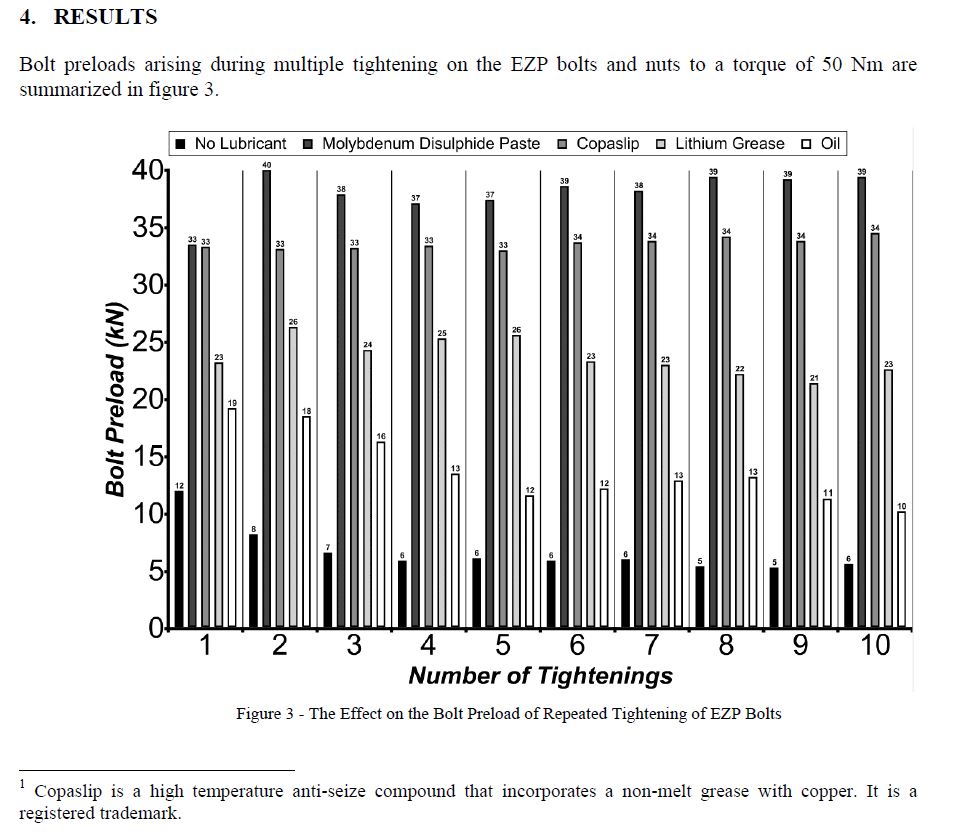
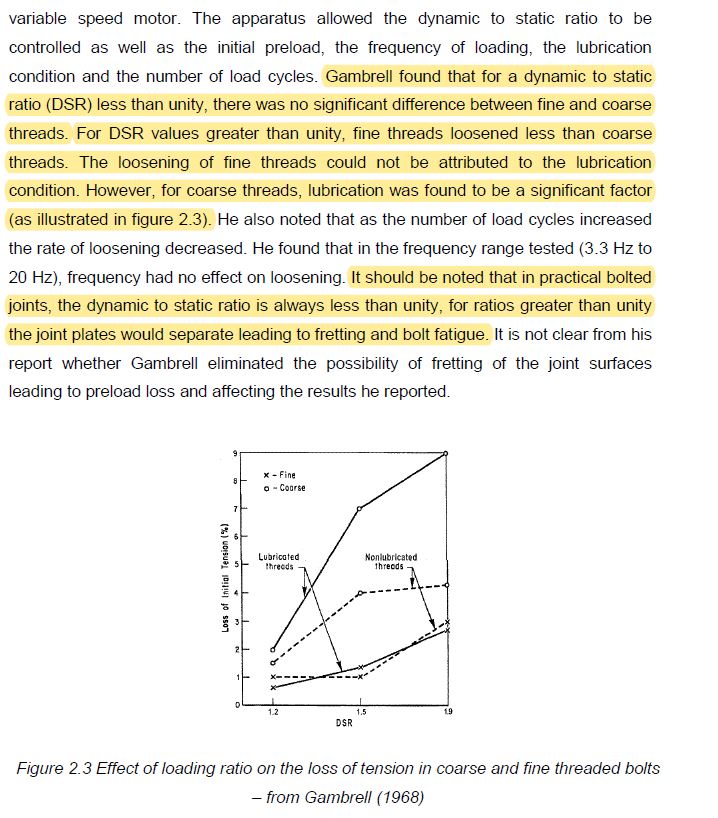
So we're on the same page. Are you saying, only when using coarse threads while above DSR unity is where you don't recommend using lubrication?

Because that is a very specific application.


DSRLossoftension.jpg


I hope you would agree that consistency in preload is paramount over all; particularly for bolts that see frequent reuse.

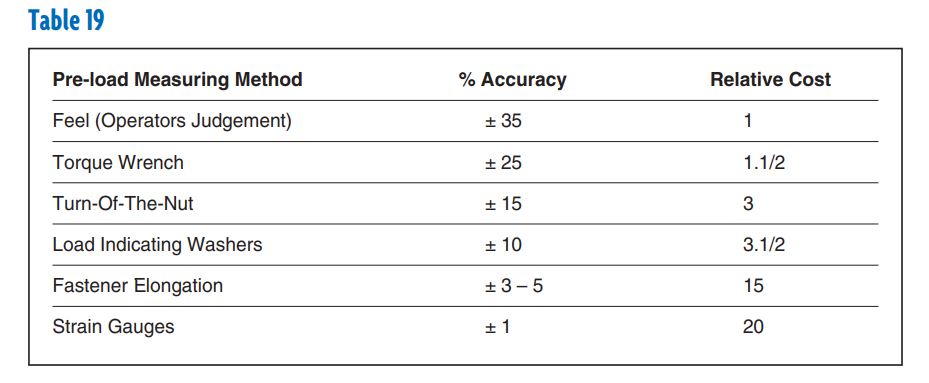
Lubrication.jpg


Lubrication2.jpg


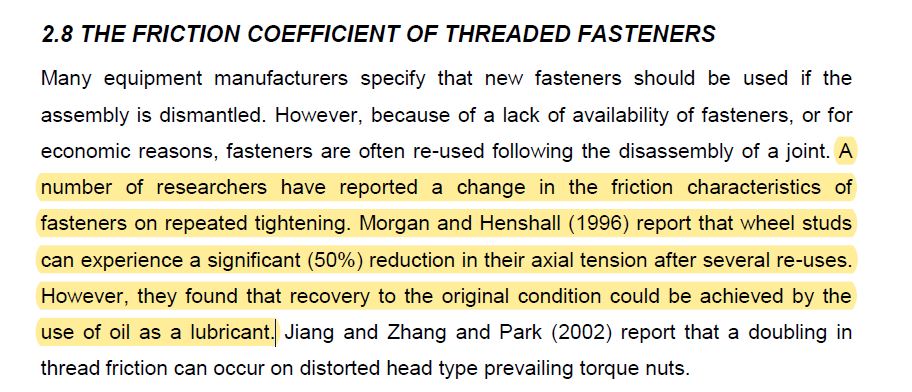
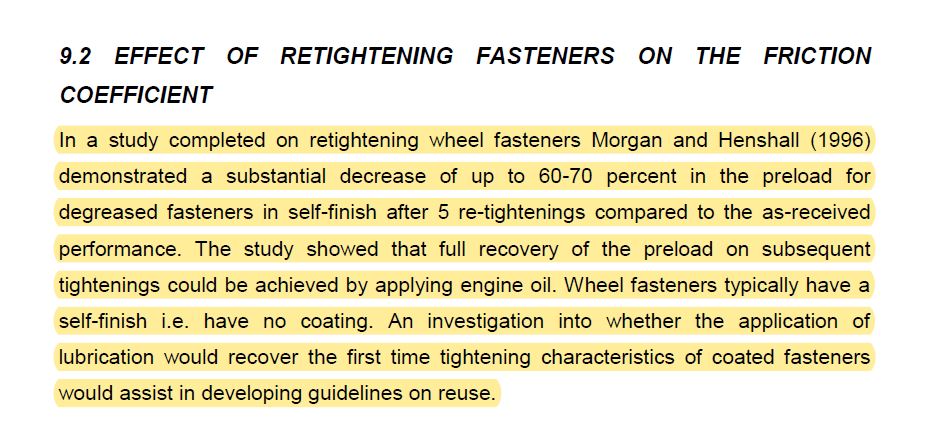
copa.jpg


copa2.jpg
 
Last edited:

Fcvapor05

Well-known member
Joined
May 4, 2014
Messages
1,079
Are you saying, only when using course threads while above DSR unity is where you don't recommend using lubrication?

No. I’m saying that this very narrow study (most all studies are narrow in scope, that’s not a slight against the study itself) provides a clear example of conditions where what I’m saying is true, is true.

That’s not a statement that it isn’t true under other conditions.

My recommendation is that when you take something apart, you put it back together the way the manual instructs you to. If it instructs you to lubricate, do so. If it does not, do not.

Rules of thumb like you’re promoting are generally wrong about 50% of the time.
 

dsaabm

Well-known member
Joined
Jan 6, 2009
Messages
308
Location
USA
Are you an engineering student? This is an interesting discussion with valid points about effects of corrosion and lubrication but have some practical perspective and maybe a xanax.

Modifying the oem torque spec to account for the difference in bolt plating or plating degradation?? Yeah then lets go ahead and torque it with our $9.99 Harbor Freight torque wrench.
 
OP
N

noid

Well-known member
Joined
Jul 15, 2010
Messages
1,341
No. I’m saying that this very narrow study (most all studies are narrow in scope, that’s not a slight against the study itself) provides a clear example of conditions where what I’m saying is true, is true.

That’s not a statement that it isn’t true under other conditions.

My recommendation is that when you take something apart, you put it back together the way the manual instructs you to. If it instructs you to lubricate, do so. If it does not, do not.

Rules of thumb like you’re promoting are generally wrong about 50% of the time.

Too say its 50% of the time is extreme.

There are legitimate applications where a locking method is required and most applications that warranty some sort of locking method will be identified (agree, read the manual).

But to say that lubrication is a bad thing is just silly because not lubricating leaves both inconsistency and degradation of preload for bolts that are reused.

I'm sure you're not insisting on changing a bolt any and everytime one is removed.


The big grain of salt with manuals is:

1. They assume everything is new and fresh - per above, just simply loosening and tightening a fresh bolt a few times can and does reduce the preload by ~50%.

2. You have to keep in mind when the manual was made. If you pull up a BMW torque manual from the 80's all the torque specs assume cadmium, the ones now indicate for both zinc and cadmium on the basis of both being available OE options.

3. There are many applications where no manual can be found, or you're creating something of your own.

Are you an engineering student? This is an interesting discussion with valid points about effects of corrosion and lubrication but have some practical perspective and maybe a xanax.

Modifying the oem torque spec to account for the difference in bolt plating or plating degradation?? Yeah then lets go ahead and torque it with our $9.99 Harbor Freight torque wrench.

Living in the rust belt is a humbling experience.

Its hard to imagine a life without anti-seize.

Re: bolt plating and degradation - remember that combinations of these effect tension by magnitudes of 50%+, this can lead to serious under or over tension.

The $9.99 harbor freight torque wrench is the least of the worries.
 
Last edited:

M635_Guy

Well-known member
Joined
Dec 5, 2019
Messages
4,333
Location
NC
Too say its 50% of the time is extreme.

There are legitimate applications where a locking method is required and most applications that warranty some sort of locking method will be identified (agree, read the manual).

But to say that lubrication is a bad thing is just silly because not lubricating leaves both inconsistency and degradation of preload for bolts that are reused.

I'm sure you're not insisting on changing a bolt any and everytime one is removed.


The big grain of salt with manuals is:

1. They assume everything is new and fresh - per above, just simply loosening and tightening a fresh bolt a few times can and does reduce the preload by ~50%.

2. You have to keep in mind when the manual was made. If you pull up a BMW torque manual from the 80's all the torque specs assume cadmium, the ones now indicate for both zinc and cadmium on the basis of both being available OE options.

3. There are many applications where no manual can be found, or you're creating something of your own.


Living in the rust belt is a humbling experience.

Its hard to imagine a life without anti-seize.

Re: bolt plating and degradation - remember that combinations of these effect tension by magnitudes of 50%+, this can lead to serious under or over tension.

The $9.99 harbor freight torque wrench is the least of the worries.

So let me get this straight: You're a guy who's read a couple articles arguing with a guy who (if I understand it right) certifies this kind of thing for a living...

:rolleyes2
 
OP
N

noid

Well-known member
Joined
Jul 15, 2010
Messages
1,341
So let me get this straight: You're a guy who's read a couple articles arguing with a guy who (if I understand it right) certifies this kind of thing for a living...

:rolleyes2

Are we comparing stamps or pinky rings or something? :p

Never try to flex your 'experience' or 'education'; instead your knowledge should be apparent through its use.
 

M635_Guy

Well-known member
Joined
Dec 5, 2019
Messages
4,333
Location
NC
Are we comparing stamps or something? :p

Never try to flex your 'experience' or 'education'; instead your knowledge should be apparent through its use.

I'm just trying to figure out if you're trying to position yourself as an expert because you read something...
 

Fcvapor05

Well-known member
Joined
May 4, 2014
Messages
1,079
But to say that lubrication is a bad thing is just silly because not lubricating leaves both inconsistency and degradation of preload for bolts that are reused.

If you want to avoid degradation of preload, lubrication is exactly what you don't want.

I'm sure you're not insisting on changing a bolt any and everytime one is removed.

I've said nothing remotely close to that.

They assume everything is new and fresh - per above, just simply loosening and tightening a fresh bolt a few times can and does reduce the preload by ~50%.

No, they don't. I can assure you of that. Re-assembly tension is a very important factor in selecting the torque values that are published in maintenance manuals; the re-assembly torque specified in the manual is often not the same torque that was applied during assembly at the factory, specifically because re-use of fasteners is a real world occurrence that automotive manufacturers evaluate when they write maintenance procedures.

This is done specifically so that when you, say, re-install a wheel that's had a new tire put on, and someone torques the lugs to the value published in the manual, that person doesn't get killed 5 minutes later when the wheel comes off because the lug bolts loosen due to insufficient preload.

You have to keep in mind when the manual was made. If you pull up a BMW torque manual from the 80's all the torque specs assume cadmium, the ones now indicate for both zinc and cadmium on the basis of both being available OE options.

This is why universal size-based torque charts are a bad idea.. which is exactly what I said earlier.

There are many applications where no manual can be found, or you're creating something of your own

Absolutely true. If you're building something that is life safety critical, you should calculate what torque your fasteners need. Do most people do this? No. Do most people build things in their garages that are truly life safety critical? Also no.

bolt plating and degradation - remember that combinations of these effect tension by magnitudes of 50%+, this can lead to serious under or over tension.

You're making categorical statements based on very limited data.. as far as I can tell you watched 1 YouTube video and read a couple of articles on the internet. This is a lot more complicated than you're making it out to be.
 
OP
N

noid

Well-known member
Joined
Jul 15, 2010
Messages
1,341
If you want to avoid degradation of preload, lubrication is exactly what you don't want.


I've said nothing remotely close to that.


No, they don't. I can assure you of that. Re-assembly tension is a very important factor in selecting the torque values that are published in maintenance manuals; the re-assembly torque specified in the manual is often not the same torque that was applied during assembly at the factory, specifically because re-use of fasteners is a real world occurrence that automotive manufacturers evaluate when they write maintenance procedures.

This is done specifically so that when you, say, re-install a wheel that's had a new tire put on, and someone torques the lugs to the value published in the manual, that person doesn't get killed 5 minutes later when the wheel comes off because the lug bolts loosen due to insufficient preload.


This is why universal size-based torque charts are a bad idea.. which is exactly what I said earlier.


Absolutely true. If you're building something that is life safety critical, you should calculate what torque your fasteners need. Do most people do this? No. Do most people build things in their garages that are truly life safety critical? Also no.


You're making categorical statements based on very limited data.. as far as I can tell you watched 1 YouTube video and read a couple of articles on the internet. This is a lot more complicated than you're making it out to be.

That's a long way of saying that you agree that there is range of preload for a given torque based on condition.

I'm just not sure if you're insisting that the torque spec in a manual is supposed to cover all conditions and factors?

I'm not insisting someone needs to break out the calculator and reinvent the wheel here, but the mechanic in So Cal is going to have a much different experience versus the mechanic in Michigan on that 2002 Ford Escape 'reassembly'.
 

Fcvapor05

Well-known member
Joined
May 4, 2014
Messages
1,079
That's a long way of saying that you agree that there is range of preload for a given torque based on condition.

I never said I didn't agree with that.

What I said was that lubricating fasteners which don't call for lubrication is a bad idea. Which it is.

I'm just not sure if you're insisting that the torque spec in a manual is supposed to cover all conditions and factors?

When was the last time you heard a story about someone putting steering rack (or whatever) back on, re-using all the bolts, and then all the bolts falling out because they weren't tight enough?

Better yet, how many professional mechanics do you know who, when putting a customer's car back together, grease every fastener and recalculate all their own torque values? Bet its zero.
 

M635_Guy

Well-known member
Joined
Dec 5, 2019
Messages
4,333
Location
NC
I never said I didn't agree with that.

What I said was that lubricating fasteners which don't call for lubrication is a bad idea. Which it is.


When was the last time you heard a story about someone putting steering rack (or whatever) back on, re-using all the bolts, and then all the bolts falling out because they weren't tight enough?

Better yet, how many professional mechanics do you know who, when putting a customer's car back together, grease every fastener and recalculate all their own torque values? Bet its zero.

The single valuable thing in this thread is the knowledge that I can ignore absolutely anything he says.
 
To avoid these ads, REGISTER NOW!
Top Bottom