To avoid these ads, REGISTER NOW!

Track saw quandry

snod83

Well-known member
Joined
May 23, 2010
Messages
81
Am I the only one who thinks a track saw is drastic overkill for sheathing? Typically a chalk line and follow by eye is close enough for sheathing in my experience. I will say, I always wrap after sheathing, so maybe this approach wouldn't work for the new integrated wrap / sheathing.

Just my 2 cents.
 
To avoid these ads, REGISTER NOW!

mike93lx

ALLIANCE MEMBER
Joined
Dec 9, 2013
Messages
37,481
Location
Richmond, VA
Am I the only one who thinks a track saw is drastic overkill for sheathing? Typically a chalk line and follow by eye is close enough for sheathing in my experience. I will say, I always wrap after sheathing, so maybe this approach wouldn't work for the new integrated wrap / sheathing.

Just my 2 cents.
Eliminating binding risk, covering the blade when it's not in use and great dust collection sound like perfectly good reasons to want to use one. Plus you don't need a chalk line. Two marks, drop the track and make the cut.

I dont always use mine for sheathing, but also don't feel like I am wasting any time when I do.

I think an argument like that could be made for lots of tools. To each their own
 

cgrutt

Well-known member
Joined
Mar 4, 2016
Messages
8,217
I would love a track saw but haven't bought one yet. Surprising actually because I own a lot of tools. To me the real value of a track saw is dust collection and ability to make fast, accurate cuts indoors, particularly in finished living spaces. Think kitchen or bath renovation in customer's home or flooring work. I can also see a benefit with using one with expensive sheeting goods for cabinetry. I personally would never buy one for sheathing (but would probably use one if I already owned it). Three key items I've found for making accurate cuts by hand are: 1. Practice .... you definitely become better with more experience; 2. A stable work platform at comfortable height ... could be as simple as a pair of saw horses with two 2x4s for holding full sheets of sheet goods; and, 3. Using a saw where you can see the cut line... that could mean either a right or left-hand blade depending on what and where you are cutting. I am right handed and strongly prefer using a left-blade saw although unfortunately most are now set up right-blade. I recently bought a corded Makita hypoid (sp?) saw and love it for general carpentry although I do mostly use my right-blade Milwaukee M18 just for convenience. I do have a small Milwaukee M12 left-blade saw which is great for small projects but it tends to stay in my tool cabinet most of the time. I sometimes clamp my level (either 4' or 8') when cuts need to be reasonably straight.

I've been thinking about a track saw for a long time and "think" I'm leaning towards Festool although the Makita is compelling because of price. The main reason I am leaning towards Festool is dust collection and the Festool splinter guard and riving knife. I've also read a lot that Makita tracks can be hit or miss in terms of how straight they are. I'm not sure if I'd buy the smaller or larger size saw... probably larger. I'd buy the corded version because it would be used almost exclusively with my Festool vac and be connected to a hose anyway so cord is no big deal.

ETA if money were no object and I needed the best I'd buy the Mafell.
 

lardy1

Well-known member
Joined
Mar 17, 2019
Messages
3,397
Location
Michigan
I'm seriously CONSIDERING buying one but I still have a hard time spending over five hundred dollars on something that does what I already do on my table saw. I can see some luxury in breaking down panels but I already have a table saw with good infeed and outfeed so I'm not gaining in capability and I'm struggling to convince myself to spend six hundred just to make it a bit easier (if it even is).
 

mike93lx

ALLIANCE MEMBER
Joined
Dec 9, 2013
Messages
37,481
Location
Richmond, VA
I'm seriously CONSIDERING buying one but I still have a hard time spending over five hundred dollars on something that does what I already do on my table saw. I can see some luxury in breaking down panels but I already have a table saw with good infeed and outfeed so I'm not gaining in capability and I'm struggling to convince myself to spend six hundred just to make it a bit easier (if it even is).
Thank me later :)


If you can get it with a 55" track, I think that's a more useful size. I have two 55's and haven't found an instance where I wished I had smaller
 

cgrutt

Well-known member
Joined
Mar 4, 2016
Messages
8,217
This one is a good reason to use it for sheathing, especially osb. No need to watch the cut and get all kinds of **** sprayed in your face
I was talking about making straight cuts without a guide. Not sure what saw you are using that sprays all kinds of **** in your face but that hasn't been a problem with me. If I were cutting sheathing it would most likely be outside on a job site and I certainly wouldn't be using a vac for dust collection. Now that I think about it some more I probably wouldn't be using a track saw for sheathing even if I owned one. Why waste an expensive blade on OSB or exterior ply?
 

mike93lx

ALLIANCE MEMBER
Joined
Dec 9, 2013
Messages
37,481
Location
Richmond, VA
I was talking about making straight cuts without a guide. Not sure what saw you are using that sprays all kinds of **** in your face but that hasn't been a problem with me. If I were cutting sheathing it would most likely be outside on a job site and I certainly wouldn't be using a vac for dust collection. Now that I think about it some more I probably wouldn't be using a track saw for sheathing even if I owned one. Why waste an expensive blade on OSB or exterior ply?
Any circular saw I have ever used throws dust and chips up to some extent
 

cgrutt

Well-known member
Joined
Mar 4, 2016
Messages
8,217
Any circular saw I have ever used throws dust and chips up to some extent
That is still the case with a track saw unless it's connected to a vac, no? BTW I do understand the blade is not exposed in a track saw just don't think sheathing is a good use for one.
 

tjansson

Well-known member
Joined
Apr 25, 2018
Messages
196
Location
Northern Vermont
How well track saws work on warped or sagging material? I use 1/2" ply for sheathing, it often has a bit of a curve to it. Most noticeable when ripping a sheet lengthwise on saw horses.
 

mike93lx

ALLIANCE MEMBER
Joined
Dec 9, 2013
Messages
37,481
Location
Richmond, VA
How well track saws work on warped or sagging material? I use 1/2" ply for sheathing, it often has a bit of a curve to it. Most noticeable when ripping a sheet lengthwise on saw horses.
If the track isn't in good contact with the material, it's going to move around, even if there is enough flex for the track to contact as the cut is made.
I would probably use a regular circular saw for that rip
 

tarbellb

Well-known member
Joined
Apr 17, 2011
Messages
5,747
Location
Oregon
Anybody on the fence and on a budget go grab the Wen and PowerTec combo

Literally under $250 for saw + 110" track

1000010398.png
 

Attachments

  • 1000010397.png
    1000010397.png
    625.4 KB · Views: 12

neophyte

Well-known member
Joined
Apr 23, 2012
Messages
9,585
Location
Pennsylvannia
Eliminating binding risk, covering the blade when it's not in use and great dust collection sound like perfectly good reasons to want to use one. Plus you don't need a chalk line. Two marks, drop the track and make the cut.

I dont always use mine for sheathing, but also don't feel like I am wasting any time when I do.

I think an argument like that could be made for lots of tools. To each their own
Track saws don’t eliminate binding risk, even ones with a riving knife.
 

neophyte

Well-known member
Joined
Apr 23, 2012
Messages
9,585
Location
Pennsylvannia
How well track saws work on warped or sagging material? I use 1/2" ply for sheathing, it often has a bit of a curve to it. Most noticeable when ripping a sheet lengthwise on saw horses.
The first thing to buy after purchasing a track saw, is a coarser toothed construction blade, preferably one meant for ripping, or combo/ripping/crosscutting.
The blades that come with most track saws have way too many teeth, and are designed for cutting fine “thin” flooring material, and are much more likely to bind or kickback when cutting deeper depths, or out-of-flat or warped/bent materials.
 

neophyte

Well-known member
Joined
Apr 23, 2012
Messages
9,585
Location
Pennsylvannia
bad word choice. I'm not talking about wood movement. You can't twist the saw.
A track clamped to non-flat material can cause the track to bend, which can then cause the saw to bind and kickback.
This is one of the reasons a coarser general purpose blade should be the first thing purchased with a tracksaw.
As for “twisting” the saw in a cut, I’ve had less kickback issues with a Milwaukee tilt-lok saw, cutting freehand, then I’ve had using a Festool track saw.
The coarser blades that typically come with general purpose circular saws are much less likely to cause kickback than the fine toothed blades that come with track saws.
The Milwaukee saws also have a higher cutting speed, which also helps.
 

mike93lx

ALLIANCE MEMBER
Joined
Dec 9, 2013
Messages
37,481
Location
Richmond, VA
A track clamped to non-flat material can cause the track to bend, which can then cause the saw to bind and kickback.
This is one of the reasons a coarser general purpose blade should be the first thing purchased with a tracksaw.
As for “twisting” the saw in a cut, I’ve had less kickback issues with a Milwaukee tilt-lok saw, cutting freehand, then I’ve had using a Festool track saw.
The coarser blades that typically come with general purpose circular saws are much less likely to cause kickback than the fine toothed blades that come with track saws.
The Milwaukee saws also have a higher cutting speed, which also helps.
I posted in this thread that I would not use a track saw on warped material.

I agree on replacing the stock blade

I like my track saw a lot and use it when possible because it performs well.
 
Last edited:
To avoid these ads, REGISTER NOW!

Firebrick43

Well-known member
Joined
May 12, 2015
Messages
14,022
Location
West central Indiana
I layout and cutout boards from rough cut air dried hardwood lumber using my dewalt tracksaw using the original blade without issues in binding cuts. Sometimes it does grab the riving knife and you have to retract and recut but never any significant kickback. This might be also due to the fact that the dewalt tracksaw has anti kickback cams on the track that do not allow it to move backwards on the track.

This gives me at least one good straight edge to then rip the other on the table saw. After jointing a face and planing to thickness I will recur one edge on the table saw if there is any additional warping and recut the other on the table saw.

I have not jointed an edge on the jointer for years.
 

mike93lx

ALLIANCE MEMBER
Joined
Dec 9, 2013
Messages
37,481
Location
Richmond, VA
I layout and cutout boards from rough cut air dried hardwood lumber using my dewalt tracksaw using the original blade without issues in binding cuts. Sometimes it does grab the riving knife and you have to retract and recut but never any significant kickback. This might be also due to the fact that the dewalt tracksaw has anti kickback cams on the track that do not allow it to move backwards on the track.

This gives me at least one good straight edge to then rip the other on the table saw. After jointing a face and planing to thickness I will recur one edge on the table saw if there is any additional warping and recut the other on the table saw.

I have not jointed an edge on the jointer for years.
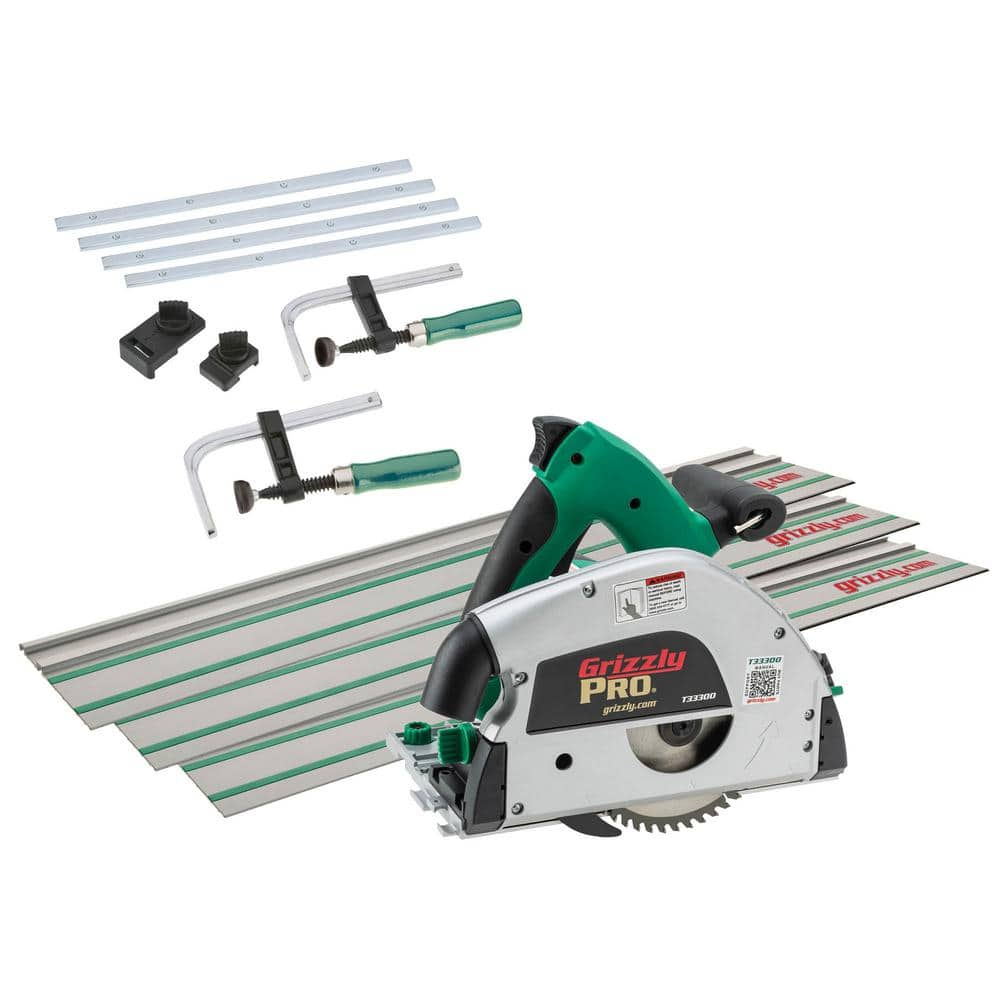
My grizzly saw doesn't have kickback cams but my buddy's wen does. Threw me of the first time I used it as I have gotten used to a "dry run" of the cut to make sure the hose and cord will move OK and I have the right reach to get all the way through a cut. Seems like it could be a nice feature, though

When I havent done something stupid like lifting the saw up while the blade is spinning before retrracting it, I haven't experienced any kick back
 

bpwoodworking

Well-known member
Joined
Jul 6, 2023
Messages
254
I’ve put a ton of mileage on little and big festool track saws. If budget allows, go with Mafell, they’re better.

I ripped 10/4 poplar recently, 10’ lengths with the Mafell tracksaw, it doesn’t skip a beat but in the past when I’ve done that with festool, I had to take 3-4 passes and baby the thing even with the correct rip blade.

I’ve done the same with 10/4 walnut and both sides toward center with 16/4 sapele.
 

Downwindtracker 2

Well-known member
Joined
Jun 13, 2019
Messages
1,715
Location
BC
Carpenters' humour : For sheathing if the cut is near by, it's good 'nuff . Anything more and the foreman is going to start asking about your girl friend Lassie, in much less polite terms.

It's been over 50 years since I started my apprenticeship . It was in commercial and industrial, a lot of cutting plywood. With a well balanced Skilsaw like the 534, I was able to cut the line in half, and not a fuzzy chalk line, leaving half the line on the good side. My Makita 5007 balances just as well as those Skilsaws. So I can't blame the saw, when I screwed up. I was using a guide, too. A bit humbling that.

Using a table saw to rip sheets takes a run of 20' with good infeed , side, and outfeed supports. It also takes careful skill and a fair bit of muscle . Cabinet shops use saws with sliding tables, the cheap ones are about $10,000, the serious ones are $30,000.

Out of the box, like my DeWalt or my Unisaw, I had to set up the saw. When I dry lubed it ,I was able to tighten up the rail adjustment, adding to accuracy.

I broke down a sheet of 3/4" plywood for some shelves after trimming the splitter guide on some sheathing. BTW, the sheathing was warped and the rail flexed to conform to the curve. The Makita connectors tightened very well, but I also used a good straightedge as the connectors don't self align.

I found I used it left handed, since I'm almost ambidextrous , no big deal with a mistake proof track.

Using it to rip 2" strips, not a track saw strong point, I found the wide grip strips very effective, and since I was only using one , it was a good thing. The clamps wouldn't work here. I was not impressed by the Amazon clamps, I may spring for some Bessey ones.

It wasn't just the saw, it's the track as well, that's important.
 

cgrutt

Well-known member
Joined
Mar 4, 2016
Messages
8,217
Using a table saw to rip sheets takes a run of 20' with good infeed , side, and outfeed supports. It also takes careful skill and a fair bit of muscle . Cabinet shops use saws with sliding tables, the cheap ones are about $10,000, the serious ones are $30,000.

More than that. My buddy is a high end cabinet maker and I remember his dad's saw back in the 80s cost more than $30k and that was completely manual. He bought a panel saw that was pretty much automated all digital screen table moved by itself etc and I think it was about $50k 25 years ago. He wound up spending about $1 mil for a CNC machine but that included a separate building. I think the machine itself was over $200k. Crazy expensive. He does some pretty high end work for people that money doesn't seem to be a problem in NYC and Connecticut. $100k for a custom closet is everyday stuff for him at this point but I remember him starting out with normal kitchens etc. He's done really well for himself.

Just saw this I don't think it's same brand but functionally pretty similar to his saw.
Screenshot_20240314_144913_Chrome.jpg
 
OP
W

Walkers

Well-known member
Joined
May 17, 2021
Messages
3,912
Location
Cave Creek Az
Am I the only one who thinks a track saw is drastic overkill for sheathing? Typically a chalk line and follow by eye is close enough for sheathing in my experience. I will say, I always wrap after sheathing, so maybe this approach wouldn't work for the new integrated wrap / sheathing.

Just my 2 cents.
I build big iron doors for a living. I build to a 1/16“ tolerance, but get a little cranky if I have to use it a lot, so going to framing with plus or minus a 1/2” is something I have a hard time adapting to.
 

mike93lx

ALLIANCE MEMBER
Joined
Dec 9, 2013
Messages
37,481
Location
Richmond, VA
I build big iron doors for a living. I build to a 1/16“ tolerance, but get a little cranky if I have to use it a lot, so going to framing with plus or minus a 1/2” is something I have a hard time adapting to.
In a non production environment, there is just no need to give up accuracy for speed. So what if I save 5 minutes building my shed or a couple hours on my shop roof? Moving slower is beneficial anyway for a non pro
 

snod83

Well-known member
Joined
May 23, 2010
Messages
81
I build big iron doors for a living. I build to a 1/16“ tolerance, but get a little cranky if I have to use it a lot, so going to framing with plus or minus a 1/2” is something I have a hard time adapting to.
Yeah - I get it. I'm also not trying to say that a track saw is not an awesome tool, as it is. It is just that for framing / sheathing, I believe it to be overkill, just my opinion.

For the record - I own a table saw, track saw, circular saw with guide, etc and my go to for framing is a chalk line (because sheathing kills pencils) and a circular saw.
 
OP
W

Walkers

Well-known member
Joined
May 17, 2021
Messages
3,912
Location
Cave Creek Az
Yeah - I get it. I'm also not trying to say that a track saw is not an awesome tool, as it is. It is just that for framing / sheathing, I believe it to be overkill, just my opinion.

For the record - I own a table saw, track saw, circular saw with guide, etc and my go to for framing is a chalk line (because sheathing kills pencils) and a circular saw.
I also don’t make great long straight cuts in sheathing, which is odd because I can use my Milwaukee 8.25” metal cutting saw and make a very accurate cut to a scribed line on and 8’ sheet of steel.
 

mike93lx

ALLIANCE MEMBER
Joined
Dec 9, 2013
Messages
37,481
Location
Richmond, VA
I also don’t make great long straight cuts in sheathing, which is odd because I can use my Milwaukee 8.25” metal cutting saw and make a very accurate cut to a scribed line on and 8’ sheet of steel.
I bet a lot of thay is the speed of the cut. Moving fast makes it easier to stay on track. Also with metal, there's more resistance to going off path
 

Downwindtracker 2

Well-known member
Joined
Jun 13, 2019
Messages
1,715
Location
BC
I have couple of skilsaws, an old Makita and recent Milwaukee, no carpenter can only have one . The Makita has great balance, the Milwaukee some how doesn't feel right, it feels clumsy. It how ever is better than the Made in USA Milwaukee it replaced, that wore out. They were both used for rough work.

What I'm saying is you ability to make good cuts could be the saw.
 

SBAG

Well-known member
Joined
Aug 27, 2022
Messages
208
I’ve put a ton of mileage on little and big festool track saws. If budget allows, go with Mafell, they’re better.

I ripped 10/4 poplar recently, 10’ lengths with the Mafell tracksaw, it doesn’t skip a beat but in the past when I’ve done that with festool, I had to take 3-4 passes and baby the thing even with the correct rip blade.

I’ve done the same with 10/4 walnut and both sides toward center with 16/4 sapele.
My thinner kerf battery powered Festool does decently, but it's still a finish saw designed mostly for sheet goods. I might look at a Mafell when and if I go bigger. I don't think the tracks are compatible though and I have a **** ton of Festool track (I don't like taking parallel and right angle guides on and off all of the time, then I swallowed the LR32 kool aid so I needed some with holes).
 

neophyte

Well-known member
Joined
Apr 23, 2012
Messages
9,585
Location
Pennsylvannia
My thinner kerf battery powered Festool does decently, but it's still a finish saw designed mostly for sheet goods. I might look at a Mafell when and if I go bigger. I don't think the tracks are compatible though and I have a **** ton of Festool track (I don't like taking parallel and right angle guides on and off all of the time, then I swallowed the LR32 kool aid so I needed some with holes).
Some Mafell saws work on Festool track, but the tracks are not really interchangeable.
 

Downwindtracker 2

Well-known member
Joined
Jun 13, 2019
Messages
1,715
Location
BC
He is another way to look at the cost. I was going to build a couple of bookcases out of 3/4" walnut plywood, as I had some. What is the cost of one walnut bookcase ? I would think the saw would pay for itself on that one project, let alone the second one . The saw then is free and second one is gravy. Or if I screw up a sheet, that is half the price of the saw. It's not that hard to do with a skilsaw and a guide as I have found out. Luckily it wasn't on something that mattered . I did get a lot more serious about a track saw after that.
 

alwaysFlOoReD

Well-known member
Joined
Sep 24, 2013
Messages
2,395
Location
Airdrie, Alberta, Canada
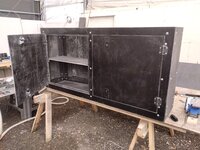
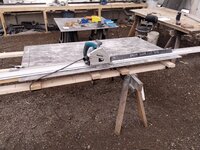
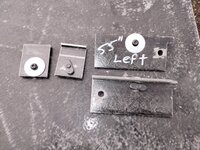
I talked the boss into buying a corded makita track saw plus the 118" track. The saw comes with a 55" track included. It has simplified and cut down labor costs for making frp panels with doors cut out of the panel. I made stops so that cuts are repeatable and there is next to no filing or sanding the inside corners. The face frame and doors are cut from one piece.
IMG_20240104_132154032.jpgIMG_20240301_150503326.jpgIMG_20240314_155444971.jpg
 

Firebrick43

Well-known member
Joined
May 12, 2015
Messages
14,022
Location
West central Indiana
I talked the boss into buying a corded makita track saw plus the 118" track. The saw comes with a 55" track included. It has simplified and cut down labor costs for making frp panels with doors cut out of the panel. I made stops so that cuts are repeatable and there is next to no filing or sanding the inside corners.IMG_20240104_132154032.jpgIMG_20240301_150503326.jpgIMG_20240314_155444971.jpg
The shop you are employed at in canada is a temporary shelter with dirt floors?
 
To avoid these ads, REGISTER NOW!
Top Bottom