Carpenters' humour : For sheathing if the cut is near by, it's good 'nuff . Anything more and the foreman is going to start asking about your girl friend Lassie, in much less polite terms.
It's been over 50 years since I started my apprenticeship . It was in commercial and industrial, a lot of cutting plywood. With a well balanced Skilsaw like the 534, I was able to cut the line in half, and not a fuzzy chalk line, leaving half the line on the good side. My Makita 5007 balances just as well as those Skilsaws. So I can't blame the saw, when I screwed up. I was using a guide, too. A bit humbling that.
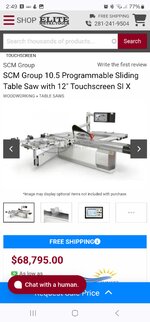
Using a table saw to rip sheets takes a run of 20' with good infeed , side, and outfeed supports. It also takes careful skill and a fair bit of muscle . Cabinet shops use saws with sliding tables, the cheap ones are about $10,000, the serious ones are $30,000.
Out of the box, like my DeWalt or my Unisaw, I had to set up the saw. When I dry lubed it ,I was able to tighten up the rail adjustment, adding to accuracy.
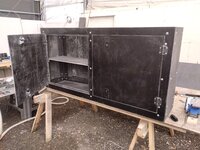
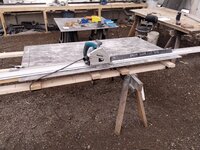
I broke down a sheet of 3/4" plywood for some shelves after trimming the splitter guide on some sheathing. BTW, the sheathing was warped and the rail flexed to conform to the curve. The Makita connectors tightened very well, but I also used a good straightedge as the connectors don't self align.
I found I used it left handed, since I'm almost ambidextrous , no big deal with a mistake proof track.
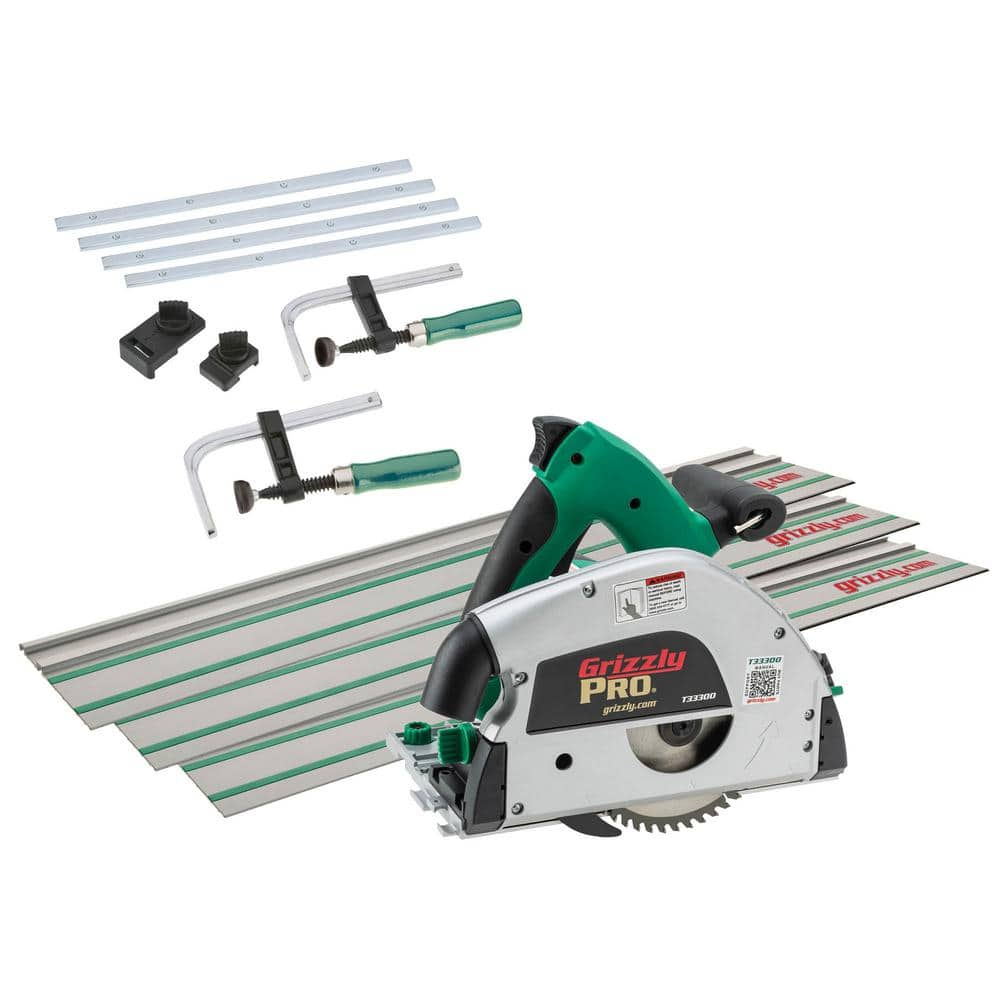
Using it to rip 2" strips, not a track saw strong point, I found the wide grip strips very effective, and since I was only using one , it was a good thing. The clamps wouldn't work here. I was not impressed by the Amazon clamps, I may spring for some Bessey ones.
It wasn't just the saw, it's the track as well, that's important.