Most cars only use the accelerometer - which is often located under the passenger seat.
However, larger vehicles and work vehicles often use a supplementary electronic "crush switch" or accelerometer on the front, because they are subject to unusual jolts from trailers and such.
As I recall the Tundra does have one of those behind the middle section of the bumper - offset slightly to the driver's side.
When there is a supplementary, the computer compares the crash impulse from the accelerometer to the switch sensor and when both register in the right sequence and timing - the airbags are deployed.
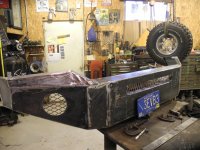
A homemade or aftermarket bumper will most definitely alter the timing of the crush of the front of the vehicle. The homemade bumper above looks considerably stronger than the OEM bumper - assuming it is - that will delay the signal coming from the supplementary switch. It's possible that it would still work, or it's possible that it wouldn't. It's possible it would still work in a low speed crash, but not a high speed one or vice versa.
The only way to test it would be to crash the vehicle to find out.
The thing that is hard to understand is that it's very, very difficult to figure out if a vehicle is crashing into something within 15 milliseconds. You have to be able to determine if you're hitting something hard, or just bumping it. You have to determine if the vehicle is rolling over or crashing forward, or getting T-boned. You have to weed out other issues - a chain drawing taught on one of the tow hooks, something dropping into the bed, or shifting in the bed, a mechanic hammering on the frame of the vehicle or the seat track, towing a heavy trailer, which can cause all kinds of bumps and jolts.
And all that has to be determined in the first 15/1000 of a second, in order to get the airbags deployed soon enough.
Ford did a study a couple years ago on an F150 and concluded that some aftermarket bumpers would work and some wouldn't - but it was written off for two reasons - first it was an engineering study; they did computer simulations, but they didn't go out and crash trucks, which is very expensive, and second folks said it was just Ford trying to get you to buy their OEM parts. I know personally that their simulations are pretty darn good and the engineers really weren't worried about their parts business, but that was the criticism anyway.
I've not looked, but I'd be surprised if the aftermarket companies don't warn you that you install their equipment at your own risk. If you look at the vehicle owners manual it also will tell you that your safety system warranty and liability are all void if you alter the vehicle.
It's your choice to change your vehicle. Just like it's your choice to smoke or not, or to ride a motorcycle or not, or do base jumping or not - all of those alter your chances of dying prematurely - some more than others. I'm not your mother.
What I am is a guy that knows what he's talking about on this topic, and giving you the opportunity to take those risks with full knowledge rather than ignorance - which some in this thread seem to possess.