To avoid these ads, REGISTER NOW!

Two post lift concrete mistake

NUTTSGT

Super Moderator
Staff member
Joined
Sep 14, 2009
Messages
50,912
Location
Northern Central Ohio
If there is dust in an epoxy hole, the epoxy won't bind to the wall as well as designed, and you will severely reduce your design strength. Inspectors will check minimum hole diameter, and put a large q-tip in the hole to check for dust. If it's not clean, they won't let you install.
I believe Zeke understands that. I believe he believes cleaning the hole should always be done and should be common sense.

I believe you two are in agreeance.
 
To avoid these ads, REGISTER NOW!

Rockable

Well-known member
Joined
Jan 6, 2019
Messages
482
Location
Oak Ridge, NC
My God! Every person I know goes through this awful angst of "is my concrete going to hold up my lift?"

It's simple math. A 12 x 12 pad under each column yields 288 SQUARE INCHES of surface area. 10,000 pounds/288 square inches = 34.7 pounds per square inch. To say that you've already over engineered it is an understatement. You will never have a problem.

(PS - add a little for the weight of the lift if you want to get exact.)
 

WNYflyer

Well-known member
Joined
Sep 13, 2009
Messages
2,119
Location
Lockport, NY
My God! Every person I know goes through this awful angst of "is my concrete going to hold up my lift?"

It's simple math. A 12 x 12 pad under each column yields 288 SQUARE INCHES of surface area. 10,000 pounds/288 square inches = 34.7 pounds per square inch. To say that you've already over engineered it is an understatement. You will never have a problem.

(PS - add a little for the weight of the lift if you want to get exact.)
For a two post lift the anchor bolts and concrete slab/foundation must also be designed to resist the overturning moment/tipping force at the base of the columns and not just the vertical axial load.
 

dave*99

Well-known member
Joined
May 5, 2009
Messages
4,263
Location
Coastal NJ
Did you install these initially or switch over to them from previously installed wedge anchors? I have wedge anchors right now and was thinking of replacing them with these since some of my existing anchors keep taking torque during monthly re-torques.
How much torque are you applying on your re-torque?
 

70runner

Well-known member
Joined
Feb 17, 2010
Messages
189
Location
Avocado country
Did you install these initially or switch over to them from previously installed wedge anchors? I have wedge anchors right now and was thinking of replacing them with these since some of my existing anchors keep taking torque during monthly re-torques.

My first lift install, bout 12yrs ago, used the supplied mechanical anchors. A couple of these eventually started spinning, would not hold torque. Replaced with Wej-It Power-Sert epoxy anchors. Next install, used all Wej-It anchors. No issues, but this time around went with the Hilti HY200/HIT-Z system as I believe it is superior to the Wej-It design.

The Hilti HY200 system is designed to eliminate standard hole cleanout, chart from their Fastening Technical Guide below. Seems counter-intuitive, so I cleaned the holes anyway. Cleaning does provide a slight load increase with the HY200 system.

HY200.JPG
 

Rockable

Well-known member
Joined
Jan 6, 2019
Messages
482
Location
Oak Ridge, NC
For a two post lift the anchor bolts and concrete slab/foundation must also be designed to resist the overturning moment/tipping force at the base of the columns and not just the vertical axial load.
True but there is plenty of room for error.
 

C-S-H

Well-known member
Joined
Jan 18, 2024
Messages
145
For a two post lift the anchor bolts and concrete slab/foundation must also be designed to resist the overturning moment/tipping force at the base of the columns and not just the vertical axial load.
Judging by their retrofit slab designs, they forgot to design for the overturning moment in one direction.
 

Homewrecker

Well-known member
Joined
Sep 19, 2013
Messages
159
Location
Toronto, Ontario, Canada
My first lift install, bout 12yrs ago, used the supplied mechanical anchors. A couple of these eventually started spinning, would not hold torque. Replaced with Wej-It Power-Sert epoxy anchors. Next install, used all Wej-It anchors. No issues, but this time around went with the Hilti HY200/HIT-Z system as I believe it is superior to the Wej-It design.

The Hilti HY200 system is designed to eliminate standard hole cleanout, chart from their Fastening Technical Guide below. Seems counter-intuitive, so I cleaned the holes anyway. Cleaning does provide a slight load increase with the HY200 system.

HY200.JPG
The documentation calls for a monthly re-torque of 100ft lbs. There are a couple of wedge anchors that keep turning a couple of degrees each time I re-torque them. My original plan was to eventually hammer those down and try some Wej-it mechanical anchors since the ones that came with the lift are probably not the greatest.

Instead, I'm considering using the Hilti Epoxy Anchors. Only issue in this case is that my holes are drilled through the slab to facilitate the need to hammer any anchors down in case they get screwed up. From what I read this system does not mention use in through-holes. I guess I could plug the very bottom of the hole somehow but would rather get someone who knows how to properly install these.
 

Rusted Nut

Well-known member
Joined
Dec 11, 2022
Messages
1,809
Location
PNW
I believe Zeke understands that. I believe he believes cleaning the hole should always be done and should be common sense.

I believe you two are in agreeance.
Yup, I read zeke’s post wrong. Good we agree.
 

jonesg

Well-known member
Joined
Mar 15, 2010
Messages
1,698
Location
northern Maine/
My God! Every person I know goes through this awful angst of "is my concrete going to hold up my lift?"

It's simple math. A 12 x 12 pad under each column yields 288 SQUARE INCHES of surface area. 10,000 pounds/288 square inches = 34.7 pounds per square inch. To say that you've already over engineered it is an understatement. You will never have a problem.

(PS - add a little for the weight of the lift if you want to get exact.)
Prudence turns to fear in a busy mind.
 

wssix99

Well-known member
Joined
Mar 2, 2011
Messages
5,159
Location
Chicago, IL
Not to second guess professionals but the idea of putting 3/4" rebar in a slab on grade is absurd.
BendPak's new concrete guide has this for new slabs but the steel area ratio (for crack control) is really aggressive. They have 12" and 10" spacing for this rebar, depending on the slab thickness and I expect these combos were chosen for ease of concrete placement.

The same design can be achieved with #4 at tighter spacings at a lower material cost, but the tight spacing has its drawbacks. I have only heard of #6 being placed like this in commercial slabs.

Maybe they are recommending this as an insurance policy so they can be 100% sure they won't have any customers call up with cracks on their new slab? Looking at ACI's guidelines for Steel Area Ratio, the BendPak guidelines meet the spec for total (saw cut) control joint elimination.

^ All of this is overkill. BendPak should at least call out that their numbers are for floors without control joints, but again this feels like par for the course for their instructions.
 

wssix99

Well-known member
Joined
Mar 2, 2011
Messages
5,159
Location
Chicago, IL
Why don't people put in Sonotube type piers in new floors when they know they are installing a lift? Everyone seems to have questions about this. I don't want any questions if it's my job.
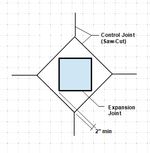
A sonotube foundation constrains the slab when it shrinks during the cure and causes cracking, so control joints are required to be cut around it. (For a circular foundation, the cuts go all the way to the circle.) https://www.jlconline.com/how-to/foundations/joints-in-concrete-slabs_o

1705864161491.png

These saw cut joints and the cracks then cause complications. It would be possible to engineer a proper sonotube foundation for a 2 post lift and sink it like a telephone pole in the ground, but to get all the needed clearances for J bolts or the anchors, I expect it would probably need to be a 24" or larger tube. (Big expense.)

The 2 post lifts don't need this because they use the slab like a flat plate attached to the columns. Even though a suspended unreinforced piece of concrete is not a great "plate," it has significantly more strength when continuously supported by ground beneath it. (If you have ever tried to break concrete sitting on the ground with a sledge hammer vs. concrete with an air gap below, you have felt this.)
 

LopezBart

Well-known member
Joined
Oct 13, 2023
Messages
2,538
Location
Lopez Island, WA
I used epoxy on a couple holes that didn’t seem right with my drop in anchors. I used Simpson (I think) high strength threaded rod designed for this application. Pretty sure it was grade 8.
Note that the strongest isn't necessarily the best in all applications. Sometimes the concrete or the bond strength is the limiting factor in overall developed strength of the entire assembly, and there's some advantages to the ductility of the lower grades, esp. if the threaded rods end up not perfectly vertical and need to be bent to install the mating assembly. Of course, as long as everything lines up, there's not harm in the stronger stuff and it helps some folks sleep better.
 

rayra

Well-known member
Joined
Dec 1, 2014
Messages
4,724
Location
Escaped from Los Angeles
If I had extra depth, I'd take advantage and use 8" long all thread with epoxy. Now you're using the whole thickness instead of the mechanical anchors in the top half of the slap. I feel like that would make up for lack of rebar.

I dont think the issue is the mechanical attachment of the lift to the slab but rather the robustness and strength of the slab undergirding the point weight of the vehicles on the left.

OP at least got a thickened base. that should help.

And since the OP managed to neglect communicating the desire for rebar AND the concrete guy didn't think a major thickening of the slab was something that he should maybe ask about putting rebar into, I feel it is necessary to bring to the OP's attention that he should wait at least 30 days before mounting his lift on / into the slab, for the concrete to achieve most of its potential strength. And as long as practicable before he lifts a car on it. Give the concrete as much curing time as you can afford to give it.
 

WNYflyer

Well-known member
Joined
Sep 13, 2009
Messages
2,119
Location
Lockport, NY
BendPak's new concrete guide has this for new slabs but the steel area ratio (for crack control) is really aggressive. They have 12" and 10" spacing for this rebar, depending on the slab thickness and I expect these combos were chosen for ease of concrete placement.

The same design can be achieved with #4 at tighter spacings at a lower material cost, but the tight spacing has its drawbacks. I have only heard of #6 being placed like this in commercial slabs.

Maybe they are recommending this as an insurance policy so they can be 100% sure they won't have any customers call up with cracks on their new slab? Looking at ACI's guidelines for Steel Area Ratio, the BendPak guidelines meet the spec for total (saw cut) control joint elimination.

^ All of this is overkill. BendPak should at least call out that their numbers are for floors without control joints, but again this feels like par for the course for their instructions.
The newer "Concrete Foundation Minimum Requirement" as linked in post #5 is brutal. Looks like it has contributions from numerous folks with no one pulling it all together in a coherent document. For New Concrete Foundation Requirement: Long bars are temperature steel while short bars are the main reinforcing? One sketch seems to indicate main reinforcing steel is to be close to the top of the foundation while other sketches show reinforcing steel near the base of the foundation so basically no definitive requirement indicated on the proper location height wise of the reinforcing steel.

In the words of Ricky Ricardo............."aye yi yi" :lol:
 

Zeke

Well-known member
Joined
Aug 13, 2009
Messages
17,176
Location
Long Beach CA, the sewer by the sea.
A sonotube foundation constrains the slab when it shrinks during the cure and causes cracking, so control joints are required to be cut around it. (For a circular foundation, the cuts go all the way to the circle.) https://www.jlconline.com/how-to/foundations/joints-in-concrete-slabs_o

1705864161491.png

These saw cut joints and the cracks then cause complications. It would be possible to engineer a proper sonotube foundation for a 2 post lift and sink it like a telephone pole in the ground, but to get all the needed clearances for J bolts or the anchors, I expect it would probably need to be a 24" or larger tube. (Big expense.)

The 2 post lifts don't need this because they use the slab like a flat plate attached to the columns. Even though a suspended unreinforced piece of concrete is not a great "plate," it has significantly more strength when continuously supported by ground beneath it. (If you have ever tried to break concrete sitting on the ground with a sledge hammer vs. concrete with an air gap below, you have felt this.)
Maybe I should have been more clear. A concrete column under any post lift of mine would be below the slab with rebar sticking out and then bent over to be tied to horizontal rebar in the slab. The slab would be continuous. Anchors and bolts would go in later unless a template could be made to hold them. Thing is, it's hard to finish around anything sticking out of the slab. I'd much rather have threaded receivers set at slab height or just below to ensure a nice level pad for the post to rest.

If that's not a good idea it won't be the first.
 

wssix99

Well-known member
Joined
Mar 2, 2011
Messages
5,159
Location
Chicago, IL
For New Concrete Foundation Requirement: Long bars are temperature steel while short bars are the main reinforcing? One sketch seems to indicate main reinforcing steel is to be close to the top of the foundation while other sketches show reinforcing steel near the base of the foundation so basically no definitive requirement indicated on the proper location height wise of the reinforcing steel.
I think those top bars you are seeing are the "alternate" dowel bars that can be used instead of keying. They have a note about this ...but they show them on a drawing of a keyed slab. -facepalm_1e6d3fa634ff6583f64bfc5acaa9265a57506370.gifThis document doesn't do a clear job of separating new slabs from repair slabs. (Calling a repair slab a "New Concrete Foundation" is not good...)

Thanks to BendPak for stepping up with this document and trying to match the likes of Mohawk, et al. but its time for Version 3.

"aye yi yi"
 

wssix99

Well-known member
Joined
Mar 2, 2011
Messages
5,159
Location
Chicago, IL
Maybe I should have been more clear. A concrete column under any post lift of mine would be below the slab with rebar sticking out and then bent over to be tied to horizontal rebar in the slab. The slab would be continuous.
Yea, this still creates the same issues and would need to be isolated like any other foundation. (Because the rebar locks and constrains the slab in those locations.)

If you put a pencil mark on the slab on top of the exact centers of where these two sonotubes would be right after the concrete dries and then measure it; that distance will decrease as the concrete cures and shrinks over the first 30 days. If the sonotubes are underneath the slabs and tied into the slab, they "lock" those locations in space. In the sonotube situation, the slab can't physically contract as it cures and uncontrolled cracks will form between those two points.

The vertical forces of a car on lift are really not significant. Our cars sit on 4 tires. When on a lift all that weight moves to the lift plates. Even though the 2 plates on a 2-post lift are less than 4 tires, they are much bigger than the contact patches of all those tires and distribute the load out to similar pressure. (On a structure like a bridge, the total weight is the significant factor but on a non-structural slab with dirt underneath, the loads move through to pressure on the ground.)
 
OP
C

cccoltsicehockey

Well-known member
Joined
Apr 3, 2014
Messages
1,388
Location
Charlotte, NC
I dont think the issue is the mechanical attachment of the lift to the slab but rather the robustness and strength of the slab undergirding the point weight of the vehicles on the left.

OP at least got a thickened base. that should help.

And since the OP managed to neglect communicating the desire for rebar AND the concrete guy didn't think a major thickening of the slab was something that he should maybe ask about putting rebar into, I feel it is necessary to bring to the OP's attention that he should wait at least 30 days before mounting his lift on / into the slab, for the concrete to achieve most of its potential strength. And as long as practicable before he lifts a car on it. Give the concrete as much curing time as you can afford to give it.
Appreciate the reminder on that. The concrete should end up good and strong by that point. Slab has been in a week now and we will only be starting electrical and plumbing this week and they are scheduled to possibly be here for 3 weeks. I won't end up having the lift installed till the full build is finished up so that will likely be around 3 months or more till the lift is installed.
 

70runner

Well-known member
Joined
Feb 17, 2010
Messages
189
Location
Avocado country
Instead, I'm considering using the Hilti Epoxy Anchors. Only issue in this case is that my holes are drilled through the slab to facilitate the need to hammer any anchors down in case they get screwed up. From what I read this system does not mention use in through-holes. I guess I could plug the very bottom of the hole somehow but would rather get someone who knows how to properly install these.
For holes drilled through the slab, Hilti told me this is a common method to remedy mechanical anchors that won't hold torque. Plug the bottom of the hole, get some proper length/width Hilti Hit-Z epoxy anchors and install per instructions. If you have concerns, call Hilti, they're very helpful.
I think those top bars you are seeing are the "alternate" dowel bars that can be used instead of keying. They have a note about this ...but they show them on a drawing of a keyed slab. -facepalm_1e6d3fa634ff6583f64bfc5acaa9265a57506370.gifThis document doesn't do a clear job of separating new slabs from repair slabs. (Calling a repair slab a "New Concrete Foundation" is not good...)
Very confusing. Noticed this when I was using their specs to design my slab rebar layout.
 
To avoid these ads, REGISTER NOW!

uscarry45

Well-known member
Joined
Oct 21, 2012
Messages
295
I dont know much about concrete but i have always wondered about attaching a large piece of 1/2“ or thicker steel plate to the bottom of the lift to spread out forces. If you expanded to the ridiculous and welded a 4ft x 8 ft x 1”plate to the bottom of each column and bolted that to 4“ concrete it would be very difficult for it to tip over
 

C-S-H

Well-known member
Joined
Jan 18, 2024
Messages
145
I dont know much about concrete but i have always wondered about attaching a large piece of 1/2“ or thicker steel plate to the bottom of the lift to spread out forces. If you expanded to the ridiculous and welded a 4ft x 8 ft x 1”plate to the bottom of each column and bolted that to 4“ concrete it would be very difficult for it to tip over
You are assuming that there is something wrong with the structural design. I design similar weldments attached to concrete on a regular basis, but with orders of magnitude more force. I use sound engineering design principles and methods, and the connections work great every time. You just have to trust that the design was done correctly. The 2-post base connections look flimsy to me, but I haven't checked the designs and they seem to work fine.
 

Garrym

Member
Joined
Feb 28, 2013
Messages
12
I dont know much about concrete but i have always wondered about attaching a large piece of 1/2“ or thicker steel plate to the bottom of the lift to spread out forces. If you expanded to the ridiculous and welded a 4ft x 8 ft x 1”plate to the bottom of each column and bolted that to 4“ concrete it would be very difficult for it to tip over
I would guess that my brackets connecting the tops of the posts to the roof would be a lot less expensive.
 

dave*99

Well-known member
Joined
May 5, 2009
Messages
4,263
Location
Coastal NJ
I would guess that my brackets connecting the tops of the posts to the roof would be a lot less expensive.
The topic of attaching the top of lift posts to the building structure has been discussed before on GJ. I'm not saying it won't work, but there were plenty of comments about it not being correct because the lift was not designed to transfer load to the tops of the posts. A certain amount of flex is part of the design etc. I suspect if you asked the lift engineering department about it they would not recommend it.

Look at it this way.... if your installation ever needed to rely on your attachment to the roof, then there is a deficiency in your installation.

Atlas has this solution.


1706532731001.png

YMMV
 
Last edited:

wssix99

Well-known member
Joined
Mar 2, 2011
Messages
5,159
Location
Chicago, IL
The topic of attaching the top of lift posts to the building structure has been discussed before on GJ. I'm not saying it won't work, but there were plenty of comments about it not being correct because the lift was not designed to transfer load to the tops of the posts.
The bigger issue for me would be that no roof or ceiling would be designed for that kind of moving load (the column tops bend and move a great deal) and it could cause the ceiling to collapse.
 

dave*99

Well-known member
Joined
May 5, 2009
Messages
4,263
Location
Coastal NJ
The bigger issue for me would be that no roof or ceiling would be designed for that kind of moving load (the column tops bend and move a great deal) and it could cause the ceiling to collapse.
You may be right. But the biggest issue to me is it's not in the manufacturers spec and even after reading a thousand posts on GJ and seeing a thousand photos of lift installations……. Let’s just say it’s a unique approach.

There is safety margin in the manufacturers design. I’m betting on that.

My wedge anchors are rock solid. I have a Rotary lift installed per the manual. Done.
 

firebirdparts

Well-known member
Joined
Jun 8, 2016
Messages
10,602
Location
Kingsport, TN
My God! Every person I know goes through this awful angst of "is my concrete going to hold up my lift?"

It's simple math. A 12 x 12 pad under each column yields 288 SQUARE INCHES of surface area. 10,000 pounds/288 square inches = 34.7 pounds per square inch. To say that you've already over engineered it is an understatement. You will never have a problem.

(PS - add a little for the weight of the lift if you want to get exact.)
With a two post lift, the concrete isn't holding the lift UP. The concrete is holding it DOWN.

Part of you post, though, is correct. People do not just bolt up and go happily sometimes when they should. Like this case here.
 

minytrker

Well-known member
Joined
Sep 19, 2012
Messages
1,376
Location
Brenham TX
Epoxy in all thread ! Drill down 7 inch - don’t blow thru the bottom of the concrete.
I have had almost 10 lifts and all were were installed with anchor bolts and were drilled all the way through the slab. I was told 20 years ago when I got my lift that you drill through so you can hammer a damaged bolts all the way through if you ever have to replace one. I check the torque on my lift anchor bolts every couple months and they are always tight.
 

Garrym

Member
Joined
Feb 28, 2013
Messages
12
I don’t know what type of roof the OP has, I’m just adding my two cents as a possible solution to a concrete problem.

The columns of my lifts, and though they are Chinese I assume they’re pretty much typical, are simply a channel in which a sled travels up and down.

I’m pretty sure it doesn’t care where it’s supported.

As for flex, no thanks.
I’m much happier working under a car where it’s rock solid.
You can have flex, I’ll pass.

As for the engineering department, I suspect they may agree with me.

Both mine are bracketed to steel roofs. I don’t imagine I’d do it if they were softwood trusses.

Neither roof has collapsed, and I wouldn’t be under a car if the posts “bend and move a great deal”.

I have tried shaking a raised car, just as a test and they barely move.
As I said, rock solid. The only flex is in the arms.

I’ve never checked the bolts in the floor. They don’t even need the nuts, they simply stop the bottoms moving.
And I don’t consider my installation deficient, it hasn’t moved in over a decade.

This is one of the roof brackets, I think it’ll hold…

IMG_5745.jpeg

And the 10mm bolts in the 80mm slab.

IMG_5756.jpeg

Cheers.

YMMV
 

Attachments

  • IMG_5745.jpeg
    IMG_5745.jpeg
    818.1 KB · Views: 9

Homewrecker

Well-known member
Joined
Sep 19, 2013
Messages
159
Location
Toronto, Ontario, Canada
The topic of attaching the top of lift posts to the building structure has been discussed before on GJ. I'm not saying it won't work, but there were plenty of comments about it not being correct because the lift was not designed to transfer load to the tops of the posts. A certain amount of flex is part of the design etc. I suspect if you asked the lift engineering department about it they would not recommend it.

Look at it this way.... if your installation ever needed to rely on your attachment to the roof, then there is a deficiency in your installation.

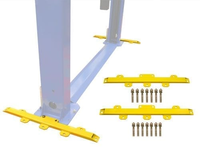
Atlas has this solution.


1706532731001.png

YMMV
I've got these base extensions for my lift. Mine are made by Peak Lift and look identical expect grey in color. Didn't really need them but was offered a good deal on the last set since the distributor doesn't sell many. There are a total of 13 anchors on each post lol.
 

Dig Doug

Well-known member
Joined
Apr 16, 2018
Messages
1,102
I have had almost 10 lifts and all were were installed with anchor bolts and were drilled all the way through the slab. I was told 20 years ago when I got my lift that you drill through so you can hammer a damaged bolts all the way through if you ever have to replace one. I check the torque on my lift anchor bolts every couple months and they are always tight.

What happens to the concrete when drilling all the way through is It Blows out the back side
sometimes it’s huge and other times it’s not. After drilling hundreds of holes, you can kinda Get a feel for the drill and you need to let up on the pressure and just let it core thru When you get down to the last inch or so.

That reduces the concrete thickness.

Quick bolts, wedge anchors, Hilti bolts etc are all great ! But every once in a while you get one that doesn’t work right, They just spin, don’t catch and just pull out, I’ve had a few bend while hammering them into the hole, or mushroom the threads….
Ive probably installed 5,000 + in various diameters

Ive never had a problem with all thread and Simpson Epoxy
With Epoxy you want to catch all sauce and not let it drain out the bottom.
 
Last edited:

Dig Doug

Well-known member
Joined
Apr 16, 2018
Messages
1,102
I don’t know what type of roof the OP has, I’m just adding my two cents as a possible solution to a concrete problem.

The columns of my lifts, and though they are Chinese I assume they’re pretty much typical, are simply a channel in which a sled travels up and down.

I’m pretty sure it doesn’t care where it’s supported.

As for flex, no thanks.
I’m much happier working under a car where it’s rock solid.
You can have flex, I’ll pass.

As for the engineering department, I suspect they may agree with me.

Both mine are bracketed to steel roofs. I don’t imagine I’d do it if they were softwood trusses.

Neither roof has collapsed, and I wouldn’t be under a car if the posts “bend and move a great deal”.

I have tried shaking a raised car, just as a test and they barely move.
As I said, rock solid. The only flex is in the arms.

I’ve never checked the bolts in the floor. They don’t even need the nuts, they simply stop the bottoms moving.
And I don’t consider my installation deficient, it hasn’t moved in over a decade.

This is one of the roof brackets, I think it’ll hold…

IMG_5745.jpeg

And the 10mm bolts in the 80mm slab.

IMG_5756.jpeg

Cheers.

YMMV

if your in a climate that has extreme temperature changes you should check them every once in a while, concrete will expand and contract w/ temperature and humidity / water

meaning the concrete can loosen up around the anchor by expanding during winter - wetter and shrinking during summer when it drys out

Im sure yours will be good, just a word of caution
 

Garrym

Member
Joined
Feb 28, 2013
Messages
12
Thanks Dig Doug.

Thought I’d better post a pic of the attachment points on top of the post.

Just in case some keyboard commando thought I was deficient in my bracketry.

I know it would never happen here, but some unthinking soul might cast aspersions on my ability to make something strong enough.

Yes I know that’s hard to believe, but you would be surprised by the way some blokes can hurt your feelings.

As I said, I think this will hold…

IMG_5767.jpeg
 

racecougar

Well-known member
Joined
Jan 26, 2021
Messages
5,042
Location
Missouri
Thanks Dig Doug.

Thought I’d better post a pic of the attachment points on top of the post.

Just in case some keyboard commando thought I was deficient in my bracketry.

I know it would never happen here, but some unthinking soul might cast aspersions on my ability to make something strong enough.

Yes I know that’s hard to believe, but you would be surprised by the way some blokes can hurt your feelings.

As I said, I think this will hold…

IMG_5767.jpeg
The connection at the post isn't the concern whatsoever. Hurt feelings and a wake-up call are better than not waking up.
 

dave*99

Well-known member
Joined
May 5, 2009
Messages
4,263
Location
Coastal NJ
The connection at the post isn't the concern whatsoever. Hurt feelings and a wake-up call are better than not waking up.
There are a lot of bolts in the load path. The roof bracket is bolted to the column extension which is bolted to the lift post…..
 

wssix99

Well-known member
Joined
Mar 2, 2011
Messages
5,159
Location
Chicago, IL
Lots of bad ideas flowing in that don't address the OP's problem, which seems to have a pathway to resolution with the manufacturer's alternate procedures and a swift kick in the nuts for the installer. I'm not sure why we would throw these other ideas on the table that would cause someone to risk life and limb. (or structure)

 
To avoid these ads, REGISTER NOW!
Top Bottom