To avoid these ads, REGISTER NOW!

Below 265 SQ/FT Unconventional Post & Beam Shed Build 12'x14'

All workspaces below 265 squarefeet.

MegaVan

Well-known member
Joined
Dec 17, 2020
Messages
274
Location
Ohio
Lurking for a long time here (years) and finally some things worth posting.

*EDIT to insert content links*

Contents for those who need to skip to the relevant portions:
*End Edit - We now return to your scheduled broadcast*

I have a mid-sized (~1.2 acres) property in a development in NW Ohio. The home is a yellow foursquare that was built by a farmer in 1916, the original farm was ~100 acres, bought by a builder and re-distributed into a development. The farmer kept woods on the 10 acres around the house as he was removing the trees with a one horse team - maybe he liked the trees - who knows. There are 20-30 mature trees on the property including several 100-300 yr old shaggy hickory trees.

Here is a snapshot from 1969 when the original builder/farmer still lived here:
1969.jpg

Today the barn and chicken shack out back are gone, the well is gone, and there are more houses built around, but most of the mature trees remain.

Living in a development was not my ideal situation, but the overall feel of the area is very park-like and the home was by far the cheapest on the block, so any improvements to the property will translate pretty well to the value of the property. No HOA.

An existing 30x40 pole barn (Built 1980) is on the property, but some structural damage was revealed during the inspection, and it does not fit well with the more premium homes in the area. A repair estimate from Morton came in at $35k for 3-5 post replacements, a couple garage doors, and new siding / roofing. This wouldn't even touch the inherent issues with the building (no overhangs, no concrete, the center of the building was never filled with gravel so it fills with water, massive moisture issues, homemade trusses likely too far apart, etc). I requested quotes from a half dozen companies for a direct replacement, but they came in at $48k-60k - partly pandemic related nonsense. I had a solid discussion with Geobarns, and as a company they seemed far more likely to deliver a product I would be satisfied with (and would match the original feel of the property.

After talking to George for a few weeks he encouraged me to do what was financially best for my situation. In my case buying a giant wooden barn when wood was at an all time high - well it didn't make any sense. He agreed that waiting for lumber to return to some version of normal was a good idea. The solution was to build a shed while waiting for that. My tools are rotting in the barn and all my "garage" stuff from the old house got shoved into the basement to protect it. A mid size highly useful shed could be valuable to me.

I came up with a plan and location:
Shed.jpg

I chose to use some construction methods similar to the existing home to try out some materials that I've been eying for the house as things wear out (siding, shingles, etc). I filed for and received a permit with the City in April - the county won't regulate a shed under 200 sq ft. I settled on 12'x14' for various reasons.

IMG_6685.jpg

More to come.
 
Last edited:
To avoid these ads, REGISTER NOW!

billconner

Well-known member
Joined
Jul 20, 2021
Messages
6,970
Location
Thousand Islands NYS
Sounds like a good plan.

I did want to comment on "the county won't regulate a shed under 200 sq ft." It depends on how you define "regulate" but usually this is "a permit is not required" but the structure still has to comply with the building code.

My jurisdiction has a similar exception for sheds under 144 sq ft, which don't require a building permit, but I still have to have a zoning permit.
 
OP
M

MegaVan

Well-known member
Joined
Dec 17, 2020
Messages
274
Location
Ohio
Building a small stick frame shed would have been well within my skillset and I wanted to use this opportunity to push myself a little and see what type of building I would enjoy and also try to create something that blends with the property and maintains that "premium" environment.

My grandfather designed and built dozens of homes and camps throughout Maine and I wanted to also attempt the design and build of this mini-shop. I knew I'd make mistakes - but this leads to a rapid type of learning and I was/am OK with that.

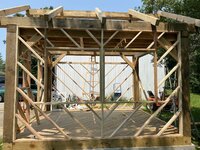
I settled on a hybrid post & beam type construction. Several variations occurred with design and changes due to COVID material shortages were required several times. The biggest changes were moving from a 12x16 (right up on that 200 sq ft mark) to 12x14, and changing the roof pitch from 12/12 to 7/12 to drop down to 8' rafters (wildly cheaper than 10' at the time).

Foundation is to be temporary and so a fully supported floor was in order. I settled on a shallow footing rather than a gravel pad so that the area under the shed can be fully ventilated. Rodent guard will be installed.

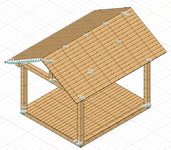
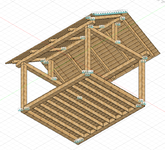
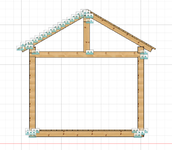
I used Fusion360 (free for home users) to double check the fit (taking things from my head to the computer to make sure there were no interferences). The overhang isn't quite the same as final.

IMG_6681.PNG
IMG_6682.PNG
IMG_6683.PNG
IMG_6684.PNG

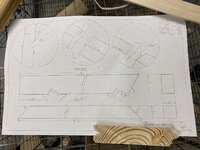
I then applied some measurements from Fusion 360 to hand drawings and made modifications as necessary to make sure that the structure was held together by gravity and the timber joints - with the intention of using heavy & long timber screws as pins holding everything together.

I like hand drawings to take to the spot and make sure I have all my measurements right. It also helps me make sure I have my purchase list right.

IMG_6678.JPG
IMG_6689.JPG
IMG_6690.JPG

Modifications were made to the ledger strip to comply with code.

Once I got the long lead materials on order I broke ground (next post).
 
OP
M

MegaVan

Well-known member
Joined
Dec 17, 2020
Messages
274
Location
Ohio
I want to take a moment to point out that what I'm doing is an inherently bad design and poor timber frame / post & beam practice.

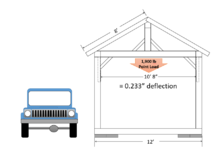
I'm utilizing a ridge beam so that I do not have to have cross ties on the interior, however, because there ridge posts rest on the cross beam for the front and rear of the shed, that means there is a point load that is extremely high relative to the rest of the loads in the design. Due to the expense of wood with Covid, using 8x8 lumber didn't actually change my costs, but it's important to note that this may not be the best design to copy for any reason.

Utilizing local snow load, the rough force per ridge beam is 1,900 lbs. At max load that would lead to a beam deflection on the rough cut 8x8's of under 1/4".

1628523494006.png

A better design would be a king truss if utilizing metal roofing- however, since I am working towards a shingle roof, this is simpler and easier.

Braces are for anti-racking forces only and were not considered in the dead or live load calculations.
 

mannydantyla

Well-known member
Joined
Jan 24, 2019
Messages
160
Location
LFK
I love your drawings

So you needed to apply for a permit yet the local government doesn't require one for sheds smaller than 200 sqft? Doesn't make sense to me but I can understand that! I'm building a 12x16 shed/workshop but it's attached to my (detached) garage. It's less than 200 sqft but because it's attached to another structure I needed a permit. No big deal though.
 
OP
M

MegaVan

Well-known member
Joined
Dec 17, 2020
Messages
274
Location
Ohio
@mannydantyla - you're correct, I just need a zoning permit from the city - their way of collecting some money on things without putting any effort in at all.

@captain14 - I've got the roof on and the walls mostly closed in - working on some windows, prepping for siding. There won't be any meaningful snow until November for sure, I find the working temperature is OK through October usually.

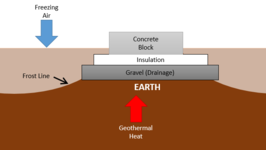
I did a lot of back and forth considering how to have a foundation for this - I decided against using a gravel pad as I felt it was too close to the dirt (and moisture problems). I also tried to figure out a way that the underside could maintain some continuous airflow to allow moisture out.

Finally I settled on a semi-insulated partial block foundation. That may not make complete sense right now but hopefully it does in a minute.

The shallow footing that I'm attempting to use is a basic concept I've seen used on some camps and homes. The idea is to use insulation and drainage to keep freezing water from creating frost heaves under the pier or foundation. I'll be honest I have no idea if it will work in this situation, but this design should be easy to jack and level if there is long term movement so I'm not worried about it either way.

1629805347134.png

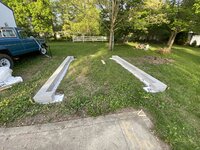
I laid out some stakes I made out of some scrap wood to get the foundation square and used a laser level to get the left and right side dug evenly. The left side has some (a lot) of gravel from a former driveway on the property, the right trench is mostly clay. The center will remain open only closed in with hardware cloth so that it can dry out. The prevailing winds are from the front to the rear of this photo:

IMG_6121.JPG

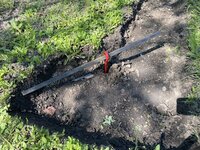
I installed two mobile home anchors at this point in opposite corners (they were 36 or 48 inches I can't recall which):
IMG_6126.JPG

Once deep enough I laid in several inches of gravel and compressed to level:
IMG_6128.JPG

Insulation inserted and concrete block (solid blocks 4"x8"x16" two tall) laid with landscape adhesive to keep them stable while things go up:
IMG_6147.JPG

Next I got working on the pressure treated for the floor/decking.
 
OP
M

MegaVan

Well-known member
Joined
Dec 17, 2020
Messages
274
Location
Ohio
The sill plate is 8x8 pressure treated rough cut timbers. These were heavy. Maybe 300 lbs or so each. Using a dolly I was able to wheel them around myself, but it was a chore. I can't seem to find the photos of prepping the timbers to fit with each other.

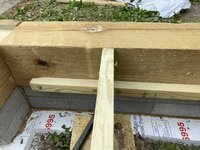
Basically I trimmed the ends to square with a Sawzall with a 12" blade (I have experience pipe fitting - this was very similar). The half laps were done with the Sawzall as well. The notched regions were done with a circular saw and several dozen passes then chiseled out by hand. Half laps are pinned in place with 3x timber screws per corner. There is the pink bubble wrap stuff between the PT and the concrete block to hopefully reduce rotting from the moisture in the blocks.

IMG_6161.JPG

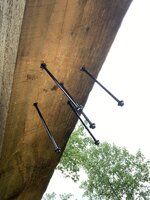
I installed large stainless hooks and turnbuckles to attach the sill plates to the earth anchors. It was very difficult to find turnbuckles that had a decent load rating. Many turnbuckles now are just cast aluminum with a very low load. These are made of steel, but I had to sift through a lot before I was able to find them. Always make sure you know the load rating of the part at the store - I had to look up the specifications on their website to know for sure. In this instance the lower rated item looked nearly identical, but had a rating of 220 lbs vs the ones I purchased with a working load of 1,500 lbs.
IMG_6162.JPG

Now here I used some older methods of joining that I realize are no longer considered acceptable, but I did take some extra precaution to make sure it is safe. I used a PT ledger strip to support the floor joists. The code permits (or used to permit) the use of some pretty small nails to hold in the ledger strip, but I used some "LedgerLok" basically lags to hold it in place which should reduce the ability of the strip to rotate as weight is applied. All joists are toe nailed as well. I used 2x8 PT for the floor joists @ 16" on center. In retrospect I wish I'd gone 12" on center, but lumber was so expensive at the time I felt I could not justify it.
IMG_6167.JPG

I installed blocking along the length of the shed, the intent is to put a mower in there - my mower weighs a lot. I'll need to proceed with caution still.
IMG_6172.JPG

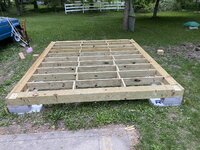
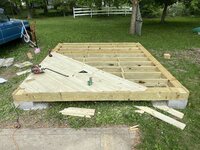
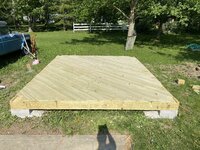
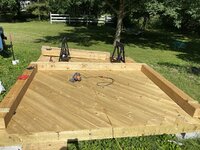
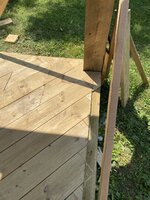
Again remembering that I'm applying similar construction to my home (1916) I applied 1x8 PT boards as decking diagonally. Due to the unruly nature of lumber prices during COVID this was actually cheaper than plywood at the time it was done.
IMG_6173.JPG

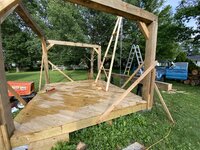
Finally I ended up with this "deck".

IMG_6179.JPG

In hindsight (20/20) I should have left the outer 3.5-4.0" uncovered for stud framing. Stupid mistake. Part of learning though. Next I started working with the remaining 8x8 (not PT) to carve and assemble the frame. Again, hindsight, I should have just learned to timberframe. May have been faster and easier.
 

jar944

Well-known member
Joined
Jul 26, 2010
Messages
5,927
Location
Northern VA
Now here I used some older methods of joining that I realize are no longer considered acceptable, but I did take some extra precaution to make sure it is safe. I used a PT ledger strip to support the floor joists. The code permits (or used to permit) the use of some pretty small nails to hold in the ledger strip, but I used some "LedgerLok" basically lags to hold it in place which should reduce the ability of the strip to rotate as weight is applied. All joists are toe nailed as well. I used 2x8 PT for the floor joists @ 16" on center. In retrospect I wish I'd gone 12" on center, but lumber was so expensive at the time I felt I could not justify it.
IMG_6167.JPG

I installed blocking along the length of the shed, the intent is to put a mower in there - my mower weighs a lot. I'll need to proceed with caution still.
IMG_6172.JPG
Looks good. I think I would have been inclined to cut joist pockets into the mud sill.
 

mike93lx

ALLIANCE MEMBER
Joined
Dec 9, 2013
Messages
37,577
Location
Richmond, VA
Definitely down for following along on this one.

Hopefully the recent drop in lumber pricing is helping you out
 

billconner

Well-known member
Joined
Jul 20, 2021
Messages
6,970
Location
Thousand Islands NYS
I don't think that your design really uses a shallow frost protected foundation. SFPF generally require foam under the entire building and some number of feet outside of the building, and at least 10" of cover. So a 10 x 10 building has an 18 x 18 area of foam on gravel so foam is at least 10" below grade. Just not enough projected area for the geothermal heat to keep frost free in cold climates. I don't think it will matter though and code does not require frost protection under 600 sf.
 
OP
M

MegaVan

Well-known member
Joined
Dec 17, 2020
Messages
274
Location
Ohio
@jar944 - I agree. I do not have a router and the time it would take to do it deterred me. I should have done it anyway (either purchased a router or taken the time)

@mike93lx - Not so much - most of my lumber was purchased as things were rising - I never had to purchase anything at peak and my worse price for a 2x4 was $7 which is ... Good? I guess? 1x material is still absurdly expensive.

@billconner - You're likely very right - however, it doesn't get too cold here so for me it is mostly about stability. I'm OK with some movement.

@Bad Eye Bill - Good eye. The J10 plays a starring role in the assembly. There will be more photos of it over time.
 
OP
M

MegaVan

Well-known member
Joined
Dec 17, 2020
Messages
274
Location
Ohio
With the deck in place it was time to move on to the frame cutting & assembly.

I cut all the posts to length (Sawzall w/ 12" blade) and notched them.
IMG_6232.JPG

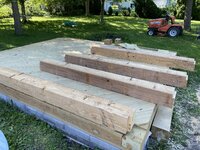
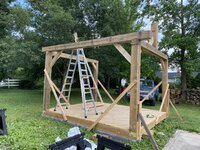
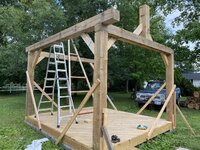
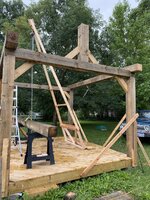
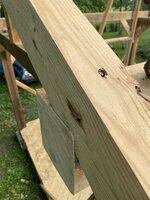
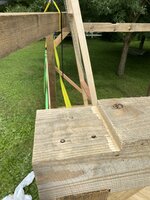
I then cut the beam to length, notched it, and assembled on the decking for a level fit using 3 timber screws as "pins". Personally I find the 8"x8" rough cut lumber appealing but there is some adjustment necessary as each one varies from 7 1/2" to 8".
IMG_6295.JPG
IMG_6296.JPG

I test fit the braces (more on this later).
IMG_6297.JPG

I then attached the ridge post with 5x timber screws.
IMG_6300.JPG

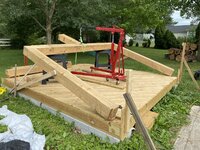
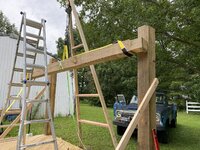
Then came the task of raising the first "bent". I attached legs to act as a safety if anything failed and also to use as temporary bracing once it was plumb and square. Also added stops to prevent it from going up and over. I started by getting it up off the ground with an engine hoist:
IMG_6469.JPG

Then I very carefully lined up the van and used straps and a temporary pole (one of the rafters) to pull it into place with the megavan. No one was within 20 feet of the bent while raising. I want to stress - this was dumb. Don't do it. I was too deep in to give up, keep reading for less dumb ideas.
Anonymous.jpg

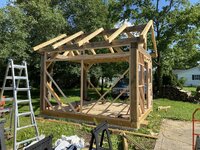
Here is the bent in place, plumb, squared, and with temporary and permanent braces in place.
IMG_6472.JPG

At this point I knew I wasn't going to be putting up anything else the way I did the first bent so I started doing research on how post frame and log cabins are built in the wilderness and away from available equipment. I looked renting a boom lift, however, $$$$$$$. So I kept looking for options that would cost less.
 

aqr81

Well-known member
Joined
Jul 20, 2010
Messages
1,127
Location
Central Valley, Ca.
Very creative project; I am going to follow and look forward to seeing your progress. You are doing a nice job and are showing very good craftsmanship.
 
OP
M

MegaVan

Well-known member
Joined
Dec 17, 2020
Messages
274
Location
Ohio
I'm going to step back briefly and show some detail on how I cut the notches on the timbers. It's nothing revolutionary - but since we've established I don't have a router it may be of interest to some.

I will stress that I'm a welder and machinist by trade so working with wood can be very frustrating, inaccurate, and unpredictable compared to metal. The idea behind this build was to make something beyond my skill level so that I can learn as much as possible. Regarding craftsmanship - head over to the forestryforum and check out what those guys do, now that's craftsmanship!

For the smallest corner notches I used the circular saw from both directions (no photo because that's pretty obvious).

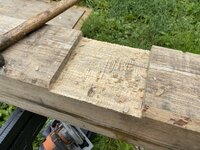
For notches in the middle of beams I set the circular saw blade to the depth desired (usually 1") and made a multitude of cuts.
IMG_6554.JPG

Then I elegantly smacked all the strips of wood out with a hammer (yeah that's a ball peen...):
IMG_6555.JPG

Then a chisel, mallet, and belt sander to clean everything up:
IMG_6553.JPG

Again - I don't think this would be considered too interesting or unusual but some may enjoy it.
 
To avoid these ads, REGISTER NOW!
OP
M

MegaVan

Well-known member
Joined
Dec 17, 2020
Messages
274
Location
Ohio
Back to old problems. Raising the other side of the shed.

I was not satisfied with the safety and effectiveness of using the mega van to lift the bent (see prior post). Additionally the yard would likely not have the traction needed for such a raise and the distance to the neighbors yard would pose issues too. So I started digging at the forestry forum to find what people would use to raise frames in the woods without a crane or a telehandler (rental costs seem high now as with everything else).

Two primary options came up. Gin poles and shear legs. Gin poles presented a lot of logistical problems as they require 3 guy wires and the land would make that pretty inconvenient, but I decided to look into the shear legs in a little more detail.

Shear legs would require a stable base, a single guy wire with a means of adjusting the length, and a pulley (or in my case - a chain hoist).

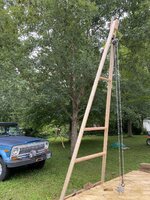
Somehow I'm missing any construction photos, but final "A" shape was made with 2"x4"x14' (everyone was out of 16' it was weird) tied off to the winch of my J10 - with a come along in between to adjust the depth, and a 15' 1/2T chain fall (chain hoist).
IMG_6547.JPG

Now, the winch on my truck is inoperable (the relay and switches were shot), but the brake on the winch works fantastically well, so I run the winch in and out manually to set the depth, then set the brake. It can be a pain, but it works.

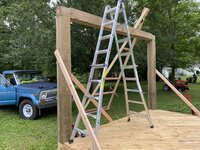
With all that nonsense sorted out I set the posts and put the shear legs to the test lifting the ~300lb beam.
IMG_6548.JPG

That worked beautifully, as I lifted the beam into place I tightened the come-a-long which moved the beam into the location required.IMG_6549.JPG

Now I will say that using this method, getting everything lined up square, plumb and level was a lot harder, especially since it had to be done 8' up in the air. Once everything was in place I put the temporary bracing on and screwed it all together.
IMG_6550.JPG

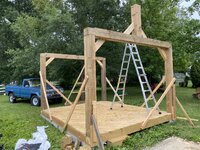
And here it is with the "permanent" 4x6 braces in place. I elected not to place the ridge post until closer to the timing of setting the ridge. I can't recall why now. I had a reason.
IMG_6552.JPG

Up next. Setting 16' beams and quality control issues.
 

wreckdiver1321

Well-known member
Joined
Aug 12, 2021
Messages
1,039
Location
Billings, MT
There's an undertone of humor to this entire thread, and I love it. Your mind for machining and metal work show through and your ingenuity is awesome. It's fun to watch you work.

Keep it up!
 
OP
M

MegaVan

Well-known member
Joined
Dec 17, 2020
Messages
274
Location
Ohio
@wreckdiver1321 - growing up in Maine I was surrounded by folks with a subtle yet persistent sense of sarcasm laced with realism. It's stuck with me through the years.

Now that I had a semi-functional crane I got to work notching the largest beams and getting them set in place.

I got the first one cut down to 16', notched and ready to raise:
IMG_6559.JPG

Raising went smoothly - although I was wishing I had those 16' 2x4's for the crane as it was a bit tight at the top.
IMG_6560.JPG

Once I was in place I found that the notch on the short side beam was not long enough - you can see it butting out too far towards the camera on both ends, but particularly the concrete side.
IMG_6561.JPG

So I got up in the air with a sawzall and chisel and cleaned things up a bit more until they fit. These are rough cut beams after all and require some massaging to get in there correctly... Not my best work. Not my worst.
IMG_6562.JPG

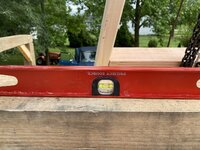
I checked for level and .... WOW! Dead level on the first try. Pin that sucker in place - this is great.
IMG_6563.JPG

Look at that. Longer braces in place (for the longer side). Beautiful.
IMG_6564.JPG

Let's see that from another angle for posterity or something. Perfect. If everything goes like this it'll be done in no time.
IMG_6565.JPG

What could go wrong.
 

Chrisb62

Well-known member
Joined
Jul 30, 2019
Messages
1,091
Location
southwest fl
Are the braces mortised in or just face nailed/screwed?
That is a fine bit of work, beautiful lines, massive beams for a smallish shed.........I like it a lot!

You are kicking Mr Murphy in the shins saying ...... What could go wrong.
 

Jayman17

Well-known member
Joined
Feb 6, 2017
Messages
3,806
Location
Seattle, Wa
I am really enjoying this build. I always wanted to try timber framing a small shed because I’ve always liked timber framed homes but those are out of reach. As you are proving a smaller build is do-able. Nice work!

Jay
 
OP
M

MegaVan

Well-known member
Joined
Dec 17, 2020
Messages
274
Location
Ohio
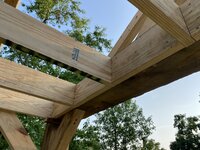
@Chrisb62 - the braces are just face screwed - I have 8&10" timber screws at each connection, one perpendicular to the post (or beam) and one perpendicular to the brace to try and make sure to account for different forces. In the end, I wasn't happy and added additional support as I'll show later. Mr. Murphy and I are getting along at this point in time as I have Mr. Hindsight on my side. At the time I really was flying pretty high though and Mr. Murphy was hanging out behind the pole barn waiting to club me.

@Jayman17 - Thanks. I've been enjoying doing it. I would NOT call what I'm doing timber framing because I feel that's a disservice to those who actually can timber frame. I'm playing with big pieces of wood. I believe I've calculated things so that they will distribute the load well. With the cost of 2x lumber at the time of building, these 8x8's really weren't THAT expensive. I mean. When a 2x4 is $11, $50-60 for an 8x8 doesn't seem so bad. I wouldn't say it's cheap either though.

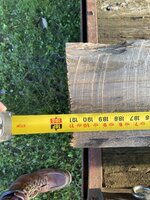
So I grabbed the next 8"x8"x16' to prep for placement and was really surprised when I went to square it off:
IMG_6577.JPG

That's not just a little undersized. I emailed the sales manager and they stated basically "tough luck" and that they believed it was because these are normally pressure treated that they "leave room for expansion and contraction". Uh. No. So it turns out BOTH of my other pieces are short by over 1". This was really a surprise because all of the 8' and 12' pieces, along with (2) 16' PT and (1) 16' not PT were all 3-4" oversized to allow room to square things up. I expressed my displeasure with the sales manager and informed him that they do not have a repeat customer.

Now I had to change my design to match these crummy pieces of wood. I decided to take all the timbers (including the one up in the air) down to 188" and let the roof decking overhang the ends by 2" on each side. It was the most logical way I could come up with. I was frustrated. In the end I think it all worked out, but I'm still not impressed with basically anyone's follow through or ownership of their products anymore.

I repositioned the crane to prepare for the new beam placement. This was a bit of a problem as there is no way I was going to be able to fit my truck in between the barn and the shed, so I came up with a solution:
IMG_6588.JPG

Yes I strung the winch through the crane, used a ****** block attached to a shackle attached to a strap hooked around the front of my Kubota. As I explained to my wife. The Kubota would have to move the whole shed if it was going to start slipping at this point.
IMG_6590.JPG

Yep. That's legit. I switched to raising the load with a single strap and two tag lines (somewhat risky) because of the limited height of the shear legs. Never stand under a live load.
IMG_6591.JPG

I built an extension on the base of the shear legs (about 30") so that it could reach the top beam and placed it in position.
IMG_6593.JPG
IMG_6594.JPG

I'm not totally sure what happened here but I think I realized I didn't have the other ridge post in place and that I needed to build and install it. So lots of sawzalling and (5) 12" timber screws later that was done.
IMG_6596.JPGIMG_6597.JPG

And.... at this point it looks like there is not a photo of the ridge beam in place on my PC, so I guess I'm going to go dig for that...
 
OP
M

MegaVan

Well-known member
Joined
Dec 17, 2020
Messages
274
Location
Ohio
Ok so after digging, scratching my head, looking at time stamps and getting some caffeine I finally figured out what happened. I decided to wait to set the ridge beam until I had 4 rafters cut so that I could make sure everything dry-fit correctly with all this rough cut lumber. Then I could lag it in place and have some confidence that everything would fit correctly.

I'll make a couple quick historical side notes here to explain how things got to the point I'm at today.

It alllll started in 2016.

We just bought our first house, it had a 30x40 (edit 24x40) pole barn with beautiful concrete and terrible electric. I was in love. I decided that I wanted to use it as a workshop mostly due to the fine folks on this forum.

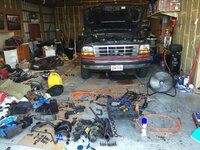
I started the process of insulating, but then went through a series of vehicular failures that redirected my focus for several years (suspect #3 in the photo):
Old Shop.jpg

Those Jeep nuts with a REALLY keen eye could spot the FC-170 in this photo - but I think they'd have to be looking way too hard.

In November 2019 we had the opportunity to move to this new property - it's hard to explain all the justification but it was the right move. I put in some effort and wrapped up the shop for selling the house. This was the day before the home was listed:
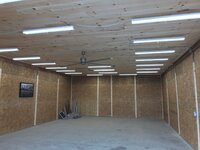
Old Shop Finished.jpg
I never even got to use it. I miss it almost daily.

Here's another perspective with the Mega Van and a 16' trailer for perspective.
Old Shop with MegaVan.jpg

100A dedicated service. Insulated all around. Man I miss that.

I'll explain a bit about the pole barn on the new property, some countermeasures I made to survive until now, then circle back to those rafters.
 
Last edited:

OP
M

MegaVan

Well-known member
Joined
Dec 17, 2020
Messages
274
Location
Ohio
So on the surface the barn on the new property didn't look terrible. Maybe pour some concrete and run with it. It was nighttime. Don't make decisions in the dark.

Here's a quick view when we moved in (the Durango just backed the trailer & FC170 frame into the barn):
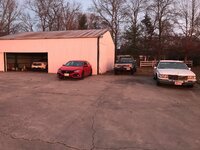
Cars.jpg

Now again this doesn't look so bad, but this property was a rental for a long time and it seems no one was really keeping up with things. We found that there were multiple places where standing water would accumulate 3-5" deep. This is really frustrating as it's pretty much down hill in every direction from our house (probably why they built the house there 100 years ago). Here's a spot between the driveways and the concrete pad:
Standing water.jpg

And again where we have the rabbit hutches. I had to patch together a platform with the leftover materials from the previous shop build so that my wife could care for them without getting mud everywhere. This water would remain there for 5-6 days after the rain had occurred. Note that the barn is RIGHT THERE. The barn is roughly the same grade. The previous owner poured a little gravel in there to hide the fact that there is water intrusion. Kick the gravel and there is standing water in the barn. No venting, massive amounts of humidity, my tools were quickly getting ruined in there.
standing water 2.jpg

Additionally about half the creosote soaked posts are rotted due to the continuous moisture and lack of protection. (currently this is substantially worse, this was just at the inspection timing)
rot.jpg

I spent my breaks during work at home COVID time to work on some water management in an attempt to dry out the property. (this one had a ribbed PVC tube stuck in it, and has held up great)
Trenches.jpg

There were more trenches and boring landscaping nonsense but there's no need to post more photos of holes in the earth. You get it. Also it worked, now there is no standing water within 4 hours of any rainfall.

This did prompt an immediate need shortly after moving in. If I was going to save my tools I needed to get them in the basement and dry as soon as possible. This barn was eating things. Quickly.
 

Chrisb62

Well-known member
Joined
Jul 30, 2019
Messages
1,091
Location
southwest fl
That is just wrong , I have bought plenty of lumber both rough cut or finish planed that was ALWAYS to a plus dimension. Crappy answer also by sales manager, I would have contacted his boss or owner. Glad you were able to find a work around, and hope to see more updates soon.
 
OP
M

MegaVan

Well-known member
Joined
Dec 17, 2020
Messages
274
Location
Ohio
To solve my barn woes I built up some benches in the basement for working:
loaded benches.jpg

Then in January 2021 built up some storage and shelves with some additional work space with my favorite aunt (a carpenter).
finished shelves.jpg

As I pulled stuff in from the barn it quickly filled up.
messy shelves.jpg

With this space I can do enough work while staying dry to get going on other projects (like the shed). It's not the best set up, but it works until I can sort other things out.

Time to move on to setting the top beam, surprise request from my wife and getting those pesky rafters in place.
 
OP
M

MegaVan

Well-known member
Joined
Dec 17, 2020
Messages
274
Location
Ohio
It's been about a month. I've been trying to get things weather tight before winter and I haven't had a chance to update much.

When last I left off I was sorting out the top beam and rafters.

I made a template to make notching out the 4x6's easier. I made the notches with a sawzall (precision tool).
IMG_6612.JPG
This was based on the drawings created early on and worked quite well.

I had to increase the height of my shear legs (as 16' lumber was missing when I built it). I nailed together an extension so I could achieve the height required for the top beam. I then used a rafter on each side to center up the top beam on the ridge posts:
IMG_6607.JPG

Front all centered up:
IMG_6605.JPG

With the top beam fastened, I moved to screw down the rafters - a decent fit:
IMG_6606.JPG

At this point things were moving along nicely, I had four (4) rafters in place and it was starting to look like a miniature building!

Then my wife walked outside.

She loved it. She also promptly informed me that with "all that space" up top - I must build a loft for extra storage.

This was not in the original plan, but I agreed because I'm not stupid.

Some quick sketches and I realized it would just be some 2x8's for the framing and it should work out easily. MY TIMING WAS GOOD. This coincided with a drop in lumber prices - in fact when I bought the 2x8x16's they were cheaper than 2x4x16's. What a weird time. I was out about $96 and built the loft. Selfishly I knew I could use the loft to make raising the remaining rafters easier.

Rather than using ledger strips again I did the following. It is very secure. If anyone wants additional details I'll try to put together an assy diagram.IMG_6615.JPG

Blocking ~4' on center:
IMG_6616.JPG

Final Product:
IMG_6614.JPG

With the loft in place it was easy to install the remaining rafters:
IMG_6618.JPG

As I turned my attention to wall framing I realized the flooring interfered with the base plates of the walls. I used a circular saw to cut out the offending pieces:
IMG_6617.JPG

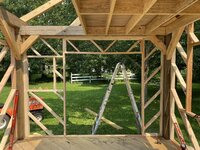
With that out of the way it was time to turn my attention to the walls. I came to realize as I spent time on the loft that I was not satisfied with the job the braces were doing. The temporary braces were doing just as much as the permanent ones. This was a great case of learning by failure - the two screw method was OK - but not good enough for the winds we experience in winter. I had to come up with some additional bracing method. Older houses use let in bracing - but the extra wood and construction time was intimidating. I continued to contemplate wires, braces over the walls, etc.

To be continued soon.
 
OP
M

MegaVan

Well-known member
Joined
Dec 17, 2020
Messages
274
Location
Ohio
My original plan was to use conventional framing techniques for the walls. I had drafted the entire thing out in that master drafting program, Power Point. Some of it was going to be a pain but it was basically all there:
1634848540672.png

However as stated previously - I wasn't pleased with the racking resistance of the structure and I knew this wouldn't help the situation much other than the windows - and I don't want to use windows for racking resistance. Let in bracing would require buying a lot more wood. Finally I ended up stealing a page from Geobarn's playbook and utilized diagonal framing. This provided the anti racking and only required about 10% more wood.

The new Power Point Plan:
1634848877491.png

I got started framing the front of the building - door and windows:
IMG_6619.JPG

Then I started up on the diagonals - this was really tricky on the front, but as I got more practice I realized it's very simple, easy, and the waste rate is extremely low. Any cut off sections can usually be used somewhere else for a small diagonal so there is always a place to use the small scraps. Here it is with the transom windows framed in and some studs on the left side:
IMG_6621.JPG

This creates a visually interesting and dynamic structure (front):
IMG_6622.JPG

(Left):
IMG_6623.JPG

Night:
IMG_6627.JPG

Left wall all wrapped up (temporary ply-wood on the loft area):
IMG_6631.JPG

Right wall started with the large windows:
IMG_6635.JPG

Right wall all done (kind of a poor representation):
IMG_6636.JPG

Continued...
 
OP
M

MegaVan

Well-known member
Joined
Dec 17, 2020
Messages
274
Location
Ohio
Continued...

Right side as viewed from the interior:
IMG_6637.JPG

Working on the rear (roll up door + window):
IMG_6640.JPG

Finished in the rear:
IMG_6641.JPG

And the rear from the outside:
IMG_6642.JPG

After this I moved on to wall sheathing. Actually in the above photo you can see the first row of sheathing - pressure treated 1x8 - on the right side as shown.

I apologize for the excess of photos - I realize it's a lot but I am a highly visual person. I realized a long time ago that my words have a tendency not to get the whole point across.
 

j p smith

Well-known member
Joined
May 22, 2013
Messages
1,213
Location
Glendale, Arizona
I may have somehow missed it in your thread but what are you planning to do in the shed with all those windows taking up wall space?
 
OP
M

MegaVan

Well-known member
Joined
Dec 17, 2020
Messages
274
Location
Ohio
@mike93lx - Thanks!

@j p smith - Good question. Currently this is a stop gap until the barn is repaired or replaced with a better workshop.

The primary activity is to get some of the "workshop" type work out of the basement so I stop waking up the kids during nap.
Second, the barn is to wet for long term storage - so some of my auto parts and such need to move to an actual dry space (this).
Third, loft storage of bins - my wife has informed me.
Fourth, garden stuffs, my wife would like to have seedlings started a bit earlier - those two very large windows face south and should facilitate that.

The front/back run East/West so there is good airflow, hence the three smaller utility windows.

The North side has the two transom windows up high for extra natural light. One thing I figured out in my old pole barn is that I do really enjoy natural light.

The "front" door is 36" wide to help with larger items in the front, and the rear roll up is for potentially getting the Kubota in during the winter for servicing (once the floor has another layer). I haven't had a dry space to work on the Kubota - ever.

I anticipate shelving on the North side, built in's on the remaining south side, and a bench under the 4'x4' windows for working and seedlings.

Just the rough image.
 
OP
M

MegaVan

Well-known member
Joined
Dec 17, 2020
Messages
274
Location
Ohio
I also am trying to consider the long term potential of the building. Once I'm done treating it like a shed it may make an enjoyable "den" or guest house during the nicer months.

Also - I'm building with lots of windows and higher quality materials than normal for a shed, simply because I want to. Older structures like my house tend to get some cheap makeovers in their life and I'm trying to test out some higher quality long lasting materials (including some of the windows) - a sort of dry run for future house repairs.
 
To avoid these ads, REGISTER NOW!
Top Bottom