To avoid these ads, REGISTER NOW!

Understanding 4 way switches

strength_and_power

Well-known member
Joined
Apr 26, 2015
Messages
1,402
Because the confuse the hell out of me. I’m in the process of replacing all the toggle wall switches with rockers. The electrician must have been getting paid by the switch, the master bed/bath has 10 switches alone.
The living room light is controlled by 3 switches. Replacing the switches one wire at a time and matching the new switch to the old has been working for me but I’d like to have a better understanding of the circuit as my eventual plan is to add Lutron Caseta switches so I can set schedules, control remotely etc. Their instructions seem pretty straightforward but one of the wires at each switch location needs to be connected to the same wire at the other switches. How do I determine what the common wire is?
The electrician must not have been getting paid to ground the switches because none of the switches I’ve encountered have been grounded. The grounds are tied together in the box so I’ve been adding a ground wire to each switch.

Thanks I’m advance
Scott
 
To avoid these ads, REGISTER NOW!

onetonbb74

Well-known member
Joined
Mar 2, 2013
Messages
76
Location
Gilroy
Watch some you tube videos...

Before taking any wiring apart, I locate the power in wires from the breaker, the load out wires (to the luminaire), and all the wires between the switches. Label everything first.

In general...3 ways are just switching continuity between common terminal on the switch and the 2 traveler terminals on the switch. Each leg is connected to the common terminal and they alternate which traveller has continuity to the common terminal based on switch position. Double throw, single pole. The common wire is either the hot coming in, or the load going out to the light, usually a black skrew on the switch. If your looking for a wire that connects the switches together, it's the traveller wires, usually on gold skrews.

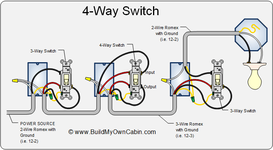
The 4-way switch has 2 sets if travelers, in and out, and the toggle switches the polarity between the travelers. This MUST be in the middle of (2) 3-way switches. Double pole, double throw on the 4-way.

3-ways and 4-ways were quite common in the 60s-00s. They only switch the hot side of the circuit. There is such a thing as a 3 way dead end, those need another conductor between boxes. When wiring modern/relay style 3-ways, they seem to eliminate the pair of traveller wires and have the instructions setup so both switches have 120v in hot and neutral, and one wire (traveller) that talks to the other switch.

Oh, the common terminal has nothing to do with a neutral wire, those jump straight to the luminaire/light from the power source in.

Hope this helps...
 

LopezBart

Well-known member
Joined
Oct 13, 2023
Messages
2,533
Location
Lopez Island, WA
Why people install 3way and 4way switches in this day and age mystifies me.
CD
If one is installing in new construction, they work well. Where the new radio control switches really shine is retrofits and "impossible" switch locations. It is really nice to be able to put a light switch on the inside of a double pocket door. I also used one to put a switch on the pull-down stair for the lights in the attic. True, I may have to replace these when they break, but I don't see them going away - they're too handy. This one is in a easy spot to reach when someone forgets to turn the light off upstairs. Having the lower switch itself on the fold down stairs means that when the stairs are raised, some cannot accidentally turn the lights on upstairs by flipping the wrong switch.

1710009563715.png
 
Last edited:

kbuhagiar

Well-known member
Joined
Dec 27, 2005
Messages
1,740
Location
Escondido, CA
Why people install 3way and 4way switches in this day and age mystifies me.
CD
It's an accurate reflection of the contrast between two eras - those of my generation, most of whom still prefer analog solutions (wired three-way-switches, wired landlines, etc), and those in the present, who look primarily for digital solutions. Neither is right or wrong, but eventually the wired three-way switch will go the same route as the landline telephone (i.e. bye-bye).

Truth be told, I have both kind of switches in my house. I'm just completing a garage expansion, and my (very young) electrician questioned my request for a wired three-way switch, and recommended a wireless solution. I insisted, he relented, and afterwards upon reflection I realized I could have just as easily gone with a wireless solution, but since it was new construction I didn't feel that bad (and the cost vis-a-vis a wireless solution was about the same).
 

cybrdyke

Well-known member
Joined
Sep 9, 2014
Messages
3,442
Location
USA
Because they want something that will just work 20, 30, 50 years from now.
mmm...I dont know. I think it's because the switches cost a quarter and those fancy new things are either voodoo or witchcraft.
There are multiple threads here about 3way and 4way wiring that are several pages long, where folks just cant figure out how to connect them and each post is more confusing than the last. I think folks are just stubborn.
CD
 

Bert_

Well-known member
Joined
Dec 24, 2016
Messages
9,716
Location
NW Iowa
mmm...I dont know. I think it's because the switches cost a quarter and those fancy new things are either voodoo or witchcraft.
There are multiple threads here about 3way and 4way wiring that are several pages long, where folks just cant figure out how to connect them and each post is more confusing than the last. I think folks are just stubborn.
CD
I know that technology can be a great thing. I've programmed and installed some PLC's and it's so much better than trying to do complex logic with relays and timers.

But a three way switch is not complex. The 3 way switch in my stairway has been turning on that light for 100 years. Even with residential I hate to install stuff that I know isn't going to make the 30-year mark.
 

mm08822

Well-known member
Joined
Jan 13, 2012
Messages
5,890
Location
NJ
How many times has recent technology been put through forced obsolecence? Then try and add to the former version only to find out there are no parts able to be sourced..........software, cell phones, firmware, chargers, batteries, home automation, PLCs, Servos, VFDs.........

Not to mention corporate consolidations where the big guy pillage and plunders the little co and spits out the crumbs.

S1, S3, S4s will be around for some time. Can't beat the price point or reliabilty.
 

eejack

Well-known member
Joined
May 18, 2021
Messages
166
Location
the garden state
Why people install 3way and 4way switches in this day and age mystifies me.
CD

First, they work. If the wiring is correct, they always work. When the inevitable 'next' lighting solution appears ( incandescent -> fluorescent -> led -> ? ) they will still work.

Second, they are replaceable. There will always be standard switches made ( because they work ). I installed scads of X-10 switches for customers decades ago - original smart home schtuff. SOL if anything goes bad now.

Third, they are not connected to the internet. They cannot be hacked, they cannot report back to some corporation about your usage, they cannot be used as a part of a Botnet. They cannot be repurposed against your will.

Fourth, they can be 'upgraded' to dimmers ( 3 ways ) or occupancy sensors ( which when they become out of date can be regressed to standard switches ).

Lastly, they are inexpensive once properly installed.
 

dogdog

Well-known member
Joined
Nov 15, 2011
Messages
12,711
Pic is worth a thousand words..
3 way switch is SPDT
4 way switch that goes in between two 3-way switch is DPDT with internally crossed.

(hey you might be able to use 4-way switch for some Motor reversing applications lol)


c62ca757f12801ea5956495e17b3ea31bcdc77cc_2_621x314.png
 

mark flucke

Active member
Joined
Feb 14, 2016
Messages
33
With all the wonderful diagrams everything is easy in conduit- find info that shows how to do it with romex- that is reality
 

dogdog

Well-known member
Joined
Nov 15, 2011
Messages
12,711
With all the wonderful diagrams everything is easy in conduit- find info that shows how to do it with romex- that is reality
Once you understand the concept of how these things work. It’s just paying attention to details and find your wires and connect it. It’s not like it’s a Mexican 3 way that would confuse you.

You can always connect it on a wood board like a test circuit to get some understanding of how it is connected.
 
To avoid these ads, REGISTER NOW!

Just_Steve

Well-known member
Joined
Jun 2, 2020
Messages
873
Location
Dutchess County, NY
Once you understand the concept of how these things work. It’s just paying attention to details and find your wires and connect it. It’s not like it’s a Mexican 3 way that would confuse you.

You can always connect it on a wood board like a test circuit to get some understanding of how it is connected.
Had to look that one up, very interesting.
 

Hohn

Well-known member
Joined
Aug 25, 2016
Messages
2,640
Location
Diesel Central, Indiana
mmm...I dont know. I think it's because the switches cost a quarter and those fancy new things are either voodoo or witchcraft.
There are multiple threads here about 3way and 4way wiring that are several pages long, where folks just cant figure out how to connect them and each post is more confusing than the last. I think folks are just stubborn.
CD
I don't think we help ourselves by using confusing terms like "3 way" for these multi-pole switch setups. Once you revert to more standard terms of poles and throws, it's a lot clearer to me. What counts as a "Way" and why do I have three way switches in a 4-way setup? Yes, confusing by term choice.

I was super confused by these multi-pole switch setups until I saw a diagram in a how-to book (Stanley maybe?) and I just shook my head thinking "all this time they just meant a SPDT as a "three way?"

The number of throws is easy enough, it's just one for each position of the switch that will form a closed circuit. When first learning this, I was always confused how a "single pole" switch could have two positions-- one off, one on. But then I understood that the "throw" is the number of positions in which current can pass through the switch. "Off" is therefore not a "throw".

The number of "poles" is just the number of independent closed circuit paths that can go through a switch. In a residential wiring application, I need a pole for the lighting loop plus an additional pole for each other switch location since they must each have power in order to function as a switch (connected by a hot run I've heard referred to as a "traveler" or "runner").

The excellent diagram posted by @PCustoms can be broken down this way:

-- Only two conductors are needed at the load (light or loop of lights) and the power coming in. This is AC, so we need to think of current from both directions, so when current reverses you could think of the load as the source and vise versa.

-- The first switch in the circuit (from either direction of current flow) has to be able to either open the circuit or send current to two places at once- a load loop and a switch loop. So it must be SPDT. This is also why we now need 3 conductor wiring to connect the additional current path.
-- Any switches added as additional locations in between the first and last switch on the run must be DPDT or "four way" and they are just switching between hot current paths and generally have no "off" position (the open circuit is provided by other switches in the run-- I like to think of it as switching between the three-way SPDT switches).

Just thinking out loud...
 

dave*99

Well-known member
Joined
May 5, 2009
Messages
4,259
Location
Coastal NJ
This is AC, so we need to think of current from both directions, so when current reverses you could think of the load as the source and vise versa.
Kind of an odd way to describe this. In this context load and source terminology refers to power flow. Not current flow. Power flows from source to load. Occasionally we need to consider back EMF but that’s another topic entirely.
 

Hohn

Well-known member
Joined
Aug 25, 2016
Messages
2,640
Location
Diesel Central, Indiana
Kind of an odd way to describe this. In this context load and source terminology refers to power flow. Not current flow. Power flows from source to load. Occasionally we need to consider back EMF but that’s another topic entirely.
You are correct. I'm just referring to current reversal, you are absolutely correct that power is not reversing.
 

geneg

Well-known member
Joined
Oct 19, 2020
Messages
467
Location
Midwest
The biggest issue is that we generally don't do this work on a regular basis. I have an electrician brother in law that does this in minutes. I have to over think, draw diagrams, & get it wrong a couple of times before everything works. It would be fantastic if there was some consistant method of marking the terminals on various brands of switches!
 

dave*99

Well-known member
Joined
May 5, 2009
Messages
4,259
Location
Coastal NJ
I read this explanation on Mike Holt. Not my words but they do make some sense. If the terminology was derived from old language…
A 3 way switch has 3 terminals so those pesky electrons have 3 ways to travel. Same follows for 4 way.


'Way' (the way we use it for switches) is from the Old English word 'weg' or the road to a town. The term 'highway' is derived from that particular use of 'way', so is roadway, passageway and particularly, entryway (portal).

It really makes more sense with valves. It may have been a poor choice for switches but that is what we are stuck with and how it came to be.

YMMV
 
OP
S

strength_and_power

Well-known member
Joined
Apr 26, 2015
Messages
1,402
Thanks for all the replies. It’s starting to make more sense. It’d probably help if I had an entire day to dedicate to it but that’s a bit of a pipe dream at this point.
 

ipgenie

Well-known member
Joined
Jan 29, 2020
Messages
561
Location
Idaho
I wired a set of 3-way switches in my shop Saturday. It's been a while since I last did one so I figured it might take a little longer than it should.
30 minutes in, I was about to pull my hair out and thinking I'd lost my grip on reality. Turned out to be two bad switches. They were loose in a box of electrical parts I squirreled away a few years ago. I finally tested them with my meter and found both were not switching correctly. Two more switches from the box, tested first, and I was in business.
Definitely took longer than it should and I learned to do a quick test before starting the install. I've never run into a bad one before but if I run into another while wiring this shop, I'll catch it before I waste too much time.
 

eejack

Well-known member
Joined
May 18, 2021
Messages
166
Location
the garden state
Once you understand the concept of how these things work. It’s just paying attention to details and find your wires and connect it. It’s not like it’s a Mexican 3 way that would confuse you.

You can always connect it on a wood board like a test circuit to get some understanding of how it is connected.

I recall my first Carter 3 way with painful clarity, and have actually used the method for temporary wiring purposes. Makes for an interesting teaching aid for apprentices.
 

dogdog

Well-known member
Joined
Nov 15, 2011
Messages
12,711
I recall my first Carter 3 way with painful clarity, and have actually used the method for temporary wiring purposes. Makes for an interesting teaching aid for apprentices.
LOL, I am guessing that is a proper term for the Mexican 3way... more PC way of describing it I guess... I did look up Mexican 3 way and more of the articles involve a midget than electrical stuff.... so probably not a correct term to describe this electrical 3 way setup... now I wonder who posted here few years ago that is the name for this....


HoraceMann

Member
Joined
Jul 13, 2024
Messages
5
Apparently started in 1999 Article 380-9 according to discussion in https://forums.mikeholt.com/threads/year-of-grounded-switches.95211/
I am trying to power a plug off a light switch. I hooked the white wire from the plug to the white wires in the box and was attempting to used the line part of the 4 way switch to pass electricity to the plug. After hooking both side of the line in the 4 way switch I get power on on side but not the other. Does not the line when hooked up on one side to power pass it through to the other side of the line. When I test that assumption I have power on the one side of the line but not the other.
 

sparky 1971

Well-known member
Joined
Oct 9, 2018
Messages
7,967
Location
Central Iowa
I am trying to power a plug off a light switch. I hooked the white wire from the plug to the white wires in the box and was attempting to used the line part of the 4 way switch to pass electricity to the plug. After hooking both side of the line in the 4 way switch I get power on on side but not the other. Does not the line when hooked up on one side to power pass it through to the other side of the line. When I test that assumption I have power on the one side of the line but not the other.
That's not going to work so you might as well give up now before the lights either stop working or won't shut off.
 

HoraceMann

Member
Joined
Jul 13, 2024
Messages
5
The light works fine. My question is the line a hot pass through or not? It is hot on one side, but does not seem to be hot on the other.
 

PCustoms

Well-known member
Joined
Jul 23, 2011
Messages
22,572
Location
VT
The light works fine. My question is the line a hot pass through or not? It is hot on one side, but does not seem to be hot on the other.

Sparky is an electrician, of he says it won't work, it probably won't work...

Post a pic of how YOU wired the outlet
 

sparky 1971

Well-known member
Joined
Oct 9, 2018
Messages
7,967
Location
Central Iowa
The light works fine. My question is the line a hot pass through or not? It is hot on one side, but does not seem to be hot on the other.
It's not passing through. To put it in simplified terms, the switched wire is passing through, but every time a switch gets flipped that wire changes. Say it's the red wire now, flip a switch and it will change to the black. You will not, I repeat not, be able to add a receptacle from a four way switch, and it's only roughly 1/2 of the three ways that can have something added from them. And, if you (or anyone) messes around with it too much the lights will either quit altogether or if too many wires are spliced at the four way, they may not shut off.
 

dogdog

Well-known member
Joined
Nov 15, 2011
Messages
12,711
The light works fine. My question is the line a hot pass through or not? It is hot on one side, but does not seem to be hot on the other.

For one thing. it's a four way switch, DPDT with the terminals crossed. scroll up or google.
under normal circumstance as a four way switch it's for traveler wires. both traverler wires are consider HOT.

if you are using it as a regular switch. then .... white wire are normally neutral.. does switching the neutral turns off lights ... yes.
is white color wire normally used as hot wires, no. but Everyone is special though. can you make use of your multimeter or non-contact thinggy to check if it is hot ?

*in other word... no one on the internet knows your particular situation.
 

wyliesdiesels

Well-known member
Joined
Aug 14, 2012
Messages
19,994
Location
Modesto, CA
I am trying to power a plug off a light switch. I hooked the white wire from the plug to the white wires in the box and was attempting to used the line part of the 4 way switch to pass electricity to the plug. After hooking both side of the line in the 4 way switch I get power on on side but not the other. Does not the line when hooked up on one side to power pass it through to the other side of the line. When I test that assumption I have power on the one side of the line but not the other.
thats a fools errand....
 

sparky 1971

Well-known member
Joined
Oct 9, 2018
Messages
7,967
Location
Central Iowa
boys i think were being trolled. new member as of today and the first thing they attempt is powering a receptacle from a 4-way :lol_hitti
Probably Googled how to connect an outlet to a four way switch and this thread came up. I Googled something and GJ came up for me a few years ago, the rest is history.
 
To avoid these ads, REGISTER NOW!
Top Bottom