You are using an out of date browser. It may not display this or other websites correctly.
You should upgrade or use an alternative browser.
You should upgrade or use an alternative browser.
Vise Info Thread
- Thread starter FMC1959
- Start date

KMScott
Well-known member

MattGavriloff
Well-known member
Sorry I've been absent for so long, it's been a busy and interesting year. Soooo many interesting Vises to read about and catch up on!
No time for my usual musings at the moment, but I wanted to drop these pictures here quick. They should be entitled "The mystery deepens"...lol.
Fier, I know you love a good vise puzzle, and wouldn't ya know, I've found another piece...
Back later with more info and my thoughts.
No time for my usual musings at the moment, but I wanted to drop these pictures here quick. They should be entitled "The mystery deepens"...lol.
Fier, I know you love a good vise puzzle, and wouldn't ya know, I've found another piece...
Back later with more info and my thoughts.
Attachments
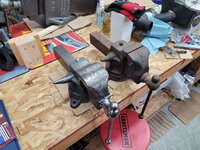

That is a great find Dave!Here is a rare one. KMScott got a photo of one in Europe, #2341, 12/26/2021 in this thread. I bought this guy today. Brown Boggs Co Ltd of Hamilton, Canada. No 10. From 1917. This can have a quick release system but this one does not but still has the guide hole on the front plate for one.
Weight: 47 lbs
Jaw Width: 3-5/8"
Opening: 5-5/8"
Replaceable jaws.
No pipe jaws or anvil or swivel jaw.
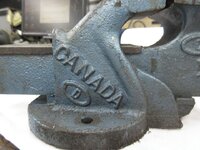
Thanks for posting that Kevin!This one is for my friends in Canada. I was looking over my small vises and found this gem.
Rae 2-1/2. 2-1/2" jaws that opens to 2-1/4 and weights 6-1/2lbs.
I've seen photos of a few, but no specs. One had markings like yours, the other two with different markings were made in Orillia after Rae was purchased by OTACO, as can be seen from the decal on this one. The No 2-1/2 doesn't appear in any of the catalogs I've seen, so any mention of it will be a good find.
Attachments


Fierljeppen
Well-known member
- Joined
- Jan 26, 2018
- Messages
- 1,159
Sorry I've been absent for so long, it's been a busy and interesting year. Soooo many interesting Vises to read about and catch up on!
No time for my usual musings at the moment, but I wanted to drop these pictures here quick. They should be entitled "The mystery deepens"...lol.
Fier, I know you love a good vise puzzle, and wouldn't ya know, I've found another piece...
Back later with more info and my thoughts.
I can't believe you found another one. That makes me wonder if the origin of those vises are more local to you?
The photos do a good job of showing the similarities and differences of the two vises. Pinned screw spindles are not that common.
The anvil out of the side is very unique. The Bonney Rapid Vise is the only other vise with the side anvil that I'm aware of.

I'm stumped, not a clue. I really hope you or someone else has some information that will shed some light on the subject. I feel the need to know more.
MattGavriloff
Well-known member
That makes me wonder if the origin of those vises are more local to you?
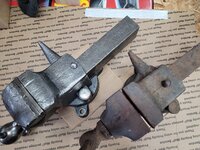
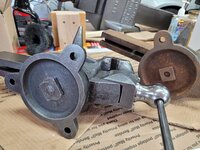
I think this is the answer, but maybe not in the sense that I'm near a "previously unknown" vise manufacturer. I'll elaborate on that in a minute, but first the details and interesting differences. For ease of reference I shall call them vise 1 (purchased 7/22/21) and vise 2 (8/6/22). Anyone uninterested in my ramblings about the small differences between them just skip to the bottom for final thoughts...lol
Vise 1 has 3 3/8" jaws, opens 7" and weighs exactly 40lbs.
Vise 2 has 3 1/2" jaws. Assuming ~1\2" for missing jaws, opens 6 3/4" and weighs 38.4lbs.
Both jaw widths are correct, there is an 1/8" between them and vise 1 is more "used" overall, but they don't appear worn down as discussed last year when I found it. Vise 2, while missing the faces, is exactly 3 1/2" wide.
Starting from the front, vise 2 has a shorter handle with obviously threaded ends with screwed on balls. Replacement? (More on that later)
Vise 2 also has a smaller meatball. They are both pinned/riveted, but vise 2 has a pair of additional holes, one with a pin in it, in the flared out portion that presses on the slide. Both appear somewhat "crude" or "handmade" (again, more on that later), but are as tight and straight as can/should be.
Vise 1 has a decorative "mustache" or "lip" over the meatball, Vise 2 has a completely flat front.
Vise 1 has buttress style threads and what looks like a homemade nut (looks like a threaded cylinder welded to a broken dovetail base). Vise 2 has square cut threads and what looks like a "normal" cast nut. Both screws have a "pilot" point on the end. The retaining collar for vise 2 is much thinner and the threads go almost all the way into the meatball so the set screw has trouble holding.
Vise 1 has just a SMALL section of jaw shelf left, and noticeable areas where the rest of the shelves broke off. Vise 2 never had jaw shelves. The overall shape of the jaw towers is obviously similar, but different. (A reoccurring theme)
Vise 1 has machining "arcs" cut into the nose past the sides of the actual slide, and there is smooth machining on the connecting face of the raised "pyramids" on the side of the nose. (hope that make some sort of sense). Vise 2 has a very squared off quality to that entire area, and has no machining on the "pyramid" faces.
Vise 1's slide measures 1 3/4" wide by 2 1/2" tall, Vise 2 is also 1 3/4" wide but is only 2 1/4" tall.
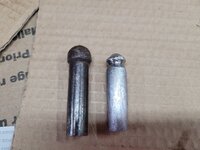
The location of the swivel jaw pin is different, and the pin for vise 2 is not tapered like vise 1 (homemade? replacement? we're getting there...). There are also no obvious nicks/marks on the pin from hand finishing like pin 1 has. Pin 2 could be made from a bolt, but there is an unthreaded hole in the bottom and the knob looks turned to me, not welded. At least without further clean up.
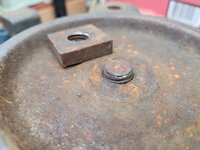
The base attachment is the same. A big square nut. The threaded portion on vise 2 is barely long enough. The nut/stud on vise 1 is HEAVILY peened. I never separated them during my clean up/restoration of vise 1 so I can't comment on the internal construction. But vise 2 is unlike anything I've taken apart before. Kind of like a Prentiss with a screw, not spring pin.
The very thin area under the swivel jaw is broken out of vise 2, I was amazed it was intact on vise 1 during clean up. I've never seen an area built so thin on a vise...lol. Though it's not structural in any way. The machined surface on top of the body seems very similar, but the underside of vise 2's swivel jaw is much more well done. (Another clue I think)
The long threaded swivel lock bolts are again, similar, but different.
I see no obvious difference in the anvil areas aside from vise 1 being heavily used for cutting on top and vise 2 has the tip broken.
Vise 1 has most all parts (screw, shaft collar, base, base nut, swivel jaw, body, and slide) marked with (18 11). I haven't been able to find ANY numbers on vise 2 yet.
Phew...I think that's it (without breaking out a micrometer, but even I have my limits).
That was like an awesome vise themed version of the game "spot the difference" from childhood...lol. Please let me know if anyone sees anything I missed.
The last bit of information that I think plays a big part of solving the mystery...
Vise 1 was purchased at an estate sale in Negaunee, Michigan.
Vise 2 was purchased at an estate sale in Negaunee, Michigan...about 1 year and 5 miles away from vise 1.
SOOOO...my current working theory, based on the large number of homemade/crude/replacment/similar parts between each vise, and the fact that from 10 feet away, or to someone without the same vise obsession as this crowd, they are identical, is they are the product of a trade school, college, or university in the area. I haven't got further with that yet as I just acquired vise 2, but I intend to talk to the estate sale company and attempt to make contact with the previous owners or families. At least see if either are willing to answer a few questions and maybe help come up with a connection. Who knows, maybe one of them actually knows the story!
The logical (hopeful) answer I then come up with would be they were made at Michigan Tech University, in Houghton, Michigan. About 2 hours from where the vises were found. I won't go crazy with the school history, but they were founded in 1885 as the "Michigan Mining School" then changed to "Michigan College of mines" and so on until the current MTU name.
In my head a least, a school with the reputation for engineering and related fields, and that was founded specifically to teach local copper and iron ore mining engineers, could certainly have offered a class where the students cast and built a vise? Walk in on Monday and there's an example sitting at the front of the room. BAM, you've got week to measure and replicate it. It sure would account for the slight build/shape/finish differences, the hand made feel, and things like the machining under the jaw. One student was obviously better with a mill?
I don't know what the significance of the numbers would be. Student ID? Maybe the one with numbers is "the original". Much thinking still to be done obviously. I'm hoping in the next few weeks I can stop in and see the owner of the estate sale company. We have some history and hopefully he's willing to help put me in touch. If not then I guess I'd have to start by contacting the university, and looking into what other smaller vocational/trade schools were in the area for the last 100 years or so...but I think it's a start. I think it would be AMAZING to find an old school photo of a class lined up with their vises like these...
Or there's a small wormhole somewhere in Negaunee spitting out "nearly identical" swivel jaw anvil vise....
Attachments
-
 20220809_165026.jpg434.9 KB · Views: 38
 -
 20220809_165054.jpg382.1 KB · Views: 33
 -
 20220809_165057.jpg440.3 KB · Views: 28
 -
 20220809_165122.jpg366.7 KB · Views: 28
 -
 20220809_165218.jpg416.6 KB · Views: 28
 -
 20220809_165222.jpg359.9 KB · Views: 27
 -
 20220809_165303.jpg283.1 KB · Views: 25
 -
 20220809_165333.jpg512.8 KB · Views: 24
 -
 20220809_165437.jpg492 KB · Views: 25
 -
 20220809_165450.jpg257.2 KB · Views: 23
MattGavriloff
Well-known member
More pictures.
Attachments
-
 20220809_172830.jpg436.4 KB · Views: 22
 -
 20220809_172632.jpg298.3 KB · Views: 21
 -
 20220809_172605.jpg234.5 KB · Views: 22
 -
 20220809_165652.jpg407.6 KB · Views: 21
 -
 20220809_170035.jpg219.2 KB · Views: 20
 -
 20220809_170045.jpg235.5 KB · Views: 19
 -
 20220809_170416.jpg222.4 KB · Views: 18
 -
 20220809_170430.jpg278.9 KB · Views: 19
 -
 20220809_183508.jpg197.2 KB · Views: 21
 -
 20220809_174855.jpg396.5 KB · Views: 22
MattGavriloff
Well-known member
And more.
Attachments
-
 20220809_173328.jpg368.1 KB · Views: 21
 -
 20220809_173247.jpg312.8 KB · Views: 20
 -
 20220809_173319.jpg346.4 KB · Views: 20
 -
 20220809_173237.jpg259.2 KB · Views: 19
 -
 20220809_173127.jpg343.6 KB · Views: 19
 -
 20220809_173138.jpg337.6 KB · Views: 18
 -
 20220809_173645.jpg308.8 KB · Views: 16
 -
 20220809_173922.jpg378.8 KB · Views: 15
MattGavriloff
Well-known member
Last ones.
Attachments




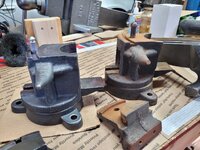
Wow....MattGavriloff, great find, great story and conjecture, and quite the long post.(is that the longest post GJ?)I think this is the answer, but maybe not in the sense that I'm near a "previously unknown" vise manufacturer. I'll elaborate on that in a minute, but first the details and interesting differences. For ease of reference I shall call them vise 1 (purchased 7/22/21) and vise 2 (8/6/22). Anyone uninterested in my ramblings about the small differences between them just skip to the bottom for final thoughts...lol
Vise 1 has 3 3/8" jaws, opens 7" and weighs exactly 40lbs.
Vise 2 has 3 1/2" jaws. Assuming ~1\2" for missing jaws, opens 6 3/4" and weighs 38.4lbs.
Both jaw widths are correct, there is an 1/8" between them and vise 1 is more "used" overall, but they don't appear worn down as discussed last year when I found it. Vise 2, while missing the faces, is exactly 3 1/2" wide.
Starting from the front, vise 2 has a shorter handle with obviously threaded ends with screwed on balls. Replacement? (More on that later)
Vise 2 also has a smaller meatball. They are both pinned/riveted, but vise 2 has a pair of additional holes, one with a pin in it, in the flared out portion that presses on the slide. Both appear somewhat "crude" or "handmade" (again, more on that later), but are as tight and straight as can/should be.
Vise 1 has a decorative "mustache" or "lip" over the meatball, Vise 2 has a completely flat front.
Vise 1 has buttress style threads and what looks like a homemade nut (looks like a threaded cylinder welded to a broken dovetail base). Vise 2 has square cut threads and what looks like a "normal" cast nut. Both screws have a "pilot" point on the end. The retaining collar for vise 2 is much thinner and the threads go almost all the way into the meatball so the set screw has trouble holding.
Vise 1 has just a SMALL section of jaw shelf left, and noticeable areas where the rest of the shelves broke off. Vise 2 never had jaw shelves. The overall shape of the jaw towers is obviously similar, but different. (A reoccurring theme)
Vise 1 has machining "arcs" cut into the nose past the sides of the actual slide, and there is smooth machining on the connecting face of the raised "pyramids" on the side of the nose. (hope that make some sort of sense). Vise 2 has a very squared off quality to that entire area, and has no machining on the "pyramid" faces.
Vise 1's slide measures 1 3/4" wide by 2 1/2" tall, Vise 2 is also 1 3/4" wide but is only 2 1/4" tall.
The location of the swivel jaw pin is different, and the pin for vise 2 is not tapered like vise 1 (homemade? replacement? we're getting there...). There are also no obvious nicks/marks on the pin from hand finishing like pin 1 has. Pin 2 could be made from a bolt, but there is an unthreaded hole in the bottom and the knob looks turned to me, not welded. At least without further clean up.
The base attachment is the same. A big square nut. The threaded portion on vise 2 is barely long enough. The nut/stud on vise 1 is HEAVILY peened. I never separated them during my clean up/restoration of vise 1 so I can't comment on the internal construction. But vise 2 is unlike anything I've taken apart before. Kind of like a Prentiss with a screw, not spring pin.
The very thin area under the swivel jaw is broken out of vise 2, I was amazed it was intact on vise 1 during clean up. I've never seen an area built so thin on a vise...lol. Though it's not structural in any way. The machined surface on top of the body seems very similar, but the underside of vise 2's swivel jaw is much more well done. (Another clue I think)
The long threaded swivel lock bolts are again, similar, but different.
I see no obvious difference in the anvil areas aside from vise 1 being heavily used for cutting on top and vise 2 has the tip broken.
Vise 1 has most all parts (screw, shaft collar, base, base nut, swivel jaw, body, and slide) marked with (18 11). I haven't been able to find ANY numbers on vise 2 yet.
Phew...I think that's it (without breaking out a micrometer, but even I have my limits).
That was like an awesome vise themed version of the game "spot the difference" from childhood...lol. Please let me know if anyone sees anything I missed.
The last bit of information that I think plays a big part of solving the mystery...
Vise 1 was purchased at an estate sale in Negaunee, Michigan.
Vise 2 was purchased at an estate sale in Negaunee, Michigan...about 1 year and 5 miles away from vise 1.
SOOOO...my current working theory, based on the large number of homemade/crude/replacment/similar parts between each vise, and the fact that from 10 feet away, or to someone without the same vise obsession as this crowd, they are identical, is they are the product of a trade school, college, or university in the area. I haven't got further with that yet as I just acquired vise 2, but I intend to talk to the estate sale company and attempt to make contact with the previous owners or families. At least see if either are willing to answer a few questions and maybe help come up with a connection. Who knows, maybe one of them actually knows the story!
The logical (hopeful) answer I then come up with would be they were made at Michigan Tech University, in Houghton, Michigan. About 2 hours from where the vises were found. I won't go crazy with the school history, but they were founded in 1885 as the "Michigan Mining School" then changed to "Michigan College of mines" and so on until the current MTU name.
In my head a least, a school with the reputation for engineering and related fields, and that was founded specifically to teach local copper and iron ore mining engineers, could certainly have offered a class where the students cast and built a vise? Walk in on Monday and there's an example sitting at the front of the room. BAM, you've got week to measure and replicate it. It sure would account for the slight build/shape/finish differences, the hand made feel, and things like the machining under the jaw. One student was obviously better with a mill?
I don't know what the significance of the numbers would be. Student ID? Maybe the one with numbers is "the original". Much thinking still to be done obviously. I'm hoping in the next few weeks I can stop in and see the owner of the estate sale company. We have some history and hopefully he's willing to help put me in touch. If not then I guess I'd have to start by contacting the university, and looking into what other smaller vocational/trade schools were in the area for the last 100 years or so...but I think it's a start. I think it would be AMAZING to find an old school photo of a class lined up with their vises like these...
Or there's a small wormhole somewhere in Negaunee spitting out "nearly identical" swivel jaw anvil vise....
There have been some very interesting and knowledgeable vise posts on this thread, but MattGavriloff, you and FJ make a great pair, the vise detectives
Fierljeppen
Well-known member
- Joined
- Jan 26, 2018
- Messages
- 1,159
I think this is the answer, but maybe not in the sense that I'm near a "previously unknown" vise manufacturer. I'll elaborate on that in a minute, but first the details and interesting differences. For ease of reference I shall call them vise 1 (purchased 7/22/21) and vise 2 (8/6/22). Anyone uninterested in my ramblings about the small differences between them just skip to the bottom for final thoughts...lol
Vise 1 has 3 3/8" jaws, opens 7" and weighs exactly 40lbs.
Vise 2 has 3 1/2" jaws. Assuming ~1\2" for missing jaws, opens 6 3/4" and weighs 38.4lbs.
Both jaw widths are correct, there is an 1/8" between them and vise 1 is more "used" overall, but they don't appear worn down as discussed last year when I found it. Vise 2, while missing the faces, is exactly 3 1/2" wide.
Starting from the front, vise 2 has a shorter handle with obviously threaded ends with screwed on balls. Replacement? (More on that later)
Vise 2 also has a smaller meatball. They are both pinned/riveted, but vise 2 has a pair of additional holes, one with a pin in it, in the flared out portion that presses on the slide. Both appear somewhat "crude" or "handmade" (again, more on that later), but are as tight and straight as can/should be.
Vise 1 has a decorative "mustache" or "lip" over the meatball, Vise 2 has a completely flat front.
Vise 1 has buttress style threads and what looks like a homemade nut (looks like a threaded cylinder welded to a broken dovetail base). Vise 2 has square cut threads and what looks like a "normal" cast nut. Both screws have a "pilot" point on the end. The retaining collar for vise 2 is much thinner and the threads go almost all the way into the meatball so the set screw has trouble holding.
Vise 1 has just a SMALL section of jaw shelf left, and noticeable areas where the rest of the shelves broke off. Vise 2 never had jaw shelves. The overall shape of the jaw towers is obviously similar, but different. (A reoccurring theme)
Vise 1 has machining "arcs" cut into the nose past the sides of the actual slide, and there is smooth machining on the connecting face of the raised "pyramids" on the side of the nose. (hope that make some sort of sense). Vise 2 has a very squared off quality to that entire area, and has no machining on the "pyramid" faces.
Vise 1's slide measures 1 3/4" wide by 2 1/2" tall, Vise 2 is also 1 3/4" wide but is only 2 1/4" tall.
The location of the swivel jaw pin is different, and the pin for vise 2 is not tapered like vise 1 (homemade? replacement? we're getting there...). There are also no obvious nicks/marks on the pin from hand finishing like pin 1 has. Pin 2 could be made from a bolt, but there is an unthreaded hole in the bottom and the knob looks turned to me, not welded. At least without further clean up.
The base attachment is the same. A big square nut. The threaded portion on vise 2 is barely long enough. The nut/stud on vise 1 is HEAVILY peened. I never separated them during my clean up/restoration of vise 1 so I can't comment on the internal construction. But vise 2 is unlike anything I've taken apart before. Kind of like a Prentiss with a screw, not spring pin.
The very thin area under the swivel jaw is broken out of vise 2, I was amazed it was intact on vise 1 during clean up. I've never seen an area built so thin on a vise...lol. Though it's not structural in any way. The machined surface on top of the body seems very similar, but the underside of vise 2's swivel jaw is much more well done. (Another clue I think)
The long threaded swivel lock bolts are again, similar, but different.
I see no obvious difference in the anvil areas aside from vise 1 being heavily used for cutting on top and vise 2 has the tip broken.
Vise 1 has most all parts (screw, shaft collar, base, base nut, swivel jaw, body, and slide) marked with (18 11). I haven't been able to find ANY numbers on vise 2 yet.
Phew...I think that's it (without breaking out a micrometer, but even I have my limits).
That was like an awesome vise themed version of the game "spot the difference" from childhood...lol. Please let me know if anyone sees anything I missed.
The last bit of information that I think plays a big part of solving the mystery...
Vise 1 was purchased at an estate sale in Negaunee, Michigan.
Vise 2 was purchased at an estate sale in Negaunee, Michigan...about 1 year and 5 miles away from vise 1.
SOOOO...my current working theory, based on the large number of homemade/crude/replacment/similar parts between each vise, and the fact that from 10 feet away, or to someone without the same vise obsession as this crowd, they are identical, is they are the product of a trade school, college, or university in the area. I haven't got further with that yet as I just acquired vise 2, but I intend to talk to the estate sale company and attempt to make contact with the previous owners or families. At least see if either are willing to answer a few questions and maybe help come up with a connection. Who knows, maybe one of them actually knows the story!
The logical (hopeful) answer I then come up with would be they were made at Michigan Tech University, in Houghton, Michigan. About 2 hours from where the vises were found. I won't go crazy with the school history, but they were founded in 1885 as the "Michigan Mining School" then changed to "Michigan College of mines" and so on until the current MTU name.
In my head a least, a school with the reputation for engineering and related fields, and that was founded specifically to teach local copper and iron ore mining engineers, could certainly have offered a class where the students cast and built a vise? Walk in on Monday and there's an example sitting at the front of the room. BAM, you've got week to measure and replicate it. It sure would account for the slight build/shape/finish differences, the hand made feel, and things like the machining under the jaw. One student was obviously better with a mill?
I don't know what the significance of the numbers would be. Student ID? Maybe the one with numbers is "the original". Much thinking still to be done obviously. I'm hoping in the next few weeks I can stop in and see the owner of the estate sale company. We have some history and hopefully he's willing to help put me in touch. If not then I guess I'd have to start by contacting the university, and looking into what other smaller vocational/trade schools were in the area for the last 100 years or so...but I think it's a start. I think it would be AMAZING to find an old school photo of a class lined up with their vises like these...
Or there's a small wormhole somewhere in Negaunee spitting out "nearly identical" swivel jaw anvil vise....
Excellent research and theory on those vises! It would make sense for them to be a "local to you" Trade School project.
I'm feeling a lot better now, but not perfect. If you can get anything to substantiate your theory, please update this thread. That would be huge.
Thanks again, for a really interesting and informative vise story and hoping there will be more to come. Many vise blessings to you.


Dave600
Well-known member
The Patent Number on the vise was assigned to Reed, 2127008 for adjusting the play in the screw nut, 8/16/1938. And the vise obviously looks like a Reed. The patent on the power unit, 2656820 approved 10-27-1953 was by Philip S. Becker for a "Power-Operated Vise" not assigned to a company as far as I could see.Erie air vise
Jaw Width 4-1/2"
Overall length 30"
No other specs
PierceA
Well-known member
Matt: that's a heck of find!! And some very good comparison work.
I like the idea of MTU having a shop project.
It is very interesting to note the machining differences, but the use of a buttress thread on the one makes me wonder if
that screw and nut were appropriated from an Athol vise?
I know of one other side horn vise.. Maybe he'll post some photos and info..
PierceA
I like the idea of MTU having a shop project.
It is very interesting to note the machining differences, but the use of a buttress thread on the one makes me wonder if
that screw and nut were appropriated from an Athol vise?
I know of one other side horn vise.. Maybe he'll post some photos and info..
PierceA
Craftsman No 1 "Hi-Duty" vise, made in England. Sadly, no specs. Recently sold in Manitoba.
Can't find another one like it. "Hi-Duty" suggests it was made by Paramo. See this post for examples.
Can't find another one like it. "Hi-Duty" suggests it was made by Paramo. See this post for examples.
Attachments


Last edited:
KMScott
Well-known member
Yep, someone adapted a Reed 104-1/2R with the air slide. I'll put it with the Reed 104-1/2R section built in Erie PA.Erie air vise
Jaw Width 4-1/2"
Overall length 30"
No other specs
Last edited:
CRSINMICH
Well-known member
Pierce: I already posted the Side Horn swiveling Mystery Vise on the main vise thread - post #87257 (I gave you credit, and thanks, for repairing the nut. Thanks again!) Mine came from an estate sale in SE Michigan. It also has buttress threads so that may well be original.
Attachments


Last edited:
Dave600
Well-known member
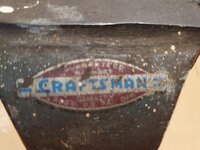
I have two of these Craftsman No 1, made in England vises. "Hi Duty" like what Paramo uses. The main nut is part of the casting and the curve at the back of the fixed jaw tower make it look like a standard Paramo No 1 but with a Craftsman badge riveted to the side in a badge shaped cavity in the casting and a Craftsman label on the front. Harden jaws screwed on. As purchased. Need to find Sears Canada catalogs to see when they were available.Craftsman No 1 "Hi-Duty" vise, made in England. Sadly, no specs. Recently sold in Manitoba.
Can't find another one like it. "Hi-Duty" suggests it was made by Paramo. See this post for examples: https://www.garagejournal.com/forum/threads/the-vises-of-garage-journal.44782/post-2014912
Jaws 3" wide.
Opens 3".
Weight - 13 lbs.
Length 10 inches.
Attachments



Dave600
Well-known member
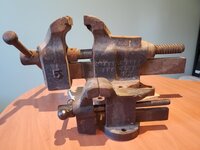
Merrill Brothers No 5, big chipping vise. From Brooklyn, NY. This guy has the new base (new meaning in the Catalog in 1902). It has 3 holes to mount it to the top of the bench but the mounting holes in the base of the vise line up with a ring of holes further inside. I have found no info on ring of holes but it looks like you could put a pin in one of vise base holes to help lock the vise in that position (holes are not threaded). It is a post through swivel design but the post and bottom hardware (lower plate and locking arm) are missing (kind of like missing pipe jaws). The outside diameter of the threaded screw is 1-3/8 inches. The length of the nut is equal to the width of the jaws and is part of the fixed jaw tower. I have a photo of this vise next to a small 3 inch, No3 American Scale exposed screw vise for comparison.
Jaws: 5 inches.
Opens: 9 inches
Weight: 85 lbs (but does not include the through hole post and bottom hardware). Catalog says 94 lbs.
Jaws inserts are screwed on. Bit of anvil area on the back.
Jaws: 5 inches.
Opens: 9 inches
Weight: 85 lbs (but does not include the through hole post and bottom hardware). Catalog says 94 lbs.
Jaws inserts are screwed on. Bit of anvil area on the back.
Attachments
-
 Merrill Bros - Catalog 1902 - 1-4 Chipping Exp screw, post thru.jpg29.4 KB · Views: 23
 -
 20220813_144554_resized.jpg77.4 KB · Views: 19
 -
 20220810_171445_resized.jpg87.1 KB · Views: 18
 -
 20220810_171339_resized.jpg52.5 KB · Views: 17
 -
 20220810_171311_resized.jpg56.9 KB · Views: 18
 -
 20220810_171216_resized.jpg162.6 KB · Views: 16
 -
 20220810_171208_resized.jpg88.5 KB · Views: 16
 -
 20220810_171121_resized.jpg106.2 KB · Views: 23
Fierljeppen
Well-known member
- Joined
- Jan 26, 2018
- Messages
- 1,159
Erie air vise
Jaw Width 4-1/2"
Overall length 30"
No other specs
Yep, someone adapted a Reed 104R with the air slide. I'll put it with the Reed 104-1/2R section built in Erie PA.
In 1944, the Bellows Co. of Akron Ohio, introduced their "Vispeed" air unit, which was sold with a 4" Reed vise, but could also work with any standard 4" or 4-1/2" vise. I'm not sure it's the same one skmbabon has shown.

Next time someone speaks dismissively of open screw vises, they need to be introduced to this!Merrill Brothers No 5, big chipping vise. From Brooklyn, NY. ...
Jaws: 5 inches.
Opens: 9 inches
Weight: 85 lbs (but does not include the through hole post and bottom hardware). Catalog says 94 lbs.
The one I posted says "Vispeed" on the bolted together housing at the back of the vise. Nice find Fierljeppen!In 1944, the Bellows Co. of Akron Ohio, introduced their "Vispeed" air unit, which was sold with a 4" Reed vise, but could also work with any standard 4" or 4-1/2" vise. I'm not sure it's the same one skmbabon has shown.

Outlawmws
Well-known member
Wilton made. possibly for SO or other
Hey, @Outlawmws , I've been meaning to say I like your sig
Outlawmws
Well-known member
Thx! For those that don't know, LL is a Robert E. Heinlein Character.
KMScott
Well-known member
Interesting info on the Vispeed. That should have it’s own listing. I am in Colorado on vacation and will change the Reed listing. Great stuff Fierljeppen! And skmbabon.

CRSINMICH
Well-known member
skmbabon: Here's another Canadian vise manufacturer to add to your list. At least I think it's new to you- MacFarlane Engineering. I ran across it while looking for other things. I also checked Google maps and, like I suspected, Paris, Ontario is not very far from London, Ontario.
EDIT: I'm going to have to remember to check the Vise Spreadsheet before I post. This vise information is already there.
EDIT: I'm going to have to remember to check the Vise Spreadsheet before I post. This vise information is already there.
Attachments

Last edited:
SkyPuncher
Well-known member
- Joined
- Dec 22, 2014
- Messages
- 243
Not sure where you would put this on the vise list, or if it even belongs there. No manufacture name, just a large "8".
3.25" jaws
42.8 pounds


3.25" jaws
42.8 pounds
Thanks for thinking of my search, @CRSINMICH. If you had posted it before 10:45 pm Thursday it would have been new to me; coincidentally that's when I saw the same post while looking for something else.skmbabon: Here's another Canadian vise manufacturer to add to your list. At least I think it's new to you- MacFarlane Engineering. I ran across it while looking for other things. I also checked Google maps and, like I suspected, Paris, Ontario is not very far from London, Ontario.
EDIT: I'm going to have to remember to check the Vise Spreadsheet before I post. This vise information is already there.
It's interesting how Canadian vise manufacturing was concentrated in a crescent from south (Merritton, Thorold, Hamilton) to west (London, Woodstock, Kitchener-Waterloo, Guelph) to north (Orillia) but Toronto, in the centre of that, didn't have a single manufacturer of note. A strange fact that is probably beyond explanation at this point.
Not sure where you would put this on the vise list, or if it even belongs there. No manufacture name, just a large "8".
3.25" jaws
42.8 pounds
I am sure someone with more knowledge will chime in, but this definitely looks like a Norris or Fisher Norris vise. The had models like this as well as chain vises that looked a lot like this

KMScott
Well-known member
Thanks FMC for your kind comments.
skmbabon, can you double check your source on the Air Driven Reed and see if it is a 4" or 4-1/2" jaw width. Thanks in advance.
Kevin
skmbabon, can you double check your source on the Air Driven Reed and see if it is a 4" or 4-1/2" jaw width. Thanks in advance.
Kevin
Only specs I could find Kevin:Thanks FMC for your kind comments.
skmbabon, can you double check your source on the Air Driven Reed and see if it is a 4" or 4-1/2" jaw width. Thanks in advance.
Kevin
Jaw Width 4-1/2"
Overall length 30"
KMScott
Well-known member
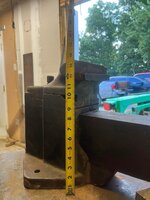
Western Tool & MFG Co Springfield Ohio.
Champion # 50.
8" Swivel jaw that opens to 15" and weights 294lbs.
I have many open spaces on these Champion vise's. If anyone has any please post pic's.
Champion # 50.
8" Swivel jaw that opens to 15" and weights 294lbs.
I have many open spaces on these Champion vise's. If anyone has any please post pic's.
Attachments
-
 Western Tool #50-V47-1.jpg441.4 KB · Views: 32
 -
 Western Tool #50-V47-3.jpg466.7 KB · Views: 31
 -
 Western Tool #50-V47-8.jpg371.1 KB · Views: 30
 -
 Western Tool #50-V47-7.jpg194.1 KB · Views: 28
 -
 Western Tool #50-V47-6.jpg233.7 KB · Views: 26
 -
 Western Tool #50-V47-5.jpg320.5 KB · Views: 25
 -
 Western Tool #50-V47-4.jpg264.6 KB · Views: 25
 -
 Western Tool #50-V47-2.jpg365.1 KB · Views: 33
 -
 Western Tool #50-V47-9.jpg49.6 KB · Views: 46
Last edited: