

You are using an out of date browser. It may not display this or other websites correctly.
You should upgrade or use an alternative browser.
You should upgrade or use an alternative browser.
Vise Info Thread
- Thread starter FMC1959
- Start date

KMScott
Well-known member
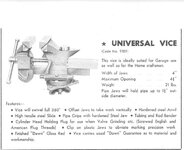
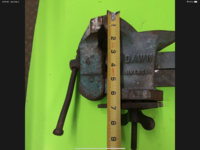
Dawn Universal Vice. Utility vice with 4" jaws that opens to 4-1/2" and weights 21lbs
Attachments


KMScott
Well-known member

Dave600
Well-known member
KMScott: That vise looks exactly like a Record 74. What are the dates on all these Dawn catalog pages you are posting? Not that I see many of them here in Ontario, Canada, but have seen a couple.Dawn Universal Vice. Utility vice with 4" jaws that opens to 4-1/2" and weights 21lbs
Thanks.
Many of the early Dawn models, like many of the early Canadian vises (Henry, Rae), were copies of the Record "classic" mechanics vise. I remember years ago on the main vise thread, there had been a lot of discussion on this. Although Record has many different models, this was the most popular, and the most copied. And from what I remember, the Record pre-dates all of the "copies".KMScott: That vise looks exactly like a Record 74. What are the dates on all these Dawn catalog pages you are posting? Not that I see many of them here in Ontario, Canada, but have seen a couple.
Thanks.
My guess is that both Canada and Australia being part of the British Commonwealth, trade between the counties was abundant. More than likely, some Canadian and Australian entrepreneurs figured why import these vises when we can make them here for less.
As the companies established themselves, they came out with other models; Dawn, most notably with their offset jaws model.
I can't say that my comments above about the Commonwealth are fact or just my imagination, but the Record definitely pre-dated all the others and there are so many Record copies out there.
**** EDIT - In re-reading Dave 600 post, I see he specifically mentioned the Record 74. Again, just my supposition, but Record was an old established company; my guess is that they were copied on other models also. Most notably, there may be other Record copies around, but I find they are most abundant in the Commonwealth countries.
Last edited:
KMScott
Well-known member
I have two catalogs that list that model, 1967 and 1969. The third 1982 catalog has the metric model numbers. I am just recording what is the in the three Dawn catalog's before I go through the older listings and reorganize them to the right areas.KMScott: That vise looks exactly like a Record 74. What are the dates on all these Dawn catalog pages you are posting? Not that I see many of them here in Ontario, Canada, but have seen a couple.
Thanks.
Thanks to CRSINMICH for these catalog's. Sure keeping me busy.
Last edited:
RTM
Well-known member

Hooterville
Well-known member
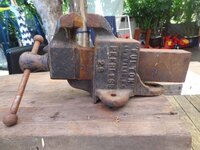
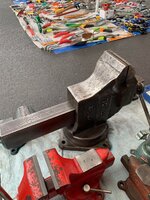
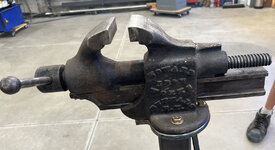
Lol, today I bought this exact vise (Fulton Peerless #28) and then I searched GJ and found your post with my new vise! I did a quick inspection and discovered it has a broken nut. Now searching GJ for ideas and options to repair/replace the nut.
KMScott
Well-known member

KMScott
Well-known member

CRSINMICH
Well-known member

RTM
Well-known member
Lol, today I bought this exact vise (Fulton Peerless #28) and then I searched GJ and found your post with my new vise! I did a quick inspection and discovered it has a broken nut. Now searching GJ for ideas and options to repair/replace the nut.
What part of the country did it come from? Hope it wasn't the same pic I posted.
KMScott
Well-known member



KMScott
Well-known member


CRSINMICH
Well-known member
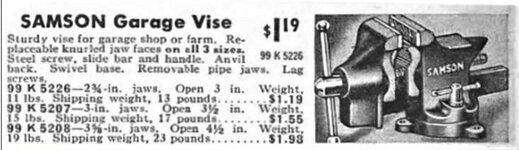
SAMSON 5207 Another light duty garage vise in its as-found, spray bombed glory. It shows up in a 1938 Sears catalog but not in 1940. Sears discontinued SAMSON around that time.
Attachments


KMScott
Well-known member
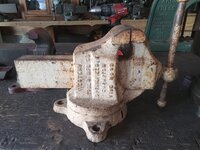
Champion #32. 3-1/2" jaws that opens to 5" And weights 36 lbs
Attachments


Last edited:
davethorik
Well-known member
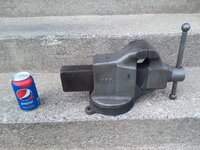
i have a Western Champion #33 to add. 4" jaw but pics wont upload. opens 6" per ad (more like 5-1/4") and weighs 51 lbs.
KMScott
Well-known member
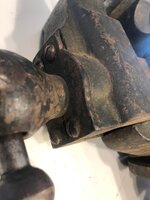
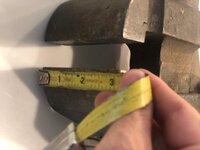
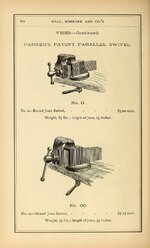
Parker 00 3-1/8" jaws that weights 23 lbs .
Anyone seen a catalog page with this vise in it. It has the look of a Parker. Check out the collar.
edit, Thanks Flerljeppen for your help.
Anyone seen a catalog page with this vise in it. It has the look of a Parker. Check out the collar.
edit, Thanks Flerljeppen for your help.
Attachments
-
 Charles Parker 00-9.jpg414.8 KB · Views: 18
 -
 Charles Parker 00-8.jpg233.2 KB · Views: 15
 -
 Charles Parker 00-6.jpg139 KB · Views: 14
 -
 Charles Parker 00-5.jpg211.5 KB · Views: 12
 -
 Charles Parker 00-4.jpg172.2 KB · Views: 14
 -
 Charles Parker 00-3.jpg115.3 KB · Views: 13
 -
 Charles Parker 00-2.jpg159.3 KB · Views: 13
 -
 Charles Parker 00-1.jpg190.4 KB · Views: 17
 -
 Charles Parker 00.jpg134 KB · Views: 22
Last edited:
Fierljeppen
Well-known member
- Joined
- Jan 26, 2018
- Messages
- 1,159
i have a Western Champion #33 to add. 4" jaw but pics wont upload. opens 6" per ad (more like 5-1/4") and weighs 51 lbs.
Western Tool & Mfg. Co. "Champion vise no. 33" vise, by davethorik.
jaw width.........4"
jaw opening....5-1/4"
weight..............51 lbs.



Fierljeppen
Well-known member
- Joined
- Jan 26, 2018
- Messages
- 1,159
Parker 00? 3-1/8" jaws.
Anyone seen a catalog page with this vise in it. It has the look of a Parker. Check out the collar.
Yep, it looks all Charles Parker to me. The catalog scan is from 1870.
KMScott
Well-known member
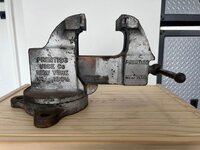
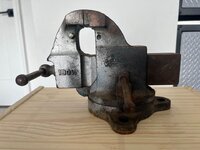
Thanks Flerljeppen, I could not list it as a Parker till I seen a Catalog page. Awesome vise.
KMScott
Well-known member



Dave600
Well-known member
Flerljeppen, what year is your catalog page for this? The shape of the actual photo behind the rear jaw does not match the photo in the catalog. The Catalog has a script style "Champion" on the vise. thanks...Western Tool & Mfg. Co. "Champion vise no. 33" vise, by davethorik.
jaw width.........4"
jaw opening....5-1/4"
weight..............51 lbs.
Fierljeppen
Well-known member
- Joined
- Jan 26, 2018
- Messages
- 1,159
Flerljeppen, what year is your catalog page for this? The shape of the actual photo behind the rear jaw does not match the photo in the catalog. The Catalog has a script style "Champion" on the vise. thanks...
I don't have a date for the catalog. I got the photos and catalog scan from "davethorik" and was just trying to help him post them.
I do see the difference you're talking about though and suspect the catalog scan is more contemporary than his vise.
Very interesting dissertation on a Japanese-made hydraulic toolmaker's vise by @Bakafish on his shop thread:
My longstanding JAM Vise addiction is well documented here, and while I'm cognizant that I often turn this thread into a show and tell I will yet again subject you to the latest arrival. It is something a little unique at least, hopefully of interest.
This 17.7kg (~40lbs.) chunk of the finest tool steel is the JAM HP150, although I paid a pittance for it, it sells for roughly $3000 and with a 120mm jaw width and 150mm span, is one of the largest units they make. But what makes it special is hidden inside the screw assembly, for this is a Hydraulic vise. Before I detail exactly what that means, let's go back a few steps and talk about screws.
Screws are miraculous things, useful well beyond simply attaching things, precision screws are the basis on which most of the modern world has been built. They are fundamentally an endless inclined plane providing mechanical advantage. They have their trade offs though, and so special thread forms have evolved to try and compensate and optimize the screw form to its purpose. For a vise we are primarily concerned with how much pressure the thread can exert without failing and the amount of force required to turn the screw compared to the force it is exerting. The typical thread forms used in quality vises and clamps are Acme or Trapezoidal (metric), and in rarer cases Square or Buttressed thread forms might be employed. A sure sign of a cheap or lightweight vise or clamp is the use of conventional threads (although they certainly do work, they will require more force for the same amount of clamping power and will fail under less pressure.) The main difference of these variants is to increase the cross sectional area increasing the strength of the screw thread and to reduce the face angle in order to increase the efficiency.
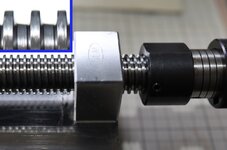
If we look carefully at these threads we can see that the thread face angles are almost perpendicular with carefully relieved root areas. This is a modified square form, and it is one of the most difficult to produce with normal threading techniques like taps and dies (although since these are ground threads, it isn't a lot harder for them to make these over a more conventional thread form.) These square threads (actually they appear to me to be a 10° Modified Metric Square Thread) are the strongest and most efficient (Machinery's Handbook 29th Ed., pg.1944) meaning that they are very good at converting the rotational torque into linear force, a higher thread angle is going to waste some of the force as the thrust vector perpendicular to the face is not as parallel to the screw axis. This efficiency becomes an important and non-intuitive factor because when we start clamping things, thread friction suddenly becomes a really critical consideration!
A short time ago, an excellent YouTuber, Jason at Fireball Tools did some real world testing on different 'off the shelf' screw threads with the same pitch, but different diameters for use in a shop built vise project he was working on, and the results were quite interesting. I won't give the results of his experiments away, but it elucidates that there are a lot of surprising variables involved in selecting the right thread form, pitch, engagement length and diameter, especially if you want it operated by hand.
So how do we cheat? We can add some clever hydraulic advantage to our system! For those who may not be familiar, hydraulics use non-compressible liquids to convey force. Since pressure is force over area, one can use pistons with different areas (one with a small face, and one with a large one) to create something akin to a fancy lever that multiplies the force we are exerting. Nothing is for free, for this to work we are trading off displacement, the large amount we need to move the smaller piston, for the smaller movement at a higher force of the bigger one. But in this case we have a hybrid of both a screw and a hydraulic piston, so the very limited amount of movement of the larger piston is not really a problem. Let's look at how they are doing this.
Hidden inside the handle, jaw and the screw are an entirely self contained hydraulic mechanism. When the handle is rotated, the screw will close the moving jaw like a normal vise until it engages with the workpiece, then when we can no longer turn it due to friction, we can engage the hydraulic system with a gentile push of the handle. Once the fine internal threads of the handle start turning, they force the smaller 'long stroke' piston inside the handle to pressurize the system. This pressure transfers force to the larger area, slower moving piston inside the moving jaw. Due to the differences in area of the two pistons this force is greatly multiplied exerting some pretty astonishing clamping power (up to almost 15kN on this model) using only gentile hand power!
I'm sure there are conventional vises of similar size that can reach similar clamping strength with a long enough bar on the screw, but rotating threads under such pressures creates all sorts of problems and forces (including possibly messing with the vises position) and is much more likely to cause wear or damage. The hydraulic force in this vise is completely linear and the threads are not forced to slide when under such high pressures.
Hope this was worth the read!


banditbigdog
Well-known member
Another Paramo, appears identical.Paramo #5. 5" jaws that opens to 6-1/4" and weights 75 lbs.
One feature the Record’s / Paramo’s have I like is the decent supporting block under the movable jaw at the front.


Last edited:
SkyPuncher
Well-known member
- Joined
- Dec 22, 2014
- Messages
- 243
Picked up a Craftsman 5197 (raised letters) with a date of 7/55. 4 1/2 jaws, 78 pounds
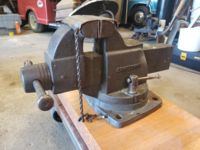
Attachments


Last edited:
KMScott
Well-known member
Add some more pic's of your 5197 skypuncher and I add your vise to the spreadsheet. You can add more to your earlier post if you like. Show the jaws and the other side if you can, add a front shot with the 5197 stamped in the handle support nose. Thanks Kevin
SkyPuncher
Well-known member
- Joined
- Dec 22, 2014
- Messages
- 243
And for size comparison here is the 5197 next to a Rock Island 574 also with 4 1/2" jaws

Very nice vise. First things, 7" are always not as abundant as the other sizes. Then, like many CDN vises that typically look like a record or other British vise; this one looks more USA roots. An 8" Record (their classic mechanics vise) weighs in at 85-90 pounds; this being a 7" and weighing 110...not quite like the old American iron, but still a nice chunk.Rae 107. 7" jaws that opens to 9" and weights 110 lbs
Last edited:
KMScott
Well-known member
Sargent with 2" jaws. Pic's compare it to a Sargent #43 3" jaw vise. No model number for the 2" vise.
Attachments


KMScott
Well-known member

KMScott
Well-known member


Outlawmws
Well-known member
I've been using a 4" Parker for near 40 years as my primary vise - far more than homeowner level at times. I used to build race cars and have done several 2 to 4 WD conversions.
Dave600
Well-known member
Here is a 1937 Atlas catalog on the Rock Island 603-605 vise.Rock Island 605. 4" jaws on this open screw vise.
Attachments

KMScott
Well-known member
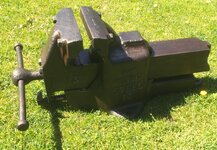
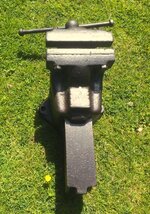

KMScott
Well-known member
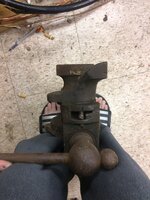
Could this be a Lewis vise? Maybe 3-1/2" jaws.
Attachments




Fierljeppen
Well-known member
- Joined
- Jan 26, 2018
- Messages
- 1,159
Could this be a Lewis vise? Maybe 3-1/2" jaws.
Stumped again, not a clue. The casted patent date was no help at all. It's a very interesting vise with unique features, but I've never seen anything like that vise in a photo or printed data. It doesn't look like a Lewis Tool vise to me though.
Hoping someone can shed some light on this one.
Outlawmws
Well-known member
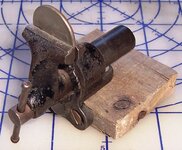
I didn't see this onr in the spreadsheet (I was getting info for WrenchGuy...) I got this in trade a complicated trade from Shift.
1" jaw (1.019) - 1.082 opening. Actual weight: (edit from 6/typo) 5 oz (despite the catalog page...)
Only markings are "Pat. Appld For" so a Pre-Patent Colton, and pretty early - A fair amount of Japanning is still on it:



1" jaw (1.019) - 1.082 opening. Actual weight: (edit from 6/typo) 5 oz (despite the catalog page...)
Only markings are "Pat. Appld For" so a Pre-Patent Colton, and pretty early - A fair amount of Japanning is still on it:
Last edited: