To avoid these ads, REGISTER NOW!

Wago Push Connectors

To avoid these ads, REGISTER NOW!

Terry D

Well-known member
Joined
Mar 25, 2015
Messages
2,202
Location
St. Louis, MO.
Yes, they come on HALO recessed lights, but I don't trust them. I cut them off and use wire nuts. To me, they are no different than back stabbing a device.
 
OP
S

scanchain

Well-known member
Joined
Mar 3, 2011
Messages
79
Yes, they come on HALO recessed lights, but I don't trust them. I cut them off and use wire nuts. To me, they are no different than back stabbing a device.

You don't trust their connections?
 

Terry D

Well-known member
Joined
Mar 25, 2015
Messages
2,202
Location
St. Louis, MO.
You don't trust their connections?

I will be honest, I haven't seen one do it in awhile, and I realize that a recessed light gets banged around a lot before it gets installed. But I cant tell you how many times that I have had opened up the j-box to wire it and those connectors had come off the wire. Its just my opinion, They just remind me of back stabbing a device, and I have had many service calls where those connections have failed. I just like wire nuts. They are quick to install compared to a wire nut.
 
Last edited:

MeentSS02

Well-known member
Joined
Aug 12, 2010
Messages
325
Location
Dayton, OH
I've used the Ideal brand for many years, and I've run a lot of current through them without issue. Some don't like them, but they sure are easy to work with, and if installed properly, I've never had one come loose. They can be removed, but it takes some twisting and some force to get them to come off.

I do only use them on solid wire though...you can use them with stranded, but at the very least, I'd want to make sure it was tinned before inserting. If it's stranded, I just use wire nuts.

Even wire nuts can be installed incorrectly. Always give the wires a good tug to make sure they are installed properly.
 

Git

Well-known member
Joined
May 18, 2008
Messages
6,894
Location
S Cal
I have no issue using the lever lock version. If you actually look at a cutaway, you can see there is a lot of contact between the wire and the Wago, and keep in mind the lever keeps the pressure applied

attachment.php
 

Attachments

  • wago.jpg
    wago.jpg
    41.6 KB · Views: 697

JRC3

Well-known member
Joined
Jun 30, 2014
Messages
12,481
Location
Southwestern OH
Yes, they come on HALO recessed lights, but I don't trust them. I cut them off and use wire nuts. To me, they are no different than back stabbing a device.

There's a huge difference between a 15 amp outlet and a few 13 watt wafer lights. 13 watts is about 1/140 of 15 amps. I agree they have no place on the back of an outlet, not even sure why it's allowed.


I've had to track down plenty of loose wire nuts in my time. People are afraid to twist a wire nut or a screw terminal tight enough for some reason.
 

Angelfire

Well-known member
Joined
Mar 22, 2012
Messages
1,367
Location
New Mexico and Ireland
I've used both their lever and push style. The lever style have been quite handy, fast, and seem to be doing their job just fine in my garage. The push connectors are even faster to use and from what I can tell, pretty much makes a permanent connection. I tried to remove a wire from one of them and was not successful. Just buggered up the wire trying to pull it out. Ended up just cutting it off and tossing the connector. So yeah, wire nuts are great particularly if you anticipate changes to your wiring but for me, the connectors really work well and are fast. They are a bit more expensive though.
Cheers.
 

Max

ALLIANCE MEMBER
Joined
Jun 16, 2018
Messages
3,315
Location
Georgia
I have to agree with Terry - the connections seem too much like a back stab on the push type. And I hate back stabs with a passion. We have a new to us house that is 15 years old, and so far I have had four back stabbed switches with bad connections that got the switch hot and cooked the bakelite (or whatever it is) switch body. I never back stab and replace all that I find in my house.

- Max

PS. Yes, I realize that back stabbing meets code. However, code sets a minimum...
 

tachyon

Well-known member
Joined
Oct 22, 2017
Messages
63
I’ve used the Waco lever style and push style on my new garage and loved them. Fast, easy, compact.

The lever style worked great with stranded wire, IMO better than wire nuts for the 20 ga dimmer wire in my UFO’s.

I just wish they had a versio. For the triple-zero gauge feeder wire I had to use! [emoji6]

To each their own, but I loved how fast the Wago units worked. Will I have issues in the future? I doubt it, but if I do I can always wire but it.

8005a4b3adbbd1a330fc368d38bc6fd0.jpg

f3d6886c0d6e6e8b5e0cab7c57af78fa.jpg


Sent from my iPhone using Garage Journal
 

Attachments

  • f3d6886c0d6e6e8b5e0cab7c57af78fa.jpg
    f3d6886c0d6e6e8b5e0cab7c57af78fa.jpg
    89.5 KB · Views: 0
  • 8005a4b3adbbd1a330fc368d38bc6fd0.jpg
    8005a4b3adbbd1a330fc368d38bc6fd0.jpg
    119.9 KB · Views: 1

Bert_

Well-known member
Joined
Dec 24, 2016
Messages
9,693
Location
NW Iowa
I use them in lights with #14 wire. It's fast and really makes quick work of can lights.

I won't be replacing all my wire nuts with them any time soon. To many failures on circuits with a decent load
 

Attachments

  • KIMG0734.jpg
    KIMG0734.jpg
    150.1 KB · Views: 153

pbon

Well-known member
Joined
May 14, 2017
Messages
3,498
I like the wago lever connectors. Obviously cost more than twisters and no more effective, but easy and convenient.
 

mobiledynamics

Well-known member
Joined
Mar 14, 2010
Messages
5,034
Location
Gotham City
Is that a stab in Wago ?

I've got 9 circuits on the Levers for the last 2 years (circuits that are on my gen trans switch). More or less, all 9 of those see some sort of load everyday. I've checked them 2-3X . All still seem nice and snug...
 

jeepxj

Well-known member
Joined
Mar 2, 2008
Messages
17,831
for lights fine. for outlets not yet unless you use the lever ones.
 

Git

Well-known member
Joined
May 18, 2008
Messages
6,894
Location
S Cal
I use them in lights with #14 wire. It's fast and really makes quick work of can lights.

I won't be replacing all my wire nuts with them any time soon. To many failures on circuits with a decent load

Not sure what your are doing, but here is a guy who put 50 amps through one - the insulation on the wire started melting and the wago was fine. And this was using one of the 'push in' type, not even a lever lock

here is the video of him testing it

here is a pic
attachment.php
 

Attachments

  • TRI-492.jpg
    TRI-492.jpg
    123.4 KB · Views: 506

Bert_

Well-known member
Joined
Dec 24, 2016
Messages
9,693
Location
NW Iowa
Not sure what your are doing, but here is a guy who put 50 amps through one - the insulation on the wire started melting and the wago was fine. And this was using one of the 'push in' type, not even a lever lock

here is the video of him testing it

here is a pic

Age and environment plays a big part. My picture is from a service call for an issue that wasn't even related to the wago. I noticed the glow and smoke a few seconds after the feed line kicked on. Not the first one I've seen do it.

Admittedly this was in a hog barn so it's a tough environment but I don't see wire nuts failing. Original installer only cared about wiring it as fast as possible. I cut the wago's out and replace with wire nuts whenever I find them.
 

jeepxj

Well-known member
Joined
Mar 2, 2008
Messages
17,831
Age and environment plays a big part. My picture is from a service call for an issue that wasn't even related to the wago. I noticed the glow and smoke a few seconds after the feed line kicked on. Not the first one I've seen do it.

Admittedly this was in a hog barn so it's a tough environment but I don't see wire nuts failing. Original installer only cared about wiring it as fast as possible. I cut the wago's out and replace with wire nuts whenever I find them.


ya do realize in europe they dont use wire nuts at all. they have industrial sites that are just as hard on connections. :beer:
 
To avoid these ads, REGISTER NOW!

matt_i

Well-known member
Joined
Mar 14, 2008
Messages
10,722
Location
SE Michigan
My take is the back stab is more of a metal edge that "bites" the wire from the little nick that seems to get in it from ones I've removed vs the flat/rounded spring contact that you see on the wago cutout above.
 

JRC3

Well-known member
Joined
Jun 30, 2014
Messages
12,481
Location
Southwestern OH

Git

Well-known member
Joined
May 18, 2008
Messages
6,894
Location
S Cal
My take is the back stab is more of a metal edge that "bites" the wire from the little nick that seems to get in it from ones I've removed vs the flat/rounded spring contact that you see on the wago cutout above.

This is what a 'backstab' type outlet looks like. Basically spring tension holds the wire in place. Look at the upper left in the pic where it says Quickwire. and your looking at the front of the outlet with the face removed. The one little piece of flexible copper is holding the wire in. Compare that to the pic of the Wago I posted above

When it comes to outlets, I prefer to pay for the 'screw and clamp' type

attachment.php


These are what I question too. https://www.homedepot.com/p/Tyco-Electronics-Romex-Splice-Kit-2-Wire-1-Clam-A22899-000/202204326 But I've never even held one, so what do I know.
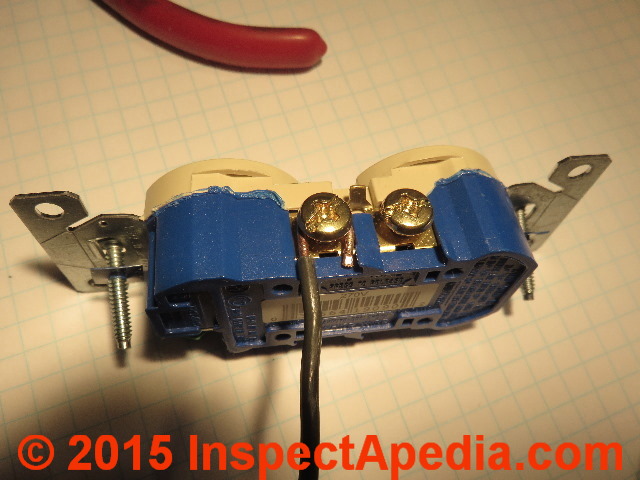
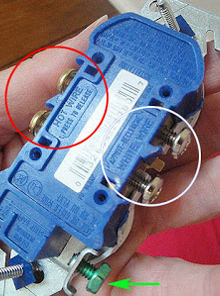
I don't have any issue using splices and they also make a tap, either. In fact, I have used them in a couple of places and it really saved my ****. You realize that those were basically made for the manufactured home business where they assemble things on site.

Personally, I have now come across two different times where a wire nut has failed. Right where the insulation was stripped from the wire, the wire broke but it was still in place because of the way the wires were twisted together. It wasn't until I removed the wire nut and started to separate the wires did it become obvious - I was troubleshooting why an outlet stopped working.

And if you ever think about using smart switches and out outlets (z-wave, etc) Wago lever locks really make it easy to install a new device or upgrade.
 

Attachments

  • backstab.jpg
    backstab.jpg
    146.1 KB · Views: 380

JRC3

Well-known member
Joined
Jun 30, 2014
Messages
12,481
Location
Southwestern OH
Maybe some people backstab because they don't quite know how to easily get the wire around the screw terminal. Look closely and you'll see a little notched protrusion or two near the screws. These are to grip the very tip of the striped wire so you can bend it by hand around the loosened screw. Look on the ground terminal and you'll see a little hole or tab in the metal for the exact same purpose. Some outlets don't have these but most do.

It took me decades to realize this. And I've never seen anyone else explain it or ever seen any type of instruction. Not even sure it's their intended purpose, but it sure works like it is.

Binding_Head_Screw_Connector_126_DJFs.jpg

coloredscrews.jpg
 

Terry D

Well-known member
Joined
Mar 25, 2015
Messages
2,202
Location
St. Louis, MO.
If a splice is made up correctly, wires stripped right, and all lined up before twisting. And the correct size wire nut is used. After twisting, I always snip the ends so they are all the same length when the go in the wire nut. A good splice will never fail. It's the ones that have way to many wires and all the stripped lengths are different that will give you trouble.

Sent from my SM-G960U using The Garage Journal mobile app
 

manwithtools

ALLIANCE MEMBER
Joined
Aug 24, 2015
Messages
13,642
Location
Lebanon, TN
If a splice is made up correctly, wires stripped right, and all lined up before twisting. And the correct size wire nut is used. After twisting, I always snip the ends so they are all the same length when the go in the wire nut. A good splice will never fail. It's the ones that have way to many wires and all the stripped lengths are different that will give you trouble.

Sent from my SM-G960U using The Garage Journal mobile app

And cases where wires of different gauges (say 3-12 and one 16 from a fixture) are wire nutted together can cause problems as well. That is one very important use of Wago connectors. We use them extensively in industrial applications (typically lever style), less issues with them than wire nuts. The other plus is the ability to remove / replace a single wire without disturbing the remaining connections. This is very important in industrial applications where a device might get replaced several times in the life of the equipment.
 

Git

Well-known member
Joined
May 18, 2008
Messages
6,894
Location
S Cal
Maybe some people backstab because they don't quite know how to easily get the wire around the screw terminal.


See the two holes in these strippers down by the crimper part? After you strip the insulation of the wire, you put the end in the hole and bend it to form a loop
attachment.php
 

Attachments

  • TRI-513.jpg
    TRI-513.jpg
    23.1 KB · Views: 338

pbon

Well-known member
Joined
May 14, 2017
Messages
3,498
I am just a DIYer and find them convenient enough to be worth the cost. But would a pro who is bidding on a job and can do a wire nut as fast as I can do a wago spend the materials money on them and lose the profit on a whole house or building?
 

MattT

Well-known member
Joined
Feb 20, 2010
Messages
3,201
I am just a DIYer and find them convenient enough to be worth the cost. But would a pro who is bidding on a job and can do a wire nut as fast as I can do a wago spend the materials money on them and lose the profit on a whole house or building?

The push in ones are about the same price as decent wire nuts and definitely save labor. So using those is a no brainer from an economic standpoint.

The lever style seem to run 25 to 50 cents higher depending on size. That's 30 seconds or less at 60 bucks an hour. Too expensive for general use because you can save more time with push ins. On something like an overhead light fixture where fighting wire nuts can take a while, and push ins aren't practical because of stranded wire, they're worth it.

FWIW I won't use these things on power circuits. Don't care how many amps a brand new one will handle on a bench. Get some age and thermal cycles on 'em and get back to us on that.
 

JRC3

Well-known member
Joined
Jun 30, 2014
Messages
12,481
Location
Southwestern OH
FWIW I won't use these things on power circuits. Don't care how many amps a brand new one will handle on a bench. Get some age and thermal cycles on 'em and get back to us on that.
I've seen plenty of backstabbed burnt up outlets to prove this. They look perfect from the front til you pull them out and often fall apart. Now imagine daising chaining while backstabbing in a kitchen or space heaters being used in separate bedrooms that share the same circuit.

But with modern LED lighting, I don't see there ever being a problem with quick connectors being used instead of wire nuts. Even with daisy chaining, 10 wafer lights that's the equivalent of a two 65w incandescent flood bulbs.
 

alfredeneuman

Well-known member
Joined
Mar 3, 2011
Messages
4,580
Location
Fullerton, CA
On something like an overhead light fixture where fighting wire nuts can take a while,

Push in connectors are a real labor saver when it comes to changing ballasts.
They can be connected to the replacement's leads before climbing the ladder.
No more tiny wirenuts to jack with.:)
 

alfredeneuman

Well-known member
Joined
Mar 3, 2011
Messages
4,580
Location
Fullerton, CA
I've seen plenty of backstabbed burnt up outlets to prove this.

The contact surface on a backstab outlet is only the very end of a tiny spring.
The contact surface on a push in is on the side of the spring.

They're not alike at all except that they both are dependent on spring tension.
 

MattT

Well-known member
Joined
Feb 20, 2010
Messages
3,201
The contact surface on a backstab outlet is only the very end of a tiny spring.
The contact surface on a push in is on the side of the spring.

They're not alike at all except that they both are dependent on spring tension.

If the only problems I'd seen were with cheap residential backstabs I'd be more inclined to trust push ins for power circuits. Backstabs are often just one of many fails there. When you're pushing 20A plus thru' 14g romex better receptacles ain't gonna delay the inevitable for long.

However I've also seen failures with industrial push in terminal blocks used for power distribution. These were under rated current and using appropriately sized wire. And guess who made some of those failed terminal blocks.......................
 

jeepxj

Well-known member
Joined
Mar 2, 2008
Messages
17,831
If the only problems I'd seen were with cheap residential backstabs I'd be more inclined to trust push ins for power circuits. Backstabs are often just one of many fails there. When you're pushing 20A plus thru' 14g romex better receptacles ain't gonna delay the inevitable for long.

However I've also seen failures with industrial push in terminal blocks used for power distribution. These were under rated current and using appropriately sized wire. And guess who made some of those failed terminal blocks.......................

well maybe they should wire the house correctly. then it wouldn't melt down.
 

MattT

Well-known member
Joined
Feb 20, 2010
Messages
3,201
When have you seen that?

Not uncommon around here in no codesville. Saw another one today. Two 14 gauge circuits landed on a tandem 20A breaker. Didn't take a picture of it but did take these two at the same trailer. And yes the orange wire is romex:wtf:

attachment.php


attachment.php
 

Attachments

  • IMG_2801.jpg
    IMG_2801.jpg
    100.7 KB · Views: 184
  • IMG_2799.jpg
    IMG_2799.jpg
    104.7 KB · Views: 178
To avoid these ads, REGISTER NOW!
Top Bottom