Are Wago Push Connectors approved by the NEC for connecting ground wires in a junction box?
https://www.amazon.com/dp/B07CNBZ78V/?tag=atomicindus08-20
https://www.amazon.com/dp/B07CNBZ78V/?tag=atomicindus08-20

Yes, they come on HALO recessed lights, but I don't trust them. I cut them off and use wire nuts. To me, they are no different than back stabbing a device.
You don't trust their connections?
Yes, they come on HALO recessed lights, but I don't trust them. I cut them off and use wire nuts. To me, they are no different than back stabbing a device.


I use them in lights with #14 wire. It's fast and really makes quick work of can lights.
I won't be replacing all my wire nuts with them any time soon. To many failures on circuits with a decent load
Not sure what your are doing, but here is a guy who put 50 amps through one - the insulation on the wire started melting and the wago was fine. And this was using one of the 'push in' type, not even a lever lock
here is the video of him testing it
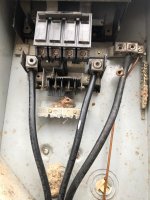
here is a pic
Age and environment plays a big part. My picture is from a service call for an issue that wasn't even related to the wago. I noticed the glow and smoke a few seconds after the feed line kicked on. Not the first one I've seen do it.
Admittedly this was in a hog barn so it's a tough environment but I don't see wire nuts failing. Original installer only cared about wiring it as fast as possible. I cut the wago's out and replace with wire nuts whenever I find them.


- 2 Wire Ccnnection
- For Use On 12 or 14 AWG (300 Volt) 2 wire NM cable with ground
- Eliminates junction boxes and wire nuts
- Fast & simple to install
- NEC compliant - article 334-40b, 2005 and 2008 NEC
- UL and CSA listed
My take is the back stab is more of a metal edge that "bites" the wire from the little nick that seems to get in it from ones I've removed vs the flat/rounded spring contact that you see on the wago cutout above.
These are what I question too. https://www.homedepot.com/p/Tyco-Electronics-Romex-Splice-Kit-2-Wire-1-Clam-A22899-000/202204326 But I've never even held one, so what do I know.
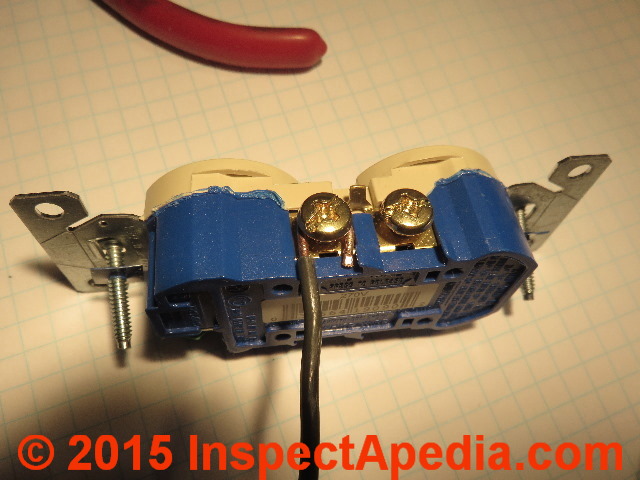
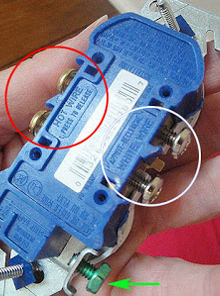
If a splice is made up correctly, wires stripped right, and all lined up before twisting. And the correct size wire nut is used. After twisting, I always snip the ends so they are all the same length when the go in the wire nut. A good splice will never fail. It's the ones that have way to many wires and all the stripped lengths are different that will give you trouble.
Sent from my SM-G960U using The Garage Journal mobile app
Maybe some people backstab because they don't quite know how to easily get the wire around the screw terminal.
I am just a DIYer and find them convenient enough to be worth the cost. But would a pro who is bidding on a job and can do a wire nut as fast as I can do a wago spend the materials money on them and lose the profit on a whole house or building?
I've seen plenty of backstabbed burnt up outlets to prove this. They look perfect from the front til you pull them out and often fall apart. Now imagine daising chaining while backstabbing in a kitchen or space heaters being used in separate bedrooms that share the same circuit.FWIW I won't use these things on power circuits. Don't care how many amps a brand new one will handle on a bench. Get some age and thermal cycles on 'em and get back to us on that.
On something like an overhead light fixture where fighting wire nuts can take a while,

I've seen plenty of backstabbed burnt up outlets to prove this.
The contact surface on a backstab outlet is only the very end of a tiny spring.
The contact surface on a push in is on the side of the spring.
They're not alike at all except that they both are dependent on spring tension.
When you're pushing 20A plus thru' 14g romex better receptacles ain't gonna delay the inevitable for long.
If the only problems I'd seen were with cheap residential backstabs I'd be more inclined to trust push ins for power circuits. Backstabs are often just one of many fails there. When you're pushing 20A plus thru' 14g romex better receptacles ain't gonna delay the inevitable for long.
However I've also seen failures with industrial push in terminal blocks used for power distribution. These were under rated current and using appropriately sized wire. And guess who made some of those failed terminal blocks.......................
When have you seen that?