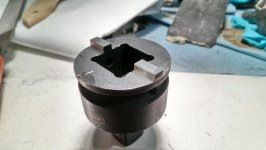
To avoid these ads, REGISTER NOW!

Walker 93632 Jack Rebuild

Hiball

Well-known member
Joined
Apr 30, 2009
Messages
14,027
Location
Missery
At least you learned something after 25 years of servicing hydraulic jacks. Let us hope the next thing you learn does not take 25 more years. See, right there you admitted that you do things by the seat-of-the-pants method and not because you researched the topic. There is information out there, just do a little research. And doing something for 25 years does not guarantee that you are doing things right. You could be replicating a mistake for many years without knowing it or doing something different from what the standards call for.

The Only thing i learned was that ive been doing something right without even needing to step into the world of RA finishes, Amazingly.. The Person i learned from my Grandfather had a fairly good grasp on what finish is acceptable and he never even used the Interwebs. I figure between my Grandfather and Me we have over 65 years in the Hydraulic Service, You would think that if 400 grit wasnt sufficient, We might have seen a few early Returns into the Shop.... LOL... Let alone Ucups with jagged gashes and teeth marks from a "Mirror Finish" <-- Lol

If quoting from the internet or posting links does not make you smarter, well, you posted and linked more than I did; I only linked the Simritna site. And you did not like Parker at all, you even made fun of the Parker manual and of me using it. So what gives? You know, I am pretty sure the Parker people know a little more than you do. It is a worldwide company, with thousands of products, not a mom and pop shop. It is a good thing that you are coming out of the cave you live in and are starting to see the light, but you still show a lot of resistance to improving your knowledge. But what do I care, it is not my problem, it yours after all.

I dont think you are following along Edgar, 400 Grit provides a recommended finish from just about every Hydraulic cylinder shop on the Internet, Including Enerpac, Who im going to assume you have heard of? Why you continue to ignore this is beyond me, You dont have to scroll back too many pages to see, And are you really going to play I dont "Link Drop" on the Internet Card? There is No Cave, If i give a Opinion or Directions on how to do something with a floor Jack, There is Solid Bench time there to back it up.

As for the 400 grit, for the third time I will explain that the 400 grit stone cut remains the same no matter how many times you make passes, but the cut depends on the tension it was adjusted to. In the case of the 400 grit wet and dry sandpaper, the grain wears out, or becomes duller, after each pass. So if you start with the 400 grit and do 3 or 4 passes, the finish at the end is finer than doing 3 or 4 passes with the 400 grit stones. With the stones, the finish should always be the same if the honer tension remains the same. That is why I stated that a 1000 grit is not really needed if you do a few passes with the 400 grit sandpaper. I hope I don't have to explain this four times.

You can explain it as many times as you Want.. IM NOT BUYING.. The Beauty of a Flex Hone and Rigid Hones is that the Tension is evenly distributed, Sure... Sandpaper wears down and Looses its Cutting ability, But when it wears down it also reduces the cylinder wall pressure at the same time. Its a Running Joke that it takes longer to set up a Honing machine, than it does to actually finish the cylinder, Onviously a Rigid Stone isnt going to wear down near as fast as some Glue Paper. We are just talking about re-finishing the Surface, Not machining a New Cylinder, I have serious doubts that your 320 grit starting paper can even touch a Glazed cylinder, maybe this why it takes multiple passes with various grits. I cant imagine the Football and the Monkey dance it would take to continue to add Paper in a attempt to regulate wall pressure to attempt to get a even cylinder wall finish. It may get you where you need to be eventually, but damn the proper tool for the job makes this job something a 8 year old could do.

As for feeling the finish with finger, I already stated that I it is not the same for the finger as for the seal. The seal sees much more pressure, or compression, against the cylinder than your finger does when feeling the finish. So what feels smooth to you may not be, in fact, so smooth for the seal. With an o-ring , a not so smooth finish that feels smooth enough for the finger, can make the o-ring twist in its groove and get damaged in a short time. A seal like an u-cup might not twist in its groove because its shape prevents it, but the seal would wear faster with a not so smooth finish. This would only be of concern for hydraulic equipment that is used daily for many hours. For a floor jack, that is used a few times a year, is not important.

Again... Im not sure if your following, YES as Stated in #152, Finish Characteristics follow Seal material/Application on Occasion, NO DOUBT Buna Nitrile Orings will require a Smoother surface based off the Application (Rod/Milwaukee) and because of the Material (Parker). Im not 100% sure if you are aware of what type of finish you can get with a 400 grit Flex/Rigid Hone "If" you utilize the proper Rpm and cutting oil/lube.

I will repeat, a finer and better polished finish is better than the cross hatch finish left by 400 grit stones in terms of seal longevity. No one has to super polish the cylinder, but it should be polished at least a little more than just leaving it with the cross hatch finish produced with 400 grit stones

I feel like im Repeating myself, But Cross Hatch is a by-product of Vertical speed in the Bore, I know its a fun word, but its being severely Misused in this thread, In regards to Hydraulic cylinder finishes, Its only purpose is to keep the Valleys Or Imperfections if thats easier to understand, that are Needed to Properly allow Oil "AHEAD" of the Sealing lips.

As for the rams, just look at the Milwaukee floor jacks which use a thick o-ring in a rod application as the main seal. The ram of the Milwaukee is hard chromed and it is smooth; no cross hatching there and it works fine, so why complain about polishing the cylinders at least a little more than the cross hatch finish left by stones? There are also many other hydraulic bottles which use u-cups in a rod application and the ram is smooth in all of them, and the u-cup holds the pressure and seals the ram, no problem there. In general, if the rams can have a smoother surface than the cross hatch finish, why can't the cylinders benefit of a better polished finish?

Again.. #152 YES and YES, SIGH... Nobody is saying that the Cylinder shouldnt be Smooth, MY God Edgar a RA of a Cylinder finished with 400 Grit is classified as a "Mirror Finish". Is that not Smooth?

If I say blue, he says red, if I say red then he says blue. This might be complaining just for the sake of complaining.

I say Yellow.. If 400 grit goes above and beyond what Enerpac considers a acceptable finish, Who am i to Argue? You can continue to Argue with them.

In the Words of Edgar, If you dont believe Me or Enerpac i could care less. Its your Story, Your welcome to tell it however you want.
 
Last edited:
To avoid these ads, REGISTER NOW!

EDGAR

Well-known member
Joined
Aug 21, 2010
Messages
437
I know you don't like to read much, but here it goes.


The so called "mirror finish " presented in the table you posted earlier is just an unfortunate name given to it that does not represent any real thing. You yourself know that the finish left by the 400 grit stone is like ten light years away from being a mirror finish. If you have ever seen a mirror, you will notice that it reflects everything sharply and there are no scratches or any sign of cross hatch pattern on the surface. And you know that is not what you have when you use the 400 grit stones. What you get with the 400 grit stones is a dull, little reflective surface finish. Be honest an accept that fact.

So how could any one, even Enerpac call the finish produced by a 400 grit stone a "mirror finish? That is beyond my comprehension. To achieve a true mirror finish you have to go to 1000 grit and beyond, the same as when a car is wet sanded to achieve a mirror finish on paint. Anyone who has wet sanded a car knows that a 400 grit is like a starting grit size to achieve the mirror finish on the paint. That is the reason there is available for sale 2000 grit sandpaper or more, because it is needed to achieve the so much sought after car mirror finish. When pigs fly, and at the same time , hell freezes over, you will be able to achieve a mirror finish with a cheap 400 grit stone honer.

I am not ignoring anything, it is you who can't grasp the concept of doing a better finish than the "recommended" 400 grit. Yes, the 400 grit finish is the commercially recommend finish for hydraulic cylinders, but that is a minimum, not a maximum finish, to produce an acceptable, usable finish but it does not produces the best finish. Companies repairing cylinders have to work fast and cheap. Achieving a better finish takes longer and may cost more in terms of man/hours which many companies will not do. I am pretty sure you yourself would not do that, or anything else, if it took more time to do for the same money.

Recommendations are not the last word. Some things can be done beyond recommendation.

My car's manufacturing company recommends a battery size for my car, yet I use a battery with more CCA's, like everyone else. My car's company recommends a certain, smallish tire size, but I am using wider tires, like almost everyone else, but there is always some **** who does not dare to go beyond recommendations. My car company recommends certain oil for the engine. Does anyone here actually uses the brand and weight recommended by the manufacturer? Probably not.

Government heath agencies "recommend" vaccinations for children, yet many fathers won't do it. Like this, there are more examples of persons not following recommendations. Recommendations are only followed if people think these are good recommendations. If they think something better can be done, well, bye bye recommendations.

Enerpac and everyone else on the internet "recommends" using at least a 400 grit stone to achieve a minimum acceptable surface finish, instead of using the coarser 180 or 220 grit stones commonly found in the cheap honers . You know some people will try to use that coarser grit. Since it is a "recommendation", and a minimum at that, I don't necessarily have to follow it, unless I am afraid to do things differently or try better things. I don't see why you can't argue Enerpac "recommendations", since you argue about everything else, and place doubt on any information presented on links or on internet sites. What gives?

So I have to guess that your tires, batteries, motor oil and everything else, are the ones recommended by your car manufacturer? In the past, I have recommended you to find more info about some of the topics we have dealt with in GJ and you have not done it. So much for following recommendations...

Since the 400 grit is not a true mirror finish, not even close, and it is silly if anyone believes so, nothing stops anyone from improving the 400 grit finish with a smoother finish. The table you posted before even shows you that there is a better finish using 500 grit, although still, the 500 will not produce a "super mirror finish", as they stated, by any means. That is just an unfortunate name they used, not a reality.The table itself does not says that you can not do a better finish, a smoother finish, than the basic cross hatch finish produced by the 400 grit. But because the need to achieve economies in the work performed, companies use the 400 grit and they are happy with it. Since the 400 grit is a minimum, anyone who wants to do it, can improve the finish to a smoother finish, without going all the way to a true mirror finish which does not retain oil, and therefore should be avoided.

A hard chrome ram is close to a "mirror finish" and you know that the smooth bright finish, which reflects whatever is close to it, is not what you achieve with a 400 grit stone. So, again, calling a 400 grit a "mirror finish" is a misnomer.

The surface finish on a hard chrome ram is undeniable proof that you don’t really need the visible cross hatch pattern produced by the 400 grit stones. A smoother finish, with a micro cross hatch pattern nearly invisible to the naked eye, can retain oil and perform better and provide a longer seal life. Why is it that you can not understand this? Stop with your fear of using anything else but the cheap 400 grit stone honer.

I did mention that for floor jacks used sparingly, the cross hatch finish produced by the cheap engine honers used in the home shop, (and not the expensive commercially sold honers used by reputable repair shops), will not wear the seals too fast because of the low usage rate, so you are not going to get back jacks, recently repaired, with worn out seals anytime soon. For equipment used every day for many hours, the cheap honer you use will wear the seals faster than what the surface finish produced by an expensive professional duty honer will. The quality of the finish produced by the expensive machines like your beloved Sunnen and others has to be superior to the cheap honers. And these run at a much slower speed than the 900 revolutions you stated for the cheap honers, which is too fast, by the way.

I did mention, in an earlier post, that when using the sand paper you need to adjust the tension by adding more wet proof papers under the sand paper after every pass, so you really don' t lose the tension as you stated. But you either did not read about it or conveniently forgot it. I never said this was fast, nor very easy to do; there is a learning curve to this. For a person with time on his hands, it can be done very nicely; for the cheap fast worker, with little time between repair jobs, this is not good.

An eight year old child could use a cheap honer and the results would be what you can expect from an eight year old. Maybe that is why you use it, because sometimes you get very childish...

If my intention was to follow the 400 grit "recommendations", I would have never raise the issue of having an improved and better finish than the one that can be achieved by your "recommended" 400 grit stones. I was looking to go beyond the basic, minimum finish produced by the cheap 400 grit stone honer you use to produce a better finish. If that is a sin, well, then I am a sinner.

And one more thing, the important part of the cross hatch is the depth of the cut, not the angle, as you have incorrectly stated in earlier posts. Whether it is 45 degrees or 15 degrees is irrelevant. I was going to post a link to that but since you don't like it when I post links and such, then I will not do it. Look it up yourself. You have a real vivid imagination to be able to come up with the kind of things you state here, because, with all your supposed search, you have learn very little, so maybe the internet is not good for you? 25 years of doing the same thing, without doing any research along the way and without learning the things you were supposed to know from the very beginning, does not necessarily guaranty good performance. And bragging about how little you have learned in those 25 years is sad. I am sorry for you if you don't care to learn anything. I hope you don't apply the same (lack of) "knowledge" on the work you do on trains.

Honing videos on Youtube. Watch how slow these professional equipments runs.


Last edited:

Hiball

Well-known member
Joined
Apr 30, 2009
Messages
14,027
Location
Missery
I know you don't like to read much, but here it goes.


The so called "mirror finish " presented in the table you posted earlier is just an unfortunate name given to it that does not represent any real thing. You yourself know that the finish left by the 400 grit stone is like ten light years away from being a mirror finidsh. If you have ever seen a mirror, you will notice that it reflects everything sharply and there are no scratches or any sign of cross hatch pattern on the surface. And you know that is not what you have when you use the 400 grit stones. What you get with the 400 grit stones is a dull, little reflective surface finish. Be honest an accept that fact.

So how could any one, even Enerpac call the finish produced by a 400 grit stone a "mirror finish? That is beyond my comprehension. To achieve a true mirror finish you have to go to 1000 grit and beyond, the same as when a car is wet sanded to achieve a mirror finish on paint. Anyone who has wet sanded a car knows that a 400 grit is like a starting grit size to achieve the mirror finish on the paint. That is the reason there is available for sale 2000 grit sandpaper or more, because it is needed to achieve the so much sought after car mirror finish. When pigs fly, and at the same time , hell freezes over, you will be able to achieve a mirror finish with a cheap 400 grit stone honer.

I am not ignoring anything, it is you who can't grasp the concept of doing a better finish than the "recommended" 400 grit. Yes, the 400 grit finish is the commercially recommend finish for hydraulic cylinders, but that is a minimum, not a maximum finish, to produce an acceptable, usable finish but it does not produces the best finish. Companies repairing cylinders have to work fast and cheap. Achieving a better finish takes longer and may cost more in terms of man/hours which many companies will not do. I am pretty sure you yourself would not do that, or anything else, if it took more time to do for the same money.

Recommendations are not the last word. Some things can be done beyond recommendation.

My car's manufacturing company recommends a battery size for my car, yet I use a battery with more CCA's, like everyone else. My car's company recommends a certain, smallish tire size, but I am using wider tires, like almost everyone else, but there is always some **** who does not dare to go beyond recommendations. My car company recommends certain oil for the engine. Does anyone here actually uses the brand and weight recommended by the manufacturer? Probably not.

Government heath agencies "recommend" vaccinations for children, yet many fathers won't do it. Like this, there are more examples of persons not following recommendations. Recommendations are only followed if people think these are good recommendations. If they think something better can be done, well, bye bye recommendations.

Enerpac and everyone else on the internet "recommends" using at least a 400 grit stone to achieve a minimum acceptable surface finish, instead of using the coarser 180 or 220 grit stones commonly found in the cheap honers . You know some people will try to use that coarser grit. Since it is a "recommendation", and a minimum at that, I don't necessarily have to follow it, unless I am afraid to do things differently or try better things. I don't see why you can't argue Enerpac "recommendations", since you argue about everything else, and place doubt on any information presented on links or on internet sites. What gives?

So I have to guess that your tires, batteries, motor oil and everything else, are the ones recommended by your car manufacturer? In the past, I have recommended you to find more info about some of the topics we have dealt with in GJ and you have not done it. So much for following recommendations...

Since the 400 grit is not a true mirror finish, not even close, and it is silly if anyone believes so, nothing stops anyone from improving the 400 grit finish with a smoother finish. The table you posted before even shows you that there is a better finish using 500 grit, although still, the 500 will not produce a "super mirror finish", as they stated, by any means. That is just an unfortunate name they used, not a reality.The table itself does not says that you can not do a better finish, a smoother finish, than the basic cross hatch finish produced by the 400 grit. But because the need to achieve economies in the work performed, companies use the 400 grit and they are happy with it. Since the 400 grit is a minimum, anyone who wants to do it, can improve the finish to a smoother finish, without going all the way to a true mirror finish which does not retain oil, and therefore should be avoided.

A hard chrome ram is close to a "mirror finish" and you know that the smooth bright finish, which reflects whatever is close to it, is not what you achieve with a 400 grit stone. So, again, calling a 400 grit a "mirror finish" is a misnomer.

The surface finish on a hard chrome ram is undeniable proof that you don’t really need the visible cross hatch pattern produced by the 400 grit stones. A smoother finish, with a micro cross hatch pattern nearly invisible to the naked eye, can retain oil and perform better and provide a longer seal life. Why is it that you can not understand this? Stop with your fear of using anything else but the cheap 400 grit stone honer.

I did mention that for floor jacks used sparingly, the cross hatch finish produced by the cheap engine honers used in the home shop, (and not the expensive commercially sold honers used by reputable repair shops), will not wear the seals too fast because of the low usage rate, so you are not going to get back jacks, recently repaired, with worn out seals anytime soon. For equipment used every day for many hours, the cheap honer you use will wear the seals faster than what the surface finish produced by an expensive professional duty honer will. The quality of the finish produced by the expensive machines like your beloved Sunnen and others has to be superior to the cheap honers. And these run at a much slower speed than the 900 revolutions you stated for the cheap honers, which is too fast, by the way.

I did mention, in an earlier post, that when using the sand paper you need to adjust the tension by adding more wet proof papers under the sand paper after every pass, so you really don' t lose the tension as you stated. But you either did not read about it or conveniently forgot it. I never said this was fast, nor very easy to do; there is a learning curve to this. For a person with time on his hands, it can be done very nicely; for the cheap fast worker, with little time between repair jobs, this is not good.


If my intention was to follow the 400 grit "recommendations", I would have never raise the issue of having an improved and better finish than the one that can be achieved by your "recommended" 400 grit stones. I was looking to go beyond the basic, minimum finish produced by the cheap 400 grit stone honer you use to produce a better finish. If that is a sin, well, then I am a sinner.

And one more thing, the important part of the cross hatch is the depth of the cut, not the angle, as you have incorrectly stated in earlier posts. Whether it is 45 degrees or 15 degrees is irrelevant. I was going to post a link to that but since you don't like it when I post links and such, then I will not do it. Look it up yourself. You have a real vivid imagination to be able to come up with the kind of things you state here, because, with all your supposed search, you have learn very little, so maybe the internet is not good for you? 25 years of doing the same thing, without doing any research along the way and without learning the things you were supposed to know from the very beginning, does not necessarily guaranty good performance. And bragging about how little you have learned in those 25 years is sad. I am sorry for you if you don't care to learn anything. I hope you don't apply the same (lack of) "knowledge" on the work you do on trains.

Honing videos on Youtube. Watch how slow these professional equipments runs.


Ok Edgar, I think you are forgetting which one of us is Red and who is Blue, so your entire argument in a thread about refinishing cylinders on a floor jack is that 400 is Ok for them, and Mininnum spec for Enerpac, but we should strive for better?

:eyecrazy:

Edgar I have No urge to continue this discussion with you, nor do I feel it's necessary to be able to use my cylinders as telescopes and finish them with 2k grit paper. In regards to Cross hatch and the importance of angles? You might want to check on that, there is absolutely a difference in regards to engines along with hydraulic cylinders, you can't have high perpendicular angles in hydraulic cylinders as they will be sources of leakage versus just holding oil to lube seals<--- this was exactly how it was explained to me from a local shop that only works on cylinders for heavy equipment. Obviously the finer the grit used, the finer the hatch marks, so in closing.. Enerpac min specs are a RA of 6-18, 400 grit can give you a RA of 4-8, that is better than Min spec, so we good right.. :spit:

And Nobody, repeat Nobody is condoning finishing cylinders with 160 grit stones, you can easily find various suppliers in many price points from Gearwrench to Portable Sunnen units.

Ok.. Lol I watched the video, the reason they are going slow is because of there bore size, RPM is derived by the size of the bore, the second video is 9", so 1200 divided by 9" is 133 Rpms, the 900 Rpm figure was specs for a BR flex hone on a 2 1/8" bore, but it has nothing to do with hones being cheap/superior.. Ha..aha. I think I'll go back to bed
 
Last edited:

Pcbship

Member
Joined
Jul 24, 2012
Messages
20
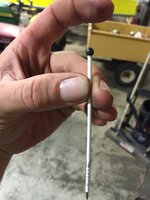
Worked on the valve seats last night. I read somewhere about gluing the ball valve to sticks or something but couldn't find the post. Thought I would tell you what I did. I had a small piece of tubing that I chamfered the edges on. c84975e999f2d32d64c9afee78a2f288.jpg
I then used thin double stick, foam tape to attach the balls. The balls self- centered on the tube. The balls held well enough to grind the seats, but was easy to rip of and put the next size on. It worked well with all but the smallest ball. For that I used the ink tube from a ball point pen.2c92eddd24f0cb9cf7ca0f07aec34cb6.jpg2ee9eb469b67b4a4f239d413e87b3e85.jpg7d42e7d93f0c335dee4e00b2c1f4bf9a.jpg the last one was from the overload valve, which has more room for the tube. I ended up reusing one valve because the old valve was 5/16 and the new kit only came with a 1/4. Oh, and the missing copper washers weren't actually missing. Seems they were added when it was rebuilt before. I did notice that one screw came out with Teflon remains on it. I put a little of the permatex equivalent of loctite 518 under the tapered seat of the screws.
The only hold up is the little piece of brass or bronze screen at the bottom of the ram. Thinking of stealing it out of the kitchen faucet.
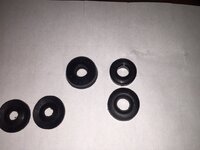
Question on the high pressure piston. My leather goods are currently soaking. This is my seal set up. Old on the bottom new on the top. The little black washer top right is extra. 4cad99ca28fa358776e22051fe20d66b.jpgI am wondering about the rubber seal. I think I have it backwards in the photo. Thinking the roundish side should go to the leather? Also I have read about putting piston in from the opposite end of the cylinder so the seals don't get damaged. I have a beveled bore and no way of putting the piston in from the back. So I guess I lube it and shove it in from the front? I don't know to adjust the nut tension. Thanks


Chris
 

Hiball

Well-known member
Joined
Apr 30, 2009
Messages
14,027
Location
Missery
Yeah Chris remove the bigger of 2 black pieces in that top pick, as I mentioned earlier you have a universal kit and the 2nd one from the right is a Ucup. In regards to which way to install the spreader (far right, top pic) the beveled/round end will mate towards the inside of the Vee and the flat side will mate with the metal washer/nut, so flip it around based off the picture. In regards to tension, there is no preset load, so use some common sense and tighten it up fairly good, But Also don't Crank them down, the Vees shouldn't move much if you try and rotate them. Oh.. Before you install the Vees on the pump piston, slide the compression nut and cut seals onto the shaft first, if you don't.. Well you will quickly figure out why after you install it in the bore. Once all that is installed, give the seals a heavy dose of lube, center the pump piston in the bore and give the piston a couple light taps with a small hammer, don't force anything. Obviously you can't "pull" the piston into the cylinder on this type of Jack, that's only on models where the cylinder can be removed etc.. The valve seat refinishing can be from member Jeeper in the snap on ya642 thread, if you google all that plus garage journal it should point you in the right direction. Oh... After you polish up the valve seats and clean up your mess, use the proper sized ball, make sure it's free of any contamination/scale drop it in the hole and find a punch that fits in the valve opening fairly tight and give it some taps with a hammer, don't get stupid with it because you don't want to overseat them, especially on the overload ball.
 
Last edited:

Pcbship

Member
Joined
Jul 24, 2012
Messages
20
The second from the right, top is the extra one? The original is rubberish and approximately the same size as the second from the right , top. The far right is hard plastic and slightly smaller than original. I thought the far right, top was extra.


Chris
 

Pcbship

Member
Joined
Jul 24, 2012
Messages
20
Ran out to take a picture before taking kids to lacrosse. The seals are in the same order, just leather seals are soaking so not in photos.7e4d7944c1c4c41b4e146b414eba0626.jpg517fb8532f2a263db522457e98e80966.jpg
The two photos are for size comparison to the original(bottom)


Chris
 

Hiball

Well-known member
Joined
Apr 30, 2009
Messages
14,027
Location
Missery
The second from the right, top is the extra one? The original is rubberish and approximately the same size as the second from the right , top. The far right is hard plastic and slightly smaller than original. I thought the far right, top was extra.


Chris

No I'm fairly certain the 2nd from the right is a Ucup (based off the profile) there has been some changes over the years in regards to the spreaders.

Scratch that, I'm 100% sure now after the added pictures. Use the top Right, the older one was a softer material and is showing the signs and years of compression.
 
Last edited:

Jeeper

Well-known member
Joined
Dec 25, 2006
Messages
2,124
Location
Round Rock, TX
The valve seat refinishing can be from member Jeeper in the snap on ya642 thread, if you google all that plus garage journal it should point you in the right direction. Oh... After you polish up the valve seats and clean up your mess, use the proper sized ball, make sure it's free of any contamination/scale drop it in the hole and find a punch that fits in the valve opening fairly tight and give it some taps with a hammer, don't get stupid with it because you don't want to overseat them, especially on the overload ball.


Hopefully the valve cutting works. The two 932/942s I have rebuilt still have handle feedback issues. One of the two is where where I recut the valves and although it improved, I apparently didn't go far enough. Really need to find a way to get a better view of the valve to know if the seat is good.

Oh well... Some point will need to tear into them again.
 

Pcbship

Member
Joined
Jul 24, 2012
Messages
20
In case anyone has a hard time finding brass screen. Just go to local tobacco shop[emoji3]. Five for $299e8b6d05e386aa3e2c5f996559174ed.jpg


Sent from my iPhone using Tapatalk
 

Pcbship

Member
Joined
Jul 24, 2012
Messages
20
Reassembled pump today. Powerwashed and scrubbed most parts. Really tempted to just put it back together use it. Went this far, feel like I have to paint it now. Think I could have bought a new one by now.


Chris
 

Pcbship

Member
Joined
Jul 24, 2012
Messages
20
One benefit of this rebuild, I had a broken power washer, that is now unbroken, and works pretty good.


Chris
 

EDGAR

Well-known member
Joined
Aug 21, 2010
Messages
437
Just for general knowledge, Brush Research sells Flex Hones in 600 and 800 grit, of various materials as needed and also sells diamond mesh in 800 and 2500 grit. Wonder why they would sell these fine grits? Certainly not for hydraulic service, as anyone can think these are too fine! I better contact them and tell them to stop selling these at once as these are not useful at all!:lol_hitti

Yes, 400 grit is a minimum spec. 500 or 600 grit could be a better spec. The table presented before in another post does mentions a 500 grit. A 600 would not hurt.

By the way, the much touted Brush Research company "bad mouths" the rigid stone honers in their web site and their catalog. They say these produce an inferior finish on the cylinder surface and, of course, that the Hone Flex finish is much better. Say what?:willy_nil
 

Attachments

  • BRUSH RESEARCH.JPG
    BRUSH RESEARCH.JPG
    117.2 KB · Views: 16
  • BRUSH RESEARCH 2.JPG
    BRUSH RESEARCH 2.JPG
    49.2 KB · Views: 15
Last edited:

Pcbship

Member
Joined
Jul 24, 2012
Messages
20
d36c773fd88c84c2d9e4d64cd82b827f.jpg
This is a picture of the hydraulic ram on a scissor lift at work. The lines running parallel are reflections of the lights. The ram looks shiny from a distance, but if you look close you can see it is not totally smooth.


Sent from my iPhone using Tapatalk
 

EDGAR

Well-known member
Joined
Aug 21, 2010
Messages
437
Do you know for a fact that it is hard chrome? A hard chrome plated ram should look much smoother than that and more reflective, closer to a mirror. You could see yourself reflected. Just look at the finish on a new ram on earth moving equipment and compare. Yours does not seems to look the same. Your ram is an indoor ram, so it does not needs the rust protection the chrome provides to equipment that lives outside all the time.

Anyway, that finish seems to be finer than a 400 grit and does not seem to be a cross hatch pattern either. A surface that is not chromed needs some type of (micro) cross hatch pattern or at least some type of micro grooves pattern to retain oil.

So, thank you, but no.
 
Last edited:

Hiball

Well-known member
Joined
Apr 30, 2009
Messages
14,027
Location
Missery
Just for general knowledge, Brush Research sells Flex Hones in 600 and 800 grit, of various materials as needed and also sells diamond mesh in 800 and 2500 grit. Wonder why they would sell these fine grits? Certainly not for hydraulic service, as anyone can think these are too fine! I better contact them and tell them to stop selling these at once as these are not useful at all!:lol_hitti

Yes, 400 grit is a minimum spec. 500 or 600 grit could be a better spec. The table presented before in another post does mentions a 500 grit. A 600 would not hurt.

By the way, the much touted Brush Research company "bad mouths" the rigid stone honers in their web site and their catalog. They say these produce an inferior finish on the cylinder surface and, of course, that the Hone Flex finish is much better. Say what?:willy_nil

Nobody is saying there isnt Applications/Materials that require smoother finishes than what 400 can give you, I REPEAT NO ONE.. This is a thread about Hydraulic Service Equipment, IN PARTICULAR FLOOR JACKS. If i was going to Use some Common sense <-- You know that stuff that got me by for 25 years previously, Prior to having to Research RA finishes because someones info just wasnt adding up. I would suspect any High Speed Reciprocating Applications, or Pneumatic applications where there is Low Pressure/Softer Sealing Characteristics require a smoother bore, Thus the Need for finer cutting materials. The Beauty of Flex Hones versus Rigid Hones is that they dont require the alot of Set up time, By there Nature they are Self centering and they can work around Inlets, etc... I never said they where better, They are Cheaper, More User friendly and create a damn nice finish when used at appropriate speed and with cutting oil, I suspect for long tubes there is no replacement for a Sunnen or similar units.

I know its not in your Nature to admit you are Wrong, But wouldnt it be Easier to just say those Magic Words? It has been fun watching you go from:

By the way, a cylinder hone with 400 grit stones will not produce a highly polished surface, not even close, no matter how much you try, it will only produce a set of finer scratches in a cross hatch pattern, which is still no good for hydraulic service.

TO..

Yes, the 400 grit finish is the commercially recommend finish for hydraulic cylinders, but that is a minimum, not a maximum finish, to produce an acceptable, usable finish but it does not produces the best finish.

Im Glad you have Learned something in this Very thread, versus just flying by the seat of your pants. :evil: and just to reinterate, 400 grit exceeds what Enerpac considers acceptable for there cylinder equipment (RA 4-8)

 
Last edited:

Hiball

Well-known member
Joined
Apr 30, 2009
Messages
14,027
Location
Missery
Do you know for a fact that it is hard chrome? A hard chrome plated ram should look much smoother than that and more reflective, closer to a mirror. You could see yourself reflected. Just look at the finish on a new ram on earth moving equipment and compare. Yours does not seems to look the same. Your ram is an indoor ram, so it does not needs the rust protection the chrome provides to equipment that lives outside all the time.

Anyway, that finish seems to be finer than a 400 grit and does not seem to be a cross hatch pattern either. A surface that is not chromed needs some type of (micro) cross hatch pattern or at least some type of micro grooves pattern to retain oil.

So, thank you, but no.

Sigh.. Cross Hatch is a Derivative of "Vertical Speed" versus RPM, Hell if your Sandpaper would hold pressure long enough, you "Could" achieve cross hatch patterns with enough vertical movement.
 
Last edited:

EDGAR

Well-known member
Joined
Aug 21, 2010
Messages
437
First, no one has denied that the cross hatch is derived the way Hiball explains it (vertical speed vs. rpm). The cross hatch pattern was not the issue here. So why dwell on that for so long if it is not an issue?

Secondly, the point (or issue)here was about the surface finish left by the 400 rigid stone honer. I said that it could done better than that. Even Brush Research agrees with me because they say the finish left by the rigid stones is inferior to the finish left by their Flex Hone product.

I also said that a finer finish could be achieved by using finer grits without affecting its longevity or performance. I also said that a real mirror finish is not suitable as it does not retains oil needed to lubricate the seals.

From Hiball

-----

I know its not in your Nature to admit you are Wrong, But wouldnt it be Easier to just say those Magic Words? It has been fun watching you go from:


Quote:
Originally Posted by EDGAR View Post
By the way, a cylinder hone with 400 grit stones will not produce a highly polished surface, not even close, no matter how much you try, it will only produce a set of finer scratches in a cross hatch pattern, which is still no good for hydraulic service
.

TO..


Quote:
Originally Posted by EDGAR View Post
Yes, the 400 grit finish is the commercially recommend finish for hydraulic cylinders, but that is a minimum, not a maximum finish, to produce an acceptable, usable finish but it does not produces the best finish
.

-----

I don't know what your imagination thinks I said there but what I said both times is that the 400 grit, even though is the minimum standard, does not produce the best finish.

I still believe that the 400 grit rigid stone, as the one you use, does not produce the best finish in a hydraulic cylinder. It just produces an acceptable, cheap enough, finish for others persons, but not for my taste.

By the way, you misread something:

From Hiball:

-----

Beauty of Flex Hones versus Rigid Hones is that they don't require the a lot of set up time, by their Nature they are self centering and they can work around Inlets, etc... I never said they where better, They are Cheaper, More User ...

-----

Brush Research in fact say that the Flex Hone is better that the rigid stones. You have to read more carefully; you just shoot from the hip and make mistakes, not the first time...

For my taste, if I had to, I would prefer to use a 600 grit Flex Hone instead of a 400 grit rigid stone. It should produce a better finish.

So you just learned about this after 25 years of hydraulic service and now you are an expert? It seems that you don't have a mind of yourself and just follow any recommendation presented to you. It is time to fly on your own wings, it is time for you to think out of the envelope and try different methods or work on improving other methods. You are still doing the same things you did 25 years ago and your knowledge therefore is 25 years old. You have learned nothing new since the things you say you learned when you started working on floor jacks. Time to freshen up.

The only one who do things by the seat of the pants is you. You just admitted that when you said you just learned something that you should have known from the beginning of those 25 years. This is the case of the one eyed man leading the blind.

Me, say I am wrong, to a person whose only merit is that he has changed many parts in 25 years without knowing things he ought to know? No way, Jose. That kind of attitude, of not wanting to learn anything, would have gotten you kicked out from any job, anywhere. You are lucky that you are your own boss in this jack repair business of yours. Maybe you should fire yourself.

And my sandpaper methods beats your rigid stone any day of the week by a long shot. It is not easier to do, but then, it is not for lazy persons or for persons that are in a hurry and like to cut corners here and there.
 
To avoid these ads, REGISTER NOW!

EDGAR

Well-known member
Joined
Aug 21, 2010
Messages
437
Quote from Pop Pop:

"Chrome plated rods are for wear, not corrosion"

Really?:lol_hitti


And that is why every single earth moving equipment, with hard chromed rams, left outside getting wet every time it rains has rusted rams. Everyone has seen that, right? I don't think so, unless the ram was mistreated and the chrome was damaged.

No one has denied the fact that the hard chrome plating gives a harder wear surface. That was not the point I was trying to make. But, you do not seem to know that it also provides corrosion resistance. Many persons know that, at least. Have you ever seen up closely one of these earth moving equipment, or any other kind, with hard chromed rams? No? Yes? Maybe?

Speaking in general, when anyone decides to comment on something, it is best if the person has done some previous research about the topic instead of saying the first thing that comes to mind. That way that person does not look bad.

By the way POP POP, is that Snap On still bleeding down? Had you followed sound advice, it would be working fine. You didn't, so it doesn't. Too bad...
 

Attachments

  • HARD CHROME 1.JPG
    HARD CHROME 1.JPG
    55.4 KB · Views: 10
  • HARD CHROME 2.JPG
    HARD CHROME 2.JPG
    60.3 KB · Views: 10
  • HARD CHROME 3.JPG
    HARD CHROME 3.JPG
    88.6 KB · Views: 10
  • HARD CHROME 4.JPG
    HARD CHROME 4.JPG
    54.7 KB · Views: 10
  • HARD CHROME 5.JPG
    HARD CHROME 5.JPG
    64 KB · Views: 13
  • HARD CHROME 6.JPG
    HARD CHROME 6.JPG
    91.8 KB · Views: 12
  • HARD CHROME 7.JPG
    HARD CHROME 7.JPG
    43.3 KB · Views: 12
Last edited:

Hiball

Well-known member
Joined
Apr 30, 2009
Messages
14,027
Location
Missery
First, no one has denied that the cross hatch is derived the way Hiball explains it (vertical speed vs. rpm). The cross hatch pattern was not the issue here. So why dwell on that for so long if it is not an issue?

Secondly, the point (or issue)here was about the surface finish left by the 400 rigid stone honer. I said that it could done better than that. Even Brush Research agrees with me because they say the finish left by the rigid stones is inferior to the finish left by their Flex Hone product.

I also said that a finer finish could be achieved by using finer grits without affecting its longevity or performance. I also said that a real mirror finish is not suitable as it does not retains oil needed to lubricate the seals.

From Hiball

-----

I know its not in your Nature to admit you are Wrong, But wouldnt it be Easier to just say those Magic Words? It has been fun watching you go from:


Quote:
Originally Posted by EDGAR View Post
By the way, a cylinder hone with 400 grit stones will not produce a highly polished surface, not even close, no matter how much you try, it will only produce a set of finer scratches in a cross hatch pattern, which is still no good for hydraulic service
.

TO..


Quote:
Originally Posted by EDGAR View Post
Yes, the 400 grit finish is the commercially recommend finish for hydraulic cylinders, but that is a minimum, not a maximum finish, to produce an acceptable, usable finish but it does not produces the best finish
.

-----

I don't know what your imagination thinks I said there but what I said both times is that the 400 grit, even though is the minimum standard, does not produce the best finish.

I still believe that the 400 grit rigid stone, as the one you use, does not produce the best finish in a hydraulic cylinder. It just produces an acceptable, cheap enough, finish for others persons, but not for my taste.

By the way, you misread something:

From Hiball:

-----

Beauty of Flex Hones versus Rigid Hones is that they don't require the a lot of set up time, by their Nature they are self centering and they can work around Inlets, etc... I never said they where better, They are Cheaper, More User ...

-----

Brush Research in fact say that the Flex Hone is better that the rigid stones. You have to read more carefully; you just shoot from the hip and make mistakes, not the first time...

For my taste, if I had to, I would prefer to use a 600 grit Flex Hone instead of a 400 grit rigid stone. It should produce a better finish.

So you just learned about this after 25 years of hydraulic service and now you are an expert? It seems that you don't have a mind of yourself and just follow any recommendation presented to you. It is time to fly on your own wings, it is time for you to think out of the envelope and try different methods or work on improving other methods. You are still doing the same things you did 25 years ago and your knowledge therefore is 25 years old. You have learned nothing new since the things you say you learned when you started working on floor jacks. Time to freshen up.

The only one who do things by the seat of the pants is you. You just admitted that when you said you just learned something that you should have known from the beginning of those 25 years. This is the case of the one eyed man leading the blind.

Me, say I am wrong, to a person whose only merit is that he has changed many parts in 25 years without knowing things he ought to know? No way, Jose. That kind of attitude, of not wanting to learn anything, would have gotten you kicked out from any job, anywhere. You are lucky that you are your own boss in this jack repair business of yours. Maybe you should fire yourself.

And my sandpaper methods beats your rigid stone any day of the week by a long shot. It is not easier to do, but then, it is not for lazy persons or for persons that are in a hurry and like to cut corners here and there.

Quoted for reference. You need to see a doctor...

1. You have done nothing but attempt to convince everyone that cross hatch finishes is the enemy of hydraulic cylinders surface.

2. It's pointless to argue whether a 400 grit flex hone provides a better finish than a 400 grit rigid hone, they both have there positives and negatives and undoubtably each manufacturer will push for there mode of transportation. In the end they both have something in common.. 400 grit.

3. Please Edgar.. You have been very adamant that 400 grit whether in Rigid or flex hones was too rough of a finish, do not make me go back and quote past responses, If your stance is that there is No difference in the above quoted responses, so be it.. I think you will find it hard for someone to believe it though. It's your story..

4. Again.. Please go back and read the Bold part again, "I" Never claimed one was better than the other in regards to rigid versus flex, do not confuse What "I" say with what "Brush Research" says.. Again don't tell me to read more carefully, you highlighted it.

5. Please Note.. I Only read up on RA finishes because of your Bat Crazy opinions about what is a acceptable finish inregards to Hydraulic, come to find out, using 400 grit stones for all those years was providing a RA finish that exceeds what Enerpac considers acceptable. I'd say that is good enough for me, if that's running by the seat of my pants.. So be it, Now go back and edit some of that stuff before the normal people wake up and see what you wrote.

6. I don't get your insinuation that using the proper tool for the job to re-surface cylinders is "cutting corners", Again.. If your sandpaper method is working for you, that is all that matters, but don't criticize someone for using industry standard equipment.
 
Last edited:

Hiball

Well-known member
Joined
Apr 30, 2009
Messages
14,027
Location
Missery
This better be good Edgar, you have been typing for over a hour on this latest reply. :beer:

image.jpg
 
Last edited:

EDGAR

Well-known member
Joined
Aug 21, 2010
Messages
437
The enemy is the cross hatched pattern produced by the 400 grit stones grit and not all cross hatches, like for example, micro cross hatches. A texture in some form is needed in the cylinder to retain oil.


Quote from Hiball:

By there (their) Nature they are Self centering and they can work around Inlets, etc... I never said they where better, They are Cheaper, More User friendly and create a damn nice finish when used at appropriate speed and with cutting oil...


If you did not say that the Flex Hone is better, then you are saying that the rigid stone is better, and that is not a fact. At least that is what Brush Research says. And you should accept that because it was you who brought the Brush Research products into this thread, not me. It was you who spoke good things about it, so now you have to stand behind it. Why talk about a product and then shoot it out of the sky? You should trash your rigid stone honer and buy a Flex Hone since you accepted that these "create a damn nice finish".

Although a 400 grit Hone Flex should produce a better finish (allegedly) than the 400 grit rigid stone, I still would prefer to use, as I mentioned earlier, if I had nothing better, a 600 grit Flex Hone, or maybe even an 800, lightly.

Quoted from Hiball:

"Please Edgar.. You have been very adamant that 400 grit whether in Rigid or flex hones was too rough of a finish, do not make me go back and quote past responses, If your stance is that there is No difference in the above quoted responses, so be it.. I think you will find it hard for someone to believe it though. It's your story.."


Hiball just discovered America...you have very keen senses...applause, please.


So, yes, I don't like the surface finish produced by any hard 400 grit, whether it is a Flex Hone or a rigid stone. That has been my point from the beginning]. This is not the first time I have said this, weren't you paying attention? You seem to have poor reading skills. Did you drop out of school? How many classes did you miss? Don't you remember I proposed finer grits from the beginning and you bashed that suggestion? I proposed finer grits because I do not like the hard 400 grit. You need to take something to treat your ADD (attention deficit disorder).

I thought that you understood that the 400 grit finish was a minimum spec finish, that produces an acceptable finish (not the best finish) for ENERPAC and others, who need to work cheap and fast. You yourself mentioned it as if you had understood that. Have you forgotten already?

I recommended to you, before, to go see Dr. Phil. I see you did not follow that recommendation. Maybe he can fix your misunderstanding brain.
 
Last edited:

Hiball

Well-known member
Joined
Apr 30, 2009
Messages
14,027
Location
Missery
The enemy is the cross hatched pattern produced by the 400 grit stones grit and not all cross hatches, like for example, micro cross hatches. A texture in some form is needed in the cylinder to retain oil.


Quote from Hiball:

By there (their) Nature they are Self centering and they can work around Inlets, etc... I never said they where better, They are Cheaper, More User friendly and create a damn nice finish when used at appropriate speed and with cutting oil...


If you did not say that the Flex Hone is better, then you are saying that the rigid stone is better, and that is not a fact. At least that is what Brush Research says. And you should accept that because it was you who brought the Brush Research products into this thread, not me. It was you who spoke good things about it, so now you have to stand behind it. Why talk about a product and then shoot it out of the sky? You should trash your rigid stone honer and buy a Flex Hone since you accepted that these "create a damn nice finish".

Although a 400 grit Hone Flex should produce a better finish (allegedly) than the 400 grit rigid stone, I still would prefer to use, as I mentioned earlier, if I had nothing better, a 600 grit Flex Hone, or maybe even an 800, lightly.

Quoted from Hiball:

"Please Edgar.. You have been very adamant that 400 grit whether in Rigid or flex hones was too rough of a finish, do not make me go back and quote past responses, If your stance is that there is No difference in the above quoted responses, so be it.. I think you will find it hard for someone to believe it though. It's your story.."


Hiball just discovered America...you have very keen senses...applause, please.


So, yes, I don't like the surface finish produced by any hard 400 grit, whether it is a Flex Hone or a rigid stone. That has been my point from the beginning[/U]. This is not the first time I have said this, weren't you paying attention? You seem to have poor reading skills. Did you drop out of school? How many classes did you miss? Don't you remember I proposed finer grits from the beginning and you bashed that suggestion? I proposed finer grits because I do not like the hard 400 grit. You need to take something to treat your ADD (attention deficit disorder).

I thought that you understood that the 400 grit finish was a minimum spec finish, that produces an acceptable finish (not the best finish) for ENERPAC and others, who need to work cheap and fast. You yourself mentioned it as if you had understood that. Have you forgotten already?

I recommended to you, before, to go see Dr. Phil. I see you did not follow that recommendation. Maybe he can fix your misunderstanding brain.


Holy ****.. A Hour for this? I refuse to venture back into cross hatch, 400 grit provides a RA finish that exceeds the recommended finish required, the only thing cross hatch has to do with the equation is the stroke rate/rpm to produce smaller angles to balance seal line/leakage points. If you don't get this, you win by attrition of being hard headed.


Sigh..I will not type this again, 400 grit exceeds what Enerpac Min spec is, Now if your interpretation of what the "best finish" is differs that is fine, but IMO you are teetering on to smooth based off numerous resources, There is nothing Cheap or Fast about Enerpac products.. it definitely contradicts your opinion, so let's be real.

Discovered America? Wtf.. There has never been a doubt in these discussions that you don't like a 400 grit finish, whether it's because of operator error or you want to simply be able to double your cylinders as telescopes. Where the problem lies, is you have adamantly told members over and over that 400 grit doesn't/can't produce a suitable finish for hydraulic applications. Again this goes against all available information whether your talking about RA cylinder finish or the recommended RA finish based of the type of seal material used.


I haven't shot either out of the sky... They both have there positives and negatives, I've already been down this road, but Hell.. Whats another time.

Flex hones = monetarily way to re-finish your cylinder bores on your hydraulic Jack equipment, by there nature they apply the correct surface pressure based off RPM, thus less room for user error.

Portable rigid hone = still monetarily acceptable, but requires some trial and error to get the cylinder pressure/Rpm to work together to create a nice finish.

Sunnen or similar fixed unit = Big Bucks, but more control over RPM, vertical movement (cross hatch) and the ability to work long cylinder tubes more uniformly.


Lemme ask you this? You claim to have had poor finishes while using 400 grit flex/rigid hones, Based off your own admission of not fully understanding RPM (YouTube videos) Do you think it's possible that you were operating too slow, thus the stones where dragging, versus riding over the surface? The beauty of flex hones is there self centering ability, with that said.. They do require a speed that keeps them in rotation to a specific RPM due to the nature of them being oversized compared to there actual bore size.

When you start stepping into 800-1000 grit finishes you by all accounts you are leaps and bounds above what is recommended to properly keep seals lubed. There is NO denying this... The literature is out there, does this Mean Edgar can't strive for those finishes? No.. But Please don't continue to pass this info off as the industry standard, No one is debating that finer grits will get you finer finishes, the question is when does it become too fine to properly keep things lubed. I'm going to go with Enerpac and Brush Research's recommendation, I would urge anyone on the fence to do there own research.
 
Last edited:

pop pop

Well-known member
Joined
Apr 1, 2010
Messages
2,859
Location
Virginia
Quote from Pop Pop:

"Chrome plated rods are for wear, not corrosion"

Really?:lol_hitti


And that is why every single earth moving equipment, with hard chromed rams, left outside getting wet every time it rains has rusted rams. Everyone has seen that, right? I don't think so, unless the ram was mistreated and the chrome was damaged.

No one has denied the fact that the hard chrome plating gives a harder wear surface. That was not the point I was trying to make. But, you do not seem to know that it also provides corrosion resistance. Many persons know that, at least. Have you ever seen up closely one of these earth moving equipment, or any other kind, with hard chromed rams? No? Yes? Maybe?

Speaking in general, when anyone decides to comment on something, it is best if the person has done some previous research about the topic instead of saying the first thing that comes to mind. That way that person does not look bad.

By the way POP POP, is that Snap On still bleeding down? Had you followed sound advice, it would be working fine. You didn't, so it doesn't. Too bad...

My Snap On is working just fine. Edgar, you need to get a life. I'm looking for the ignore button.
 

EDGAR

Well-known member
Joined
Aug 21, 2010
Messages
437
I am sorry to inform you, but your beloved Sunnen recommends 500 grit to hone steel in any hardness as shown in the table provided by Sunnen in their web site. So, who do I follow? Do I follow Sunnen, a company dedicated to the science and art of cylinder refinishing or do I follow Enerpac, a company who business is building pumps and rams?

If I have to choose, I choose Sunnen.

Let me again repeat that the 400 grit specified by ENERPAC produces a minimum surface finish that is acceptable (to them) but is not the best that can be achieved, within reason. This grit specification is geared towards companies refinishing cylinders, so cost concerns are involved in this recommendation. Using a 400 grit will cost less than trying to produce finer finishes with finer grits, which can take longer and this is not good for companies that have to work fast to fulfill the daily work schedule. The 400 grit is a cost saving decision, it is not the best surface finish producer.

A finer finish should cost more in time and resources uses, so any company wanting to save money will go with "roughest" finish that is acceptable to use in cylinders. This "roughest" finish accepatble in this case is the one produced by the 400 grit. If using a 220 grit stone could save money and at the same time produce an acceptable finish, Enerpac would recommend this grit and the companies refinishing cylinders for a living would use that grit unless a finer finish was required by the owner of the hydraulic cylinder. Unfortunately, the 220 grit stone does not produces a finish acceptable for hydraulic cylinders, so the cheapest choice then is the 400 grit stone.

Neither Enerpac, nor Sunnen warns against using a 500 grit or a 600 grit in steel cylinders. An even using an 800 grit lightly after honing with a coarser grit, could be used to achieve a plateau finish, as achieved by the Flex hones. If you do not know what a plateau finish is, go to Brush Research; they explain it there.

The only finish that will not retain oil is the pure mirror finish. Finishes produced by 600 grit, 800 or even 1000 grit will retain oil. The thing here, as in anything else done in life is: do not over do it.

The angle of the cross hatch is not important here, is the depth of the cut that is important. And my complain or issue, is the depth of the cut , it has never been about the angle. Stop taking about the angle!

The literature out there, as you said, only mention that mirror polished surfaces do not retain oil. They do not say anything about the grits we are talking about here. Not a single company says not to use finer grits because they do not retain oil, as you incorrectly think. Stop making up things.

I have never said to finish the surfaces so fine that the cylinders can be used as telescopes, as you said. That is just silly.

Again, the reason for using 400 grit is purely a money saving move for companies that hone cylinders for a living. You do not understand this because you are not a company that has to work fast and do as minimum work as possible per repair, to save money and at the same time to be able to do more work in workday. You know, there is usually a quota to fulfill each day, they can not spend one day working in just one cylinder.

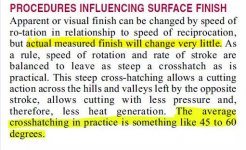
All of the screen pics below are form the Sunnen web site. Pay special attention to the second pic were it says that "speed and rate of stroking affect actual finish only lightly".
Check also the third picture, the one with the no. 4 in front. Different from what you say, as usual.

Also, I neglected to mention, because I thought it would be obvious, that in my sandpaper method, the mandrel is moved in and out while turning, the same as with the rigid stone honer.
 

Attachments

  • SUNNEN STONE SELECTION.jpg
    SUNNEN STONE SELECTION.jpg
    131.5 KB · Views: 17
  • FINISH IN HONING.JPG
    FINISH IN HONING.JPG
    19.6 KB · Views: 11
  • STROKE SPEED.JPG
    STROKE SPEED.JPG
    24.2 KB · Views: 13
  • CROSS HATCH DEGREES 1.JPG
    CROSS HATCH DEGREES 1.JPG
    62.2 KB · Views: 15
  • 500 GRIT STONE - 5 MICRO INCHES.JPG
    500 GRIT STONE - 5 MICRO INCHES.JPG
    46 KB · Views: 14
  • 500 GRIT SUNNEN.JPG
    500 GRIT SUNNEN.JPG
    40.9 KB · Views: 19
Last edited:

Hiball

Well-known member
Joined
Apr 30, 2009
Messages
14,027
Location
Missery
I am sorry to inform you, but your beloved Sunnen recommends 500 grit to hone steel in any hardness as shown in the table provided by Sunnen in their web site. So, who do I follow? Do I follow Sunnen, a company dedicated to the science and art of cylinder refinishing or do I follow Enerpac, a company who business is building pumps and rams?

If I have to choose, I choose Sunnen.

Let me again repeat that the 400 grit specified by ENERPAC produces a minimum surface finish that is acceptable (to them) but is not the best that can be achieved, within reason. This grit specification is geared towards companies refinishing cylinders, so cost concerns are involved in this recommendation. Using a 400 grit will cost less than trying to produce finer finishes with finer grits, which can take longer and this is not good for companies that have to work fast to fulfill the daily work schedule. The 400 grit is a cost saving decision, it is not the best surface finish producer.

A finer finish should cost more in time and resources uses, so any company wanting to save money will go with "roughest" finish that is acceptable to use in cylinders. This "roughest" finish accepatble in this case is the one produced by the 400 grit. If using a 220 grit stone could save money and at the same time produce an acceptable finish, Enerpac would recommend this grit and the companies refinishing cylinders for a living would use that grit unless a finer finish was required by the owner of the hydraulic cylinder. Unfortunately, the 220 grit stone does not produces a finish acceptable for hydraulic cylinders, so the cheapest choice then is the 400 grit stone.

Neither Enerpac, nor Sunnen warns against using a 500 grit or a 600 grit in steel cylinders. An even using an 800 grit lightly after honing with a coarser grit, could be used to achieve a plateau finish, as achieved by the Flex hones. If you do not know what a plateau finish is, go to Brush Research; they explain it there.

The only finish that will not retain oil is the pure mirror finish. Finishes produced by 600 grit, 800 or even 1000 grit will retain oil. The thing here, as in anything else done in life is: do not over do it.

The angle of the cross hatch is not important here, is the depth of the cut that is important. And my complain or issue, is the depth of the cut , it has never been about the angle. Stop taking about the angle!

The literature out there, as you said, only mention that mirror polished surfaces do not retain oil. They do not say anything about the grits we are talking about here. Not a single company says not to use finer grits because they do not retain oil, as you incorrectly think. Stop making up things.

I have never said to finish the surfaces so fine that the cylinders can be used as telescopes, as you said. That is just silly.

Again, the reason for using 400 grit is purely a money saving move for companies that hone cylinders for a living. You do not understand this because you are not a company that has to work fast and do as minimum work as possible per repair, to save money and at the same time to be able to do more work in workday. You know, there is usually a quota to fulfill each day, they can not spend one day working in just one cylinder.

All of the screen pics below are form the Sunnen web site. Pay special attention to the second pic were it says that "speed and rate of stroking affect actual finish only lightly".
Check also the third picture, the one with the no. 4 in front. Different from what you say, as usual.

Also, I neglected to mention, because I thought it would be obvious, that in my sandpaper method, the mandrel is moved in and out while turning, the same as with the rigid stone honer.

You Just Keep on Googling there little buddy... Eventually you will put together a couple of paragraphs that will convince yourself your out of the Hole your fingers and keyboard has got you into. If you arent smart enough to figure out that different methods (SUNNEN Rigid Hones versus Flex Hones) will Carry different Finishing grits/processes due to there Cutting Nature, Im not going to try anymore. I Dont Have a Sunnen Unit, I only spoke on there behalf as a very popular supplier for Hydraulic shops (including one here locally) , I have Flex Hones and a Universal Portable Rigid stone with various grits. If you are trying to convince the Community that Enerpac, Who strictly caters to the Industrial/Professional Sector is cutting corners by utilizing a 400 grit versus 500 grit you are out of Mind, Even then the 500 grit is a far cry from the 1000 you preach or PREACHED as you seem to change your tune based off the Google top pages.

Please go back and Read your attachments, to achieve a RA of 4 you will need 500 grit (per Sunnen), I believe that goes right along with the earlier chart i posted in #155 where its also possible with a 400 Grit, Thats a far cry from 800 to 1000 you have been screaming about, Enerpac desires 6-18 and that goes right along with Parkers Sealing characteristics based off Poly Material, So if your CURRENT Claim is 500 can due something 400 cant, I feel sorry for you. Im fully aware of what a plateau finish is, Based off your Earlier comments of: (#145 See Below) You My Friend are the one now understanding.

The hydraulic seals ride compressed against the wall cylinder under load, therefore you need a smooth surface like a highly polished surface, free of scratches or swirls. This is not the same. Why is this so difficult to understand?

Versus (#146)

Yes Cylinder bores look smooth to the Eye, But require some Cross hatching or Imperfections under magnification, which is what you get with a RA 8-18 surface, These Imperfections help with lubing the seal and extending the life.

Plain and Simple, Plateau Honing is only there to Knock the Sharp Edges down and create a surface (peak) for the seal to ride against that can properly keep things lubed (valley).

The Funny thing about all this, You have never once documented or showed any pictures of any Hydraulic Service here at GJ, You bashed Dorsey in attempt to belittle his knowledge and he rebuilt 4 Jacks with Pictures, I wonder how Edgar would do rebuilding a jack if he didnt have any Internet available. :D Secondly, Since Dorsey is Much smarter than Me, He just put you on the Ignore list because even though He could have compared resumes and showed you exactly how much he did know about Hard Chromed Rods and Hydraulic Cylinders, He chose silence over watching your talk in riddles. Damn.. I wish i would have thought about that..
The literature out there, as you said, only mention that mirror polished surfaces do not retain oil. They do not say anything about the grits we are talking about here. Not a single company says not to use finer grits because they do not retain oil, as you incorrectly think. Stop making up things.

Shame.. Shame.. Shame... Someone hasnt been studying there Parker Handbook.

Exhibit A.. Dynamic Applications.

There are two areas of concern that have been
observed on extremely smooth surfaces, the first
being seal wear, the second being leakage. When
surface finishes have been measured at or below
1 µin Ra, an extremely accelerated seal wear rate
has been observed. A small jump to 1.8 to 2 µin
Ra shows significant improvement, indicating that
the extremely low range should be avoided. With
higher values showing even greater life extension, the
optimal range for Ra has been determined to be 3 to
12 µin
.


IF there is a RA Jump from 12 to 4 when going from a 320 grit to 400 grit, Do you care to Guess where a +500, Let alone where 800-1000 will land you? I didnt think so...
 
Last edited:

Hiball

Well-known member
Joined
Apr 30, 2009
Messages
14,027
Location
Missery
Also...

Edgar.. The most important thing out of all this back and forth is that your claim to fame that 400 grit "can't produce" a finish suitable for hydraulic seals is debunk. I'm thankful for this, now the membership can get back to there normally scheduled program of "refinishing" there cylinder bored without fear of there jack chewing there hand off.

Wheww...

Secondly.. You cant criticize someone for utilizing Brush Research guidelines "Because they are only trying to sell there product" and then come back and try and Use "Sunnens" Guidelines as the Gospel, Its called being Hypocritical. I think you should really read someones response with the Intent to Listen, Versus Respond. Obviously the 2 methods Rigid/flex are going to have different characteristics, But in the End if you take the time to look at the RA chart, and Fully Understand how the RA of a Cylinder is calculated (Valleys versus Peaks) You will see that a RA of "4" Which Exceeds Enerpac Specs, can be acquired with a grit of 400, The only difference between the 2 methods is the Manufacturer Specs it takes to get there, The RA doesnt know how the Cylinder was Finished or what Method (flex/Rigid) was used to get there, It only knows that the surface is sufficient for Seal longevity in regards to Material/Application.
 
Last edited:

Burgerkong

Well-known member
Joined
Apr 17, 2010
Messages
2,501
Location
Markham, Ontario, Canada
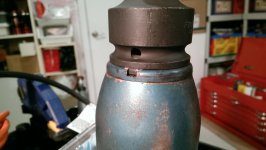
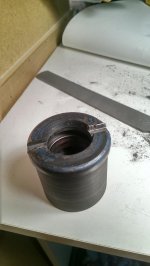
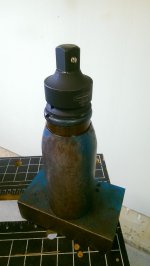
Thought I'd post this here, took a good 30 seconds of impacting with the Fuel and holding the socket to ensure it doesn't slip around before the nut turned and turned and turned!
 

Attachments

  • IMAG1554.jpg
    IMAG1554.jpg
    136.1 KB · Views: 78
  • IMAG1551.jpg
    IMAG1551.jpg
    135.1 KB · Views: 84
  • IMAG1514.jpg
    IMAG1514.jpg
    140.5 KB · Views: 79
  • IMAG1505.jpg
    IMAG1505.jpg
    131.3 KB · Views: 81

6PTsocket

Well-known member
Joined
Mar 12, 2014
Messages
4,593
I have a similar 1 1/4 ton walker that I have been meaning to fix for years. I got the cylinder sleeve off but the collar is in bad shape from wrench marks and the notches are filed wide and rounded off from a home made tool. When it was last used, a long time ago, there were tank leakage problems. Later Lincoln jacks call For Loctite 515 flange sealant. Mine was a dry fit. How tight does it have to be? Does the sealant work? Is it feasible to weld a big thin nut to the outside of the collar without warping the cylinder? Any suggestions greatly appreciated
 

Hiball

Well-known member
Joined
Apr 30, 2009
Messages
14,027
Location
Missery
I have a similar 1 1/4 ton walker that I have been meaning to fix for years. I got the cylinder sleeve off but the collar is in bad shape from wrench marks and the notches are filed wide and rounded off from a home made tool. When it was last used, a long time ago, there were tank leakage problems. Later Lincoln jacks call For Loctite 515 flange sealant. Mine was a dry fit. How tight does it have to be? Does the sealant work? Is it feasible to weld a big thin nut to the outside of the collar without warping the cylinder? Any suggestions greatly appreciated

Once you damage the slots its Damn near impossible to re-torque the tank nut back to factory specs, I do use Loctite 518 for all Metal to metal surfaces on these jacks, it's just cheap insurance to remedy any high or low spots. Even with using 518, you still need to torque the tank nut down significantly, there is nothing worse than leaky reservoirs. The only problem with welding a nut on the end of the tank nut, which would preferably need to be done "off" the Jack is that the distance between hinge assembly/cylinder doesn't really provide much room, thus the lift arm wouldn't properly rest at its lowest position account bottoming out between the end of the cylinder/hinge.
 

6PTsocket

Well-known member
Joined
Mar 12, 2014
Messages
4,593
Thanks for the advice. Do you know what the torque spec is? is 518 a better choice than 515?
I had another issue but I just finished fixing it this morning. The original pump mounting bolts are 3/4" shoulder bolts with a 5/8" locking thread. I managed to strip both the pump and bolts on two of them, years ago. I took a little piece of 3/4", .035 wall chrome moly tubing and JB Welded it into a hole in a 3/4" thick scrap of oak with the bottom sticking out so it would bottom in the 3/4" shoulder in the pump. I clamped the pump and my home made drill bushing to my drill press table and The ID of the tube just fit, after removing about .001", an 11/16 drill that is the right size for 3/4-16 thread. I did this for a few reasons. The thread is shallow and I didn't want to go off center. Enlarging a hole with a regular 2 flute bit is a no no because it can grab and throw stuff. With my bushing and everything clamped and lots of cutting fluid, I got a nice centered hole. Tapping went smoothly. I got a couple of Grade 8, 3/4-16 bolts that now have an inch of clean thread to grab.
 

Hiball

Well-known member
Joined
Apr 30, 2009
Messages
14,027
Location
Missery
Thanks for the advice. Do you know what the torque spec is? is 518 a better choice than 515?.

I believe factory spec dependent on model/era is roughly 350-400 ft lbs. in regards to the difference between 515/518, I believe 518 to be the newer of the two and 518 to have a little better initial solvent resistance and also able to fill wider gap abnormalities versus 515.
 

6PTsocket

Well-known member
Joined
Mar 12, 2014
Messages
4,593
Thanks again for some invaluable information. No wonder people are struggling with it. Do you know of anybody that might have that part for such an old jack before I start messing with it?
I did my drilling with a bit from a Chinese HF Silver and Deming set. It actually cut quite well. I am amazed.
 

Hiball

Well-known member
Joined
Apr 30, 2009
Messages
14,027
Location
Missery
Thanks again for some invaluable information. No wonder people are struggling with it. Do you know of anybody that might have that part for such an old jack before I start messing with it?
I did my drilling with a bit from a Chinese HF Silver and Deming set. It actually cut quite well. I am amazed.

I have a few laying around, but not sure when I'll get a chance to check, Plus I am on baby watch as the wife is due anytime or will be induced Monday. It might pay dividends to call Steve in my Signature and see what he has from that Era.

Good luck..

I would also like to add, the Reason Walker/(early)Lincoln utilized these special tank nuts was to attempt to prevent unauthorized service centers from servicing the Jack, Hein Werner and Blackhawk used similar little socket adapters to attempt to keep there service department in business.
 
Last edited:
To avoid these ads, REGISTER NOW!
Top Bottom