At least you learned something after 25 years of servicing hydraulic jacks. Let us hope the next thing you learn does not take 25 more years. See, right there you admitted that you do things by the seat-of-the-pants method and not because you researched the topic. There is information out there, just do a little research. And doing something for 25 years does not guarantee that you are doing things right. You could be replicating a mistake for many years without knowing it or doing something different from what the standards call for.
The Only thing i learned was that ive been doing something right without even needing to step into the world of RA finishes, Amazingly.. The Person i learned from my Grandfather had a fairly good grasp on what finish is acceptable and he never even used the Interwebs. I figure between my Grandfather and Me we have over 65 years in the Hydraulic Service, You would think that if 400 grit wasnt sufficient, We might have seen a few early Returns into the Shop.... LOL... Let alone Ucups with jagged gashes and teeth marks from a "Mirror Finish" <-- Lol
If quoting from the internet or posting links does not make you smarter, well, you posted and linked more than I did; I only linked the Simritna site. And you did not like Parker at all, you even made fun of the Parker manual and of me using it. So what gives? You know, I am pretty sure the Parker people know a little more than you do. It is a worldwide company, with thousands of products, not a mom and pop shop. It is a good thing that you are coming out of the cave you live in and are starting to see the light, but you still show a lot of resistance to improving your knowledge. But what do I care, it is not my problem, it yours after all.
I dont think you are following along Edgar, 400 Grit provides a recommended finish from just about every Hydraulic cylinder shop on the Internet, Including Enerpac, Who im going to assume you have heard of? Why you continue to ignore this is beyond me, You dont have to scroll back too many pages to see, And are you really going to play I dont "Link Drop" on the Internet Card? There is No Cave, If i give a Opinion or Directions on how to do something with a floor Jack, There is Solid Bench time there to back it up.
As for the 400 grit, for the third time I will explain that the 400 grit stone cut remains the same no matter how many times you make passes, but the cut depends on the tension it was adjusted to. In the case of the 400 grit wet and dry sandpaper, the grain wears out, or becomes duller, after each pass. So if you start with the 400 grit and do 3 or 4 passes, the finish at the end is finer than doing 3 or 4 passes with the 400 grit stones. With the stones, the finish should always be the same if the honer tension remains the same. That is why I stated that a 1000 grit is not really needed if you do a few passes with the 400 grit sandpaper. I hope I don't have to explain this four times.
You can explain it as many times as you Want.. IM NOT BUYING.. The Beauty of a Flex Hone and Rigid Hones is that the Tension is evenly distributed, Sure... Sandpaper wears down and Looses its Cutting ability, But when it wears down it also reduces the cylinder wall pressure at the same time. Its a Running Joke that it takes longer to set up a Honing machine, than it does to actually finish the cylinder, Onviously a Rigid Stone isnt going to wear down near as fast as some Glue Paper. We are just talking about re-finishing the Surface, Not machining a New Cylinder, I have serious doubts that your 320 grit starting paper can even touch a Glazed cylinder, maybe this why it takes multiple passes with various grits. I cant imagine the Football and the Monkey dance it would take to continue to add Paper in a attempt to regulate wall pressure to attempt to get a even cylinder wall finish. It may get you where you need to be eventually, but damn the proper tool for the job makes this job something a 8 year old could do.
As for feeling the finish with finger, I already stated that I it is not the same for the finger as for the seal. The seal sees much more pressure, or compression, against the cylinder than your finger does when feeling the finish. So what feels smooth to you may not be, in fact, so smooth for the seal. With an o-ring , a not so smooth finish that feels smooth enough for the finger, can make the o-ring twist in its groove and get damaged in a short time. A seal like an u-cup might not twist in its groove because its shape prevents it, but the seal would wear faster with a not so smooth finish. This would only be of concern for hydraulic equipment that is used daily for many hours. For a floor jack, that is used a few times a year, is not important.
Again... Im not sure if your following, YES as Stated in #152, Finish Characteristics follow Seal material/Application on Occasion, NO DOUBT Buna Nitrile Orings will require a Smoother surface based off the Application (Rod/Milwaukee) and because of the Material (Parker). Im not 100% sure if you are aware of what type of finish you can get with a 400 grit Flex/Rigid Hone "If" you utilize the proper Rpm and cutting oil/lube.
I will repeat, a finer and better polished finish is better than the cross hatch finish left by 400 grit stones in terms of seal longevity. No one has to super polish the cylinder, but it should be polished at least a little more than just leaving it with the cross hatch finish produced with 400 grit stones
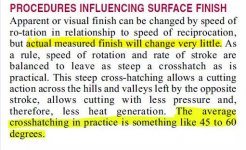
I feel like im Repeating myself, But Cross Hatch is a by-product of Vertical speed in the Bore, I know its a fun word, but its being severely Misused in this thread, In regards to Hydraulic cylinder finishes, Its only purpose is to keep the Valleys Or Imperfections if thats easier to understand, that are Needed to Properly allow Oil "AHEAD" of the Sealing lips.
As for the rams, just look at the Milwaukee floor jacks which use a thick o-ring in a rod application as the main seal. The ram of the Milwaukee is hard chromed and it is smooth; no cross hatching there and it works fine, so why complain about polishing the cylinders at least a little more than the cross hatch finish left by stones? There are also many other hydraulic bottles which use u-cups in a rod application and the ram is smooth in all of them, and the u-cup holds the pressure and seals the ram, no problem there. In general, if the rams can have a smoother surface than the cross hatch finish, why can't the cylinders benefit of a better polished finish?
Again.. #152 YES and YES, SIGH... Nobody is saying that the Cylinder shouldnt be Smooth, MY God Edgar a RA of a Cylinder finished with 400 Grit is classified as a "Mirror Finish". Is that not Smooth?
If I say blue, he says red, if I say red then he says blue. This might be complaining just for the sake of complaining.
I say Yellow.. If 400 grit goes above and beyond what Enerpac considers a acceptable finish, Who am i to Argue? You can continue to Argue with them.
In the Words of Edgar, If you dont believe Me or Enerpac i could care less. Its your Story, Your welcome to tell it however you want.
Last edited:


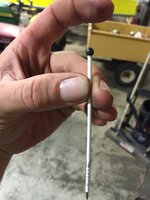


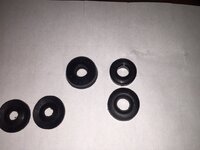




 and just to reinterate, 400 grit exceeds what Enerpac considers acceptable for there cylinder equipment (RA 4-8)
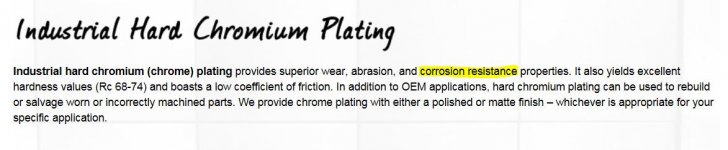

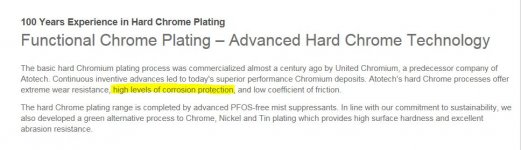









 Secondly, Since Dorsey is Much smarter than Me, He just put you on the Ignore list because even though He could have compared resumes and showed you exactly how much he did know about Hard Chromed Rods and Hydraulic Cylinders, He chose silence over watching your talk in riddles. Damn.. I wish i would have thought about that..