To avoid these ads, REGISTER NOW!

welder selection

knotdust

Well-known member
Joined
Apr 22, 2019
Messages
2,228
Location
Ohio
I want to add a welder to my shop. I have use of the one at the home farm but there are times I can't load everything up and run there.

I've looked at the small Hobarts and Lincolns at the local farm store.
115 V wire welders $500-700 range. Most have 5/16'' maximum thickness

Most times this would be enough for my needs.

I plan to run a dedicated line to the garage from my electrical panel. (30 amp heavy enough?)

Or would I be further ahead to watch for a good used Lincoln buzzbox and run a 220 line to the garage. I've seen them run around $200 most times.

Most of my welding would probably be done in the summer and outside to keep fire risks at a minimum.
 
To avoid these ads, REGISTER NOW!

HoosierBuddy

Well-known member
Joined
May 9, 2006
Messages
2,915
Location
Southern Indiana
I've had my Lincoln ProMig135 for about 15 years. Not sure they still make that model, but it's a strictly 120V welder that will work with flux coated wire or a bottle. I set mine up to use a bottle.

In all that time I've had maybe 2 times it wouldn't go heavy enough for what I needed to do. In those cases, I've used it to tack whatever I'm welding together and taken that to a buddy who has made a pass on it with his arc welder.

Units of that kind will plug right into a 15 amp circuit making them super portable and very flexible.

The next step up is the dual voltage kind which will work off 120 or you can plug them into 240 for more capacity. That type would be even better...but as I say...my small one has worked great for me for a long time.

In the end, you really need to know what you intend to weld to answer your question. If you are going to be fixing bulldozers or welding ship hulls....that's quite a different machine from someone like me that is welding brackets or doing automotive work mostly.

Phil
 

maxpat82

Well-known member
Joined
Dec 9, 2012
Messages
275
a 120v welder only need a 20A 120v circuit (can run most of the time on a regular 15A circuit)

just get one that you can put a gaz bottle on if you ever want to do sheet metal with mig.

I love my Lincoln SP125plus(like more then 20years) and it do everything that I really need..(But I have a chinese tig/rod AC/CD 120-240v machine too)
With fluxcore you can weld 1/4"+ with multiple pass if you know what you are doing.
 

ford33

Well-known member
Joined
Feb 26, 2011
Messages
2,118
Location
Chicago, IL. USA
I have a 135 amp and 180 amp welding machines and the 135 does everything I need to do for home repair and automotive repair. Compared to the 180, the 135 is smaller, easier to transport and plugs into a 120 vac outlet. It works well for my needs.

If welding outside, the wind may be an issue for you when using gas but a simple wind block will remedy that issue. Also, depending upon how close your neighbors are from you, the arc may cause some people to be concerned and of course there is the issue of fires caused by sparks if you live in a dry climate.

Both machines are Eastwoods, Chinese made, and frequently on sale. They have the 135 amp, 120 vac machine on sale today for $300. The 175 amp machine with aluminum spool gun is $550 on sale.

Good luck with your future projects.
 

MoonRise

Well-known member
Joined
Nov 5, 2010
Messages
4,027
Location
NJ
120 V wire feed welder can maybe do 5/16" steel using FCAW. Flux core welds typically have more spatter than a nicely done GMAW weld, and of course have slag to clean up.

They can typically NOT weld that thickness using GMAW (aka MIG). Max practical workpiece thickness on a 120 V GMAW machine is -usually- about 14 gauge steel (2.0 mm thick), sometimes maybe 12 gauge (2.5 mm thick).

To weld thicker than that using GMAW, you really have to move up to a 240 V wirefeed machine. 175-190 amp class machine, or up to the 'new' 210 amp class machines (which are usually also capable of running on 120 V input power at a REDUCED output power level).

Not welding sheet metal, and more like 1/4" thick plate mostly? You could go with a 240 V SMAW (aka stick) machine. Entry level 'basic' stick machines usually cost less than a wire feed machine, and you can get various types of electrodes if you want/need. And SMAW typically can be used outside with less concern for a breeze blowing away the shielding gas used with GMAW.

But SMAW is a slower welding process than wire feed typically. And the welds do have more slag and spatter than a clean and 'well done' GMAW weld. So you have to maybe do a bit more clean up of the work piece after welding.

A used (or new, they still make them) 240 V 'buzz box' can do a lot of welding tasks. Typically they do need to be run off of a 50 amp 240 V circuit (those big older transformers in them have a pretty big input current surge when first fired up).

Newer inverter-based machines (stick or wire-feed) are usually a bit more efficient on input power than the older transformer based machines. And usually smaller and lighter.

And welding 'thin' sheet metal type stuff with a stick machine is usually NOT so easy (without a fair or LOT of practice and/or skill).

The 'new' 210 class inverter machines (Lincoln 210 MP, etc) can do most (if not ALL) of the welding tasks a home task guy would ever need to do.

A 120 V input GMAW machine does limit your max work piece thickness more than a 240 V (or the 210 amp machines which are usually dual-voltage capable for 120 V or 240 V operation) machine does.

Your call.
 

PWC Repair

Well-known member
Joined
Dec 27, 2012
Messages
3,165
Location
Arkansas
Think realistically about what you might weld. 1/4" or 5"16 is pretty thick stuff. I don't have a car, truck, or trailer with anything that thick on it. I recently sold my older 115v (made in the USA)Century wire welder. After watching a few vids on the HF Easy Flux 125, I got a coupon and bought one. It does 1/8" no problem, just did some exhaust pipe worked great, cranked it up and did a bit of 3/16" it did the job, and for the hell of it I tacked together some 26ga duct sheet metal. Tiny, easy to transport, works on any 115v outlet, and still works fine off a 50ft 12/3 extension cord! I think for the money I might like to have one of the HF Vulcan TIGs.
 

matt_i

Well-known member
Joined
Mar 14, 2008
Messages
10,722
Location
SE Michigan
My take?

Get 2 welders: a small Mig machine and an AC/DC stick machine. Something like a Miller Thunderbolt would be cool. Its 15 lbs....

Use your Mig to tack stuff together for alignment if its thick.

Then burn some 7018s, DC-stick.

I do exactly this but use tig instead, but the concept works well for me, you'll have a strong weld where you need it and convenience where you need it.

A Lincoln tombstone which does AC/DC would be more plentiful and probably less expensive. But heavier.
 
Last edited:

rburke65

Well-known member
Joined
Nov 10, 2007
Messages
12,349
Location
Canfield, Ohio
I have a smalle Lincoln....120 volt. I think..?.. it’s a 135 amp....I’d have to go to the shop to verify. Butitsbeen plenty.
 

MoonRise

Well-known member
Joined
Nov 5, 2010
Messages
4,027
Location
NJ
I did not realize the Miller Thunderbolt was so light !

The Thunderbolt 160 DC stick welder is indeed listed as just 15 lbs (just the machine, not including leads/cables). It's a modern inverter DC stick welder. Can take 120 V or 240 V input power.

The Thunderbolt 210 runs on only 240 V power. And it's heavier, listed as 15.5 lbs. :lol:

The older (out of production) Thunderbolt XL AC/DC stick welder is a bit heavier than that. :lol: 107 lbs shipped. It's bigger too.
 

lis2323

Well-known member
Joined
Dec 25, 2016
Messages
3,234
The Thunderbolt 160 DC stick welder is indeed listed as just 15 lbs (just the machine, not including leads/cables). It's a modern inverter DC stick welder. Can take 120 V or 240 V input power.


The Thunderbolt 210 runs on only 240 V power. And it's heavier, listed as 15.5 lbs. :lol:


The older (out of production) Thunderbolt XL AC/DC stick welder is a bit heavier than that. :lol: 107 lbs shipped. It's bigger too.


Thanks for that. Not that I’ve ever owned one but I was only envisioning the old ****** XL. Didn’t even know there was an inverter TBolt.


My inverter Maxtron 450 that I had weighs closer to 200#. [emoji2]

099ffd3f9014b48d648d09bf45d60f3b.jpg
 

Attachments

  • 099ffd3f9014b48d648d09bf45d60f3b.jpg
    099ffd3f9014b48d648d09bf45d60f3b.jpg
    92.5 KB · Views: 10
Last edited:

stangconv

Well-known member
Joined
Sep 17, 2018
Messages
72
Location
Saskatchewan Canada
h2hAmhW.jpg


Just picked up this Hobart 210.

120 and 220
 

Kaizen

Well-known member
Joined
Jan 9, 2015
Messages
6,938
Location
New England
Note that with a 110 machine you have to use flux core wire to get to the 1/8 or above size. Gas mig is just cleaner. My little 300 dollar Eastwood 135 will handle 1/8 with flux no problem. Also have gas for thinner solid wire.


Sent from my iPhone using The Garage Journal mobile app
 

nikerret

Well-known member
Joined
Jan 22, 2015
Messages
757
Location
Kansas
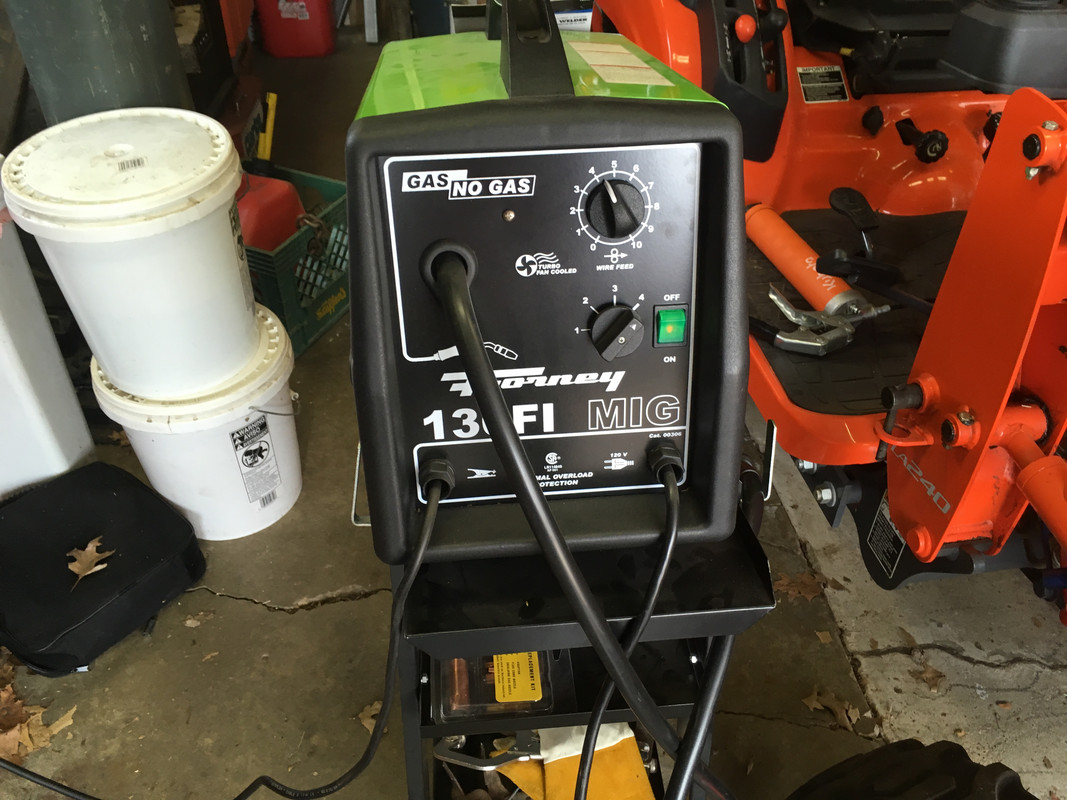
I bought this “Forney” 130 amp wire welder new for around $225. Yes, Lincoln Electric, Miller, Esab, or Hobart are better machines. The one I have is the same one labeled by Craftsman, HPC, and the older Clarke. The Clarke has three heat settings, mine and the others have four.

It’s surprisingly capable. Just a couple of day’s ago, a friend from the County shop stopped by to use it on a suspension part that broke. It was able to weld the part from two pieces back to one, even outside in below freezing temperature. He was impressed with my budget machine and he’s used to using Miller’s top of the line stuff.

I’m not saying it’s the end all of welders, just that I found a great machine to learn on at a good price. Plus, since it’s a 120v and not a show piece, if I need to haul it around, I can. I took it to welding class, one day, to have the instructor help me on my own equipment. When he ran it, you couldn’t tell the difference between my cheap welds and the school’s much better flux core 120v machine.

I would look for a good deal and learn to run it. Then, when you know what you’re looking at and looking for, get a nicer unit.


CraigStu

Well-known member
Joined
May 22, 2014
Messages
4,009
Location
Blacksburg, Va
I have very little experience w/ Mig but the couple times I have tried a flux wire unit I didn't like it at all. I would definitely look for a Mig that can do both flux and gas so you have a choice later on. It's been years since I last used my little Lincoln stick welder but one thing I remember from when I used it a lot more was that SS rods splatter a lot less than the common rod.
 

Antoin

Well-known member
Joined
Dec 31, 2013
Messages
97
Location
Ireland
I have an Esab C160i Caddymig. Mostly used for car bodywork/ exhausts but I have used it for gates as well.
Works well up to 5/6mm.
After that I have a small Tecarc 160 "stick" welder for anything thicker.

So if you are welding a lot more of anything 4mm or under I would go with a mig. Anything thicker and go with stick.
 

Catch_22

Well-known member
Joined
Aug 1, 2016
Messages
139
Location
Nashville, TN
h2hAmhW.jpg


Just picked up this Hobart 210.

120 and 220

This is what I own. I wish it was inverter driven though. For something that is 120 and 220 (read meant to move around sites) being lighter would be nice. I was floored with I got my inverter plasma cutter at how light it was.

But in the price range these run its fantastic.
 
OP
K

knotdust

Well-known member
Joined
Apr 22, 2019
Messages
2,228
Location
Ohio
This is all helpful. I have done very little MIG. Most everything I have done is stick on a Lincoln BuzzBox. Learned in AgTech years ago on stick before the days of MIG and TIG.

Most of what I would do is lighter sheet metal. Rarely more than 3/16'' or 1/4''. If I do it could be tacked and hauled to the farm shop for final weld. It's less than a 1/4 mile away by road, less through the fields.

The suggestion of 2 units is not going to happen on my retirement budget. :(

The little Hobart units some of you bought were one of the models I was looking at and the comparable Lincoln. The AC/DC inverter units were a bit more money but may be better option. I may go to the local welding supply house and chat with them as well. They would be there if I needed service and sometimes it pays to spend the little extra to purchase from a supplier like that than the local farm store. I would have to purchase the bottle gas from them anyway and establishing a relationship like that is usually a good thing. I think I will probably purchase one of the brand names at some point rather than an HF unit or other off brand. I've found that spending the little extra to purchase a good name brand product pays off over the long haul. I would rather spend once than twice.

So thanks guys for your advice. It was all very helpful.
 

lis2323

Well-known member
Joined
Dec 25, 2016
Messages
3,234
Looks like you are on the right track.

If you decide on mig only and NOT multi process I will also suggest the Miller 211.

I have not personally used one but I have welder friends that have purchased them for the portability and ending up loving them.

If I needed one I would definitely buy new as in my area the asking price for used ones are nuts. Better to buy new with full warranty and return policy. Put it on your CC get air miles and up to a month to pay.

JMHO. Good luck.
 
To avoid these ads, REGISTER NOW!

sberry

Banned
Joined
Jun 18, 2005
Messages
35,747
Location
Brethren, Michigan
If you want to save some then a 240V circuit is in order, a 180 red one from the box store is good as is the Hobart 190,very simple, very good.
 
OP
K

knotdust

Well-known member
Joined
Apr 22, 2019
Messages
2,228
Location
Ohio
Hmm had not thought of refurbished units. I have refurbished Dewalt tools and like them. Maybe the local welding supply will have a refurb unit or who knows a good trade in unit. I'll check it out.

I'm not in a huge hurry as in a must have next week or even next month. This is more of a medium range goal.
 

sberry

Banned
Joined
Jun 18, 2005
Messages
35,747
Location
Brethren, Michigan
The sooner you get it the more you can use the thing. Welding is like one of the utilities,, ha,, I have an anxiety attack if I get more than 100 ft or so from a torch. You wanna get a deal but itty bits aint worth waiting if you can help it and get past this. Buy a 180 or 190 off the shelf and run a 230 circuit. Yes, a 211 is a different better machine but it cost 500 more too and the cheaper one does the same thing for the real red meat work.
There is such a thing as good free advice, this is like a value added salesman. Get a 180 feeder and the best gas bottle you can find. Run a number 10 cable circuit for it, get a recept and put it on a 30 breaker, up to 50 if you got it for free.
About 750 for a machine. Not much more $ than they were 30 years ago for the basic model.
You can change to 023 for super body work but for general shop I like 030 to give it some more top end.
 
Last edited:

sberry

Banned
Joined
Jun 18, 2005
Messages
35,747
Location
Brethren, Michigan
You can do a lot with a 140. Better than none. A 180x211 class is 2x the machine and got just enough poop for some light fab work, really gives it some more punch. Its in the same size weight scheme but is a LOT more capable for fab work, a bit faster too. If time and materials are money then a size bigger is more practical. Joe Hometime can go a long ways on 10# of wire.
But if you ask,,,,, what welder is right for me anyone telling you to get anything but a 180 mig is doing a disservice and iffn you cant do it all with that then its still a machine you want when the dust settles.
I know if you ask a special job shop what would it be if they could only have 1 it would be tig but not me no way no how. It would be a mig short circuit. I keep my 250 mig around due to the fact its not worth much and ok when I need to spit some out but I worked every day for months never used anything but a 180 with a 5 speed.
Mine has made 1000's and 1000's of welds. Just used it, about an inch of weld on a bracket. I got about 10 machines, this is what I use, got it set for convenience. I do move it to another plug once in a while to the mechanic bay but have about 25 ft of extra cord on it hangs from the boom and can reach the place, can twist it around behind the benches too, reach out on to the shop floor etc.
I use a little stick on occasion mainly cause I can, could do most of that with this too if I needed to. I need a little practice, sticks is where it shows up
 

Attachments

  • bench welder.jpg
    bench welder.jpg
    155.7 KB · Views: 43
  • bench sp door.jpg
    bench sp door.jpg
    149.8 KB · Views: 40
  • bench welder 4.jpg
    bench welder 4.jpg
    148.8 KB · Views: 42
Last edited:

brownbagg

Well-known member
Joined
Mar 20, 2006
Messages
5,208
one of my welder is the hobart ironman 230. you can get it at tractor supply for $1500, but what i wanted to add to the conversation, once you start getting into the big amp machine, they are so smooth at lower amp, you not fighting the machine. my miller 140 is a boat anchor compare to the 230. Its just so smooth it make you 500% better welder overnight. the guy with the miller 400 inverter, oh i wish i could play with that. on welders, bigger is really better. I would not touch anything under a 210
 
OP
K

knotdust

Well-known member
Joined
Apr 22, 2019
Messages
2,228
Location
Ohio
and as so often happens my life went topsy turvey for the 4 years after retirement. My mom's dementia started increasing and she needed 24/7 supervision. My sister, sister-in-law and myself provided the bulk of that with other hired help filling in nights and other assistance. As you can imagine not a lot got accomplished on any of my hobbies or projects over those 4 years. I was often only home overnight or 4-6 hours at a time and other necessary tasks took precedence (laundry, lawn mowing, firewood splitting) So now at 70 years old I'm starting to get back in the retirement projects. A welder will be one of the first purchases I think and maybe some basic MIG classes if that is the model I choose.
 

Inventive1

Well-known member
Joined
Jul 24, 2007
Messages
52
How does the cost of running a mig welder and a stick welder compare? I'm wondering about the cost of the wire and gas for the mig compared to the cost of the stick welding rods?
 

supratreo

Well-known member
Joined
Sep 4, 2020
Messages
354
Location
elk grove, CA
i bought a 210MVP a few years back and love it. i feel like i get much better welds when i'm using 220v, also has a higher duty cycle vs cranking it up on 110v. i got this because there are times when i do need to transport it and use it on 110v. if it was dedicated to my garage then i would probably look for a 220v only unit. the thing is pretty damn heavy though. roughly 90lbs iirc.
 

CraigStu

Well-known member
Joined
May 22, 2014
Messages
4,009
Location
Blacksburg, Va
How does the cost of running a mig welder and a stick welder compare? I'm wondering about the cost of the wire and gas for the mig compared to the cost of the stick welding rods?
Obviously it depends how much welding you do. W/ my tig a gas refill is about $50 because I use one of the smallest tanks so it is easy to carry. The most I have refilled it has been 5 times in a year. That included some large projects. More often it is 2-3 times per year. I think it really depends on what you will be welding. Trailers and similar using 1/8inch or > steel a stick is fine. <1/8inch steel you really want a mig or tig. I have had little luck w/ mig but it has usually been rental migs that use the flux core wire. Migs that run w/ gas do a much better job
 

finn

Well-known member
Joined
Mar 27, 2005
Messages
16,183
Location
The UP, God's country
Also depends on if you use an argon / CO2 mix or if you can live with straight CO2 for mig welding.

Co2 isn’t as pretty, but it works.
 

bdbecker

ALLIANCE MEMBER
Joined
Nov 18, 2015
Messages
5,543
Location
Iowa
How does the cost of running a mig welder and a stick welder compare? I'm wondering about the cost of the wire and gas for the mig compared to the cost of the stick welding rods?

Generally speaking, SMAW is going to be less expensive than GMAW. Lincoln tombstones are fairly easy to find on the used market for a couple of hundred dollars. A 5lb pack of electrodes can be be had for $30, and a decent wire brush and chipping hammer can be purchased for another $20. That is all you really need to have a solid welding setup that will serve you well for most projects (granted, you need a hood, gloves, and probably a jacket, but that applies to welding in general). SMAW is a pretty versatile process, allowing you to weld a variety of materials and thicknesses in different positions requiring nothing but a different electrode and some adjustments to your machine settings. It is also a bit more tolerant of welding outside where wind may be present. On the downside, welding thin materials can be tricky, the process is a little slower, and the welds require cleaning.

Lower amp GMAW machines can be found at a similar cost to a decent size SMAW setup, but if you want a larger machine for thicker materials, price can be several times as much. Also, as you pointed out, the extras can add up quickly. Shielding gas, regulator, torch consumables (tips, diffusers, nozzles, liners), drive rolls, etc. aren't terribly expensive on their own, but can end up costing nearly as much as the machine itself when everything is said and done. GMAW can weld a variety of materials, but you'll need to make sure to have the correct shielding gas, which means another bottle or two floating around the shop. GMAW is faster and cleaner than SMAW, so you'll save some time there. It is also better suited to thin materials than SMAW.

I think the main appeal of GMAW is that people think that its easier to learn than SMAW. You just point and shoot... how hard is that? I'd argue that both processes have their nuance, but that GMAW isn't necessarily easier than SMAW. I also believe that the 'point and shoot' simplicity of GMAW creates a lot of false confidence with people who are new to welding. That is why you'll often see people recommend starting with SMAW because once you learn that, GMAW comes pretty naturally. Not so much the other way around. Personally speaking, I struggled with SMAW and never really got the hang of it until I became decently proficient in GMAW, so it can be done.

FCAW (flux core wire welding) is a hybrid of the two processes. It combines both the best and worst features of both. For a home hobby shop, the benefits of getting a small FCAW machine don't really outweigh the negatives (in my opinion) of just getting a good sized SMAW machine for not much more cost. If you are willing to spend the money on a good size wire welder, you might as well get on the bottle right away and run GMAW.

I can't really comment on GTAW (TIG welding) as I don't have that much experience running one (yet). On paper, it actually seems like a nice middle-ground when it comes to versatility and cost, especially if you are willing to forego AC. The learning curve is certainly steeper, but you get the ability to weld a variety of materials and thicknesses cleanly, while only needing a bottle of argon and minimal consumables.
 

tester19

Well-known member
Joined
Apr 25, 2021
Messages
225
Location
chigago
If you currently only have 120 VAC then get the smaller welder. BUT you state you need to run a line anyway so in that case really consider installing a 220 VAC connection. Kind of a future proof idea too.
.
.
.
 

nadogail

Well-known member
Joined
Jan 23, 2009
Messages
31,904
Location
Coronado, CA
If you want the Maximum capability from only one welder an AC/DC Stick welder can weld anything from razor blades to Steel Bridges.
 
To avoid these ads, REGISTER NOW!
Top Bottom