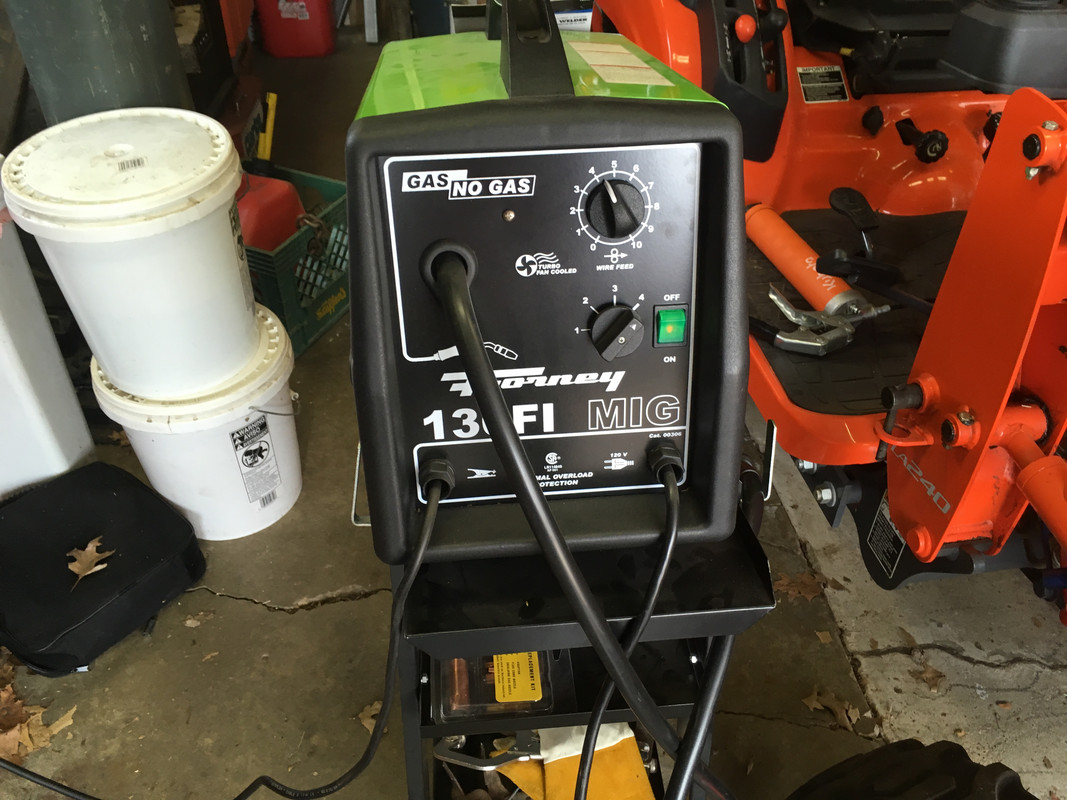
How does the cost of running a mig welder and a stick welder compare? I'm wondering about the cost of the wire and gas for the mig compared to the cost of the stick welding rods?
Generally speaking, SMAW is going to be less expensive than GMAW. Lincoln tombstones are fairly easy to find on the used market for a couple of hundred dollars. A 5lb pack of electrodes can be be had for $30, and a decent wire brush and chipping hammer can be purchased for another $20. That is all you really need to have a solid welding setup that will serve you well for most projects (granted, you need a hood, gloves, and probably a jacket, but that applies to welding in general). SMAW is a pretty versatile process, allowing you to weld a variety of materials and thicknesses in different positions requiring nothing but a different electrode and some adjustments to your machine settings. It is also a bit more tolerant of welding outside where wind may be present. On the downside, welding thin materials can be tricky, the process is a little slower, and the welds require cleaning.
Lower amp GMAW machines can be found at a similar cost to a decent size SMAW setup, but if you want a larger machine for thicker materials, price can be several times as much. Also, as you pointed out, the extras can add up quickly. Shielding gas, regulator, torch consumables (tips, diffusers, nozzles, liners), drive rolls, etc. aren't terribly expensive on their own, but can end up costing nearly as much as the machine itself when everything is said and done. GMAW can weld a variety of materials, but you'll need to make sure to have the correct shielding gas, which means another bottle or two floating around the shop. GMAW is faster and cleaner than SMAW, so you'll save some time there. It is also better suited to thin materials than SMAW.
I think the main appeal of GMAW is that people think that its easier to learn than SMAW. You just point and shoot... how hard is that? I'd argue that both processes have their nuance, but that GMAW isn't necessarily easier than SMAW. I also believe that the 'point and shoot' simplicity of GMAW creates a lot of false confidence with people who are new to welding. That is why you'll often see people recommend starting with SMAW because once you learn that, GMAW comes pretty naturally. Not so much the other way around. Personally speaking, I struggled with SMAW and never really got the hang of it until I became decently proficient in GMAW, so it can be done.
FCAW (flux core wire welding) is a hybrid of the two processes. It combines both the best and worst features of both. For a home hobby shop, the benefits of getting a small FCAW machine don't really outweigh the negatives (in my opinion) of just getting a good sized SMAW machine for not much more cost. If you are willing to spend the money on a good size wire welder, you might as well get on the bottle right away and run GMAW.
I can't really comment on GTAW (TIG welding) as I don't have that much experience running one (yet). On paper, it actually seems like a nice middle-ground when it comes to versatility and cost, especially if you are willing to forego AC. The learning curve is certainly steeper, but you get the ability to weld a variety of materials and thicknesses cleanly, while only needing a bottle of argon and minimal consumables.