I understand what you "latest technology" freaks are trying to say but you guys still don't know what us old tech guys are saying.
Do any of you soldering iron "rocket scientists" know what a cold solder joint is? If you do, then do you know what it can do in UHF circuits or even high powered DC circuits? (as noted in my electrolytic capacitor example, tin can style)
I do understand what a cold joint is (been soldering electronics for the last 35 years).
To be fair, I made some assumptions about the "old techs" that posted, such as having a thorough understanding how tip geometries and mass can affect performance, as well as differences between unregulated and regulated irons/stations, and even that there are variations between regulated station brands (still suspect this is the case

).
What I was getting at, as when I was younger (not a kid BTW, but just out of uni), was that for larger joints (larger AWG, buss bars, large RF connectors, .... sorts of things), it was necessary to go for the larger wattage irons and/or crank the temps on a temp controlled station (i.e. either crank the 80W iron, or grab the 120W <Weller gear FWIW>), to make sure the joint got enough heat to flow properly (good joint). Essentially all things being equal, that large joints meant the bigger/est irons would be required.
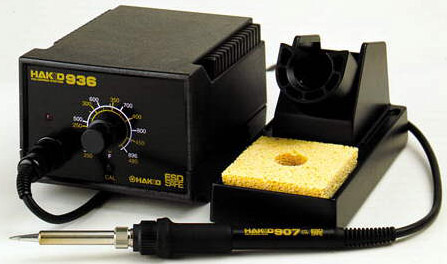
Up to this point, I'd never really thought about iron construction in terms of tip to heater relationships (tip butts up against the element, such as Weller's LT series, slid over the element as the Hakko 900M series does, ...).
Then some of the newer stuff started to appear, and through videos and meeting some that owned or had access to one, what they were capable of. Using less wattage no less (i.e. JBC T2245 or newer T245 irons vs. what I would have previously thought it would take a 120W Weller or similar to tackle with good results). Completely shocked me as to how well the thing was able to work (solder lugs, such as those found on large electros, RF connectors, and large AWG wire ...).
So after seeing this thing in action, it changed my thinking on how the tip/heating element construction affected the power consumption necessary to accomplish the joint correctly.
That's all I was trying to point out (i.e. ~50 - 65W using the newer tech can actually keep up with irons ~2x the power using the older tech (tip slides over the heater type of construction), not that a ridiculously small power iron (say 15W), with newer tip tech & regulation could tackle any joint on the planet.