To avoid these ads, REGISTER NOW!

What multimeters do y'all like?

To avoid these ads, REGISTER NOW!

SlotlessMan

Well-known member
Joined
Dec 27, 2016
Messages
208
Location
NW WI
Depends on why I am using use the multimeter.

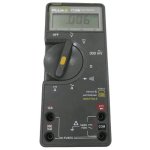
When accuracy matters to the right of the decimal point, I use a Fluke 77 that is from the 80s. Great unit!

I use a $20 disposable GB when I just need to know what the general potential is. Good enough for me 99% of the time.
 

tyyost

Well-known member
Joined
Jan 14, 2009
Messages
813
Location
Tunkhannock, PA
I have one of those Klein meters.. The temperature probe is 8 degrees inaccurate at 200 degreesF and there's no way to correct the offset, and the stupid safety plastic around the tips of the probes won't allow them to go into small places.
The grey tips come off, they are isolators when working on components in tight spaces.
 

Citation

Well-known member
Joined
Jan 20, 2016
Messages
3,271
Location
Indy
OP, you didn't say if you are willing to look at used. My Brymen suggestions mostly assumed used (typically off ebay) vs new.
Another used "good deal" would be the IDEAL 61-486. This meter is made by APPA. They do meters for several brands. I had a lesser version a while back. Not a bad meter at all. Not Fluke but like Brymen, often close enough for a lot less money. I had one recently on my ebay watch list for around $35 without probes. For probes I would get either Fluke TL75 or even better Pomona (the OEM for Fluke) silicone probes. The total setup would be around $50 if you look for deals. Good meter overall and easily better than what $50 new would buy. However, not everyone is OK with doing the used item hunting.
 

KnurledNut

Well-known member
Joined
Jan 28, 2011
Messages
8,396
Location
n/a
I also have Klein, Field Piece and UEI meters but they are at a different price point. Field Piece makes meters specificly aimed at the HVAC industry.
(Quoting your post for reference but replying to the thread in general.)

HVAC and automotive overlap in a lot of ways.
I’m currently carrying a Fieldpiece SC260 (Taiwan) for work and it gets used for everything, high and low voltage circuits, tradeswork, vehicle and equipment maintenance.
It’s not IP rated, but built rugged enough to be used on hot roofs or inside freezing coolers, exposed to elements testing outdoor equipment, and durable enough to bounce around in a toolbag 40-hrs a week.
IMO the test leads are as important as the meter and these are high quality, UL-listed silicone with gold plated tips and removable probes for use with other accessories like needle backprobes and alligator clips. It’s fairly compact for the features it offers and has an integrated swivel magnet which has been beneficial for automotive use too.
It’s been reliable, accurate, and responsive, and the functions are well engineered and user friendly even in poor lighting. This isn’t a meter for the clean room bench tester guy, but as someone that takes the tool to the job instead of the job to the tool, I have come to appreciate it. It quickly became apparent to me why so many seasoned techs carry them daily once I got my hands on one. This replaced one of my Flukes.

Like several other posts in this thread, the price I paid was significantly less than what it currently retails for unfortunately.
 

PoorUB

Well-known member
Joined
Mar 29, 2021
Messages
12,023
Location
Fargo, ND
Not really the guy to ask. I’ve got 2 old Fluke 77s likely 30+ years old. Sort of the old cry once and like the old Timex add says keeps on ticking.
IMG_5357.jpeg
I bought a Fluke meter back in the 80's and used it for a few years, in may have been a 77, but I forget. Around 2000 I switched jobs and bought a new Fluke and gave the old one to my dad. Pop passed away in 2021 and cleaning out his mess I ran across the old fluke and it had good batteries in it so dad was still using it. So about forty years old and still works fine. I added it to my Fluke test meter collection.
 

tool_scrounge

Well-known member
Joined
Jul 20, 2010
Messages
4,250
Location
Southern California
My choice? Used Or NOS Fluke volt meters. I have bought a number of them over the years, from Mil Spec Fluke 27/fm meters (used to be amazing deals on them on EBay, literally built like a brick) to newer 87x meters. Even some of the really old Fluke 8060 push button meters.

I was always curious on how accurate they all were, so on a whim I found a reasonably priced Fluke 515a Portable Calibrator. It is a precision voltage and resistance calibration source for on-site calibration.

What surprised me was that all the Fluke meters were well within specification. So I prefer used Fluke meters for cheap. They also hold up well to abuse.
 
To avoid these ads, REGISTER NOW!

PoorUB

Well-known member
Joined
Mar 29, 2021
Messages
12,023
Location
Fargo, ND
So I prefer used Fluke meters for cheap. They also hold up well to abuse.
IMO, the way they hold up to use and abuse over time, Fluke is the cheaper meter because you just buy it once.
I have owned Field Piece and others I can't recall and none lasted more than a couple years. So what did you gain if you have to replace a meter every few years or run a Fluke forever? The fluke I bought in 2000 lasted me about eight years until it took a dive of a scissor lift 20 feet in the air. It failed the drop test! :ROFLMAO: The one that replaced it is in the drawer in my work bench, so it is about 18 years old. I have a Fluke electronic thermometer that is about 20 years old, plus an 87III about the same age. So thee Fluke VOMs and a thermometer.
 

dyermullet

Well-known member
Joined
Sep 9, 2017
Messages
61
Location
TX
The grey tips come off, they are isolators when working on components in tight spaces.
That Klein meter is junk. It times out and shuts off way too quickly. Any project I have used it on it always off. My fluke doesn't do that. It is comical how fast it shuts off.


Since it has a button for ac DC everytime you turn it back on have to set voltage.
Just a horrible design.
 

Cruzan80

Well-known member
Joined
Jul 22, 2015
Messages
4,499
Location
Denver, CO
My choice? Used Or NOS Fluke volt meters. I have bought a number of them over the years, from Mil Spec Fluke 27/fm meters (used to be amazing deals on them on EBay, literally built like a brick) to newer 87x meters. Even some of the really old Fluke 8060 push button meters.

I was always curious on how accurate they all were, so on a whim I found a reasonably priced Fluke 515a Portable Calibrator. It is a precision voltage and resistance calibration source for on-site calibration.

What surprised me was that all the Fluke meters were well within specification. So I prefer used Fluke meters for cheap. They also hold up well to abuse.
Really hoping that you somehow confirmed that the Portable Calibrator was in spec/calibrated.

Not a big deal for 3.5digit DMMs (the calibrator would have to be MASSIVELY out of spec for it to matter for those), but absolutely for anything precision. Hence my joking comment above about a bench meter...
 

IcarusLSC

Active member
Joined
Mar 9, 2017
Messages
29
Location
Canada, eh!
I've got a couple Flukes and a couple Innovas still kicking around. Not had any issues yet other then a heard time trying to find a fuse for Fluke 115 I use much of the time. No around here had one :/
 

mikedodge

Well-known member
Joined
Jun 27, 2017
Messages
2,984
You had a harbor freight one and primarily use it for automotive type use. For that I use the cheapest one I can find that uses 9V battery. It does its job and I'm not going to spend much on a good Fluke type meter that's only going to get greasy or put down where it might get dropped or whatever else that might damage it.
 

Rinspeed

Well-known member
Joined
Apr 26, 2020
Messages
1,875
Location
NY
Not had any issues yet other then a heard time trying to find a fuse for Fluke 115 I use much of the time. No around here had one :/


Lol, I had to look because they are just standard configuration fuses. They are 11 amp fuses and not many EEs design a circuit with 11 amp fuses, except Fluke I guess. :) Bussmann KTK-11 is what you're looking for.
 

AdAstra

Well-known member
Joined
Aug 27, 2021
Messages
202
Listen to this guy.

Also discussed here.

Brymen BM037 is a solid one meter choice for most work, unless you know you’ll need inline current measurement.

I often grab it over my stable of larger Flukes at work. But if that’s not in budget, the Uni-T 210E seems decent.


I've answered a similar question a number of times.

1. Fluke is my favorite when someone else is paying the bills. I really like the 87-3, 87-5 and the 187. I don't care for the 113-117. My issues with them is the lack of Touch Hold which is a great Fluke feature. When you set the meter to touch hold it waits for a stable reading then freezes the display. This is great because that means you can keep your eyes on the probes, not the screen since the reading you want will be there when you remove the probes from the sparking bits. Most Fluke's also have very fast continuity checking. If you are willing to look used, sometimes the old (like sold when Regan was in office) Fluke 27's can be had on eBay. They are very robust and can be used as bricks if the need is there. The Fluke 101 may be a good deal if you want a very basic but very well made meter for likely $50-60. It will not do current ranges. Amazon's price is high but I think other sites have it for less.

2. Second to Fluke, and the meter family I typically recommend the most, is something made by Brymen. They are an OEM for many good meters including the Matco MD251 and MD257 (often very good deals used on Ebay). They also make the GreenLee MD820A I used in the garage. If you look at either their smaller or bigger family of meters (Matco is the smaller family, the MD820A is the larger) you will see the family resemblance. Any of those are very solid meters and all but equal to Fluke in terms of safety and accuracy. Only the lack of touch hold bothers me.

3. Depending on your uses and honestly, one I always suggest as a second meter is the Uni-T UT210E (must be the E version). This is a low cost clamp meter that can read AC and DC and down into the mA range. I will not claim Amazon has a good price, I recall these being ~$50 not the current asking price. https://www.amazon.com/dp/B0188WD1NE?tag=atomicindus08-20
These are nice because you can measure current through a wire without breaking the circuit. Note, it measures net current so if you clamp it around an extension cord you will see zero net current even if you are clearly loading the cord. You can only measure one leg at a time. Anyway, thanks to having voltage, capacitance and resistance ranges it really does most of what you need. The electrical safety features aren't as good as those used by Fluke and Brymen but that is less important if you are doing mostly home/automotive (non-EV) work. Of the above options this might be the one I would get as an only meter so long as you know you don't need inline current measurements and you don't need temperature measurements. It, along with the Fluke 101 are the only ones that are available for around $50-60 new. The others are ebay searches.
 
To avoid these ads, REGISTER NOW!
Top Bottom