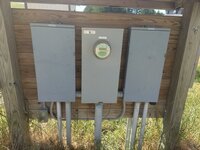
Also, the main breakers are not supposed to be used as switches.
404.11 - Circuit Breakers as Switches - A hand-operable circuit breaker equipped with a lever or handle, or a power-operated circuit breaker capable of being operated by hand in the event of a power failure, shall be permitted to serve as a switch if it has the required number of poles.
As far as backfeeding breakers goes:
If the breaker has "line" and "load" markings, then you must abide by them and not backfeed it. Any breaker that does not have those markings can be backfed. That being said, most breakers do NOT have these markings and therefore there is no issue with backfeeding them. As far as I know, it's mostly GFCI breakers that have these markings, and you can supposedly fry the electronics in them by backfeeding them.
705.12(D) is the only code section I could find that mentions this. However, that section otherwise doesn't apply to backup/portable generators. It applies to "installation of one or more electric power production sources operating in parallel with a primary source(s) of electricity." In other words, it's when you have two or more sources providing power simultaneously. A good example would be a grid-tie solar panel system. A backup generator does not operate in parallel with utility power. You're either using utility power, or you switch over to generator power. It's one or the other, not both at the same time (paralleled). The appropriate code sections for generators are Article 702 - Optional Standby Systems and Article 445 - Generators. That being said, backfeeding is backfeeding, whether it's from a grid-tied solar system or a portable generator. The breaker would operate the same in both cases.
408.36(D) says that breakers "that are backfed and used to terminate field-installed ungrounded supply conductors shall be secured in place by an additional fastener that requires other than a pull to release the device from the mounting means on the panel." So, as long as you have a hold-down bracket on the breaker, then YES you can backfeed a breaker. If you weren't allowed to backfeed a breaker, the NEC wouldn't have this section. Instead, they'd have a section that said "never backfeed a breaker" or something to that effect.
445.12(A) says that generators "shall be protected from overload by inherent design, circuit breakers, fuses, protective relays or other identified overcurrent protective means suitable for the conditions of use." In other words, assuming it's ok to backfeed a breaker (and we've already established that is ok), this is a perfectly acceptable way of connecting a generator, since the backfed breaker is suitable for use.
702.5(D) says that "transfer equipment shall be suitable for the intended use and shall be listed, designed, and installed so as to prevent the inadvertent interconnection of all sources of supply in any operation of the transfer equipment." This is literally the whole purpose of an interlock kit: to prevent the generator from electrically connecting to the panel while utility power is still connected.
Some more food for thought: A 2-pole breaker is mostly intended for 240V loads. A 240V load does NOT use a neutral wire. (I'm not counting a 240V/120V load like a kitchen oven. In those cases, the neutral is there ONLY for the parts that run on 120V. The 240V parts do not use the neutral). Something like a 240V motor only has 2 hots and a ground. So, without a neutral wire, how does current return to the panel to complete the circuit? It goes down one hot leg, through the load, and returns on the other hot leg (from the load, INTO the breaker, on the LOAD side). Sounds very similar to a breaker getting backfed, doesn't it?