To avoid these ads, REGISTER NOW!

Woodworking 101--Tools and Tips

Jgaz

Well-known member
Joined
Dec 16, 2016
Messages
1,657
Location
AZ

NOT QUITE WOODWORKING
AGAIN
Due to structures on the bottom of my benchtop, the first two dog holes in line with my tail vise had to be blind holes. Because of that, I used Veritas bench pups which are only 2 3/8" inches long. The problem with that was that when working on very thin stock (see Roubo bookstand post #7392 and clock post 7395) the pups were hard to grip in order to raise them. My solution was to put a tapped hole on the bottom of the pup for a thumb screw. Now the pup can be easily be adjusted for thin stock.
That thumb screw is a good idea.

I have a deep blind hole in the thick chop of my vise.
I drilled and tapped a hole in all my bench dogs and welded up a tee handle to be able to pull them out or to adjust them to the correct depth.

IMG_3800.jpeg
 
To avoid these ads, REGISTER NOW!

Jgaz

Well-known member
Joined
Dec 16, 2016
Messages
1,657
Location
AZ
Can I make a post in the “Not Quite Woodworking” sub thread?

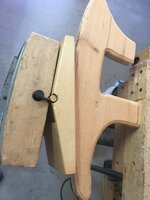
This might help explain why I have such a thick chop on the moveable jaw of my wood working vise pictured above.

This pivoting wooden piece it’s screwed to a hinge which in turn is welded to a piece of 3/4” rd. stock.
The whole assembly then slips in the hole in the thick block on the vise jaw.
IMG_3801.jpeg

IMG_4256_Original.jpeg

The pivoting jaw makes it much easier to clamp an angled surface.
Here I’m repairing a poorly designed child’s rocker for my favorite clients….neighborhood kids.

Note: Not an original idea I think I first saw it in an old, black and white Fine Woodworkingmagazine.
 

CRSINMICH

Well-known member
Joined
Aug 15, 2015
Messages
2,397
Location
Southeastern Michigan
Jgaz: That's a terrific idea. I'm going to have to make something like that. Maybe I'll tie it to the dog on my face vise. I noticed that the regular jaws of your vise are lined with gasket material. That's another good idea. I used a material called Crubber. It's made of cork and rubber.
 

Jgaz

Well-known member
Joined
Dec 16, 2016
Messages
1,657
Location
AZ
Jgaz: That's a terrific idea. I'm going to have to make something like that. Maybe I'll tie it to the dog on my face vise. I noticed that the regular jaws of your vise are lined with gasket material. That's another good idea. I used a material called Crubber. It's made of cork and rubber.
My material is crubber as well. I’m about to epoxy it in place, any contact cement I’ve used won’t hold.

Of course my garage is in Phoenix. Any metal surface stays 103* to 105* overnight all summer long.
When you pull a car into the garage mid afternoon the air temp in the garage goes over 120*!
That could have something to do with the contact cement not holding.
 

Farmerjonathan

Well-known member
Joined
Nov 23, 2013
Messages
349
Location
Northwestern Indiana
IMG_0789.jpg
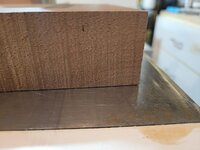
I wanted to see what you guys thought on this. I have an old cabinet with a butcher block maple top. It's starting to come apart in a couple places. I dont think I can spread some of the cracks any further. What type of glue do you think would be best?? Regular titebond? CA? This would not be a food surface and will likely be treated with tung oil when finished.

Thanks!

Looks like shop benches in many schools. If you look along the edge you should see some plugs. In your picture it looks like two of the holes have the plugs removed already. Generally is a threaded rod running the width and by removing the plugs you can tighten the rods eliminating the splits.
 

Mr. Wonderful

Well-known member
Joined
Jan 15, 2018
Messages
1,771
Location
Pacific Northwest
Looks like shop benches in many schools. If you look along the edge you should see some plugs. In your picture it looks like two of the holes have the plugs removed already. Generally is a threaded rod running the width and by removing the plugs you can tighten the rods eliminating the splits.
I took a closer look and there is no metal in it. It looks like there is just a couple dowels running through there. I haven't started working on it yet though.
 

Farmerjonathan

Well-known member
Joined
Nov 23, 2013
Messages
349
Location
Northwestern Indiana
I took a closer look and there is no metal in it. It looks like there is just a couple dowels running through there. I haven't started working on it yet though.
If the dowels you are talking about are flush with the wood sides of the bench top, those are the plugs I am talking about. Drill in with a small bit in the center of the dowel and see if you hit metal.
 

CRSINMICH

Well-known member
Joined
Aug 15, 2015
Messages
2,397
Location
Southeastern Michigan

RUSTIC BENCH
After making fairly precise clock parts (see post #7395) this was a good antidote. Not many of the dimensions had to be much better than "good enough". Also, it was a two day project and that includes drying time. It was made for an aging cat who has begun to have trouble making it up to her favorite eyeballin' seat on the window sill.

The mortises were hand bored with a brace and 1" auger bit and the 1" round tenons were hand cut in the ends of 1.5" dowel rod sections. The wedges were scraps of something in the bin.
 

Attachments

  • Finished bench (2).JPG
    Finished bench (2).JPG
    119.6 KB · Views: 69
  • Finished bench (1).JPG
    Finished bench (1).JPG
    257.1 KB · Views: 49
  • Wedged tenon.JPG
    Wedged tenon.JPG
    242.6 KB · Views: 43
Last edited:

CRSINMICH

Well-known member
Joined
Aug 15, 2015
Messages
2,397
Location
Southeastern Michigan

AUGER BITS
There is way more to auger bits than this post but here are a couple of things that I learned by using one to bore the mortises for the rustic bench.

First, I learned how to sharpen auger bits. It's not hard but it is possible to make a bit unusable.

Second, the leading part of the bit, referred to as the snail, actually pulls the bit into the wood.

The third thing is not something I expected or heard of before. The snail is cone shaped and, as it gets deeper into the wood, it can exert pressure sideways. Most of the time that is not a problem but this time, with a very large bit, the snail was so large that it ended up splitting the wood along the grain. After some experimentation, I solved the problem by drilling a pilot hole with a twist bit. I had to try different sizes because if the pilot hole was too large the snail wasn't able to pull the auger through the wood.

Finally, I attached this drawing of the tips of two auger bits that show their snails. One looks like it has finer threads than the other. It actually has two threads instead of one. The bit with coarser threads works better in softer woods and the one with finer threads works better in hard woods.
 

Attachments

  • 1918 auger bits..jpg
    1918 auger bits..jpg
    65.5 KB · Views: 37

Jgaz

Well-known member
Joined
Dec 16, 2016
Messages
1,657
Location
AZ

RUSTIC BENCH
After making fairly precise clock parts (see post #7395) this was a good antidote. Not many of the dimensions had to be much better than "good enough". Also, it was a two day project and that includes drying time. It was made for an aging cat who has begun to have trouble it making up to her favorite eyeballin' seat on the window sill.

The mortises were hand bored with a brace and 1" auger bit and the 1" round tenons were hand cut in the ends of 1.5" dowel rod sections. The wedges were scraps of something in the bin.
Nice work on the bench. Those tenons look to be a perfect fit
 

rharman

Well-known member
Joined
Apr 22, 2012
Messages
8,800
Location
SoCal

RUSTIC BENCH
After making fairly precise clock parts (see post #7395) this was a good antidote. Not many of the dimensions had to be much better than "good enough". Also, it was a two day project and that includes drying time. It was made for an aging cat who has begun to have trouble it making up to her favorite eyeballin' seat on the window sill.

The mortises were hand bored with a brace and 1" auger bit and the 1" round tenons were hand cut in the ends of 1.5" dowel rod sections. The wedges were scraps of something in the bin.
Substitute cat for Snoopy, but you get the message!
Project I'm most proud of is the steps I made for our aging beagles to assist getting up on the bed & couch. Just plywood and carpet remnants but oh so much satisfaction.

1694841565727.png
 

BobLon

ALLIANCE MEMBER
Joined
Apr 19, 2017
Messages
141
Location
Florida
Hatch I made for a sailboat. A 1/4"-square lip in the teak plywood sets into a grove in the teak frame. Afrormosia corner blocking. No fasteners--only WEST epoxy used for assembly.

IMG-2298.jpg
IMG-2299-1.jpg

I am curious. How large of panels do you find you can do that with before panel expansion becomes an issue (that doesn't look like plywood)? Or is Teak that stable, don't work with that wood.
BobL.
 

ez-duzit

Well-known member
Joined
Jun 24, 2013
Messages
5,097
Location
Marina del Rey
I am curious. How large of panels do you find you can do that with before panel expansion becomes an issue (that doesn't look like plywood)? Or is Teak that stable, don't work with that wood.
BobL.
It is teak-veneered plywood. Teak is very stable. I have glued solid teak to very large panels with no issues, using WEST epoxy.
 

acer66

Well-known member
Joined
Dec 4, 2010
Messages
4,418
Location
Western North Carolina
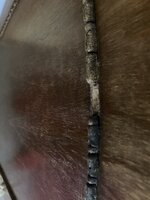
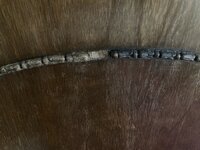
Got a new to me free furniture piece, nothing special but some detail pieces are missing which I like to fix.

No idea what these are called.
They look like individual pieces about 7/8” long.

Thank you.
IMG_2965.jpeg
IMG_2963.jpeg
 
To avoid these ads, REGISTER NOW!

CRSINMICH

Well-known member
Joined
Aug 15, 2015
Messages
2,397
Location
Southeastern Michigan
acer: PugetDude is probably correct. There are many different versions of molding called egg and dart. Yours looks like a fairly simplified version. Check out Peter Follansbee's or Mary May's YouTubes about carving. I'm not sure you could buy replacement moldings so you might have to carve them yourself. Give it a try. Good luck.
 

Jgaz

Well-known member
Joined
Dec 16, 2016
Messages
1,657
Location
AZ
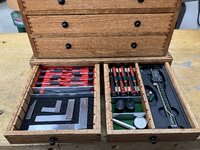
I decided to make a riser tool box to go under a machinist chest I made about 10 years ago.
Wooden Tool Box 001_Original.jpeg

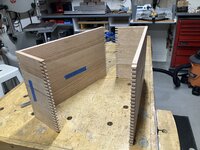
Yesterday I cut finger joints on the four carcass panels.IMG_3830.jpeg

IMG_3831.jpeg

Dry assembled it today to lay out the dados for the center dividers
IMG_3834.jpeg
I put the finishing touches on the riser chest today. I’m still working on what tools will go where.
Might still make a sliding till to go in the bottom drawer similar to what I did in the original top chest

Post #597 I this thread will show the original top chest in more detail.
IMG_4036.jpegIMG_4028.jpegIMG_4030.jpeg
 
Last edited:

CRSINMICH

Well-known member
Joined
Aug 15, 2015
Messages
2,397
Location
Southeastern Michigan
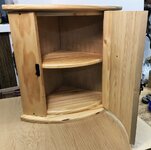
CURVED FRONT CORNER CABINET
Inspired by Norm Abrams' New Yankee Workshop Season 5, Episode 8
Because of the coopered door, this project has been on the To Do list since the episode originally aired. It was done mainly with hand tools but a table saw was pulled out from a corner of the garage for carcass work.

The forged hardware inspired the use of cut nails as accents on the top and bottom of the side styles to add to the rusticity. It was a fun project but a copy of Norm's measured "draw ring" would have helped tremendously.
 

Attachments

  • Cabinet left.JPG
    Cabinet left.JPG
    381.7 KB · Views: 28
  • Cabinet center.JPG
    Cabinet center.JPG
    343.5 KB · Views: 26
  • Cabinet open (2).JPG
    Cabinet open (2).JPG
    254.2 KB · Views: 23
  • Cabinet right.JPG
    Cabinet right.JPG
    263.3 KB · Views: 42

Woody1320

Well-known member
Joined
Sep 27, 2017
Messages
164
Location
Southeast Michigan
CURVED FRONT CORNER CABINET
Inspired by Norm Abrams' New Yankee Workshop Season 5, Episode 8
Because of the coopered door, this project has been on the To Do list since the episode originally aired. It was done mainly with hand tools but a table saw was pulled out from a corner of the garage for carcass work.

The forged hardware inspired the use of cut nails as accents on the top and bottom of the side styles to add to the rusticity. It was a fun project but a copy of Norm's measured "draw ring" would have helped tremendously.
CRSMich, that came out beautifully. Very well done.
 

Mb4

Well-known member
Joined
Mar 23, 2020
Messages
214
Location
Northeast
The beautiful thing about woodworking is that, with few exceptions, there are a number of ways to get from Point A to Point B, regardless of your tools or in many cases your space. I haven't been able to read through the 186 pages of posts, so I don't know if this is mentioned, but the most important thing for anyone starting out is getting the lumber properly dimensioned and flat is 3/4 of the job. Taking the time to learn how to do this is so important and makes learning all sorts of joinery that much easier. If you don't have access to power tools, just find an old Stanley plane, flatten the sole if it's out of true, and learn how to use a pair of winding sticks. The only tool in woodworking that you really should save up to spend any big money on is a quality combination square, but if you look around you can find good used ones (if you know how to test a square) or can buy new blemished squares (the cosmetics don't make the square any less accurate) for discounted prices. Granted, while pricier power tools can make the job a lot easier and faster, everything in woodworking builds off of properly flattening and dimensioning lumber.
 

NBraun

Well-known member
Joined
Sep 14, 2020
Messages
158
Speaking of getting your lumber completely flat.

I have some 8/4 walnut that I need every bit of thickness I can get out of it. I've already taken two passes at the jointer and I can't seem to get the twist out of the board. I'm starting to wonder if it's a me issue or a jointer issue. the pieces are 4"x22" and i'm using a 6" rigid jointer. I don't think they're too long for the bed of the jointer.

Thoughts?
 

Attachments

  • G7ERgqHl.jpg
    G7ERgqHl.jpg
    45.7 KB · Views: 29
  • KzsptkBl.jpg
    KzsptkBl.jpg
    50.4 KB · Views: 44

CRSINMICH

Well-known member
Joined
Aug 15, 2015
Messages
2,397
Location
Southeastern Michigan

UNION Tool Chest - Style D
I guess this is more Not Quite Woodworking

This was found at an unadvertised estate sale that had garage sale prices. It was dirty but in good shape (except for the leather on the handle). It only needed a good cleaning. I didn't try to make it look like NIB. The excerpt is from UNION'S 1929 catalog. Style D was in older UNION catalogs too.

Amazingly, the key was still in one of the small drawers.
 

Attachments

  • IMG_8413.JPG
    IMG_8413.JPG
    310.7 KB · Views: 26
  • IMG_8412.JPG
    IMG_8412.JPG
    304.5 KB · Views: 22
  • IMG_8414.JPG
    IMG_8414.JPG
    354.3 KB · Views: 25
  • 1929 UNION 'D' Chest.jpg
    1929 UNION 'D' Chest.jpg
    331.2 KB · Views: 26

acer66

Well-known member
Joined
Dec 4, 2010
Messages
4,418
Location
Western North Carolina
IMG_3437.jpegI might be overthinking this but I need a sanity check.

I wanted to connect the two perpendicular pieces of wooden countertops with biscuits for alignment and pocket screws to hold them together with no glue.

Install the brackets in the way that they allow the tops to move like indicated by the arrows.

This is all in a climate controlled basement.

Is that okay?

Thank you.
 

cycle61

Well-known member
Joined
Apr 5, 2020
Messages
500
Location
Middle of Oregon
Those tops don’t actually move very much. I have one made of the same material in my van, it’s been secured to the kitchen cabinets for a year now with no issues. Of course, since our application lives in a permanent 4.5 earthquake it’s substantially overbuilt compared to residential.
 

BobLon

ALLIANCE MEMBER
Joined
Apr 19, 2017
Messages
141
Location
Florida
If you're talking about wood movement due to changing humidity, wood does not expand very much (if at all) along the grain, how you have your arrow drawn. It would expand across the depth of the countertop, but I agree with the above statement, probably not a lot.
BobL.
 

acer66

Well-known member
Joined
Dec 4, 2010
Messages
4,418
Location
Western North Carolina
If you're talking about wood movement due to changing humidity, wood does not expand very much (if at all) along the grain, how you have your arrow drawn. It would expand across the depth of the countertop, but I agree with the above statement, probably not a lot.
BobL.
Oops, thank you for clarifying the direction.

Guess I will mount the brackets accordingly and hope for the best. 😉

When does one to worry about expanding?

Thank you.
 
Last edited:

joe_pinehill1

Well-known member
Joined
Feb 23, 2013
Messages
537
Location
Northern Virginia
ALL: i had to move the 4x4 staining inside my wife's side of our garage that Mrs. DIF was happily (for first time maybe in a while) to give up for one of my projects.

my plan is to build either a brick or basalt base around the base of the 6x6 cedar posts to give it maybe a better look and also hide the copper green that i put on them for protection from bugs and rot. any ideas on how i would finish it in wood if i decided to go that route or if a mason or brick guy wants to lend some of their finishing tips i'm sure the thread wouldn't mind.

also i think i might want to add one more 4x4 on top of it. this was the biggest hurdle in my design getting my wife's approval. she fought me the entire time i was getting the 4 x 4's ready to put up there saying it would be TOO BIG and when i finally put them up there she actually liked them. so if i add another one i might get the spacing a bit better and another thing i have never screwed them in place (don't want to nail in case i need to take it apart again to restain it if we are still living here in 3 or 4 years). anybody want to say if i should toe nail screws in or i have some 6 inch phillips head galvanized screws that i could put in straight in from the top that i'd probably want to first pre drill a hole through the cedar to do that.

any thoughts??

like i said it was a fun project and when i originally put it in i actually would see people just sitting in front of my house staring at it (I hope they were anyway instead of checking out my bride or my stuff). i remember one guy slamming on his breaks and then when he saw me in the driveway giving me a huge thumbs up. many of my builders (I was a REALTOR for 30 years) would stop by and wonder why i didn't have them build it and when they found out i did it myself they said WELL DONE.

hope some of you enjoy it and if you might want to copy my design or ask any questions feel free to cause i'm happy to share.
DIF looks great! A pergola is on my list this summer. Can you tell us the ratio of the cut out at the end of each beam and rafter? Is the a golden rule ? Your's look the right ratio.
 

drivesitfar

Well-known member
Joined
Oct 23, 2013
Messages
36,008
Location
Pacific Northwest
Joe: while I had a few old jar lids and was trying to figure out a good method of getting some cuts that weren't random and that matched my bride came out and took my sharpie and drew the end cuts on a piece of cardboard. I actually cut out the piece of cardboard and used it as a form so to speak and I kept it on a shelf with some other woodworking tools. if you'd like actual measurements please PM me and i'll see if I can give you some so you can duplicate if you'd like to build a pergola. or if others don't recall what my 10 year old Pergola with 6 6x6 cedar posts holding it up looks like i'll post up a few more pics if asked.

hope you all have a great 2024!!!
 

BobLon

ALLIANCE MEMBER
Joined
Apr 19, 2017
Messages
141
Location
Florida
When does one to worry about expanding?

As long as wood has space to expand into it is not an issue.

How much wood will expand is subject to a lot of variables. Humidity and temp of course, but also the type of wood, grain orientation, size of piece, finish, etc.
If your wood is dry and acclimated to your climate and whatever you build will stay in the same environment you will likely see minimal movement.

However, if you trap a piece of solid stock, like gluing in an inset bottom to a box, or drawer, bottom you could have issues.
The larger the piece of solid stock, the more total movement will be seen (cumulative across the width).

Seems like I read somewhere that approx. 1/8" of movement across a 12" piece should me allowed for (I could be off base on this one though).

Wood movement really needs to be evaluated against the project at hand. Either design around the issue if present, or make allowance (like the floating panel in a door, or drawer bottom).

Hope this makes sense.
BobL.
 

acer66

Well-known member
Joined
Dec 4, 2010
Messages
4,418
Location
Western North Carolina
As long as wood has space to expand into it is not an issue.

How much wood will expand is subject to a lot of variables. Humidity and temp of course, but also the type of wood, grain orientation, size of piece, finish, etc.
If your wood is dry and acclimated to your climate and whatever you build will stay in the same environment you will likely see minimal movement.

However, if you trap a piece of solid stock, like gluing in an inset bottom to a box, or drawer, bottom you could have issues.
The larger the piece of solid stock, the more total movement will be seen (cumulative across the width).

Seems like I read somewhere that approx. 1/8" of movement across a 12" piece should me allowed for (I could be off base on this one though).

Wood movement really needs to be evaluated against the project at hand. Either design around the issue if present, or make allowance (like the floating panel in a door, or drawer bottom).

Hope this makes sense.
BobL.
I does indeed makes sense.

Thank you BobL.
 
To avoid these ads, REGISTER NOW!
Top Bottom