A Coachmakers Shave
As we zip around in our modern wheels, it is hard to believe that just 125 years ago personal transportation required a horse. Coaches and carriages fueled an industrial boom during 19th century America and those tools were made in such large numbers that they are still quite common today. Coachmaker's beaders and quirk routers can be identified at a distance. Most look like spokeshaves. The beaders have identical blades on both sides for working different grain. Here is one that I picked up several decades ago.
Here is the bottom.
This one has a hickory bottom and looks like it was user made. My guess is that it is late 19th century--I am picking an arbitrary date of 1880. The blades are for beading and are rusty.
Odd thing is that the blades are bedded at a very high angle of 80 degrees. That is scraper territory and I am anxious to see how well this tool works.
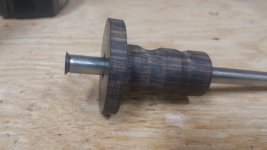
Sharpening a profile blade can be a daunting task. I find the beading blades pretty easy once I find a screwdriver that has the right sized shaft.
I pick some sandpaper that has a lightweight backing and wrap the shaft with it.
Just pull the paper tightly and shoeshine the bead on the shaft. Just try to ignore why this motion seems so natural.
Soon enough your blade will be polished and sharp and the profile will be intact.
Now our attention moves to the back of the blade. There is good news and bad news. The good news is that this blade shows wear. That is good because it means the plane was some craftsman's user. Pristine blades in planes is almost never a good finding because it means that someone started and gave up. The bad news about use is that craftsmen of yore were pinched for time and often lazy. Sharpening blades with profiles is a time consuming task. The shortcut is to sharpen only from the flat side by putting a back bevel on the blade. It is an effective but short termed solution. Sooner or later, the cutting angle will be too steep and someone will have to touch up the profile. In the case of this blade, that someone is me.
The flat and shiny back shows my sharpening and the dark tips show evidence of backbeveling. I do my best to flatten and then repeat some of the backbeveling.
I repeated the same procedure for blade #2. Then I discovered another issue--the wedge was not wedging. Here is a picture.
One dead giveaway of this user made plane is the unconventional wedge mortise. Apparently, the owner had narrow steel stock for the blades and made a narrow mortise for the blades to keep them parallel. Then he made a wider wedge to hold said blades in place. BUT he made the blade bed too deep and then split the plane hammering the wedge in place.
It is too bad that he did not consult any Japanese planemakers as they could have told him of a remedy. Japanese blades are hammered into a tight mortise in the dai, or plane body. This tight fitting mortise is hard to get right and the blades sometimes slip. The clever Japanese carpenters use paper behind the blade to shim it up. Who knew that flimsy paper would make a good shim? Why, those clever Japanese carpenters, that's who. So I followed their plan by finding some cardstock and making a shim.
So now the shave is ready for action. The blades have been sharpened and shimmed. I tried some walnut. The blade jumped around and chattered a bit.
I found that moving the blade back and forth worked better to remove some of the chatter marks. But it still left a nasty looking bead.
So then I tried the end grain. Maybe the scraper angle works better there.
Nope. This plane does not like walnut. Maybe it was made for softer wood. I switched to a piece of pine construction lumber.
Yes. That is the ticket. I am sure I could do better with more practice and better wood. Perhaps poplar or fir. Carriages were certainly made from light woods.
So the mystery is solved for this plane. Beaders and quirk routers were important to the carriage makers because water flow was a big issue for them to solve. Look closely at carriages, especially around windows and door frames. You will see an intricate pattern of beads and quirks designed to direct water away and keep it from leaking inside. These guys were clever hydro engineers working away in wood. I admire their work and appreciate using their tools.


 I really like my looong stick.