As we finished up the WJ for the day, my son headed home to spend time with his family, and I thought I would tackle a small job on our Jeep that I've been meaning to get to for a few weeks now.
Let me preface on this task and give it some context. Sorry, this will be long.
About 4 years ago and 50k plus miles ago we were at our annual Jeep gathering with our friends in South Dakota. As we were coming off the trail one afternoon and heading back towards camp the Jeep got a dead pedal and went into limp mode. I had a DTC so we pulled off and I checked the code. Came up as a P2138 which is a throttle pedal voltage variation code. At the time that one didn't stand out to me as I had not had much experience with that particular code but it cleared and was fine, so we continued back to camp.
Upon getting back to camp and having internet I did some research to discover this was a common problem with mid-2000 GM vehicles and usually pointed to either an accelerator pedal or throttle control. Seeing as how I only had about 12k-15k or so miles on the GM powertrain in the Jeep at that time I had a difficult time thinking it could be either and although I had installed a GM pedal into the Jeep, I purchased a new OEM pedal and not an aftermarket.
I crawled under the dash and unplugged the Weatherpack connector at the throttle pedal, gave it a visual inspection, including all of the wiring to the plug and upon not seeing anything out of the ordinary, I reconnected it and went about the remainder of the trip without incident.
I figured one of two things, either it must have been a nuisance code, maybe I slipped on the pedal and it flipped back suddenly giving a false error OR maybe there was a connection issue with the pedal connector. Either way it didn't seem to give me any further issues the remainder of the trip nor the several weeks later as I daily drove it.
Although, once I returned home I did more research about the code and what it took to set the code. I found out that GM used two switches/potentiometers in their pedal assemblies. One registering a low to high (0V-5V) and one high to low (5V-0V) and they must agree with one another or it will give a voltage variation code. I thought it could have been either one of the wires feeding either of the switch circuits back to the ECM or it could have been a floating ground in that circuit giving an error. But either way I figured it had to be something in the pedal assembly or connector.
The next month we were with our same group of friends in Moab in October and the first couple of days the Jeep ran without missing a beat, like normal. On the third day we had just aired down and hit the first several hundred yards of the trail when it did it again. I thought to myself we were bouncing around on the washboard section and it must have caused the issue. I pulled off, checked the code using the Aeroforce gauge on the dash and it was the same P2138 code. I cleared it and it ran fine for the remainder of the trail. That is until we aired up and hit the pavement back to camp. It did it several more times as we were heading back to camp. It actually got to the point as we were driving through Moab that as soon as I cleared the code it would return and the pedal would go dead.
I was not sure what to do here as I didn't have a spare pedal nor was my gut thinking that was the issue. I had talked to Robbie @ Motech on several occasions when I was planning my LS swap back in 2018 and he had been very helpful in answering my questions about parts selection when I was preparing for my engine swap and I had actually purchased some parts from him along the way so I thought I'd give him a call and pick his brain if he was willing to talk with me. I think I have a pretty good rapport with Robbie as he has used my videos to link to other LS swap videos for Jeeps and we have communicated multiple times over the phone. I had assisted him and his wife several years ago when they were looking for a second home in Utah so I hoped we would be willing to assist me or at least let me bounce some things off of him. It was mid-week and early enough in the afternoon I thought maybe he'd still be at his shop in Las Vegas. I called him and when he didn't answer I left a message. He was AWESOME. He called me back within about 10 minutes and asked how he could help.
I explained my issue and he immediately asked me if I was using the OEM GM bail connector where it went from the engine bay and connected to the interior wiring harness. I said yes, I was using the OEM connector but had minimized the wire count to only use the circuits that were necessary. He informed me that GM had a TSB out several years earlier referencing an issue with that particular code as well as a couple of others and had changed that connector to a different style.
He said in their shop build, they cut that bail connector out of the circuit and merely hardwire the wiring together around the connector. I knew right where that connector was in my Jeep, but it was slightly buried down under the master cylinder and brake booster, so not the easiest to access in a hurry. I thanked him for his help and went about getting the Jeep back to camp. We nursed the Jeep back to camp and after happy hour and the Jeep cooling down, I went out to dig into the area where the connector was located.
I didn't like the idea of cutting the plug out of the circuit and bypassing it by soldering or joining the wires together solidly around the connector because I liked the idea of having a connector there for the time when/if I need to raise the body off the chassis for major work. I thought long and hard about correcting this issue permanently by joining the wires but then rejected the idea because I wanted to keep the serviceability factor in play. I thought maybe I'd hardwire the wires then if/when I had to lift the body, I'd deal with it then, but also rejected that idea.
While the wife was in the coach fixing dinner that night, I went out to work on the Jeep so it was ready for the next day's trail. I moved the components out of the way and dug that connector out enough that I could disconnect it and inspect it. Upon disconnecting the bail connector I did see the pins that were visible and grabbed a small pick to insert into the male pins and spread them ever so slightly. I also used the pick to go down alongside the socket side of the connectors and squeeze them a bit tighter with the thinking of just making a tighter connection between each pin and socket in the connector housing.
The Jeep ran perfectly for the remainder of the week and has not skipped a beat in the 4 years since and over 50k miles. That is until a couple of weeks ago when the wife and I were in Ouray, CO for our annual trip. We had wheeled six days straight covering several hundred miles of pavement driving and a couple hundred miles of off-road driving and didn't have a single issue until heading back to camp on the last day of the trip. On the last day (Friday) of our trip we ran a 38-mile trail between Owl Creek, Silver Jack Reservoir and into Montrose via Hwy. 50 which was a trail that we had not run before. We aired up and hit the pavement driving west into Montrose passing the Black Canyon of the Gunnison and heading back to camp.
We turned south onto Hwy 550 heading to Ouray from Montrose as it began to rain and we were just enjoying the relaxing drive. Just past a section of one-lane road where there was construction, the Jeep bobbled, the CEL illuminated and I got a dead pedal. The wife looked at me in panic and I said, it feels like that code P2138 has returned. She didn't quite remember the issue, but I sure did.
We found a wide spot along the highway so I could pull off and clear the code. I figured it was the last day of the trip and I'd deal with it when we got home. I cleared the code and we drove about a quarter of a mile and it returned. We pulled off again, cleared it and this time it returned immediately upon depressing the accelerator pedal. I let the Jeep roll a little further off the road and this time and I dug out the tools to get down to that bail connector. I disconnected and reconnected the bail connector and it ran perfectly the rest of the way back to camp and has done since.
However, not wanting to deal with this issue again, I thought I would cut that OEM connector out and take it out of the equation, but I wanted to keep the ability to disconnect the interior harness from the main engine harness. I also know that the interior harness is where I tied my CAN bus module into the system. I made the connection to the interior wiring under the dash. The CAN bus module I am using is what creates the handshake between the Chrysler BCM and the GM ECM so it is system critical.
I know in the off-road industry as well as race industry Deutsch connectors seem to be the go-to connections for most everything, especially those system critical circuits. I have used the Deutsch DT connectors in the past and really like them, but I have been using the Size 16 which is more suited for 14-18 gauge wiring. The wires coming through the interior harness are 20-gauge wires and much smaller amperage rating than what the Size 16 is suited to carry. I thought I could just strip the wires back a bit further and double them over to create a thicker cross section in the solid barrel connectors but I knew that wasn't the "right" way to do it.
A few weeks ago I ordered the smaller DTM connectors which use a Size 20 pin and socket. These carry a smaller approx. 7-amp rating compared to the 13-amp rating of the DT series, but even being rated at 7-amps, they will be overkill for this application of carrying reference voltage and grounds to the interior harness and CAN bus module. But as you know my saying that "Overkill is Underrated", I figured I would order and use the Deutsch DTM series and create a better connection between the engine harness and the interior harness compared to what the GM bail connector was providing.
Sorry for the long drawn-out preface to this repair.
Now for the repair as I had some time Saturday afternoon to finally address this issue once and for all.
I removed the bracketry holding the E38 ECM and the fuse panel for the swap and moved them over and out of the way so I could gain some access to the wiring under the brake booster and master cylinder.
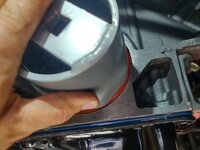
This is the GM OEM bail connector that has been causing my issue. I only used 10-wires to connect my interior needs to the GM engine harness.

Before cutting any wires, I went through wire by wire and identified the color on either side of the connector and assigned them a number in which they would reside to in the 12-pin Deutsch DTM housing.

First cut and crimp. I figured I'd use the receptacle on the interior side which accepts the pin connector. One crimped and ready to install into the receptacle.

Inserting the other side which is the socket into the plug side of the connector.
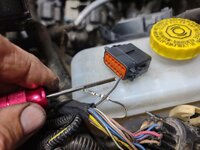
I moved through wire by wire until all ten wires were cut, stripped, crimped and installed in their respective locations in the Deutsch housings and then cut the remaining several wires from the engine side that were not in use, thus removing this bail connector from the Jeep.
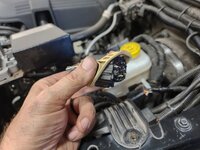
Plug and receptacles have their pin and socket retainers installed as well as taped back up using the cloth tape and electrical tape to mimic the OEM harness.

Connection made.
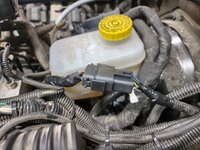
Tucked back down into place and zip-tied to prevent unnecessary bouncing around and vibrations.

Bracket holding the GM E38 ECM and fuse panel reinstalled into place and this job completed and ready for a test drive.
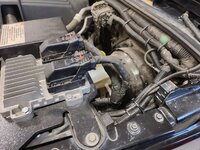
Yesterday the wife and I went for a nice long drive after breakfast and gave the Jeep a thorough test putting some miles on her. That repair should provide a reliable and vibration proof connection able to withstand the rather harsh environment in which it resides.
Thanks for looking and sorry about the long story leading up to the repair. For nearly 65k miles now the Jeep has performed flawlessly either on road or off, but this issue was intermittent enough to cause worry and stress at times. Knowing what was causing the issue lessened the stress about being in the back country alone and having it go into limp mode, but what really bothered me was when we were with a group and had it happen. That was embarrassing and something I wanted to address and eliminate from the possibility of happening again.