To avoid these ads, REGISTER NOW!

Anyone know anything about JO-Line torque wrenches?

Grayspoked

Well-known member
Joined
Jul 5, 2019
Messages
52
Location
Pasadena
@Grayspoked -

This recent acquisition sent me on a search for patents:

Jo / Jo Mfg. Co., South Gate, CA (4225 E. La Palma Ave., Anaheim, CA 92803) / "Jo-Line" torque wrench, drill / acquired by K-D 1979 / patent 2310759 Feb 9 1943 Ira C. Clawson & 2743678 May 1 1956 & 2897704 Aug 4 1959 & 3016773 Jan 16 1962 Robert Glen Woods / https://www.garagejournal.com/forum/showthread.php?t=413693 /

This model 8081A shows up in the 1971 Catalog No. 55 on page 36. The illustration shows what appears to be an identical model. (same torque range: 5-200 in lbs)

It shows up in the 1982 Catalog No. 60 on page 36, but the illustration shows a model with a more "Facom-ish" head than the one in my photo. (different torque range: 30-200 in lbs)

JO sold to K-D (Lancaster PA) in 1979. I have to assume that the model shown in the 1982 catalog is of K-D origin. (K-D went on to change hands again several times.)(list of manufacturers and brands of mechanics hand tools)

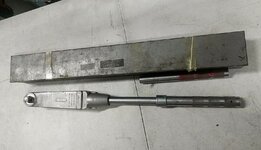
My question is: Was this Indestro unit made by Jo? (Indestro outsourced all kinds of stuff - I'm certain this was an item they were not making in house.)
Four:

I very dimly recall Indestro as a Jo-Line customer in the second half of the 1970's Indestro was not a big or regular customer, which is why my memory of them is dim. Further, my understanding of the story is that KD didn't kill the Jo-Line business immediately. It took a while. KD acquired Jo-Line's customer list, and Dad consulted with KD for 6 months or so after the sale. I am sure that one of his jobs was to assure skittish customers that KD was up to the task of providing them with quality product.

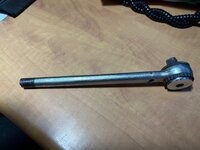
However, the wrenches you depict in your photos are NOT anything I recognize as a Jo-Line product. The ratchets look more like New Britain ratchets, which Jo-Line had not used since starting with the Facom designs in the mid-1970's. Dad has told me on several occasions that Jo-Line didn't manufacture ratchets until the Facom design in the mid-1970's, and thereafter I do not recall any of the standard Jo-Line ratcheted wrenches (see my post above from the last couple of days about the standard Jo-Line tools) having anything other than the Facom design.

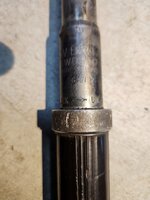
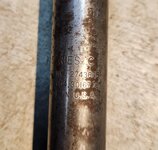
However, there are many differences in your Indestros and a Jo-Line product. Starting from the bottom of the tool, the rubber grip on the handhold is nothing like Jo-Line's. Jo-line's rubber grips had thinner vertical ridges and the circular base was much narrower than your Indestros. Jo-Line lock rings were grooved vertically instead of the diamond pattern on your tool. The font on the lock ring retainer was noticeably smaller and bore the month and date of manufacture since at least the first half of the 1970's, while your tool does not have that. The patent notices run, how do I say it, north-south, so you have to turn the tool on its side to read them. Jo-Line products printed the patent notices east-west, so you held the tool vertically to read them.

Further, KD had had 3 years by 1982 to, err, improve on Jo-Line's designs. I expect what you have is one of those improved designs, although based largely, if not entirely, on my Grandfather's patents and technology. I also suspect that you ahve a wrench that KD manufactured in the eastern United States, not Anaheim, California.

None of this is bad from a collector's perspective, whatever my personal feelings about KD. My understanding is that KD tanked the business by the mid-ish 1980's. thus, your tool may be more rare than many Jo-Line products.

Bill
 
To avoid these ads, REGISTER NOW!

Grayspoked

Well-known member
Joined
Jul 5, 2019
Messages
52
Location
Pasadena
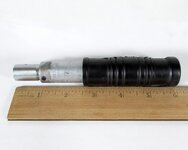
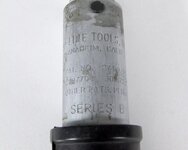
I believe I found a 1/4" click type torque wrench like Packard V8 was describing in his original post. The calibration certification is dated Jun 16 1959.

I gave a half-hearted attempt at disassembly--the two small screws on the back of the head came out easily, but I couldn't pry the plate out and didn't want to **** it up. I have no pressing need for a 1/4" torque wrench, but I really like it and would like to have it operating smoothly. Currently the twist handle starts to bind around 40 in/lbs and gets worse as I go up. It stops at about 110 and I don't want to force it beyond that.

I'm hoping that Grayspoked (Bill) will chime in with the best way to bring it back to working order and possibly also lend meaning to the codes stamped on the side of the head. (SA AD 2558)

I've really enjoyed Bill's first-hand insights into his grandfather's company. One more question: This wrench has no JO name on it and I couldn't find a name associated with it on Google--is it the predecessor for one of the later named tools?

Thanks again for all the great history of the Jo-Line Tools!
Radar (I resemble "Old" too much):

A couple of comments.

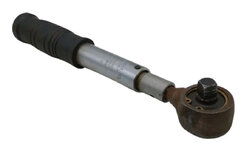
I think yours is a Jomi. I am seeing Dad on Saturday and will confirm. The thing that gives it away is the big box ratchet. That was a signature of the Jomis. I was lunching with Dad yesterday, and he told me a bit I didn't know about the Jomis. I'll add more to that thought in a later post (I realize that there are holes in the story I want to tell that he can fill).

Another point that distinguishes the Jomis is that the big square ratchet housing was made out of cast aluminum. That was not a problem from the perspective of the wrench's performance. The housing is not load-bearing, so aluminum's softness was irrelevant to the tool's accuracy. However, mechanics were then and are now generally not known for gently handling their tools such that soft die-cast aluminum doesn't get bent out of shape when dropped on the concrete floor or tossed in the tool box. Dad tells me that the government had to buy a lot of Jomis because military repairmen were none too gentle with those housings. Dad's comment seems consistent with Lugz observation that "SAAF" on your tool

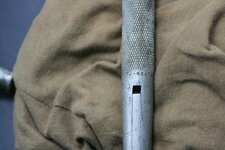
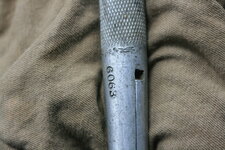
I have never seen a Jomi with a date on it like yours appears to have at the red tape in your photos ("6-59"). The earliest dating I am aware of on JO/Jo-Line tools is maybe the late 1960's. I have a Jotite that is dated 10-70 on its spring tube. I suspect that the date on your tube is a later addition. maybe its a repair
I acquired a 600lb Jo-line torque wrench about a year ago. An ex left it behind. I have no idea where it came from, what it's for... who would even use it... I definitely will never need it in my lifetime. I have no idea what to do with it. It's big, heavy looks like it does a lot of work. I won't throw it away, but I can't find anything on the specific make and model to give it away, sell it, donate it. My local Goodwill said they wouldn't take it. I attached photos. If anyone has any information on this particular tool, I'd appreciate it immensely.
Star:

Better late than never.

You have what we at Jo-Line called a Size 4 torque wrench. I described the Size 4 in a post I made in the last few days. I, like you, wondered who bought them. My guess is that it was used in aviation manufacturing or ship building. You didn't need a beast like this, particularly with a square drive (rather than a ratchet) in the automotive industry. I'll ask Dad when I see him Saturday.

Yours is about 39 inches long. It's calibration scale goes from 100-600 foot pounds. It is the largest regular production torque wrench Jo-Line made, other than what we called the "1202," a picture of one of which Billboard Guy uploaded shortly after you posted.

You don't sound like a collector, but you're certainly in company with a lot of them. My guess is that your wrench is a rather rare example of its kind. First, the date marked on it - 6-70 - is the earliest dating I recall seeing, and that date was right at the beginning of my second summer at Jo-Line! I was too young to have done anything material to build your wrench. I may have put black paint in the incused lettering on the handhold, but I wouldn't have been trusted at that time with doing anything else. Further, Dad had moved Jo-Line past marketing its own products into the realm of private label manufacturing by this point. Actual "Jo-Line" products by this time were quite unusual. I have seen these with all sorts of private label branding.

My understanding was that there was a limited need for a Size 4 wrench (we didn't make them very often or in great numbers), but, when you needed a Size 4, nothing else would do.

Bill

P.S., a little manufacturing story about the Size 4. I worked at Jo-Line on Saturdays during high school. I spent a lot of Saturdays folding boxes, but sometimes the number of orders saw me getting pressed into service in the shipping or assembly areas. There was a tester named Roger. A tester was the guy who actually calibrated a wrench. Testing involved the use of a big scale arrangement, with specialized levers designed to permit the tester to put a wrench into place in the mechanism, and then to adjust it so that it clicked at the right times up and down its calibration scale. The job involved a lot of lifting. I only weighed about 140 pounds at the time, so I was never a tester while I was in high school. I did some testing later in my Jo-Line career. I was never again as buff in my upper body as I was after a summer of testing.

Back to the story. Roger was a tester. As I heard and saw it, Roger was a man mountain who had tried out to play on the line (offensive or defensive I never heard) for USC's football team. Whatever his talents as a lineman, Roger was a bit, well, too dim to handle the academics at USC, and this was before Billy Sample actually made USC an academic university worthy of its football team. Roger didn't make the cut, so he came to work at Jo-Line as a tester.

Roger was always something of a loose cannon. Even on his best days, you walked softly near him, and agreed with everything he said, unless you wanted your arms and legs plucked from the rest of you like a child might take the wings off a fly. This particular Saturday was not one of Roger's best days. He had not yet had the time to move from being drunk to being hung over when our Saturday shift began at 7 AM sharp. Roger was apparently upset about something that morning, to which his inebriation added a certain fire. Soon, Roger was windmilling Size 4's across the assembly department, knocking large pans of wrenches off of work benches and causing employees to scatter before being brained by a ten pound torque wrench flying at you at high speed.

Managers took control of the situation - gingerly, but firmly. Roger was escorted off the premises. I never saw him again.
 

four.cycle

Well-known member
Joined
Oct 19, 2015
Messages
28,862
Location
Tacoma, Washington
JO model B and model JOTRU10AT
(photo: ebay for comparison)
 

Attachments

  • Jo-Line Series B torque wrench (patent 2743638 2897704 3016773)(ebay 133545695228 01).jpg
    Jo-Line Series B torque wrench (patent 2743638 2897704 3016773)(ebay 133545695228 01).jpg
    278.5 KB · Views: 47
  • Jo-Line Series B torque wrench (patent 2743638 2897704 3016773)(ebay 133545695228 02).jpg
    Jo-Line Series B torque wrench (patent 2743638 2897704 3016773)(ebay 133545695228 02).jpg
    371.2 KB · Views: 19
  • Jo-Line Series B torque wrench (patent 2743638 2897704 3016773)(ebay 35425802264 01).JPG
    Jo-Line Series B torque wrench (patent 2743638 2897704 3016773)(ebay 35425802264 01).JPG
    88 KB · Views: 15

Old Radar

Well-known member
Joined
Apr 17, 2019
Messages
2,755
Location
San Antonio, TX
Radar (I resemble "Old" too much to throw that into your salutation):

A couple of comments.

I think yours is a Jomi. I am seeing Dad on Saturday and will confirm. The thing that gives it away is the big box ratchet. That was a signature of the Jomis. I was lunching with Dad yesterday, and he told me a bit I didn't know about the Jomis. I'll add more to that thought in a later post (I realize that there are holes in the story I want to tell that he can fill).

Another point that distinguishes the Jomis is that the big square ratchet housing was made out of cast aluminum. That was not a problem from the perspective of the wrench's performance. The housing is not load-bearing, so aluminum's softness was irrelevant to the tool's accuracy. However, mechanics were then and are now generally not known for gently handling their tools such that soft die-cast aluminum doesn't get bent out of shape when dropped on a concrete floor or tossed in a tool box. Dad tells me that the government had to buy a lot of Jomis because military repairmen were none too gentle with those housings. Dad's comment about how lots of Jomis were sold to the military during the war seems consistent with Lugz observation that "SAAD" on your tool means San Antonio Army Depot.

I have never seen a Jomi with a date on it like yours appears to have at the red tape in your photos ("6-59"). The earliest dating I am aware of on JO/Jo-Line tools is maybe the late 1960's. I have a Jotite that is dated 10-70 on its spring tube. Most of the rest of the dating appears on the lock ring retainers. I never saw a tool dated as informally as is yours coming out of Jo-Line. I suspect that the date on your spring tube is a later addition. Maybe it's the date of a repair, or the date of an inventory, or maybe even some sort of early version of a "sell-by" date. Who knows, but June 1959 strikes me as a bit late for a Jomi. Again, I'll confirm with Dad.

Then again, there is the Jo-Line trademark on the ratchet housing. The company was JO, not Jo-Line, into the 1950's.

Now the hard part. The last time I repaired a torque wrench was probably at Christmas, 1976, 47 years ago. I spent about 3 years in the repair room, and saw a lot of historical Jo-Line and JO product come through. I don't ever recall actually repairing a Jomi. We may not even have had parts then to repair one, unless Les Trimble or Ziggy Sopinski was able to scrounge something out of the deepest depths of the tool crib. I have no idea how you would go about repairing one of those. I have exploded diagrams for a lot of Jo-Line's products, but the Jomis are so old I have nothing on them.

Again, I'll ask Dad on Saturday, but my hopes are not high.

Thanks for being patient with me, since you first asked your question - what - 4 years ago? Sigh....

Life has a way of moving on.

Bill
Thanks Bill--I look forward to anything else you may find out from your Dad after your visit on Saturday!

As for the red tape date (JUN 16 1959) I have always assumed that it is the date of the tool's latest test or calibration.
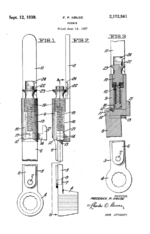
While examining the Jomi today under magnification, I found the patent number on the edge of the handle, just above the seal on the end. The aluminum there is worn but the tops of the numbers were visible enough to identify "2172561". The USPTO website shows a patent date of 12 Sep 1939 with Frederick P. Kruse of Berkeley, CA, as the inventor. No indication of manufacturer or to whom the patent was assigned.

I am left with a question about when Jomis were manufactured. You say your Dad commented about how lots of Jomis were sold to the military during the war seems at odds with the Jo-Line trademark not coming into use until the 1950s--unless he was referring to the Korean War.

Here's the diagram of the mechanism from the patent application:
1712941398582.png
 

Provincial

Well-known member
Joined
Sep 21, 2011
Messages
6,868
Location
Near Salem, OR
I'm happy to see this thread revived! Bill is a treasure.

I was using my old New Britain torque wrench recently, and this thread made me look at it closer. I bought it in probably late 1971 or early 1972. I chose to not get a ratcheting head model for two reasons. The first was cost, as I was still a student with little income, and the second was that I expected to only use it for the final torque, having used a regular ratchet to do the initial tightening. It has served me well, and spent it's first 25 years following me around in hand-carry tool boxes as far away as Alaska. It has always worked flawlessly, and was only recalibrated once, about five years after I bought it. It is still right on the numbers, but I always release the spring tension when not in use, and never abused it.

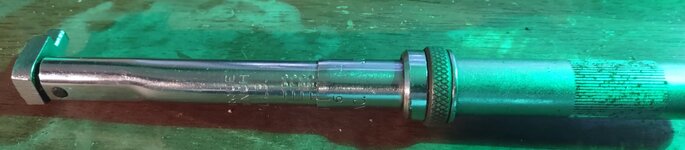
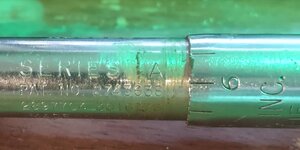
When I saw this thread revived, I paid closer attention to the design of my wrench. It is marked "TWD-150 MADE IN USA 6-71" and in another area "Series C" and patent numbers 2743638, 2987704, and 3016773, as well as Made in USA again. The handle and locking ring are consistent with JO Line, so I'm sure it was made by them for New Britain.
Torque Wrench.jpg
Adjuster .jpg
Patents.jpg
 

Grayspoked

Well-known member
Joined
Jul 5, 2019
Messages
52
Location
Pasadena
I'm happy to see this thread revived! Bill is a treasure.

I was using my old New Britain torque wrench recently, and this thread made me look at it closer. I bought it in probably late 1971 or early 1972. I chose to not get a ratcheting head model for two reasons. The first was cost, as I was still a student with little income, and the second was that I expected to only use it for the final torque, having used a regular ratchet to do the initial tightening. It has served me well, and spent it's first 25 years following me around in hand-carry tool boxes as far away as Alaska. It has always worked flawlessly, and was only recalibrated once, about five years after I bought it. It is still right on the numbers, but I always release the spring tension when not in use, and never abused it.

When I saw this thread revived, I paid closer attention to the design of my wrench. It is marked "TWD-150 MADE IN USA 6-71" and in another area "Series C" and patent numbers 2743638, 2987704, and 3016773, as well as Made in USA again. The handle and locking ring are consistent with JO Line, so I'm sure it was made by them for New Britain.
Torque Wrench.jpg
Adjuster .jpg
Patents.jpg
Provincial:

Y'know, I may have packed your tool for shipment 53 year ago. I almost certainly folded the box in which it was originally shipped. As I noted yesterday, I spent a lot of weekends at Jo-Line making money folding boxes so as to engage in teenage mischief. By June of 1971, I was working for the summer in the shipping room, packing into shipping crates all those boxes that I had folded on weekends now stuffed with torque wrenches to send them, in this case, to New Britain. Just to be clear, yours is unquestionably a Jo-Line product. The three patent numbers on your tool are Jo-Line patents that were stamped on all Series C to the best of my knowledge. I have in my hand an AC Delco flex-head torque wrench that I personally stole from Jo-Line back in the day, and it has all three of the patent numbers that appear on your tool (plus one more - 3783703 - which is either because this wrench is a Series D or because of the flex-head - I didn't look it up).

That reminds me. I need to ask Dad what all those "Series" are. What series any particular tool was never mattered much to me so long as the tool in question worked when I was finished with it.

Anyway, I recall so clearly that I was working in the shipping room in the summer of 1971 because of the following story. I had been working for minimum wage since I joined Jo-Line in 1969, which in those long-ago days was $1.65/hour. I was going nuts on the afternoon of Friday, August 13, 1971 packing an order that had to be out on a truck by 3:30, which was quittin' time for the day shift (overtime being frowned upon by management, although I loved time-and-a-half). The plant manager, Bob Finn, came into shipping while I was sweating and grunting, packing wrenches as fast as the wrench cleaning team could get them to me. Bob was kind of like a Highway Patrol officer - nothing good could come from being noticed by him, so most of us did our best to lay low and not be noticed whenever he ghosted through. I therefore studiously ignored him. To my horror, he came right up next to me, tore some paper off a nearby roll of paper towels and, without saying a word, wrote "$1.75 hr 8/13/71." He then left shipping, never having said a word. MY FIRST RAISE EVER, and it was a whole dime per hour!! I was in heaven! Then, Nixon dropped his infamous freeze on wages on Sunday, August 15. Bob came back to shipping on Monday and told me he couldn't give me my raise because of the wage freeze. Well, I had taken home that piece of paper towel on which he had written my raise and taped it to the wall of my room. MY FIRST RAISE EVER, after all. I read Nixon's wage freeze order and then brought the scrap of paper towel back to Bob's office on Tuesday. Bob had given me my raise on August 13, two whole days before Nixon froze wages! My raise was perfectly valid! Bob had to agree that I had the proof he needed to validate my raise, and I got my raise in my next check. Justice was served.

Just to put you at ease, I did NOT remember those dates without help. I remembered the Friday/Sunday/Monday/Tuesday sequencing, but not the precise dates. Thank goodness for Wikipedia, which gave me the August 15 date (but shame on them for not recording my FIRST RAISE EVER). The rest was easy.

Back to things of more interest here. Dad told me this week that New Britain was a regular supplier of ratchets to Jo-Line, until Dad reproduced the Facom ratchet a few years after Jo-Line made your tool. My own experience taught me that New Britain was also a good and regular customer of Jo-Line's, much better than was Indestro, about which I commented last night. I packed a lot of TWD-150s and, if memory serves, TWR-150s (the ratchet version) over the years. I was sad to learn that New Britain Tools has faded away over the decades, a victim of multiple corporate acquisitions and reorganizations.

It sounds like your TWD-150 is still serving you well. Rolling the handhold down to release tension on the spring is probably contributing to your tool's longevity. I have been astonished to see how many Jo-Line products are still out there, being used for the purposes for which we built them no more recently than 45 years ago.

Bill
 

Grayspoked

Well-known member
Joined
Jul 5, 2019
Messages
52
Location
Pasadena
JO model B and model JOTRU10AT
(photo: ebay for comparison)
Four:

I had seen these banging around in the tool crib. How does one say it gently? These were not huge sellers.

What you have is a pre-set torque wrench that could be set anywhere between 36-108 inch pounds or 3-9 foot pounds. I recognize the Jotru 10AT designation. However, I have a catalog from 1977 that references this tool as a 9 PJ. The next page in the catalog lays out eight "handle attachments," among which is the ratchet in your photo. The ratchet in your photo looks like a 3/8", which would make it a JD-6 handle attachment.

Can't tell you much more than that. These tools were highly unusual.

Bill
 

four.cycle

Well-known member
Joined
Oct 19, 2015
Messages
28,862
Location
Tacoma, Washington
^ I only posted that to show an example of that head design. After comparisons with Don's, I have to assume my "Indestro" was made by New Britain. (The head is exactly the same as an NB55 I have here.)
 

four.cycle

Well-known member
Joined
Oct 19, 2015
Messages
28,862
Location
Tacoma, Washington
^ there are a ton of JO torque wrenches listed on ebay! that's how I found the photo image of the one that I had thought might be a match to the one I just got!
 

Provincial

Well-known member
Joined
Sep 21, 2011
Messages
6,868
Location
Near Salem, OR
Grayspoked, it is really cool that you packed my wrench when it was new! Just think, we have both handled that wrench, and only now discovered that fact, more than 50 years later.
 

Grayspoked

Well-known member
Joined
Jul 5, 2019
Messages
52
Location
Pasadena
Interestingly (to me!) there are currently several Jomis on ebay--3/8, 1/2 & 3/4 drives.

Jomi Size 4.jpgJomi Size 4-a.jpg
All:

Teaser alert!

There is a very important reference to the whole torque wrench industry in this data plate Radar focused on in this photo. It is the reference to "MIL-H-4034B (USAF)". This is the military specification for what the Air Force (charmingly, but this is the military) refers to a a "HANDLE: Socket Wrench, Torque Indicating, Square Drive." The first MIL-H-4034 (to which was probably appended "(USAAF)" was issued in 1940 or 1941, and was the first military specification for a torque wrench (or, as the military referred to it, "HANDLE, Torque"). The "B" in the data plate Radar photoed probably refers to the second revision of the original MIL-H-4034; this spec was updated several times. most recently in the 1960's as best I can tell), and finally obsoleted. Dad told me that the "H" stands for "Handle." Apparently, the Air Force doesn't like the perfectly reasonable name "torque wrench." It prefers "Handle, torque."

You guys seem to have found things I have no idea how to find, like patents. I tried to find the original MIL-H-4034, but was unsuccessful. Maybe someone here can find the original MIL-H-4034.

Dad told me that this spec essentially described the Jomi series of torque wrenches (OK: Handle, Torque). It did not describe dial indicating torque wrenches or beam-type torque wrenches. This gave JO (it wasn't Jo-Line yet) something of a monopoly over torque wrenches during WWII. Of course, this report is based on the memory of a man who's a few months short of his 100th birthday. It'd be great to actually see the original MIL-H-4034 to verify this.

One other thing. I reported in a recent post that there were two kinds of Size 4 torque wrenches manufactured by Jo-Line, according to a catalog dated 1977. One had a calibration scale that topped out at 400 foot pounds and the other had a calibration scale that topped out at 600 foot pounds. I couldn't figure out why anyone would spend good money for a Size 4 that topped at 400 foot pounds when a 600 foot pounder was available. I don't have a price list at hand, so the issue could be cost, but my anticipation that the cost differential between these two tools would be pretty minimal. The guts of each wrench were the same; the only difference was the calibration scale.

Radar's plate perhaps explains this weirdness. The military put out a spec for a Size 4 that topped out at 400 foot pounds. The commercial market wanted 600 foot pounds. Why trash the 400 foot pounder after the military's interest waned (if it ever did - I don't recall Jo-Line building military Size 4's while I worked there, but that doesn't mean that Jo-Line didn't make them while I was at school between 1969 and 1978) in favor of the 600 foot pounder, when all you had to do was keep the 400 foot pound calibration scale die rust-free in order to make the 400's should anyone ever order one?

I had hoped to have some more insights from Dad tonight, but he has better days and worse days. Today was a worse day. He recently asked for a steak dinner, which my wife and I will provide him tomorrow, so maybe I'll have some more intelligence then.

Bill
 

Grayspoked

Well-known member
Joined
Jul 5, 2019
Messages
52
Location
Pasadena
Grayspoked, are you saying the ratchet heads with a bolt were made by Jo-Line themselves? I've wondered for years who made that mechanism.
3 Bay:

I wasn't quite sure what you meant when you referred to a ratchet "bolt." Given that a picture is currently worth 1383 words (before inflation: 1000 words), I thought I'd attach some photos of the Facom-style ratchet that is the only ratchet Jo-Line ever manufactured.

I also thought I'd take the opportunity to show, rather than tell, about some of the guts of a Jo-Line micrometer torque wrench.

These phots show the Facom-style ratchet in what I have referred to in other posts as a torque wrench's "hinge." The hinge is the long thing in which the ratchet is embedded.

I referred in other posts to the "hinge pin" in a torque wrench. Pardon me for repeating myself a little, but putting text next to a picture has always struck me as more efficient than posting a picture and telling people that the relevant text was "recently" posted somewhere else. The hinge pin is the fulcrum point at which the torque applied by a torque wrench is most accurately applied. I responded to a post by Lentuk about a wrench with a funny head assembly that featured a Proto ratchet that his was the most accurate wrench out there because its drive was in a line with its hinge pin. Well, the hole in this hinge around where you might place its throat is what the hole into which a hinge pin goes looks like, sans hinge pin.

Second, I have referred to my Grandfather's revolutionary development in torque wrenches. That development is the pivot-and-plunger mechanism by which the tool is instructed about the amount of torque the user wishes to apply. That mechanism didn't exist before R. Glen Woods and JO Manufacturing. The pivot sits in a a recessed box in the plunger that's maybe one or two millimeters deep. The other side of the pivot fit into the slot at the bottom of the hinge. You can see that slot in a couple of these photos.

Hope this all is of interest!

Bill
 

Attachments

  • Siz3 Hinge 1.jpg
    Siz3 Hinge 1.jpg
    455.5 KB · Views: 22
  • Size 3 Hinge 2.jpg
    Size 3 Hinge 2.jpg
    354.1 KB · Views: 125
  • Size 3 Hinge 3.jpg
    Size 3 Hinge 3.jpg
    375.5 KB · Views: 19

Etchase

Well-known member
Joined
Nov 10, 2017
Messages
2,000
Location
Hawaii
3 Bay:

I wasn't quite sure what you meant when you referred to a ratchet "bolt." Given that a picture is currently worth 1383 words (before inflation: 1000 words), I thought I'd attach some photos of the Facom-style ratchet that is the only ratchet Jo-Line ever manufactured.

I also thought I'd take the opportunity to show, rather than tell, about some of the guts of a Jo-Line micrometer torque wrench.

These phots show the Facom-style ratchet in what I have referred to in other posts as a torque wrench's "hinge." The hinge is the long thing in which the ratchet is embedded.

I referred in other posts to the "hinge pin" in a torque wrench. Pardon me for repeating myself a little, but putting text next to a picture has always struck me as more efficient than posting a picture and telling people that the relevant text was "recently" posted somewhere else. The hinge pin is the fulcrum point at which the torque applied by a torque wrench is most accurately applied. I responded to a post by Lentuk about a wrench with a funny head assembly that featured a Proto ratchet that his was the most accurate wrench out there because its drive was in a line with its hinge pin. Well, the hole in this hinge around where you might place its throat is what the hole into which a hinge pin goes looks like, sans hinge pin.

Second, I have referred to my Grandfather's revolutionary development in torque wrenches. That development is the pivot-and-plunger mechanism by which the tool is instructed about the amount of torque the user wishes to apply. That mechanism didn't exist before R. Glen Woods and JO Manufacturing. The pivot sits in a a recessed box in the plunger that's maybe one or two millimeters deep. The other side of the pivot fit into the slot at the bottom of the hinge. You can see that slot in a couple of these photos.

Hope this all is of interest!

Bill

I’m following with tremendous interest.
 

thehorse13

Well-known member
Joined
Mar 15, 2015
Messages
3,478
Location
Jefferson County, WV
Some of you guys have found awesome JO/JO Line torque wrenches. The only one I've ever come across is this preset handle that happens to be set to the exact torque spec for the belly pan on one of my cars. When I first grabbed it, I thought it was 1/4 inch drive but after a closer look and confirmation with war time Snap On sockets, it is in fact 9/32. I use a 9/32 to 1/4 adapter when I use this tool.

1713088525186.png
 

Private Lugnutz

Well-known member
Joined
Mar 30, 2012
Messages
30,573
Location
The Authentic Jersey Shore
The first MIL-H-4034 (to which was probably appended "(USAAF)" was issued in 1940 or 1941,
I don't think the Military Specification (MILSPEC) system was established until well after WWII, Bill, ca. 1951, or so. In 1941, and throughout WWII, torque wrenches for all technical branches of the War Department (US Army, US Army Air Forces, etc) and the Navy (still its own department) were specified by federal specification GGG-W-686, and federal specifications also continued long after the advent of MILSPEC. The best dating 'tell' on OR's torker is the 11-digit Federal Stock Number, which is ca. 1953.
Dad told me that the "H" stands for "Handle." Apparently, the Air Force doesn't like the perfectly reasonable name "torque wrench." It prefers "Handle, torque."
This kind of nomenclature isn't unique to the Air Force, or even the military, even though that is the most popular and common association for most people. MILSPEC alphanumeric designators were derived from the original Federal Standard Stock Catalog, administered by a bureau inside the Treasury Dept (that would, much later be spun off into what would become the G.S.A.), as far back as 1934, and a phonetic system of three-part alphanumerics for stock numbering in which the prefix was a Class of items, the letter in the middle was a Type of item within that Class, and a suffix provided specificity. In that system, Class 41 was hand tools, and H was Handle, but also Hammer, and many others. It was replaced by the 11-digit FSN format, amd eventually a 13-digit format adding COO, which is still in use as the NSN system. The "5120" in the FSN/NSN is the Class (hand tools), the old system's "41".

I believe the Army organized their torque wrenches under Wrench, not Handle, but here's a handy photo of some other Army "handles" from a popular tool-set, just for context.
 

Attachments

  • 41-H-1505 SNL G-27 page no markup.jpg
    41-H-1505 SNL G-27 page no markup.jpg
    147.8 KB · Views: 26

MR.X

Well-known member
Joined
Dec 13, 2010
Messages
1,792
I found this #16 JOBE flare end torque wrench at the flea this morning. It was plugged with some kind of hard but chalky glue at the end, probably sold as a pre-set and not meant to be removed, but I dug it out to reveal the tensioning screw recessed inside that would allow you to adjust the torque setting. @transam81 posted a #10, 11, and 16 in this thread a few years ago, and I think @RagTopTA may have a couple or at least one, as well, not reported on this thread, and I'm not sure which # his is.
Here's a similar one I've had forever. May not be JO related. I see the "TJ" tool number prefix on North American Aviation tools but I don't have any additional info.
 

Attachments

  • IMG_0166.JPG
    IMG_0166.JPG
    652.6 KB · Views: 19
  • IMG_0165.JPG
    IMG_0165.JPG
    554.8 KB · Views: 16
  • IMG_0164.JPG
    IMG_0164.JPG
    590 KB · Views: 18
  • IMG_0163.JPG
    IMG_0163.JPG
    776.7 KB · Views: 30
To avoid these ads, REGISTER NOW!

Outlawmws

Well-known member
Joined
Aug 9, 2011
Messages
39,230
Location
The Badlands
I picked up a No 10 JOAR Conduit wrench today, Not sure what size/type of conduit it's for, but it is too small for 3/4 EMT, and way too big for 1/2" EMT.

JOAR.jpg
 

T444e

Well-known member
Joined
Feb 25, 2016
Messages
450
Rigid conduit and pipe are the same ID/OD. Like I said, just a guess. Would it possibly fit a rigid Coupling? Again another guess. Looking closer at the picture, I'm not sure how it would bite on the conduit, the jaws look awfully smooth.

I believe a rigid coupling should be the same as a merchant pipe coupling (coupling that comes on T&C pipe).
 

fishyfool

New member
Joined
Nov 2, 2023
Messages
4
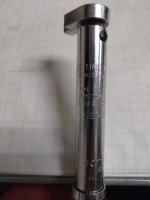
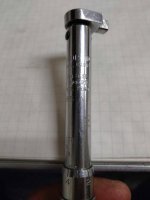
I have had this little torque wrench since high school in the late 70's
It's a Jo Line Anaheim manufactured tool.
Never seen another one quite like it. I was working on a bicycle and someone asked about it and the only answer I had was I don't know.
it's post 1968 to the best of my sleuthing skills.
it's 1/4" drive 200 inch lbs
Anyone know the model number or can steer me towards info?
 

Attachments

  • IMG_20240728_062441333.jpg
    IMG_20240728_062441333.jpg
    180.2 KB · Views: 27
  • IMG_20240728_062451314.jpg
    IMG_20240728_062451314.jpg
    161 KB · Views: 24
  • IMG_20240728_062504001.jpg
    IMG_20240728_062504001.jpg
    282.3 KB · Views: 21
  • IMG_20240728_062457892.jpg
    IMG_20240728_062457892.jpg
    215.3 KB · Views: 18
  • IMG_20240728_064706407.jpg
    IMG_20240728_064706407.jpg
    188.4 KB · Views: 19

RTM

Well-known member
Joined
May 13, 2019
Messages
13,157
Location
SF Bay Area
I have had this little torque wrench since high school in the late 70's
It's a Jo Line Anaheim manufactured tool.
Never seen another one quite like it. I was working on a bicycle and someone asked about it and the only answer I had was I don't know.
it's post 1968 to the best of my sleuthing skills.
it's 1/4" drive 200 inch lbs
Anyone know the model number or can steer me towards info?
Here is the patent for the first number, should be no newer than 17 years after that, when sold. Often some useful info in them.

Second

Third


Looks like there is a model number hiding somewhere in the text stamped on the body, can’t read it due to glare, any help?
 
Last edited:

d42jeep

Well-known member
Joined
Oct 22, 2014
Messages
16,539
Location
Northern California
I have had this little torque wrench since high school in the late 70's
It's a Jo Line Anaheim manufactured tool.
Never seen another one quite like it. I was working on a bicycle and someone asked about it and the only answer I had was I don't know.
it's post 1968 to the best of my sleuthing skills.
it's 1/4" drive 200 inch lbs
Anyone know the model number or can steer me towards info?
Does the wrench in post 87 look like your inch lb torque wrench?
-Don
 

Schurkey

Well-known member
Joined
Oct 27, 2011
Messages
2,369
Location
The Seasonally Frozen Wastelands
These phots show the Facom-style ratchet
size-3-hinge-2-jpg.2093381

How is that ratchet head disassembled? Remove the Allen-head bolt in the middle, and the rest falls apart?

I would likely lube the guts with my usual Clevite liquid engine assembly lube, unless you have other suggestions.


Tell your Dad (and yourself) that the pair of you has been informative and entertaining; and I hope he enjoyed his steak--and many more. I'm so pleased that this thread has gotten new life.
 

Grayspoked

Well-known member
Joined
Jul 5, 2019
Messages
52
Location
Pasadena
size-3-hinge-2-jpg.2093381

How is that ratchet head disassembled? Remove the Allen-head bolt in the middle, and the rest falls apart?

I would likely lube the guts with my usual Clevite liquid engine assembly lube, unless you have other suggestions.


Tell your Dad (and yourself) that the pair of you has been informative and entertaining; and I hope he enjoyed his steak--and many more. I'm so pleased that this thread has gotten new life.
Schurkey:

Thanks for the nice note.

Here's how you take apart a Facom-style ratchet.

You're right, you start with an Allen wrench. Can't remember the size of the Allen wrench anymore, but that shouldn't be a problem. Taking out that screw will allow you to remove the chromed backplate. Inside you will find a reeded interior ring on the hinge that holds the whole assembly. The tang at the front of the ratchet will hold a pawl and spring against that reeded ring that help direct the direction in which the ratchet turns. The pawl kind of looks like a gray half moon with the corners rounded off, and reeding where the round part of the moo would be. The spring is a small V-shaped wire concoction that bounces around easily.

You may have asked this question because the lubricant inside your ratchet has dried up over the last 50 years or so. Stuff like that happens. I have a vague memory that Moly-Dee 104 grease was used in the wrench assembly itself, although we might have used oil in the ratchet assemblies.

Now, why can I remember Moly-Dee 104 after all these years when there are so many things from much more recent times that I wish I could remember, and can't? Moving along....

Make sure you open your ratchet somewhere where you can't lose any parts. That spring is quite small (the pawl isn't much larger), and it might jump out when you remove the backplate. I have no idea where you'd go to get a replacement if you lost either of them - unless, of course, you bought another tool and cannibalized the ratchet.

Bill
 

Grayspoked

Well-known member
Joined
Jul 5, 2019
Messages
52
Location
Pasadena
The "dynamic jaws" are serrated with a fine tooth serration. Nothing like a Pipe wrench.
Outlaw:

I posted a few years ago about JOARs. You can find all that on the first page in this thread.

Here's the meat of what I had to say about them back then:

******

The Joar in the catalog has some history behind it. The B-17 bomber was a revolutionary aircraft in the late 1930's. Revolutionary machines inevitably have things that are thought through right the first time, and other things that need tweaking in later models.

The electrical system in the B-17 was one of its revolutionary aspects. The Sperry machine guns on top and in the belly of the aircraft were electrical from the start, and electrical systems proliferated through the aircraft, as electrical power helped the crew make the aircraft a "Flying Fortress." This was important, because the B-17 flew without ****** in daylight over the heart of Germany until the P-47 and P-51 came along.

The electrical wire in the B-17 originally was routed through the aircraft in conduit. This caused manufacturing issues. The conduit had to be installed into the aircraft and the wiring run through it in the body of each aircraft. Essentially, electricians stuffing wire into conduit had to get involved in the manufacturing process at the same place in the airplane and at the same time as plumbers were installing the hydraulics, equipment installers were installing equipment, and structure people were building out the airframe. The conduit helped create a manufacturing bottleneck. It was discovered that eliminating the conduit would save over 100 pounds of weight, streamline manufacturing, and allow quality control checks to be much more efficient.

Oh, and one other thing. The B-17As and B-17-Bs didn't do a whole lot of unescorted flying over hostile territory. However, the USAAF lent some B-17Cs to the RAF in 1941. The RAF tried these B-17Cs in unescorted daytime raids, and experienced losses they deemed unacceptable. One of the things that led to these losses was that a lucky German shot that hit the electrical conduit tended to shatter the conduit it hit, causing complete loss of whatever electrical systems passed through the affected conduit.

The USAAF and Boeing responded by eliminating the conduit, introducing the revolutionary electrical harnesses, and running the electrical wiring through numerous spots in the B-17's inner hull, so that a lucky shot might sever one strand of wiring, but not a bunch of them. I don't know when this change was made, but the B-17D is a likely suspect. It was manufactured in large numbers, and the conduit problem came to white-hot light in the B-17C.

So, how does the Joar figure in this story? Well, the Joar was designed to be used in the installation of conduit in those early B-17s. Each piece of conduit was only so many feet long, and did not run in a single piece from nose to tail of the aircraft. The fasteners and joints where pieces of conduit were joined needed to be tightened to within specified tolerances. Boeing used Joars to do that.

Dad says that J O was selling Joars like hotcakes in the early years of World War II, but that sales fell off a cliff once Boeing eliminated conduit from the B-17. Your catalog indicates that Grandfather was still trying to sell Joars in the early 1950's. Why not? He had all the tools and jigs to make them. However, Dad says that selling Joars after their use on the B-17 was done was like beating a dead horse.

So you have a little (OK, tiny) piece of history in your hands when you hold one of J O's Joars in your hand.

*****

I think there may be a little more about JOARs in those 2019 posts.

Bill
 

Etchase

Well-known member
Joined
Nov 10, 2017
Messages
2,000
Location
Hawaii
Outlaw:

I posted a few years ago about JOARs. You can find all that on the first page in this thread.

Here's the meat of what I had to say about them back then:

******

The Joar in the catalog has some history behind it. The B-17 bomber was a revolutionary aircraft in the late 1930's. Revolutionary machines inevitably have things that are thought through right the first time, and other things that need tweaking in later models.

The electrical system in the B-17 was one of its revolutionary aspects. The Sperry machine guns on top and in the belly of the aircraft were electrical from the start, and electrical systems proliferated through the aircraft, as electrical power helped the crew make the aircraft a "Flying Fortress." This was important, because the B-17 flew without ****** in daylight over the heart of Germany until the P-47 and P-51 came along.

The electrical wire in the B-17 originally was routed through the aircraft in conduit. This caused manufacturing issues. The conduit had to be installed into the aircraft and the wiring run through it in the body of each aircraft. Essentially, electricians stuffing wire into conduit had to get involved in the manufacturing process at the same place in the airplane and at the same time as plumbers were installing the hydraulics, equipment installers were installing equipment, and structure people were building out the airframe. The conduit helped create a manufacturing bottleneck. It was discovered that eliminating the conduit would save over 100 pounds of weight, streamline manufacturing, and allow quality control checks to be much more efficient.

Oh, and one other thing. The B-17As and B-17-Bs didn't do a whole lot of unescorted flying over hostile territory. However, the USAAF lent some B-17Cs to the RAF in 1941. The RAF tried these B-17Cs in unescorted daytime raids, and experienced losses they deemed unacceptable. One of the things that led to these losses was that a lucky German shot that hit the electrical conduit tended to shatter the conduit it hit, causing complete loss of whatever electrical systems passed through the affected conduit.

The USAAF and Boeing responded by eliminating the conduit, introducing the revolutionary electrical harnesses, and running the electrical wiring through numerous spots in the B-17's inner hull, so that a lucky shot might sever one strand of wiring, but not a bunch of them. I don't know when this change was made, but the B-17D is a likely suspect. It was manufactured in large numbers, and the conduit problem came to white-hot light in the B-17C.

So, how does the Joar figure in this story? Well, the Joar was designed to be used in the installation of conduit in those early B-17s. Each piece of conduit was only so many feet long, and did not run in a single piece from nose to tail of the aircraft. The fasteners and joints where pieces of conduit were joined needed to be tightened to within specified tolerances. Boeing used Joars to do that.

Dad says that J O was selling Joars like hotcakes in the early years of World War II, but that sales fell off a cliff once Boeing eliminated conduit from the B-17. Your catalog indicates that Grandfather was still trying to sell Joars in the early 1950's. Why not? He had all the tools and jigs to make them. However, Dad says that selling Joars after their use on the B-17 was done was like beating a dead horse.

So you have a little (OK, tiny) piece of history in your hands when you hold one of J O's Joars in your hand.

*****

I think there may be a little more about JOARs in those 2019 posts.

Bill


Thanks Bill!
 

Grayspoked

Well-known member
Joined
Jul 5, 2019
Messages
52
Location
Pasadena
Mine is slightly different. mine's got a lock ring and different knurling
I see series A but no model. Date of 3-71
Fish:

I recognize your tool. In fact, I may have helped manufacture and ship it.

Jo-Line's model number for your tool is 2002 AI. Here's where that number comes from (other than the company catalog dated August 1977, from which I pulled this).

The "200" that starts the model number refers to the top number on the tool's calibration scale. You mentioned that your tool tops out at 200 inch pounds. That's where the "200" comes from on this occasion. How am I so confident about that? Well, the "I" in "AI" refers to "inch," as in "inch pounds."

The "2" that ends the "2002" in the model number refers to the size of the drive. Jo-Line measured the size of the drives on its tools in increments of eighths of an inch. You reported that your tool has a 1/4 inch drive on it. 1/4 inch is two eighths of an inch. Jo-Line would count that as a "2" in the model number.

The "A" in "AI" refers to "adjustable." This "A" distinguishes your tool from, say, a JOTE (the little T-shaped jobs that I believe have been discussed earlier in this thread - but I didn't slow down to check). A JOTE was pre-set at the factory. You can set yours at 30 inch pounds at the low end to 200 inch pounds at the high end.

There is no "R" in this model number. Jo-Line used an "R" in its model numbers when a wrench had a "r"atchet. Yours doesn't have a ratchet, so no "R."

Many Jo-Line model numbers had an "M" at the end (e.g., "AIM"), because they had a metric calibration scale on the other side of the wrench from the imperial scale shown in your photos. However, the vast majority of wrenches manufactured by Jo-Line didn't have an "M" in their model numbers, because American customers didn't give a wet petunia about the metric system back in the day.

Your tool should be about 8 3/4 inches long, tail to tip, when rolled down to the 30 inch pound setting. It should be about 3/4" across the top, excluding the drive. It should be about 1/2-5/8" across the base (the measurements in my catalog are based on a 5/8"-wide rubber handhold, which was wider than the steel one you have. The head should be about 5/8" wide. It should weigh about 12 ounces.

Now, why do I say that I recognize it? I mentioned in another post earlier today that Jo-Line (actually, my Dad) figured out that private label was the way to go. I mean, which would you take, a tool made by some unknown outfit somewhere in the wilds of Southern California or a tool offered by Snap-On or Mac Tools? Three guesses about which tool most buyers would take -- and the first two guesses don't count. Jo-Line made a few - emphasis on few - wrenches branded with its own name. I saw maybe one or two shipments of Jo-Line branded tools over the nine years (weekends, holidays, and summers only - I was a student otherwise) I worked at Jo-Line

There was one Jo-Line customer that didn't give a hoot about brand names -- the military. The military (we called this customer simply "the government," although it's difficult thinking about what the State Department or the IRS would do with one of these) put out a Request For Proposal ("RFP"), to which manufacturers would respond with bids. The low bidder who met the specifications in the RFP tended to get the contract. Dad hated the government contracts. What was great for the government and the taxpayers was awful for the manufacturers. It was real hard to make an honest buck doing business with the government. Further, the specifications almost always had some screwy term that made government tools more difficult and expensive to make (more on that below). Dad only bid on government work with reluctance and only at a price he'd be willing to take if he happened to land the contract.

However, products that Jo-Line sold to the government were proudly branded "Jo-Line." Government wrenches were just about the only ones that carried that branding after about 1961-1962, when my Dad rose high enough in the Jo-Line hierarchy to tell HIS Dad (my Grandfather) how to sell torque wrenches.

There was little demand for inch pound wrenches like yours during my tenure at Jo-Line (1969-1978). Further, there was little demand for what we called "square drive" (as opposed to "ratcheting") wrenches during this period. Finally, my 1977 Jo-Line catalog does not even list a 2002 AI (no "M") for sale to private (non-government) customers. You couldn't even buy a wrench like yours from Jo-Line unless you entered into a specific contract to make wrenches without the metric calibration scale on it. No one but the government did that.

Your lock ring dating gave this one away to me. Of course, "3-71" means that your tool was manufactured in March, 1971. That dating corresponds in time just about right with a strong memory I have of one of the more obstinate orders I ever saw at Jo-Line. It was an order of a few hundred government 2002 AIs. The contract specifications required that each wrench be placed in a little metal box, much like the much larger one depicted in post 172, above. Each box had affixed to it a sticker like the one depicted at post 172, proclaiming the box's contents as being a "wrench, torque" (love the military!), along with all that other information shown there that no one ever read. Jo-Line subcontracted out the manufacture of these boxes. The boxes for this order arrived at Jo-Line as the 2002 AIs were being assembled - "Just In Time" manufacturing, before that became a buzz-word! Unfortunately, the boxes got screwed up somewhere along the way. The boxes were about 3/4" shorter than they were supposed to be. Our policy was that we packed our adjustable wrenches for shipment set at their lowest calibration, 30 inch pounds in your case. Doing this minimized stress on the spring located in the middle of the tool and essential to its accurate operation. The government 2002 AIs wouldn't fit in the required boxes if we set them the way we typically did. Remember my saying above that there was always something out of the ordinary with a government order? Well, here it was, big time. We couldn't get new boxes and meet the delivery time requirements specified in the contract. We didn't want to roll up the tools so that they would fit in the little metal boxes (setting them at somewhere around 100 inch pounds, as I recall) when we shipped them, given our spring stress concerns.

I remember a meeting with the plant manager (everybody knew he was an important guy because he wore a tie to work and had a desk next to the Jo-Line V.P, and across the hall from my Dad's office), the lead man from the assembly department, and me representing the shipping room. What to do? The answer was simple. Roll the tools up to 100 inch pounds. Not optimal, but hey, it was a government order. Anything else and we'd blow the delivery deadline while simultaneously having to re-do the boxes which would **** all the profit out of the contract.

Well, all these hundreds of little wrenches had been rolled down to 30 inch pounds after they had been tested and calibrated - standard operating procedure, right?? That meant that somebody had to roll each and every one of them up to 100 inch pounds so that they were short enough to fit in the %$*&^!!! metal boxes. Then, somebody would have to actually get the wrenches into those %$*&^!!! metal boxes. The edges of the box bottoms and lids themselves were sharp, and only permitted themselves to be opened and closed with great reluctance and only after much pleading and wrestling. Further, you couldn't stack the metal boxes very high because they were really slick (with rounded edges) so they'd slide off the shipping room table and bang onto the concrete floor if all you did was look at them funny, denting the boxes along the way. I didn't duck fast enough when a call for volunteers to perform these tasks was made. I strongly recall standing at an assembly department table rolling 2002 AI wrenches up to 100 inch pounds, and then carting to the shipping room metal boxes with a wrench in each one a few at a time. From there, we got them on a Yellow Freight truck (may Yellow Freight rest in peace!) in time to meet the specifications in the RFP. There were four or five of us who spent two-three hours doing these stupid tasks. Sheesh.

Sorry for the long-winded tale. Actually, the very long-winded tale. It's just that this small disaster has stuck in my mind for over 50 years now. Your photos brought me back perilously close to PTSD.

Enjoy your wrench, Fish. I hope it's still accurate.

Bill
 

Old Radar

Well-known member
Joined
Apr 17, 2019
Messages
2,755
Location
San Antonio, TX
I found an empty Jo-Line steel case today at an Estate Sale.
It is embossed vs. labeled and is 12.5 x 1.75 x 1.5.
It has a full length piano hinge and the top & bottom sides meet at an angle vs. horizontally.
I was hoping Bill @Grayspoked could tell us which tool came in this case.

Nov 16 24b.jpg

Nov 16 24d.jpg
 

Grayspoked

Well-known member
Joined
Jul 5, 2019
Messages
52
Location
Pasadena
Radar:

My apologies for the delayed response. My wife demanded that I take her somewhere where she could stick her toes in warm sand. Happy wife, happy life - so I did. I am now getting back to my correspondence.

Your box predates me. For reasons I will state below, I can no longer consult Dad. Thus, I am doing a bit of guesswork.

Your box is stamped with Jo-Line's South Gate location, with the name of the company stated as "J O Mfg.". The company changed its name from J O to Jo-Line sometime in the 1962-1963 period. It moved from South Gate to Anaheim, California in 1968. Thus, your box probably dates to the late 1950's or early 1960's.

As I have noted above (I hope), the metal boxes like yours were made for government orders. The government purchased torque wrenches on individual contracts. I will post at some point the stories I heard about how the government specs for torque wrenches were heavily influenced by Grandfather but, still, each Request for Proposal from the government was different. However, I never saw the government order ratchet torque wrenches. Thus, I will assume that your box relates to a wrench that lacked a ratchet.

Next, I will assume that the wrench that came in your box was a standard J O (OK, Jo-Line - the products didn't change much when the name changed) product. That is, the wrench that originally occupied your box was what we at Jo-Line called a Size 0, 1, 2, 3, or 4 (be happy to expand my comments on those sizes if anyone's interested). Those sizes were the ones Jo-Line sold to commercial customers. If that assumption is correct, then the wrench that was originally in your box would have been virtually identical in appearance to the wrench Fishyfool asked about in Post 186 and to which I replied in Post 195, except that Fishyfool's tool was what I would call a Size 0 and the wrench that originally occupied your box was a Size 1. Fishyfool's tool was a 2002 AIM (see post 195 for more on what that means). My guess is that your tool would have been a 2503 AI (I have no idea if the government would have ordered dual imperial/metric scale tools, that would make that "AI" into an "AIM" for metric). A 2503 differs from a 2002 in three important ways. First, a 2503's range of torque values for which it could be used went from 30 inch pounds on the low end to 250 inch pounds on the high end. The 2002 only went from 30 to 200 inch pounds. Second, the drive (some call it the "tang") on the square drive is 3/8 inch on a 2503 while it is 1/4 inch on a 2002. Third, a 2002 is 8 7/8 inches long, while a 2503 is 13 inches long. Fishyfool's tool would slide back and forth in your box, but a 2503 would not.

Now, it's possible that my assumption above was that your box held a wrench that conformed to a standard size, Size 1 in your case. What if that assumption is wrong? Well, if so, I'd put my money on your box's original wrench might have been a 50 PJ. The 50 PJ is a preset tool (one whose torque setting was set at the factory and could not be changed in the field) that could be set anywhere from 120 to 600 inch pounds. I looked online for a picture of one of these, and couldn't find one. They are pretty unusual. However, if you think of something that looked like Fishyfool's 2002 except that the handhold didn't rotate (kind of like a Jotru would look like if the Jotru didn't have a rubber handhold - I found tonight a number of photos online of Jotrus), about which there are posts above, and there was a female hex drive in place of the square drive on the 2002

That's the best I can do!

Now, I said above that I can no longer consult with Dad. Dad passed away peacefully on August 15, 2024, a couple of months shy of his 100th birthday. He and I had spoken about how much he enjoyed being that old, which is to say "not much." He made me promise that I would stand aside and let him go when his time had come, just as he had done for his mom and his wife. I promised that I would do so, and I kept my word when the time came. His death was as much a relief as it was a loss.

I am soloing from here on out.

Bill


I found an empty Jo-Line steel case today at an Estate Sale.
It is embossed vs. labeled and is 12.5 x 1.75 x 1.5.
It has a full length piano hinge and the top & bottom sides meet at an angle vs. horizontally.
I was hoping Bill @Grayspoked could tell us which tool came in this case.

Nov 16 24b.jpg

Nov 16 24d.jpg
 
To avoid these ads, REGISTER NOW!
Top Bottom