6869704X4
Active member
It looked like he was trying to break it so he could make a video.Nice video. For me personally I perfer to spend a minute with a welder vs hours with that method.


It looked like he was trying to break it so he could make a video.Nice video. For me personally I perfer to spend a minute with a welder vs hours with that method.
I would be filling that gap from the top of the broken stud to the surface first, and then the washer? CorrectYou're not going to get anything hot enough with a Mig pak 140 to do any damage.
You're smart to weld the flat washer in first since there is some distance between the surface and the stud.
I did crack them in sequence. Reverse of tightening sequence. Still broke 3 of them. I think 2 of them might have already been brokenThis is why you should break free one bolt and then retighten it, then break free the next and retighten it and repeat until all have been broken free then loosing them similar to a torque sequence.
Take them all out the last one will alwas break.
Especially on exhaust manifolds.
Not saying it would work every time, just a good practice. And of course a good soak with your favorite penetrating oil before hand. Also a good practice to tighten the bolt before trying to back it out. Very dependent on case by case. Just suggesting practices that might help others avoid posting this same question.OP says 3 bolts broke, how does your logic apply?
After re reading your post, I get it now. That’s a real good ideaThis is why you should break free one bolt and then retighten it, then break free the next and retighten it and repeat until all have been broken free then loosing them similar to a torque sequence.
Take them all out the last one will alwas break.
Especially on exhaust manifolds.
But did you retighten the others? Sometimes this is unavoidable, especially with rust, I’m just posting to potentially help others in this situation. For what you have I would recommend taking the head to a machinist as you already have the head off. I would try the welding approach, especially with an Al head as the steel weld should not stick to the Al head. Ya might want to coat the area around the weld with some anti splatter spray or even just some Pam cooking spray. Unless you’re very confident in your skills, do not use an EZ-out bolt extrater as it’s much more difficult to remove after you break it off in the hole.I did crack them in sequence. Reverse of tightening sequence. Still broke 3 of them. I think 2 of them might have already been broken
Many bolts are already broke off before you put a wrench on them. Aluminum heads with cast or steel manifolds equals different growth rates in a heating cycle overtime breaking the bolt off or bolt being stretched when you put on wrench breaking the head off. Go lift the hood on nearly any l.s motor or others with 125k plus miles on them and you will find plenty of broken bolts on the exhaust manifolds. Very common. On cast iron to cast iron you are dealing with the issue of rusted stuck bolts. Fe ford series legendary for breaking the bolts off because of rust etc...This is why you should break free one bolt and then retighten it, then break free the next and retighten it and repeat until all have been broken free then loosing them similar to a torque sequence.
Take them all out the last one will alwas break.
Especially on exhaust manifolds.
Can you post a pic of the bolt you're working on?I would be filling that gap from the top of the broken stud to the surface first, and then the washer? Correct
Can you post a pic of the bolt you're working on?
Yes fill the gap with weld, preferably continuous until it's flush or above the surface.I would be filling that gap from the top of the broken stud to the surface first, and then the washer? Correct
I was having difficulty posting as well, I wanted to comment on the pic I uploaded and couldn’tNo clue why I can't quote your post, but Sorry forgot that pic was in OP...
Weird. I can quote this one..guess it's your faultI was having difficulty posting as well, I wanted to comment on the pic I uploaded and couldn’t

I think I’m going to look for a slightly thicker washer than the one I had set asideIf you use brake clean wait awhile before welding. Degreaser followed by isopropyl alcohol prob healthier.
All good except don't use fairly high heat and slow wire speed. Wire speed = heat, without it you'll just melt back to the tip.
Set it for ~ the max so it punches into the stud, maybe once setting below max. If the washer is nice and thick I'd leave it set high for the whole process. When you weld the nut sometimes its difficult to start the weld down at the bottom of the inside of the nut, pretty much set the nozzle right into the nut. If you're melting away the washer/nut then turn it down one tap
It is non chlorinated brake and parts cleaner if that makes a differenceIf you use brake clean wait awhile before welding. Degreaser followed by isopropyl alcohol prob healthier.
All good except don't use fairly high heat and slow wire speed. Wire speed = heat, without it you'll just melt back to the tip.
Set it for ~ the max so it punches into the stud, maybe once setting below max. If the washer is nice and thick I'd leave it set high for the whole process. When you weld the nut sometimes it’s difficult to start the weld down at the bottom of the inside of the nut, pretty much set the nozzle right into the nut. If you're melting away the washer/nut then turn it down one tap

 . Using the Lincoln Mig Pak 140 on settings 1.5C to build up the stud. That part went perfectly, wasn’t able to to weld the buildup to the washer, my son in law said that’s because the washer I got was stainless steel? Is that correct? We were able to get it out by just continuing to build the stud up till it was about 1/4” above the surface and turned it out with vice grips. Did it damage the threads? Yea, I would say it did a bit, I looked at after with a magnifying glass and it looked like the top 2 threads that were showing may have gotten slightly damaged. I’m not concerned about the 2 damaged threads in this situation, after we were done we threaded in an old stud and it threaded smooth as butter. The new gaskets are going to be Remflex graphite gaskets that only require 20 ft pounds of torque and there’s still 14 or so good threads so I’m calling this a victory. If the stud were broken off deeper, I would try putting some copper tube down the hole before building the broken stud up. I would love to hear from the guys that know, what could have been done better, and if the stainless washer did in fact cause me issues? Thanks for all the responses
Nice job! One only gets better with experience and you had no big issues with no experience. Its the way to go in many cases.
Got it out
Got it out
I will see if I have the washers I tried to use, I had tried to tack 2 together because they were relatively thin. If not I have many more of that size. I will post a pic or 2 tomorrowIf I never wanted to weld anything else ever again, I'd still keep a mig welder around for broken bolts.
Should have no problems welding to stainless washer, do you have a picture of it?
Heli-Coil is the spring repair. I guess they're still around. Haven't used one for a long while. Drill bit size is not shown (part # bla bla) so you have to use their kits. Works well, though.I would not use the weld method on a bolt broke that far down. if its close to flush with the top then yes as you can weld to both the new bolt and the broken stud.
I'd use drill bits and easy outs. Yes you need to drill straight but if you ruin the threads they have spring looking things to fix it. Forget the name but readily availble.
Start with the small one and give it a try. If it does not move drill bigger. Once you remove the center of the bolt you'd be amazed how many come out.
I bought a oxy torch specifically for heating studs on my f150 exhaust manifolds. I also got a few special tools that help grab onto the stud before it breaks.
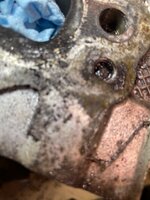
nothing new there ive done many o many o times many deeper , I expect them to break or I just torch the manifold off and go after em , if someone has tried to drill they can have it its already boogeredFor a little background, when I was taking the exhaust manifold off the right bank head of a 2016 Ram, 3 bolts broke, 2 were above deck height and this one is about 1/8” below deck height, so not deep at all. I’ve watched a few you tube video’s and originally was going to buy a good punch, some good drill bits and a set of easy outs but then I was warned that things could go wrong and I could damage the aluminum head, so then I got to watching videos about building up the stud with weld, then welding a washer to what I built up, and then weld a nut to the washer. I’ve never done this before and I’m really not much of a welder so I want to make sure I’m not going to destroy this head, if there is much chance at all that I will destroy it, then I will just pay someone to extract it, although as easily as the rest came out, I think it’s going to come out rather easily. I’ve already found a washer that has a center hole smaller than the diameter of the broken stud and a nut, but I’m unsure of a lot of things. Can I do this with flux core? Do I basically lay tack welds on top of each other, cleaning the tack weld in between? Or do I keep a hot puddle and just keep going till it’s slightly above the deck height? If I have a large puddle will it melt the aluminum threads? Or again am I just laying quick little tacks, trying not to let the puddle hit the threads? In one video I watched, it said that the weld would not stick to the aluminum but again just not sure of the finer details. I need some guidance, even if that guidance is don’t do it. I do plan on practising first with one of the broken studs in a vice, and see if I can build that up but…
When you fill them up with weld when they are deep, do you run a copper pipe down to protect the threads or just fill it up?nothing new there ive done many o many o times many deeper , I expect them to break or I just torch the manifold off and go after em , if someone has tried to drill they can have it its already boogered
I need to get gas. Would be a little easier then the flux coreIn Aluminum just fill with short bursts, it won't stick.
Grab a 20lb Co2 bottle. Can usually find them used for next to nothingI need to get gas. Would be a little easier then the flux core
Straight CO2? Or is it better mixed with Argon? I just don’t want to pay tank rental since I will probably have it for the rest of my lifeGrab a 20lb Co2 bottle. Can usually find them used for next to nothing