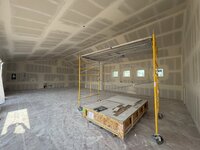
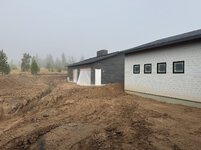
I don't think I went over the solar plan before. So buckle up, this could go long. 33 panels get it to a 14.19kW DC system, flush mounted to the workshop south facing roof. They estimated 19,534 kWH from the system annually.
Let's go through costs first. That system before any rebates incentives etc will cost ~$45K (I think this is high and could've come in less). The 30% federal tax credit expires this year so I have to have the system up and running before year end to save ~$13K. I didn't have batteries in the budget but we are at least planning to be able to add them later. My solar guy suggested I start with one powerwall 3 (or similar system) to cover the main load centers and add more batteries if that isn't enough. Google search says the first battery plus the control systems is in the $15K range - before any incentives or tax credits. Additional batteries would be around $6K each.
Mixing in costs, production and consumption, the solar contractor estimated I would spend ~$3K per year starting this year on electricity without solar (increasing to $5K by 2044 if it goes up 3.4% annually), but only $600 per year with solar. I can't find the exact breakeven on my setup but I think it is closer to 10 years. I've seen some suggest this makes most sense if you get into the 7-10 year payback period. Without the federal tax credit I'm not sure many of these systems make any sense financially but we'll see. And the above says nothing about the opportunity cost of taking $30-$45K and investing it etc. So with a 10 year time horizon my common sense meter tells me it is smarter financially to skip solar based on today's economics even though I didn't. The panels are under warranty for 25 years. The 30 year estimate has these saving me over $100K. For this to make any sense you need to be in it for the long haul. And again, a simplistic look at the magic of compounding interest - take $30K and invest it with a conservative 6% annual return you're up to $172K over 30 years.
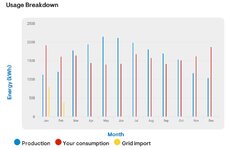
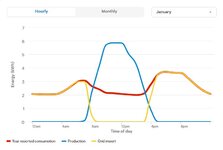
Production vs consumption and how it works with your electricity provider will vary. Annually, the diagrams below show what they predict for my install - generating more than I use annually and earning credits with the utility. But this doesn't include batteries and I clearly need to pull power from the grid at night when the panels aren't producing. And that also varies by season. When you look at the daily breakdown, batteries should/could be designed to eliminate any grid import if you have enough of them. I guess it depends on your ultimate goal of being off the grid entirely or being somewhat more self-sufficient. I have a gas line to the house with a large gas boiler for heat, a gas stove, gas grill, and gas fireplaces so being truly off grid isn't a goal for me. For me, the value of the batteries comes from acting as a backup/generator and I don't think it adds to any significant cost savings for house operating costs. Here's why...
To 'sell' excess power to the grid I think you need a utility that allows net-metering (which I have). This should work regardless of batteries - where they track the electricity sold into the grid and then you settle up monthly. On a daily basis this should net out the use at night if you are putting more into the grid during the day than you use at night. At the end of the month if you still put more into the grid than you used, you get credited on your bill at the wholesale rate. So from an economics standpoint, the batteries offset the wholesale price you receive for excess power generation and during the months (winter) you use more than you produce, those consumption costs. On a typical day, excess generated energy first goes into your batteries, then the grid. At night you pull from those batteries first, then the grid if the batteries get too low (a reserve threshold that I think I can set?).
Anyhow, a good local solar contractor should be able to pull together estimates for you and walk you through the nuances for your home and electric utility. Hopefully my overview helps get you started if you think this is the right path for you.