larson0290
Member
I have to say awesome shop. I have read all 216 pages and enjoyed it all. I have also driven by your shop before, taking the back roads to see my buddy at U of I. looks very nice.






Aye! Caramba!
You've clocked the casting flash on the pipe caps AND the manufacturers logo on the flanges. Well-played, sir. Very well-played.

Gee wiz, does nothing get by you guys? Sharp eyes there oberst thanks.
Thomas
.
I have to say awesome shop. I have read all 216 pages and enjoyed it all. I have also driven by your shop before, taking the back roads to see my buddy at U of I. looks very nice.

Unreal dude, you are awesome. I would have had the greatest time going through all that good old stuff.
Wow.
What a neat find Thomas. Thanks for sharing. The meter housings are really capture the art deco look and the needle on the vacuum gauge is really slick.
It's a never-ending treasure trove!
Randy
This shop and its resto is very likely the coolest thing i have ever seen!!
I bet the pointy ends of the other two meters are visually unique as well. I'll need to power them up and see what what they look like.That is the best looking Allen Dist. Machine I've had the honor of looking at.
Great find.
Thanks again for all the time you spend sharing the great adventure of your shop.
I look at my shop in a whole new light since I started following this thread.

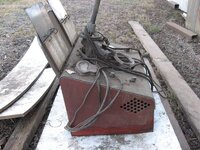
Nice find on the Allen tester, Thomas. Is there a strobe or degree wheel somewhere underneath the dust/dirt preservative?
Nope, we all have very sharp eyes. Blunt eyes could spot the switch panel though
Thomas, if you're ever in Oxfordshire, England... You can enjoy a beer on me
I think I should make that switch plate a focal point on shop tours from now on. Everyone will want to see it for themselves. Bob, I thought of you immediately when I can across the old Allen. Especially in light of the fact you just recently serviced a newer Allen for me. What are the odds, huh? Your description "dust/dirt preservative" is an appropriate term, it's a very thick coat of it, whatever it is and no doubt it provided some protection of some sort.
I only wiped the meter faces off, took a few photographs and then returned it to it's resting place so I can't answer your question just yet. As old as it is I'd suspect a degree wheel wouldn't you but who knows? Does anyone out there know when strobes started to appear on distributor machines? I'll get back to it and do an in depth look see and let you know.
I tried to do an accompanying history of the Allen Electrical Equipment Company with that post to make the post a little more complete but I could find very little information on them. Basically all I could find was that they were based in Kalamazoo, Michigan.
Thomas


Here's a little item I've been using since 1969. It disappeared last year and I had to buy a new one. Then I found it stuck in the washer. It is so dull from the years of use that when I used the new one, I almost cut my finger off.

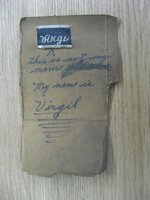

I notice on the correctly spelled patch they pretty much copied his handwriting...
I notice on the correctly spelled patch they pretty much copied his handwriting...
The photo above was copy'ed from facebook,Its one of my ****** scans! the copyright and info is on the back of the real photo. Anyway, this is a photo of my Dad,he was a Harley Davidson expert and won meny awards at the paradise mesa strip and was a member of the S.D.T.A, and a member of the Chula Vista Hi-Way Haunts car club 1950s. He raced a 1939 knuckel head harley with a fuel ijection system he designed him self, almost 50yrs befor Harley Davidson came out with fuel injection. He defenitly was a man ahead of his time.Here is a photo Lou Bingham sent to me of another Jeraulds car..
Someone from the San Diego Roadster Club gave it to him years ago. We have NO INFO on the car , driver or years this photo was taken. Only thing we know for sure is it was taken at Paradise Mesa Drag Strip. This photo was taken by Bob Hardee. A San Diego LEDGED at the local race tracks as Official Track Photographer
The body work on this car reminds me of those fenders I hammed out in a hour for Fred Lobellos Tank for Bonneville this year, Ain't nothing smooth about them ... but they work...

Randy Chenowth


The photo above was copy'ed from facebook,Its one of my ****** scans! the copyright and info is on the back of the real photo. Anyway, this is a photo of my Dad,he was a Harley Davidson expert and won meny awards at the paradise mesa strip and was a member of the S.D.T.A, and a member of the Chula Vista Hi-Way Haunts car club 1950s. He raced a 1939 knuckel head harley with a fuel ijection system he designed him self, almost 50yrs befor Harley Davidson came out with fuel injection. He defenitly was a man ahead of his time.


 In theory it should have worked.........but I neglected to tell them a little black dye goes a looooonnnng way. They had never used dye before so they just used heaps of it. I was doing another project right about then and by the time I remembered to tell them to use the dye sparingly it was too late!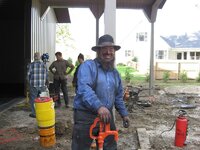

 As it cures it is getting lighter, from almost black to now grey but still not what I had in mind. It does hide tire marks though so I was successful with that.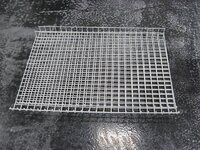
I like the finished floor, but I think having it lighter would have made the place feel much bigger. But hey, you have plenty of space for it to not feel small (looking through the eyes of the internet).
For some reason, I had about 55 email notifications about this one post
I initially was planning on a very light, natural colored floor with occasional dark marbled streaks.........here and there. It was going to be beautiful................sigh...........all light and airy............just beautiful..............Really inviting to the eye and warmth to the soul............
Not sure why the multiple post notifications. Guess the system wanted to make sure you didn't overlook another goof I did out there? Like the switch plate wasn't enough right?
Thomas
 Its not letting us down keeping an eye of the...err.... well... not-as-perfect-as-the-rest-of-it

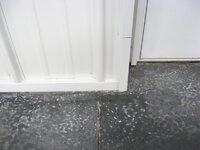
This is to follow up on some inquiries about the concrete floor in the barn. I had Morton install metal interior walls and they provide a lip on the bottom of the walls...

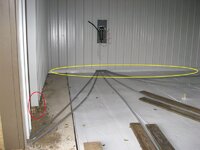
...seen circled in yellow and red. This lip is the surface that the concrete is poured to and it gives a more finished appearance and when concrete is used provides a continuous seal around the perimeter of the building. Also seen in this photograph are gray electrical conduit used as a means of getting power from the power panel to various parts of the building since I didn't surface mount the electrical on the walls. Hiding the wiring just gives a much cleaner appearance. More on the electrical later.

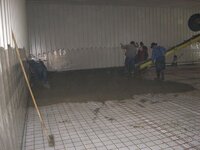
The concrete is 6" (15.2 cm) thick. The red circled object is one of three electrical outlets installed in the floor. The yellow circle is around a grade stake. That will be the top of the concrete and is used as a reference while it's being poured. Eventually those will be driven down into the concrete. Clearly seen everywhere is the white of the the insulation I used under the concrete. It's 1/4" (.6 cm) thick styrofoam that is vinyl covered on both sides to provide a vapor barrier as well. It's specially designed for this use and more can be found here: http://www.thebarrier.com/

Here you see on the right where the floor insulation hasn't been laid down. The grey tube sticking up in the back is a drain line that goes to a large french drain I installed in opposite corners of the building. Those are what my dehumidifiers drain into.

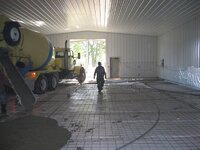
During the pour. You can see the "highway mat" reinforcement used which is much superior to consumer grade concrete matting. It's literally the same matting used in road or highway construction. This doesn't come in rolls, rather it comes in sheets, it's too stiff to roll up. This mat is lifted to mid point of the thickness of the concrete or about 3" above the insulation once the initial pour is done. There are special "hook" tools which grab the mat and it's worked up from the bottom. The critical thing is to have the mat stationed at the mid point of the thickness. Also note the plastic sheeting taped to the walls. Concrete will splatter when poured and it's a stinker to remove from the finished surfaces. Easier to let to splatter on plastic and then just remove the sheeting later and throw it away later.

Another view of everything. Boards were placed on either side of the electrical conduit to keep it from being crushed by the truck when it was driven over. I had 25% "fly ash" added to the concrete mix to whiten the color up. I wanted to lighten it up for better light reflectivity. That did't quite work out as I had planned.


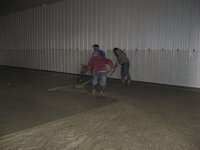
Here the concrete is being finished with a power troweler. The gentleman to the left is sprinkling concrete dye onto the concrete as it's being troweled. The idea was to sprinkle a little bit in to create swirls in the floor to help hide the tire marks. Big mistake!!!

Here you can see dye residue on the trowel operator. That stuff was a fine powder and it went everywhere. Remember the 25% fly ash I added that would whited and lighten the color up?? It was completely overwhelmed by the black dye. As a consequence...

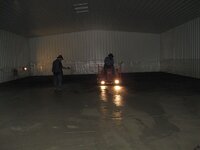
...the floor I took pains to try to lighten up turned out very dark.

The "mottled" appearance on the surface was from...

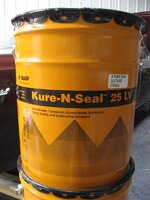
...Kure-N-Seal, 5 coats of it. To strengthen concrete you want to slow down evaporation and sealing the surface really helps with that. The first coat went on just a few hours after the concrete was finished and I could walk on it. Other coats went on every 4-6 hours until all 5 were applied. The Kure-n-Seal will eventually wear away and the mottling will go away as it does.

Here's a better look at the lip detail on the bottom of the walls. It stops wind infiltration and also keeps little creatures (think mice) from burrowing under the walls and getting in.
The floor insulation works exceptionally well. I use ceiling radiant heat and once the floor is warmed up it doesn't conduct cold into the building since it's insulated from the cold ground. The floor isn't a big cold plate now but a warm thermal mass. Highly recommended if you plan on heating the building.
Thomas
should have helped keep temperatures down..Hello all,
My wife works with Thomas as a crew member and mentioned that I might be interested in reading about his activities, off duty in Illinois. This was right before this past Christmas. Today, I finally completed reading (and re-reading some parts) of the entire 218 pages. I had no idea!
I cannot say it any better than all of you have already written. This is a journey of epic proportions. Thomas and Chris have made us a part of the journey. His photo journalistic style is vivid and breathtaking. I can close my eyes and navigate my way around the buildings and property during the various periods reported. To me the story is an emotional roller coaster and is as compelling as any historical, archeological search can be.
The contributions, suggestions, and effort everyone offers speak volumes about the quality of the group. Can't wait to see what is next. . . .
Here's a link to a site with more belly tank, lakester info:
http://www.cb750cafe.com/bikes.php?cat=24
Thanks,
Wayne (type47fan)
Thank you for the very kind words and also for the great link about lakesters, good stuff that. Those are the kinds of items the group here provides plus they really keep me on my toes. You must know by now there always seems to another project or two in the works so stand by.The floor looks good... Did you keep it wet and cool after it set and before applying the sealant??.. Being inside and out of the
The special Hook tool used to be made out of scrap Re-Bar bent to shape with a hook on one end and a handle on the other... We also used to use broken bricks to hold up the mesh during the pour.. On some jobs they specify wire towers or bridges to ensure the wire reinforcing material is properly positioned in the slab for optimum strength...
The lamp black appears to have worked better as a surface treatment rather than being added to the mix before being poured...
What strength mix did you order?...
More is coming at ya! I like the darkness and think it works great in such a large space. Understanding the benefits of a very light floor for lighting purposes and finding dropped fasteners, it is nice to see something a little different from time to time. Thanks for the update on the floor Thomas! I've been quietly waiting over here in the corner to hear the story on that finish.
Thanks again!
Erik
 I should have the final on this post soon.