2013 Update - Season 3 - Race Date 10/5/2013
Well, the advertised race to be held in May was cancelled. The Sand Springs race is being held later this year and my understanding is they are moving it back downtown.
Since he was entered in 2 classes last year, novice and competition, my grandson got about 7 runs and placed 4th in the competition class. We had no equipment failures. We were handicapped by low weight of the driver. The only observed difficulty revolved around steering. They used a starting ramp with a rather abrupt transtion to the road and when the car hit this, my grandson would tend to jerk the steering wheel back and forth, slowing him down.
I decided I would attempt to improve the steering this year.
This is a top down view of the spindle.

This is a view of the spindle from the rear.

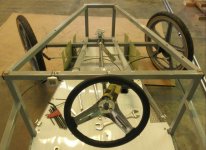
This is a view of the steering shaft and arm from the rear.
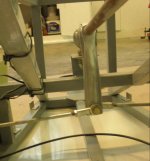
This is a view of the steering shaft and arm from the side.
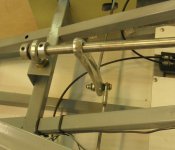
A brief recap:
* I copied steering from soap box derby cars and go-karts and other down-hill racers.
* Because the wheels have standard bearings that are not really designed for side loads, I decided to not have any camber in the suspension, as I believed the camber would create a side load and friction which would be detrimental.
* I did try to build the correct ackerman angle into the steering.
* I looked at a number of carts and other downhill racers that had no caster desingned into the steering. Because camber primarily makes the steering self-centering and because of the challenges of trying to fab that, I did not design in caster.
* As raced last year, the front wheels can be turned through a 53 degree arc. This amount of steering is accomplished by moving the steering wheel only 45 degrees (1/8 of a turn).
* The goal this year is to slow down the steering, hopefully making it a bit easier for my grandson to handle without the seesawing of the wheel and resultant negative effect on speed.
With this type of steering, the maximum the steering wheel can be turned is 180 degrees (1/2 turn). In order to go above that one must have a steering box or rack of some sort that incorporates gears.
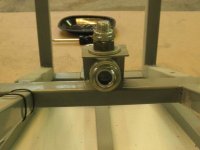
The first step this year is to lower the front of the shaft in preparation for shortening the steering arm so that more steering wheel input is required for a given amount of movement of the wheels. By moving the pivot below the bracket, I have lowered it 2.5 inches. This required creating a 1/2 height lock nut for under the bracket and sliming down the collet that holds the end of the shaft.




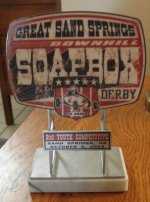
 Great result!