What better way to start the new year than by wrapping up a project from the previous year(s)? These are a few last details on the
Barn
Bench,
BB.
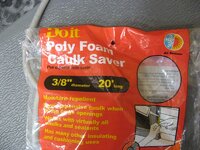
I sealed the area between the bottom of the bench and the floor with backer rod as seen above. It comes in many different diameters, is inexpensive and is compressible to fit.
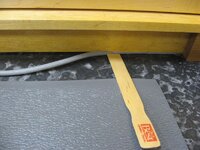
Here I used a wood paint stirrer to push the backer rod into place. You need to use something relatively wide and blunt to push the strip, otherwise it'll just poke a hole in the foam. I used different thickness pieces of wood depending on the area that was being sealed. When done...
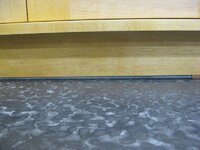

...it completely seals small areas which prevents items from falling under and being lost. To seal the area behind the back splash on top...
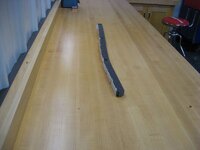
...Morton makes these foam strips.
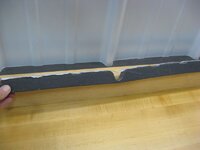
They match the profile of the interior steel siding perfectly and also have adhesive on them to hold them in place.

Additionally they incorporate these interlocking tabs to further help seal all the strips together.
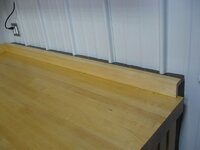
That results in one long continuous sealed strip.

Here's the inside corner which was tapered and had to be trimmed to fit.
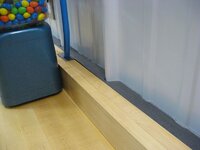
This is how the tricky airline area looks when done. It sealed up nicely.
For the ends of the bench...
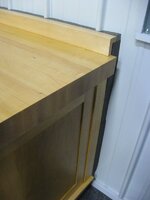
...I used larger rectangular foam blocks...

...trimmed to fit. Now the area behind the bench is completely sealed to keep objects from falling back there and it also keeps spiders from making a home back there.
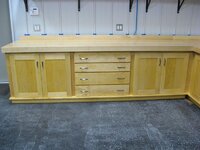
I wanted a nice, tight fit on the door gaps when they were closed. However doing that would make the doors bind together when opened or closed. To solve that...
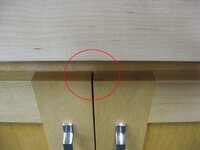
...I used the jointer with the fence set on a shallow angle to relieved the gap opening on the back edge only, leaving the front gap tight when viewed from the front.
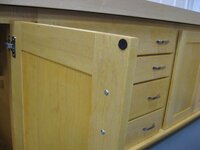
Felt pads from Chris's picture framing shop were attached to the top corners to keep the doors from banging when shut.
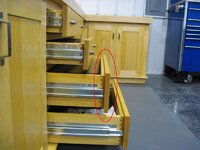
Since I used 7/8" (2.2 cm) thick Maple drawer fronts...
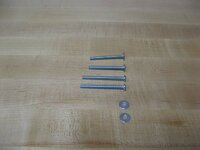
...the screws that came with the drawer pulls (on top) were a little too short for my liking. When the original screws were installed there were only a couple of threads engaged so I substituted longer screws to make the pulls more secure and lessen the chances they would loosen up over time.
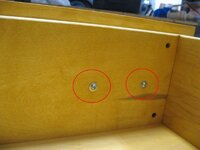
Because these new screws had smaller diameter heads I also placed washers on them to prevent them from being crushed into the wood when tightened up. (stop squinting, yes they're clocked!

)
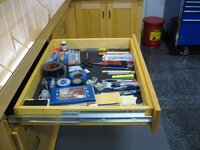
I used 200 lb (90 kg) full extension, ball bearing drawer slides.
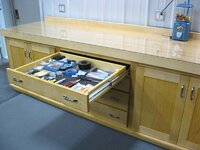
These are deep drawers and that makes them much more useful by being able to easily access the back of the drawers.
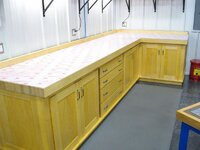
To further protect the top finish from harm (the top has 6 coats of Varathane floor finish, the cabinets below have 5 coats of Watco Danish Oil) I decided to use...

... 2 pieces of 3/16" (.47 cm) thick Polycarbonate sheet, sized to match the two top butcher blocks.
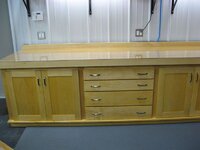
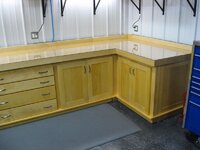
My plastics supplier felt this would be the best, most durable material based on how I would be using the bench.
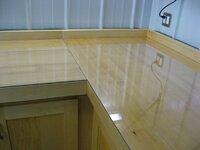
The edges were "eased over" and...

...the outside corners slightly rounded.

A view when looking at the edge.
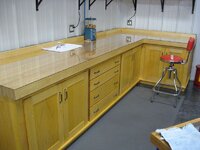
The high gloss surface is not especially to my liking but with time I'm getting use to it. Everything is a compromise, the world is not a perfect place, and to protect the top this was my compromise. I just hope whoever owns that bench 100 years from now will thank me.
That now concludes this portion of our program. I've got a
SPOUSE bench out in the barn still in the works. I'll post on that one in the future. Thanks again everyone for last year. It was fun for me and apparently for you too. Let's see what new adventures the coming year will bring us, shall we?
Ever Optimistic Thomas

 I will be lighting up my FNFAL with a few mags, but safely pointed into the ground so no one will get hurt.





 Otherwise I might be in big trouble for wasting all your time!


