You have learned a valuable lesson. At least it only cost you $40 - you could have easily paid $150 or more for that same lesson!
Very astute - maybe not for the reason you may think, but let's start anyway:
1) I've learned how to take the pump apart and avoid problems when I do take the
other one apart... But wait, I'll let you in on it later

2) I've learned to recognize different sounds and what they mean (Again, I'll explain later)
3) $40 is cheap when it comes to learning things, and it was an opportunity for me to refresh what I had leaned 40 years earlier in Mechanic School (I graduated but only worked for a few months in a garage - although I love working on cars, getting slush on my face and dealing with grime of the typical salt belt garage quickly made me change my mind)
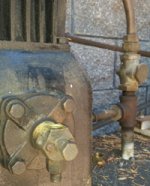
My advice? Pull the motor and scrap the rest (or save the pump for a parts donor - it's a Campbell Hausfeld pump that was used on millions of Sears compressors). It's not economical to repair that pump, unless you can find another identical one for cheap to rob parts from (or a complete pump that works, and then you still need a tank and the other parts).
Again, right on - and as you may have guessed by now, the reason I got this compressor in the first place - was that I had purchased a similar Sears compressor for a pittance because it needed work and figured that in the worst case scenario between the two of them I'd have enough spare parts to make one good one out of the two
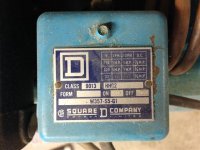
However, it turned out the Sears deal worked better than expected after I fixed the sticky, burnt contacts on the pressure switch, the stuck pressure gauge that simply had dirt in its orifice, the check valve that was leaking, replaced the mangled o-ring, made a new tank to check valve washer out of tin and an o-ring, soaked the stuck safety valve with jig-a-loo to unstick-it, polished the leaky drain valve seat smooth, get some pipe fittings and a quick release and replace the ratty old 14 gauge electrical cord with a longer 12 gauge...
I also removed the head to check for potential damage after I found a piece of metal in the check valve, thinking it could been a loose reed valve screw (turned out to be simply the worn out check valve rivet, which I replaced with a screw), found that the pistons and cylinders were in decent condition with very minimal scoring then made a new head gasket out of paint soaked cardboard, verified head flatness and found it could be improved with sandpaper on a piece of plate glass...
It now works surprisingly well, I was able to measure its output at >8 CFM @ 90PSI, and that's at 400m altitude (~1300ft)
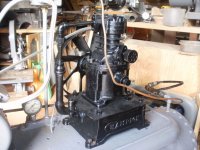
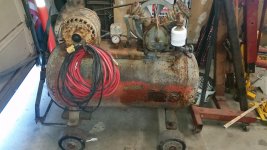
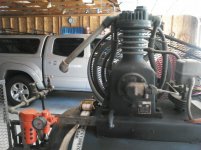
Here's a picture of the thing after restoring it, the only thing that still needs to be done beside installing a regulator is to check the insides of the tank and pressure test it (I already acquired a more recent tank should I need to replace it)
I also noticed, from comparing the sound of the Sears versus the Speedaire, that the Sears may need some new reed valves as it makes a kind of a fluttering, vibration like sound, as if the reed valves weren't tight against their openings, like they seemed to be on the Speedaire when I looked at the head... Hey, who knows, maybe those reeds will fit the Sears head and solve that problem ;-)
If you are shopping for another compressor, make sure that you can hear it run, and start the compressor with no pressure in the tank. If the pump has excessive bearing play at the rod or piston pin, you will be able to hear it knocking between zero and 20-30 psi - at higher pressures, the pressure in the cylinder will mask the bearing slop as it holds the sloppy parts together on one side so the knocking goes away.
Excellent advice and well taken - IF I can get another deal like that! I actually passed on another one a few weeks ago because of a bad noise that I thought was coming from the bottom end, that was different sounding than this one and that I now believe could have been simply come from a bad check valve... But as the seller had been quite dificult to deal with (you know, the kind that makes you feel they are doing you a big favor simply answering your questions and are offended when you suggest their "excellent condition" turns out to be a "needs work"), that kind of sealed the fate of that deal...
Soooo... I'm not 'out in the street' so to speak, although I still need to 'certify' this old lady's tank (I intend to do it with the pressure washer method and have already acquired a larger tank from a failed oil-less compressor for that very purpose should I need it), but I would still love to be able to get the other pump going if it was at all possible in a cost effective manner... You know, getting it round again with emery cloth? I remember truing the crankshaft on an old 302 Ford back in the 70s that was also slightly out of round (OK, probably not as bad as this one), took many hours for sure but it worked... Even if it made me dead last in school and the teacher told me I'd never last in the industry
My question is, if indeed my idea is sound, that once ground, would it be as tough as before, or would the grinding weaken the crankshaft to the point that it would fail very soon thereafter? In other words, would it be worth the effort (by very soon I mean, fail again within a few years)?