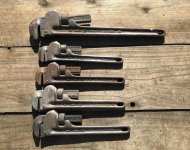
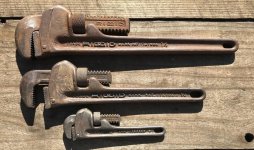
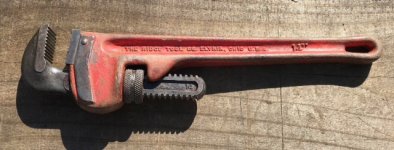
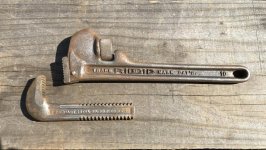
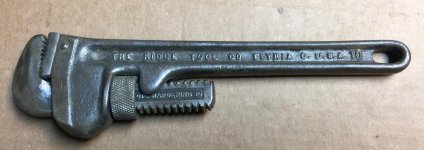
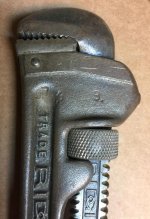
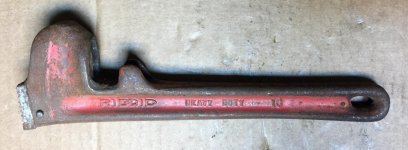
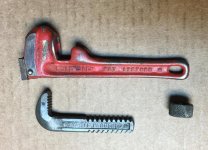
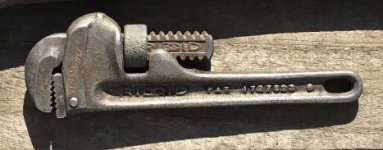
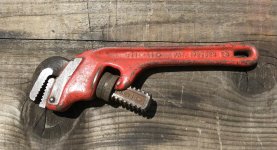
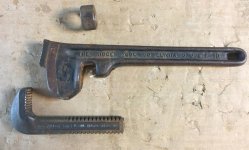
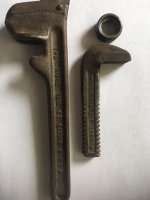
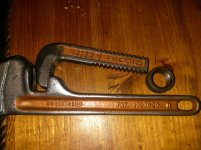
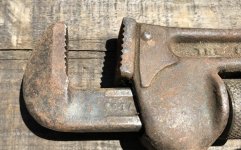
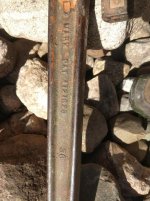
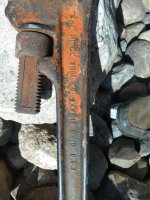
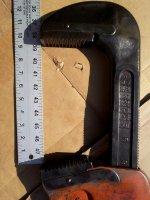
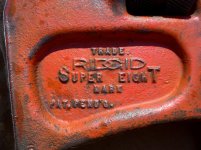
That is a real head scratcher, Don! I don't remember seeing a "PAT'D" mark before. If someone already reported one on this thread, I missed it. I am working on one cup of coffee here, and raring to get out the door for my flea market, so I reserve the right to either un-screw this or screw it up even more later, but I think you may have found a missing link.

Follow my logic and double-check or argue with me....
That wrench could not have been made in 1938 or later, so the "8" in the code has to be 1928. I am thinking it has to fit between the top two photos in my chart on post #1. The "PAT PEND'G" marking on the first wrench (which has none of the features patented in the second patent) has to refer to the first patent (which they never put on a wrench.) The "PAT PEND'G" on the second wrench (which has the features patented in the second patent) has to refer to the second patent, which they started putting on wrenches after it was granted. I think that means the "PAT'D" on your wrench has to refer to the first patent. With a code ending in "8", it can't refer to the second patent, which wasn't granted until 1929. It looks to me like their initial philosophy on the patents was to just forge "PAT'D" on the wrench, without the actual number. When they applied for the second patent, they went back to "PAT PEND'G" again. When that was granted, they decided to forged in the number instead of "PAT'D," maybe because now there were two patents in play. I would be tempted to think the sequence could be for the second patent - "PAT PEND'G" to "PAT'D" to "1,7272,623", but again, that second patent wasn't granted until 9/19/1929. Unless you've got a dynamic jaw made in 1928 inside a wrench made in 1929.
As you know, my initial motivation with this thread wasn't so much to figure out how to date all the wrenches, but the wartime wrenches. So I can live with fuzzy and TBD!