To avoid these ads, REGISTER NOW!

Adding circuits to an already full panel - what are my options?

BigGarage

Well-known member
Joined
Jun 5, 2019
Messages
2,346
Location
Just south of Detroit, MI.
What is old enough to expect failures? No one will give an answer in years, let alone justify it with evidence.

If old enough what about swapping out all the breakers for new (if availalble)?

My main panel was upgraded from the old fuses to a circuit-breaker panel probably in the mid to late 70's. I have had several issues with it in the last several years, from a breaker failing to corrosion and even rust causing problems. I was able to purchase new Pushamatic breakers online and even got a 60 amp one for a subpanel.

I could swap out all of my breakers with new, I still have 5 or 6 new ones, but I'd still have the panel with corrosion all over the neutral bus bar and rust on the sides and bottom of panel. With panels located in a basement the moisture gets to it and my feeder line from the meter into the house is very old and I think moisture also got in through that. I used clear flex seal on it the last couple years until I get the panel replaced.

Going by my experience I'd say that my main panel would last another 40 years if it wasn't for the moisture that got to it. As it is I'm replacing it since I would have an old panel, main line that needs replacing from meter, and many minor issues even if I replaced all the breakers with new.

Every case is different and every homeowner must make his own decisions after seeking out all the info he can find.

Dennis
 
To avoid these ads, REGISTER NOW!

mike93lx

ALLIANCE MEMBER
Joined
Dec 9, 2013
Messages
37,539
Location
Richmond, VA
What is old enough to expect failures? No one will give an answer in years, let alone justify it with evidence.

If old enough what about swapping out all the breakers for new (if availalble)?

i'd say 40+ years, but you won't be satisfied with that.

this is opinion, not fact...you'l need to make your own decision.

considering the feeder is old, the buss bars are old, there may be corrosion, my preference is to swap.

I recently had my meter pan, and feeders replaced with new. the piece of mind knowing it is all new, and high quality, plus the much better aesthetics was worth the $1600. panel was done a few years ago, so it's all new and will be fine as long as I live here.
 
OP
S

stickshift

Well-known member
Joined
Nov 16, 2011
Messages
1,236
Location
northeastern US
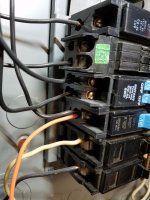
One thing that needs cleaned up (dangerous) is the cable coming in from the upper left. It has a red going to a breaker on the right and a black going to a tandem on the left. In addition to not having a common disconnect they are on the same phase which can put too much current on the white neutral wire leading to overheating.
Thanks for pointing this out. No matter what option I take, I will get this resolved.

It sounds to me like you are going with the sub-panel because it would be less expensive, so I suggest going ahead and doing it. Just keep in mind that the cheapest way is usually not the best way.
This post makes it sound like I came here just to have a pre-determined course of action validated. That is not the case. I've been on GJ for nearly a decade. In that time, whenever there is consensus advice on something, I nearly always take that advice. The difference is I'm usually given a clear explanation, and not simply "Go with option B because we say so."

Most folks on GJ like to plan for future upgrades, and they also like new stuff that looks good and is installed neatly. That's probably why you get so many recommendations for a new main panel. However, adding a subpanel would also work fine.
Thanks, that all makes sense. Whether it's worth a large upfront expense now is what I'm trying to figure out. And I probably need to give you guys more color on why I contemplated adding circuits in the first place so you have a better understanding of how this is more nice-to-have than absolutely-must-have; will provide said color below.

In your price comparison you are mixing apples and oranges (more or less). If you can install a subpanel for $100, then you can install a 100 amp main panel for about $200-250 (mainly because you need more breakers). The cost to upgrade to 200 amp service and replace a panel is probably $2000, but you can install a new panel without upgrading service.
Maybe, maybe not. In my county, homeowners can perform some electrical work themselves and then have it inspected. But there is other electrical work that only licensed electricians are supposed to perform. I'm guessing (and I do need to confirm) that adding a sub-panel is something I can do myself and have it inspected. I'm almost certain that replacing the main panel is a no-go from the county's perspective, and further, there is no way to disconnect power to the main panel without removing the meter, and that's misdemeanor territory, so I won't be venturing there.

One possibility: If you install a 200 amp main panel (or lower amperage) and but use a 100 amp main breaker, you will have a new panel that is code compliant and be ready for a future 200 amp heavy up. If you want to spend more money later, do the heavy up then and put the 200 amp main breaker back in the panel.
I'm not sure I understand the point. What would I get out of installing a 200A main panel with a 100A main breaker vs using a 200A main breaker? Seems I'd literally have to go through all the same steps including having the POCO turn off power, install 200A capable service lines, etc. So what would be the benefit of using a 100A main breaker?
 
OP
S

stickshift

Well-known member
Joined
Nov 16, 2011
Messages
1,236
Location
northeastern US
OK, given some of the responses, I think I need to provide more color on why I'm contemplating adding circuits. As things currently stand, the existing 100A service is meeting our needs - we've never tripped the main breaker. That said, as you all know, back when 100A installations were common, nobody was contemplating dishwashers, microwaves, electric kettles, computers, printers, etc. And they weren't contemplating the large electricity demands of modern kitchens, which is why decades ago, you could have circuits that fed the kitchen as well as other parts of the house. Today, the kitchen would get its own circuit and likely several circuits.

That brings me to my situation. I'm remodeling a room that will be used as an office - which means computers, printer, etc. That room is supplied by outlets that are on the same circuit used by several outlets in the kitchen. This office has had similar equipment in the past, and we haven't tripped this circuit's breaker in the past, but the potential load (if all or even most of the devices in the office and kitchen were drawing power simultaneously) would likely trip the circuit breaker (but not the main breaker). And it's the peak load I'm worried about more than the continuous load because the really high draw devices aren't on continuously (e.g., microwave) and some of the devices only have large draws on power up (e.g., printer - and I rarely print anything these days, so printer is mostly left off).

So I was thinking while I've got the drywall removed in the office, it probably makes sense to add a circuit to feed this room, and reduce the load on the circuit that supplies this room and the kitchen. That's when I removed the service panel's cover and discovered the panel is full. Hence this thread.

Since we haven't had an issue yet, I think even one additional circuit is sufficient to forestall potentially tripping the breaker for some time, perhaps years. And as a couple of people have suggested, I may be able to squeeze another circuit into the existing panel, so that's the cheapest option - and one that I was unaware of when I started this thread.

Actually, the cheapest option is to not add any circuits and just manage our devices. I.e., I could move microwave and coffee maker to other outlets in the kitchen. And then just coordinate when I turn on the printer with what's going on in the kitchen, etc. Inconvenient for sure, but doable. But if I can squeeze an additional circuit into the existing panel, that would be preferable to doing this power usage coordination dance.

So when I started this thread, thinking the panel was maxed out, I figured if I need a new panel or sub-panel, why add only 1 circuit. Why not add a few 20A lines to reduce loads on existing circuits and to make it so that I can shut off power to one room without shutting off power to multiple parts of the house, and while I'm at it, why not add a 220V line out to the attached garage, making a 220V welder a possibility.

Hopefully this color gives you guys a better understanding of where I'm coming from. I'm thinking my options are as follows:

1. Do nothing until I actually start tripping a breaker. Upside is least costly up front. Downside is if I do trip the CB the kitchen and office share, the walls in the office are already closed and I'll have to make holes to run new wire.

2. Pull new wire through while the walls in the office are open, but don't connect either end. If I start tripping the CB, then deal with adding a circuit or replacing panel or adding sub-panel.

3. Add a new circuit (or two, if possible) to existing panel and truly max it out (in terms of CBs, not load). A little up front work and expense, but probably forestalls future tripping for some time, possibly years.

4. Add a new sub-panel. More work and expense (a lot more expense if I'm not permitted to do this myself followed by inspection), but opens up possibility of what we can power, including new tools like a welder.

5. Replace the main panel with a 100A panel. A lot more expensive. Opens up possibilities similar to #4. Also preempts possible issues related to age of existing panel - that said, there is no rust or obvious corrosion on the panel and the basement where the panel is located does not have a moisture issue.

6. Replace the main panel with a 200A panel. Marginally more expensive than #5. Opens up possibilities, future-proofs (though we're not going to be here in 10yrs, so future-proofing isn't a high priority), increases home value a little bit.

@mm08822, let me check and get back to you on your specific questions.

It occurred to me this morning that a couple of tools might get me a better handle on what I'm dealing with in terms of loads and how close our use is to tripping the CB or even the main breaker. One is a clamp style ammeter - I could put it on the power line of the circuit shared by the kitchen and office and see what the load is when lots of devices are in use simultaneously. Though would I learn more from that than I would from adding up max amperage for everything on the circuit? What would be ideal is an amp meter with memory - so I could leave it on for a few days or even a week and see what real-world peak load is. Is there such a tool at the consumer level?

That brings me to the other issue - the CBs are very poorly documented. What I've been doing is as I've replaced worn out outlets, I've written down every outlet and light fixture I can find on the same circuit. But this is a piecemeal process. It might be worth investing in a circuit finder and map out the entire house. At the very least, it would help make a more informed decision with respect to the options listed above.
 
Last edited:

PCustoms

Well-known member
Joined
Jul 23, 2011
Messages
22,825
Location
VT
Op, do a load calc. Odds are 100A is fine for your house.

Another option is to buy a 200A panel now (30 space or more) and wire it as a sub off your existing panel, just to the side. You can add as many circuits as you want to it (within capacity of the breaker that feeds it). The 200A breaker will only be a disconnect, so for now ignore the rating.

Down the road you can upgrade the service, and now your sub becomes the main.
 

ard

Well-known member
Joined
Feb 16, 2015
Messages
4,391
Location
Sierra Foothills... California
Looking at the main cable, it feels like this may have been a 60A fused service that got upgraded in 1970 with a 100A panel.

Is it REALLY a 100A 'service'?

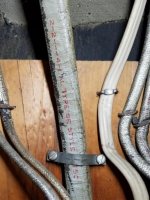
Looking at the wires, seems like there is old romex, and much old cambric-covered cables. IMO it isn't a clean '1960 install'.

If it isn't wired properly to size for a 100A service, you don't even have that....
 

brewchief

Well-known member
Joined
Sep 20, 2008
Messages
2,370
Location
Michigan
OK, given some of the responses, I think I need to provide more color on why I'm contemplating adding circuits. As things currently stand, the existing 100A service is meeting our needs - we've never tripped the main breaker. That said, as you all know, back when 100A installations were common, nobody was contemplating dishwashers, microwaves, electric kettles, computers, printers, etc. And they weren't contemplating the large electricity demands of modern kitchens, which is why decades ago, you could have circuits that fed the kitchen as well as other parts of the house. Today, the kitchen would get its own circuit and likely several circuits.

That brings me to my situation. I'm remodeling a room that will be used as an office - which means computers, printer, etc. That room is supplied by outlets that are on the same circuit used by several outlets in the kitchen. This office has had similar equipment in the past, and we haven't tripped this circuit's breaker in the past, but the potential load (if all or even most of the devices in the office and kitchen were drawing power simultaneously) would likely trip the circuit breaker (but not the main breaker). And it's the peak load I'm worried about more than the continuous load because the really high draw devices aren't on continuously (e.g., microwave) and some of the devices only have large draws on power up (e.g., printer - and I rarely print anything these days, so printer is mostly left off).

So I was thinking while I've got the drywall removed in the office, it probably makes sense to add a circuit to feed this room, and reduce the load on the circuit that supplies this room and the kitchen. That's when I removed the service panel's cover and discovered the panel is full. Hence this thread.

Since we haven't had an issue yet, I think even one additional circuit is sufficient to forestall potentially tripping the breaker for some time, perhaps years. And as a couple of people have suggested, I may be able to squeeze another circuit into the existing panel, so that's the cheapest option - and one that I was unaware of when I started this thread.

Actually, the cheapest option is to not add any circuits and just manage our devices. I.e., I could move microwave and coffee maker to other outlets in the kitchen. And then just coordinate when I turn on the printer with what's going on in the kitchen, etc. Inconvenient for sure, but doable. But if I can squeeze an additional circuit into the existing panel, that would be preferable to doing this power usage coordination dance.

So when I started this thread, thinking the panel was maxed out, I figured if I need a new panel or sub-panel, why add only 1 circuit. Why not add a few 20A lines to reduce loads on existing circuits and to make it so that I can shut off power to one room without shutting off power to multiple parts of the house, and while I'm at it, why not add a 220V line out to the attached garage, making a 220V welder a possibility.

Hopefully this color gives you guys a better understanding of where I'm coming from. I'm thinking my options are as follows:

1. Do nothing until I actually start tripping a breaker. Upside is least costly up front. Downside is if I do trip the CB the kitchen and office share, the walls in the office are already closed and I'll have to make holes to run new wire.

2. Pull new wire through while the walls in the office are open, but don't connect either end. If I start tripping the CB, then deal with adding a circuit or replacing panel or adding sub-panel.

3. Add a new circuit (or two, if possible) to existing panel and truly max it out (in terms of CBs, not load). A little up front work and expense, but probably forestalls future tripping for some time, possibly years.

4. Add a new sub-panel. More work and expense (a lot more expense if I'm not permitted to do this myself followed by inspection), but opens up possibility of what we can power, including new tools like a welder.

5. Replace the main panel with a 100A panel. A lot more expensive. Opens up possibilities similar to #4. Also preempts possible issues related to age of existing panel - that said, there is no rust or obvious corrosion on the panel and the basement where the panel is located does not have a moisture issue.

6. Replace the main panel with a 200A panel. Marginally more expensive than #5. Opens up possibilities, future-proofs (though we're not going to be here in 10yrs, so future-proofing isn't a high priority), increases home value a little bit.

@mm08822, let me check and get back to you on your specific questions.

It occurred to me this morning that a couple of tools might get me a better handle on what I'm dealing with in terms of loads and how close our use is to tripping the CB or even the main breaker. One is a clamp style ammeter - I could put it on the power line of the circuit shared by the kitchen and office and see what the load is when lots of devices are in use simultaneously. Though would I learn more from that than I would from adding up max amperage for everything on the circuit? What would be ideal is an amp meter with memory - so I could leave it on for a few days or even a week and see what real-world peak load is. Is there such a tool at the consumer level?

That brings me to the other issue - the CBs are very poorly documented. What I've been doing is as I've replaced worn out outlets, I've written down every outlet and light fixture I can find on the same circuit. But this is a piecemeal process. It might be worth investing in a circuit finder and map out the entire house. At the very least, it would help make a more informed decision with respect to the options listed above.
Does your power supplier use smart meters? Here they do and the power company has a device that you can pay a small fee(2$ month) and it will provide you with real time power usage info via a smartphone app.


If all you need is one more circuit I would skip adding a subpanel at this time and use a tandem breaker.

Getting a couple quotes on both replacement of the 100 amp panel with a new 100 amp panel and upgrading the service to 200 amp would be a good idea, if your external riser and meter pan is in good shape a new 100 amp panel may be far more cost effective, if it's in rough shape then a 200 amp upgrade would be a no brainer.

Sent from my SM-G965U using Tapatalk
 

James-W

Well-known member
Joined
Feb 3, 2013
Messages
12,432
Location
Southeastern Wisconsin
This post makes it sound like I came here just to have a pre-determined course of action validated. That is not the case. I've been on GJ for nearly a decade. In that time, whenever there is consensus advice on something, I nearly always take that advice. The difference is I'm usually given a clear explanation, and not simply "Go with option B because we say so."
You asked the question of whether to replace the old panel or add a sub-panel in order to be able to have more circuits. In answering your question several members have given you reasons why they feel the old panel should be replaced rather than adding a sub-panel. There is no “definitive” answer to the question, obviously there is more than one way to add new circuits, but some ways of doing it give you more options for later on should your power needs change.

The cheapest way is to add a sub-panel, but will have the least amount of options later on should you decide to remodel other rooms, add on to the house, add major appliances that require more power, or perhaps building a workshop and branching off the main panel.

The best way is to replace the old panel with a new one and changing to a 200 amp service. This gives a large panel with many more circuit breakers to take care of future needs. You don't necessarily need to upgrade to a a 200 amp service, but it wouldn't be a bad thing if you did. Yes, it will cost more initially, but down the road you will be all set if your power needs should change in the future.

In any case, it is your house and your money, do what you feel is best for you.
 

dscheidt

Well-known member
Joined
Apr 26, 2017
Messages
2,893
Most folks on GJ like to plan for future upgrades, and they also like new stuff that looks good and is installed neatly. That's probably why you get so many recommendations for a new main panel. However, adding a subpanel would also work fine.

They're also spending someone else's money. If I hired an electrician to do that job (adding the circuits called out in the first post), I'd expect to get a range of options. New panel, new service entry wiring. Add a small panel. Add a new main panel, wired as a sub.

The last is what i'd probably do. Put in a new 40 space (assuming there's room physically for it) main panel, with a 200A main breaker. Feed it from a 60A breaker in the existing panel. Put the new circuits, and whatever got displaced to allow the new breaker, into the sub.
 

klassenl

Well-known member
Joined
Feb 20, 2016
Messages
713
Location
Southern Alberta
If I was faced with this question during work hours I would give 2 options.

1a. Make space in the panel for new circuits.
1b. Add a small sub panel if there just wouldn't be enough room
2. Remove existing panel and replace it with a new 30/60 space 100a panel.

If I could make space in the existing panel for all of the new circuits I probably would even ask if they wanted to do anything else.

Upgrading to 200a "just because" is ridiculous.

When all else fails call your local trusted electrician.
 
Last edited:

nadogail

Well-known member
Joined
Jan 23, 2009
Messages
31,957
Location
Coronado, CA
We bumped our service to 200 Amps from 100.

Prior to our adding solar panels on the roof we upgraded the main panel at the meter, service mast and conductors from the standalone garage to the new sub-panel in the house.

The New Induction Cook Top and The Air Conditioner bumped our usage enough to convince the electric utility to allow us 26 solar panels on our roof.

We wound up with a new service mast, larger conductors in the mast, copper instead of Aluminum to feed the house sub, the garage and sub panels came from Home Depot, because I get a discount there.
 

Bert_

Well-known member
Joined
Dec 24, 2016
Messages
9,728
Location
NW Iowa
If your really trying to pinch pennies here the other option I might consider is adding no smaller than a 100A 20sp subpanel. 30space would be better yet, don't care if you don't need that many spaces now. Use a service rated panel with a main. The idea would be that in time this could be the new main panel


Upgrading to 200a "just because" is ridiculous.

It's not ridiculous when you realize the difference between 100A and 200A is only a few hundred dollars. When replacing a panel and service equipment I almost always go 200 even though it is rarely needed.
 
Last edited:

klassenl

Well-known member
Joined
Feb 20, 2016
Messages
713
Location
Southern Alberta
It's not ridiculous when you realize the difference between 100A and 200A is only a few hundred dollars. When replacing a panel and service equipment I almost always go 200 even though it is rarely needed.

Just a question. Are you an electrician? Are you a general contractor?
 

James-W

Well-known member
Joined
Feb 3, 2013
Messages
12,432
Location
Southeastern Wisconsin
Having more power than you currently need is not a problem. I have never heard of anyone complaining that they have too much available power. On the other hand, a LOT of people complain about not having enough available power. Right now you are wanting to add additional circuits. The current electrical panel in the house is too small to suit your current needs, therefore it is time to do something. The opening poster asked for options, we have been giving him options. We aren't trying to spend his money, we are giving him options to choose from. Odds are though, if he would take our suggestion and replace the service panel with a 200 amp panel, at some point down the road he would actually save money because if he replaces items in the house that require more power, he will already have the available power on hand.

The whole point is, unless you have a crystal ball and know for certain you will never need more electrical power than what you currently have, planning for the future is a desirable thing to do.
 

James-W

Well-known member
Joined
Feb 3, 2013
Messages
12,432
Location
Southeastern Wisconsin
Just a question. Are you an electrician? Are you a general contractor?
If you are wondering how he knows the cost difference between a 100 amp service and a 200 amp service, he may very well be an electrician or a contractor. But it really doesn't matter because you do not need to be either of those things to know the cost difference between a 100 amp and a 200 amp service. I know the difference and I am none of those things, I am just a homeowner.

When I built my garage I checked into things like this. The power company runs the line from the street to the garage for free. The power company doesn't care if you want 100 amp or 200 amp, either way they will run it for free. The only additional cost is for the larger service panel with more breakers and the extra cost for the larger cable from the mast head down to the meter base and then into the panel.
 

mrobins297aaa

Well-known member
Joined
Sep 20, 2010
Messages
3,283
Location
south east michigan
If your really trying to pinch pennies here the other option I might consider is adding no smaller than a 100A 20sp subpanel. 30space would be better yet, don't care if you don't need that many spaces now. Use a service rated panel with a main. The idea would be that in time this could be the new main panel

best economical answer, the OP doesn't need more power he just needs more circuits..........Put in a 100amp breaker in the main panel to feed a 100a sub........done
 
OP
S

stickshift

Well-known member
Joined
Nov 16, 2011
Messages
1,236
Location
northeastern US
Does your power supplier use smart meters? Here they do and the power company has a device that you can pay a small fee(2$ month) and it will provide you with real time power usage info via a smartphone app.
My POCO is PSEG Long Island. They say they don't offer anything like that. But I do have a smart meter installed, and the best that lets me see is 15-min intervals, which doesn't say anything about instantaneous load.

Also, I asked if the service to my house is 100A. They say that only my electrician can tell me that. :headscrat

I tried explaining to the woman that I can't power a factory from the line that runs to my house, which means POCO installs different lines, so they should know how much current the line to my house (weatherhead) is rated for. She didn't understand, and kept saying only my electrician would know.

Perhaps I'm not using the correct lingo?
 
Last edited:

mm08822

Well-known member
Joined
Jan 13, 2012
Messages
5,925
Location
NJ
My POCO is PSEG Long Island. They say they don't offer anything like that. But I do have a smart meter installed, and the best that lets me see is 15-min intervals, which doesn't say anything about instantaneous load.

Also, I asked if the service to my house is 100A. They say that only my electrician can tell me that. :headscrat

I tried explaining to the woman that I can't power a factory from the line that runs to my house, which means POCO installs different lines, so they should know how much current the line to my house (weatherhead) is rated for. She didn't understand, and kept saying only my electrician would know.

Perhaps I'm not using the correct lingo?

Or maybe your hairdresser.

They don't have records going back that far and it's a trivial point for them, anyway.
When you change, if you need a bigger wire, you get a bigger wire. Lot's of times they just replace the existing at the same time they crimp at the weatherhead.

Pictures man!
 
OP
S

stickshift

Well-known member
Joined
Nov 16, 2011
Messages
1,236
Location
northeastern US
This panel is ripe for an upgrade. Even if you keep it at 100a service, you could still upgrade to a panel with more branch circuit space.

You can probably add a quad breaker also free up 2 more spaces, but then you are 100% maxed out.

Provide a readable pic of the panel label - cb's, accessories, ratings, etc.
Panel label is very small and provides very little info - UL listed, Class - CTL, Enclosed Panelboard, and then a number, which looks like it might be a serial #.

What is the load on the 2 pole 40a cb? It looks like #12 (possibly #10) wired to it?
Central AC unit. I couldn't tell you gauge by looking at it, but the wires to that 40a CB are thicker gauge than the others.

Post some pics of the outside hardware.
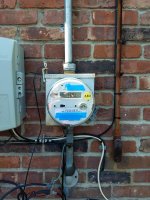
Pics below.

What is conduit size?
Conduit diameter is ~1-1/8".

How does conduit transition to se cable?
See pics. Looks like the conduit terminates at the brick. Next thing I can see is on the inside, where the SE cable comes through the wall.

Who is the Poco?
PSEG Long Island

You know for a fact or you are quessing about meter removal? It varies by poco.
Guessing by the sticker on the side of the meter: "Tampering with LIPA's meters, seals, or equipment is a Class A misdemeanor punishable by one year in jail or $1000 fine".

Looking at the pic the showing the wires to the left column of breakers, looks like that 2nd breaker from the top, a 15A breaker, is a free slot (no wiring).
 

Attachments

  • weatherhead.jpg
    weatherhead.jpg
    137.4 KB · Views: 68
  • 2019-06-23 16.21.25.jpg
    2019-06-23 16.21.25.jpg
    129.6 KB · Views: 68
  • 2019-06-24 17.10.26.jpg
    2019-06-24 17.10.26.jpg
    144.3 KB · Views: 58
  • 2019-06-24 16.59.31.jpg
    2019-06-24 16.59.31.jpg
    125.6 KB · Views: 60
  • 2019-06-24 17.00.09.jpg
    2019-06-24 17.00.09.jpg
    99.2 KB · Views: 59
  • 2019-06-24 17.00.49.jpg
    2019-06-24 17.00.49.jpg
    127 KB · Views: 55
  • 2019-06-24 17.08.05.jpg
    2019-06-24 17.08.05.jpg
    84.8 KB · Views: 64
To avoid these ads, REGISTER NOW!

dscheidt

Well-known member
Joined
Apr 26, 2017
Messages
2,893
Or maybe your hairdresser.

They don't have records going back that far and it's a trivial point for them, anyway.
When you change, if you need a bigger wire, you get a bigger wire. Lot's of times they just replace the existing at the same time they crimp at the weatherhead.

Pictures man!

Around here, you get a drop based on their prediction of load. Upgrade from 60A to 200A service, they don't change the wire, unless you show them the actual load is going to change. Even then, they may not change anything, because they don't have to. Their distribution isn't covered under NEC rules, and they know that even if you pull 200A, you're not likely to do so very long at a time. If the service drop melts, they replace it with a bigger wire.
 

acer66

Well-known member
Joined
Dec 4, 2010
Messages
4,418
Location
Western North Carolina
My guess is that 75gmck25 said get a 200a panel and stick a 100a main breaker in there so you do not have to pay for a 200a service now but if you need one in the future you can upgrade to 200a service by simply putting the original 200a breaker in there without having to do another panel swap.
 

Stuff

Well-known member
Joined
Aug 31, 2013
Messages
572
With new pics can see red wire is on other leg so not an immediate concern. Old rules allowed it. Current rules need at least a handle tie - 2 pole breaker is the norm.
 

mm08822

Well-known member
Joined
Jan 13, 2012
Messages
5,925
Location
NJ
Panel label is very small and provides very little info - UL listed, Class - CTL, Enclosed Panelboard, and then a number, which looks like it might be a serial #.

Central AC unit. I couldn't tell you gauge by looking at it, but the wires to that 40a CB are thicker gauge than the others.

Pics below.

Conduit diameter is ~1-1/8".

See pics. Looks like the conduit terminates at the brick. Next thing I can see is on the inside, where the SE cable comes through the wall.

PSEG Long Island

Guessing by the sticker on the side of the meter: "Tampering with LIPA's meters, seals, or equipment is a Class A misdemeanor punishable by one year in jail or $1000 fine".

Looking at the pic the showing the wires to the left column of breakers, looks like that 2nd breaker from the top, a 15A breaker, is a free slot (no wiring).

I was hoping to tell you about pulling the meter and replacing everything below it with a 100a service hardware (assuming you were capable to safely do that) would be a better approach to purchase new hardware and maximize your labor for the long term solution.

HOWEVER, looking at the exterior pics, you’re really in need of a complete new service from the weatherhead down to the dirt.
  • The weatherhead is swinging in the breeze,
  • the 1” emt above the meter is not terminated properly at either end,
  • can’t tell if the se cable in the conduit is proper size (might be copper?),
  • the conduit exiting the meter goes into a sill plate (made for cable) and
  • I doubt it too properly transitions to sec cable, and
  • I see some leakage into the basement from the se cable.
  • Can’t be certain but your neutral block may not be bonding to enclosure/ground.

The conduit above the meter looks somewhat recent – anyone “fix” anything lately?

I also went online and PSEGLI Redbook is very **** about touching their meter/seals but does have provisions for electricians to cut in/cut out with proper notice.

Whether you tandem/quad out the existing panel or add the 100a main breaker sub panel (re-use for future) you need the entire service changed out very soon.
 

mm08822

Well-known member
Joined
Jan 13, 2012
Messages
5,925
Location
NJ
Around here, you get a drop based on their prediction of load. Upgrade from 60A to 200A service, they don't change the wire, unless you show them the actual load is going to change. Even then, they may not change anything, because they don't have to. Their distribution isn't covered under NEC rules, and they know that even if you pull 200A, you're not likely to do so very long at a time. If the service drop melts, they replace it with a bigger wire.

I'm talking about an old drop where insulation is old, brittle, worn. Many times the linemen take it upon themselves to replace it for that reason alone. This way connections at both ends are new also.

They seem to have 2 sizes on the truck - #2 & 2/0 aerial cable. #2 gets used quite a bit.
 

ard

Well-known member
Joined
Feb 16, 2015
Messages
4,391
Location
Sierra Foothills... California
Looking at the main cable, it feels like this may have been a 60A fused service that got upgraded in 1970 with a 100A panel.

Is it REALLY a 100A 'service'?

Looking at the wires, seems like there is old romex, and much old cambric-covered cables. IMO it isn't a clean '1960 install'.

If it isn't wired properly to size for a 100A service, you don't even have that....

Can anyone else see what size wire OP has running into his 100A main breaker????
 

mm08822

Well-known member
Joined
Jan 13, 2012
Messages
5,925
Location
NJ
2-2-4 al ....at least from meter. mute point after seeing exterior.

Screen Shot 06-24-19 at 11.23 PM.JPG
 

Bert_

Well-known member
Joined
Dec 24, 2016
Messages
9,728
Location
NW Iowa
Just wanted to establish he doenst even have a 100A service

Sure he does. #2 AL is the right size for a 100A residential service. #4 CU would also be acceptable.

I agree that the whole service is well past it's prime.
 

Schu338

Well-known member
Joined
Sep 14, 2018
Messages
57
Location
Ny
Its not all about the actual load draw. Your bed still holds the same 2 people but would you keep it 40 years? That service is nearing its end-of-life before you start having problems. What is it 30-40 years old? That's a long time for residential quality circuit breakers.

A change of panel / breakers is a small cost for protecting the future. At the least either change the panel to a larger (200A?) with plenty of extra spaces or add the same type panel as a sub which will become the main if / when the outside portion of the service is replaced. Then down the road when finances allow, just change the outside service part. You're not wasting money and you wont regret it. This is part of the down-side of owning a house but its much better to be pro-active than reactive. Don't wait for the roof to leak before you fix it.
 

ard

Well-known member
Joined
Feb 16, 2015
Messages
4,391
Location
Sierra Foothills... California
Sure he does. #2 AL is the right size for a 100A residential service. #4 CU would also be acceptable.

I agree that the whole service is well past it's prime.

And I was unsure the whole time, hence was hoping someone would clarify. So thanks. :beer:

(Tripped up by the difference between ampacities for service use vs general wiring...)
 

Norcal

Well-known member
Joined
Mar 16, 2008
Messages
13,754
And I was unsure the whole time, hence was hoping someone would clarify. So thanks. :beer:

(Tripped up by the difference between ampacities for service use vs general wiring...)

The difference is between a residential service that handles the entire load and any other service.
 

mm08822

Well-known member
Joined
Jan 13, 2012
Messages
5,925
Location
NJ
I was under the impression that #2AL is ok for 100A service entrance use, but if you were running it to a subpanel (for example), it was 90A.

??

From NEC table 310.15: XHHW #2 AL is rated for 85A @75C.

There is an exception for service entrance conductors (just before table 310.15)....(with various additional constraints).
The exception permits s.e. conductors to be rated at 83% of OCPD. 83% of 100a = 83A. 85a > 83A. (You'll see it works out for 4/0 in same manner)

When used in non s.e. application, e.g. - feeder, 85A can be rounded up to 90A to use the next std size cb. NEC240.3
 

anythingyoucanimagine

Well-known member
Joined
Feb 6, 2019
Messages
425
Location
New England
neutral bar, 5th screw from the bottom.

You'd probably be fine with 100A for a house. Real issue is you are maxed out in that panel (out of room). You are either on nec 2017 or maybe still 2014. That means if you were to rewire your kitchen you'd need one 20A appliance/countertop (1), one branch for lighting so you can see (2), one for dishwasher (3) (maybe cheat and put disposal on that one), one for over-range microwave with vent hood (4) (if applicable), one for stove/range (5). Maybe I'm forgetting some.

I might get shot for saying this but I've seen inspectors sign off on 200A panels with 100A service running into a 2-pole 100A breaker.

Doesn't matter what amperage you end up with, you need a bigger panel (more circuits). In the grander scheme, bumping up to 200A is not much more than doing a bigger 100A panel.
 

mm08822

Well-known member
Joined
Jan 13, 2012
Messages
5,925
Location
NJ
neutral bar, 5th screw from the bottom.

You'd probably be fine with 100A for a house. Real issue is you are maxed out in that panel (out of room). You are either on nec 2017 or maybe still 2014. That means if you were to rewire your kitchen you'd need one 20A appliance/countertop (1), one branch for lighting so you can see (2), one for dishwasher (3) (maybe cheat and put disposal on that one), one for over-range microwave with vent hood (4) (if applicable), one for stove/range (5). Maybe I'm forgetting some.

I might get shot for saying this but I've seen inspectors sign off on 200A panels with 100A service running into a 2-pole 100A breaker.

Doesn't matter what amperage you end up with, you need a bigger panel (more circuits). In the grander scheme, bumping up to 200A is not much more than doing a bigger 100A panel.

????

Whats wrong with a 200a panel fed off of a 100a service with a 100a cb protecting it?
 

anythingyoucanimagine

Well-known member
Joined
Feb 6, 2019
Messages
425
Location
New England
????

Whats wrong with a 200a panel fed off of a 100a service with a 100a cb protecting it?

5th screw from bottom has neutral+ground:
https://www.garagejournal.com/forum/attachment.php?attachmentid=904902&d=1561412192


That I know of, there's nothing wrong with 200a panel fed off 100a service with 100a cb as protection. If done properly it'll be fine, code compliant, etc. Maybe even a selling point: "All you need is a new meter & wires". From what I've been told/taught by electricians, doing that is a bit frowned upon or looked at as the cheap/hack way out because it's virtually the same money to just upgrade to 200a service.

A quick look at a big-box website shows that for $139 you can buy either a 32-space 100a panel or a 40-space 200a panel. Same website has 100a breaker for $40 and meter sockets range from $35-$55. Not sure who pays for the meter or conductors between weatherhead and street. Assuming PoCo handles the overhead wires, a short length of appropriate SER (OP's pics show overhead) would be in the $50 range and meters are also about $50.

With any new panel OP may need new conductors between meter and new panel so including that assumption, about $160 for a bigger 100a panel, about $220-$225 for a 200a panel with 100a cb and maybe $300 for a full 200a service upgrade.

The easiest/cheapest way out is to buy a bigger 100a panel. A 32-space 100a panel gives you all 32 spaces available. A 40-space 200a panel only gets you 38 usable spaces because of the 100a breaker. Are six spaces worth ~$75? Or for another $75 ($150 more than a 32-space 100a panel) you get 200a service with all 40 spaces available.

When you lay it out like that it's short money to upgrade to 200a service.

If OP wants to diy/homeowner permit as cheap as possible just do a bigger 100a panel. Looks like everything (except required receptacle) comes in from above. Measure everything but new can should be taller so everything should fit. Just pull the meter and swap in a bigger 100a panel.

Really how I'd look at it: If you have to replace the wires between the meter and the panel, just upgrade to 200a service. If you can reuse the wires between meter and current panel and you want to go cheap, just install a bigger 100a panel.
 
To avoid these ads, REGISTER NOW!
Top Bottom