OK, given some of the responses, I think I need to provide more color on why I'm contemplating adding circuits. As things currently stand, the existing 100A service is meeting our needs - we've never tripped the main breaker. That said, as you all know, back when 100A installations were common, nobody was contemplating dishwashers, microwaves, electric kettles, computers, printers, etc. And they weren't contemplating the large electricity demands of modern kitchens, which is why decades ago, you could have circuits that fed the kitchen as well as other parts of the house. Today, the kitchen would get its own circuit and likely several circuits.
That brings me to my situation. I'm remodeling a room that will be used as an office - which means computers, printer, etc. That room is supplied by outlets that are on the same circuit used by several outlets in the kitchen. This office has had similar equipment in the past, and we haven't tripped this circuit's breaker in the past, but the potential load (if all or even most of the devices in the office and kitchen were drawing power simultaneously) would likely trip the circuit breaker (but not the main breaker). And it's the peak load I'm worried about more than the continuous load because the really high draw devices aren't on continuously (e.g., microwave) and some of the devices only have large draws on power up (e.g., printer - and I rarely print anything these days, so printer is mostly left off).
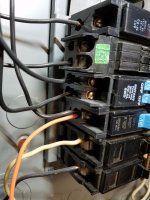
So I was thinking while I've got the drywall removed in the office, it probably makes sense to add a circuit to feed this room, and reduce the load on the circuit that supplies this room and the kitchen. That's when I removed the service panel's cover and discovered the panel is full. Hence this thread.
Since we haven't had an issue yet, I think even one additional circuit is sufficient to forestall potentially tripping the breaker for some time, perhaps years. And as a couple of people have suggested, I may be able to squeeze another circuit into the existing panel, so that's the cheapest option - and one that I was unaware of when I started this thread.
Actually, the cheapest option is to not add any circuits and just manage our devices. I.e., I could move microwave and coffee maker to other outlets in the kitchen. And then just coordinate when I turn on the printer with what's going on in the kitchen, etc. Inconvenient for sure, but doable. But if I can squeeze an additional circuit into the existing panel, that would be preferable to doing this power usage coordination dance.
So when I started this thread, thinking the panel was maxed out, I figured if I need a new panel or sub-panel, why add only 1 circuit. Why not add a few 20A lines to reduce loads on existing circuits and to make it so that I can shut off power to one room without shutting off power to multiple parts of the house, and while I'm at it, why not add a 220V line out to the attached garage, making a 220V welder a possibility.
Hopefully this color gives you guys a better understanding of where I'm coming from. I'm thinking my options are as follows:
1. Do nothing until I actually start tripping a breaker. Upside is least costly up front. Downside is if I do trip the CB the kitchen and office share, the walls in the office are already closed and I'll have to make holes to run new wire.
2. Pull new wire through while the walls in the office are open, but don't connect either end. If I start tripping the CB, then deal with adding a circuit or replacing panel or adding sub-panel.
3. Add a new circuit (or two, if possible) to existing panel and truly max it out (in terms of CBs, not load). A little up front work and expense, but probably forestalls future tripping for some time, possibly years.
4. Add a new sub-panel. More work and expense (a lot more expense if I'm not permitted to do this myself followed by inspection), but opens up possibility of what we can power, including new tools like a welder.
5. Replace the main panel with a 100A panel. A lot more expensive. Opens up possibilities similar to #4. Also preempts possible issues related to age of existing panel - that said, there is no rust or obvious corrosion on the panel and the basement where the panel is located does not have a moisture issue.
6. Replace the main panel with a 200A panel. Marginally more expensive than #5. Opens up possibilities, future-proofs (though we're not going to be here in 10yrs, so future-proofing isn't a high priority), increases home value a little bit.
@mm08822, let me check and get back to you on your specific questions.
It occurred to me this morning that a couple of tools might get me a better handle on what I'm dealing with in terms of loads and how close our use is to tripping the CB or even the main breaker. One is a clamp style ammeter - I could put it on the power line of the circuit shared by the kitchen and office and see what the load is when lots of devices are in use simultaneously. Though would I learn more from that than I would from adding up max amperage for everything on the circuit? What would be ideal is an amp meter with memory - so I could leave it on for a few days or even a week and see what real-world peak load is. Is there such a tool at the consumer level?
That brings me to the other issue - the CBs are very poorly documented. What I've been doing is as I've replaced worn out outlets, I've written down every outlet and light fixture I can find on the same circuit. But this is a piecemeal process. It might be worth investing in a circuit finder and map out the entire house. At the very least, it would help make a more informed decision with respect to the options listed above.