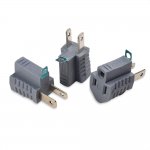
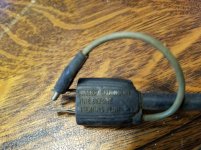
Do you guys remember these adapters? Unbelievably, they're still sold. I remember the ones with the little wire that was meant to be connected to the center screw of the outlet. Not sure what good that would have done if the outlet wasn't grounded.
Seemed like most people didn't know that, didn't use it, and/or just cut them off.
Mike
I have been using power tools at our family cabin for the past month using those exact adapters without incident. The cabin is wired with two conductors. The boxes are not grounded, and the receptacle slots are identically narrow (only the “hot” slot is narrow on more modern outlets), so I have to use adapters from before the “neutral” prong got wide, or cut the “neutral” prong down to fit the narrow slot. Some equipment is designed to distinguish between “hot” and “neutral” potential, but a lot of older equipment is not.
Do I like it, or consider it “safe”? NO. But...
The function of the ground is to provide an alternate route in the eventuality of a fault (alternate to your body). Unless there is an actual fault in your equipment (in which case, don’t use it - get it repaired), the “ground” should never carry current.
The only equipment I’ve seen malfunction
because of a missing ground is electronics. The touchpad on my work laptop was really erratic, and I eventually discovered the culprit was a broken-off ground prong on the charging station cord.
The “neutral” and “ground” conductors in much 115V residential wiring are at the same (ground) potential, and inside the circuit-breaker panel they are connected to the same buss.
I am not an electrician, I am not disparaging the wisdom of the electrical code, and I am sure real electricians will see errors in my conceptualization or terminology. But those adapters have their uses, and the various iterations of “grounding” wires in mid-century equipment only look different from one another - functionally, they’re doing the same (redundant, and usually unnecessary) job.
As far as screwing a ground to the faceplate...historically, you’re probably right - no benefit, as residential wiring generally doesn’t have metallic sheathing, and older 2-wire installations don’t have a “ground” wire. But in newer 3-wire installations, the box (if metallic) and the receptacle (even 2-slot ones) should be grounded. Also, commercial wiring does have metallic sheathing (conduit), and when properly installed, is grounded. That’s probably the thinking behind some of the outmoded grounding options we see on older equipment. In some residential wiring, the old natural gas lines (e.g. for gas lamps) were repurposed (after being disconnected) and may (or may not) function to similarly ground the converted fixtures (just don’t count on it).
Again, I am not an electrician, so fact-check me. I’ll gladly delete this post if anyone objects to its contents. I’m NOT advocating “taking chances” with such a potentially deadly resource.


 I had never seen one before. I posted pics in the Keystone thread.