To avoid these ads, REGISTER NOW!

Rebuilding a monarch 10ee lathe

OP
G

Grant Gunderson

Well-known member
Joined
May 17, 2013
Messages
2,320
Location
Bellingham, WA
While doing a bit more research into the Steelman method of converting the 3Phase AC motor of the lathes Motor / Generator setup to Single Phase, I found a really good manual on installing Steelman's H-A-S static phase converters... this site does a really good job of describing the steps needed to modify a 3 Phase motor to run on single phase. In this case 240V.

The first challenge with this conversion, is you need a 12 wire motor. Problem is most 3Phase AC motors only have 9 leads coming out out it. As is the case with Reliance VS drive this lathe uses. This is shown clearly on it's name plate:
IMG_5898.jpeg
The first step was to take the M/G apart and separate the internal star point.
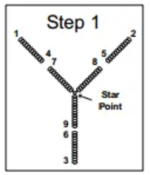
Screen Shot 2022-06-03 at 10.20.07 PM.pngScreen Shot 2022-06-03 at 10.20.14 PM.png
This then gives you 12 leads. The first part of this thread on PM does a good job of describing that process. I documented that full process earlier in this thread. Starting HERE.
IMG_3744.jpeg
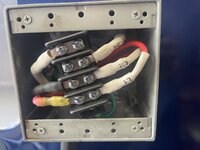
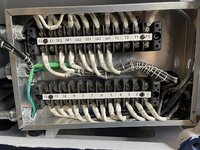
I used an Ohme meter to identify each of the leads as per the diagram in step2 above. With this done, I reinstalled the motor, and then wired the terminal panel. There is a lot of wiring going on in the terminal panel, so I did my best to keep it as organized as possible. I first connected the wires from the Lathes DC motor.
IMG_5775.jpeg
I then connected the leads from the DC generator portion of the M/G unit and laced the wires together to keep things tidy.
IMG_5788.jpeg
Next up was the main AC voltage in from the lathes main contactor panel. When I original ran the wire, I based it on the length of the original factory wire. In order to fit everything into one connection box, I replaced the factory vertical box, with a larger horizontal one. Thus created a problem, the AC main leads are too short!
IMG_5790.jpeg
So I ran 3 new leads from the main contactor panel.

In doing so, I spent some time looking at the panel and trying to better understand it.
IMG_5799.jpeg
If I am correct in my thinking, there is a transformer for a light by the main switch on the front of the machine, a 208-220V coil... not total sure what its purpose is in starting the M/G. There is two heaters, both #1375. Before starting this project, I had no idea what heater's where in relation to a AC motor. Turns out they are a thermal overload safety device to protector the motor. Am I correct in thinking that these protect against long term over current situations, where as a fuse only protects against short circuits? Regardless, I need to figure out what the value of these heater units are. It is also worth noting that only leads T1 and T2 to the motor have heaters on them. T3 does not, so when I connect the lathe to the mains I will only be connecting it via L1 and L2 for this conversion and only T1 and T2 will be transferring power to the M/G unit.
 

Attachments

  • IMG_5799.jpeg
    IMG_5799.jpeg
    353.2 KB · Views: 4
  • IMG_5799.jpeg
    IMG_5799.jpeg
    351.1 KB · Views: 3
Last edited:
To avoid these ads, REGISTER NOW!
OP
G

Grant Gunderson

Well-known member
Joined
May 17, 2013
Messages
2,320
Location
Bellingham, WA
I then connected the T1, T2, T3 leads and laced them. T3 is there incase I ever decide to convert back to the factory 3Phase system.
IMG_5793.jpeg
Ok, we are finally starting to get somewhere, and then I ran out of the solder filled crimps I have been using, so there it sat for a few days while I waited for order from McMaster. This is when I also realized my location for the Supco really won't work here.
IMG_5778.jpeg
Its going to have to lay horizontal on the bottom of the box to the left of the lower terminal block. That will give me more room for the wires.

When the rest of the crimps arrived from McMaster, I completed the connections for the Motor portion of the M/G.
IMG_5892.jpeg
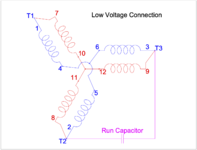
I used this schematic to make the connections.
Screen Shot 2022-06-03 at 11.11.05 PM.png
Ok finally, I am starting to get close to being able to power up and test the M/G to see if this will actually work!

But first time for some math.

The ampere reading on the input side (L1 & L2) of the H-A-S Static Converter will read as expected with any single phase equipment. That is, as the load increases, amperage will increase and both lines will be carrying the same amount of amperage. It is important to remember that these two lines will be carrying more amperage than the nameplate of a three phase motor will indicate. This is true because it will be carrying the same total power on two lines that it would be carrying on three lines when operating on three phase. The current required from single phase lines times 1.73 delivers the same power as three phase provided that the system efficiency and power factors are the same. For an H-A-S Static Converter-motor combination, the exact full load amperage taken from the single phase lines is calculated as follows:

(ConvertedMotorFLA=1.73PFH−A−S∗PF3Phase∗Eff3PhaseEffH−A−S∗FLA3Phase)

Where:

  • PFH−A−S= Power Factor of H-A-S Static Converter and motor combination
  • PF3Phase= Power Factor of H-A-S Static Converter and motor combination
  • Eff3Phase= Efficiency of three phase motor from nameplate or motor data
  • EffH−A−S= Efficiency of H-A-S Static Converter and motor combination
  • FLA3Phase= Three phase full load amps from motor nameplate
At full load conditions, it has been found that the power factor of the H-A-S Static Converter – motor combination is approximately .95 and its efficiency to be very nearly the same as when the motor is operated on three phase. The ratio of Eff3Phase/EffH-A-S then becomes unity and our equation simplifies as follows:

(ConvertedMotorFLA=1.73 /.95∗PF3Phase∗FLA3Phase=1.82∗PF3Phase∗FLA3Phase)

FLA3Phase for this motor is 13.2A

ConvertedMotorFLA=(1.73 /.95) x PF3Phase x 13.2

ConvertedMotorFLA= 1.82 x .95 x 13.2

ConvertedMotorFLA = 22.8 Amps!

The above relationship should be used to determine maximum L1 and L2 heater coil and fuse sizing.

At first thought, it would appear that this amperage is excessive; but it must be remembered that due to the winding connections, the I2R losses are spread out over all the motor windings.

Evidently, The T3 amperage may read higher than T1 amperage at no load or partial loads. This condition is normal and will not damage the motor or the converter. The T3 amperage will decrease as the load on the motor increases, while T1 and T2 amperages will increase as the motor approaches full load conditions. Although the actual amperages for L1 and L2 may be easily calculated as shown above, the amperage to use for the proper heater coil sizing for T3 is not so easily obtained. For practical purposes, however, the maximum T3 amperages should be calculated as follows:


T3 = .75 x FLA

So T3 = .75 x 22.8

t3 = 17.11


So based upon that info, I looked up the chart provided by Steelman and got the following:

Minium needed wire size for L1, L2, T1 is 10, for T2 it is 12 and for T3 it is 14. I used 10 for L1, L2 and T1 and then used 12 for T3.
So good to go there.

For the heater coil section the full load amperage is 22.8. I need to figure out what those Cutler Hammer #1375 heaters are actually rated at and confirm, they are adequate for this.

According to the Steelman chart, I should also add a heater to the T3 (starting circuit) with a value of 11.4 (thats a bit lower than the 17.11 I actually calculated) I will need to source one of these. I’ve never shopped for these before and seems like a big difference in prices on them. So could really use some advice on what to purchase.

I'll need a 30 amp breaker for the mains.

The overall input wattage (I2R) of the motor at full load when operated with an H-A-S Static Converter does not exceed the overall input wattage of the motor when operated on three phase. For this reason, at full load conditions, the motor will have the same approximate temperature rise as if operated on three phase power.
 
Last edited:
OP
G

Grant Gunderson

Well-known member
Joined
May 17, 2013
Messages
2,320
Location
Bellingham, WA
While researching the heaters this AM, I found this post that contains the specs for the Cutler-Hammer heater coils:

"The table below is for use with 40C rise motors. Coils selected from this table will allow a maximum of approximately 125% of rated motor current. If protection is wanted at 140% of rated motor current use one size larger heater coil than as listed. To find the approximate tripping currents of the heaters, multiply the minimum currents by 1.25."

The relevant section for the 10EE would seem to be as follows:

"Motor Amperes - Heater Coil No.
9.96-11.0 - H1370
11.1-12.1 - H1371
12.2-13.4 - H1372
13.5-14.6 - H1373
14.7-15.8 - H1374
15.9-17.6 - H1375
17.7-19.0 - H1376
19.1-21.0 - H1377
21.1-22.7 - H1378
22.8-24.8 - H1379
24.9-26.7 - H1380

Below the table it reads "Each of these numbers, prefixed by 9586, is the catalog number of a package of two coils."

The "Size 1" CH contactor in the 10EE should be good for 27A continuous based on the information I dug up about NEMA size ratings." Ok thats good as It will now be seeing 22.8Amps so I will be well within its limits.

So bassed upon that chart the factory heater coils are good for 15.9-17.6 Amps. too low for the single phase conversion. I will need the 1378 or 1379 coils for T1 and T2. The original 1375 coil is adequate for the T3 section... I ended up finding all of these on E-bay for pretty reasonable prices, so ordered a replacement set of the factory 1375 ones, a set of 1378 and 1379. At $5 a coil, I figured its worth having them on hand. I think I will go with the 1378 series first as it will trip sooner than the 1379 to give the motor a little extra protection, if that doesn't work, ill go with the 1379 as the calculated amperage is right on the line for max load.

That same post brought up the question if just one leg would trip the overload, specially if wired for single phase:

"does anyone here know if these CH overloads will trip with just one "leg" or heater coil used, or if they require both to be in circuit, and as such wouldn't the current rating of the heater coils then be directly correlated to current flow across both "legs"? Obviously both would have to be wired for 3 phase configurations, but for anyone converting their machine to single-phase power and using the original contactor and overload combination, that could potentially present an issue whereby the original machine wiring in my machine as well as others as Cal has noted in other places on the forum has the contactor coil across L1 and L3, but the overload is on L1 and L2, so if one were to hook up to single phase with only one side of the overload in play, to avoid changing the way the contactor coil is powered, then only one side of the overload is wired up, and perhaps it wont trip at all, or will trip with different current characteristics than if both sides of it are wired up"

This is something I hadn't thought about, so I went out and took another look at my machine.
IMG_5799.jpeg
Looking at my contactor, the coil is wired to L1 and the other side is connected to the right side of the overload switch (same side as T2 opposite of the main switch wire), so I believe the above concern isn't an issue as I am still using the coil as originally wired, and still using both heaters between leads T1 and T2. So Far so good (hopefully).

As wired via the schematic in my previous post the starter circuit is also connected to T1, so I'm thinking in this configuration, I may not need a separate heater for it, as it will be protected by T1's heater. However, this has potential to further increase the amperage on T1, but I think it will be ok, as the starting circuit should only have larger loads on it during starting, and then decreases as the motor load increases (opposite of T1's current draw) So as long as I am not starting the motor under a close to full load situation, that should be ok, in theory... or so I think.

Once the heater's I order arrived, I should be pretty close to being ready to power up for a test, to see if this conversion works.

However, something else I noticed looking at the contactor today, is one of the leads from the main forward / reverse switch on the head stock is connected to L3, which in this situation, I will not be using.
IMG_5900.jpeg
I haven't had a close look at that switch, but from knowing that you can reverse the direction of any 3 phase motor by reversing any two leads, I'm guessing thats what thats doing. I'll need to have a closer look at this and figure out, how to change it if needed. First things first, get the M/G spinning before doing more mods than needed, and verify everything with a meter.

At least at this point, I feel like I'm starting to learn a few things about AC motors.... time will tell if I actually comprehend, what I think I am learning....the proof will be if it actually works.
 
Last edited:
OP
G

Grant Gunderson

Well-known member
Joined
May 17, 2013
Messages
2,320
Location
Bellingham, WA
For the disconnect I ordered the following:

Siemens HF321N 30-Amp 3 Pole 240-volt 4 Wire Fused Heavy Duty Safety Switches. I found it for $55 in an amazon warehouse sale.


image.jpeg

I then ordered these fuses:

Bussmann BP/FRN-R-30 30 Amp Fusetron Dual Element Time-Delay Current Limiting Class RK5 Fuse, 250V Carded UL Listed

The Square D sub panel I installed in my garage previously is set up for 50 amp service. with dedicated circuits for the Bridgeport, my cabinet saw, welder, an accessory 110 circuit, and then finally a dedicated circuit for the lathe once I install it in its finally resting spot and run conduit and pull the cable for it. As long as I dont run any of the bigger draws simultaneously, shouldn't be an issue, and since its just me, I dont see that happening. The sub panel is nice, to, as its easy to lock all of the power out all of the machinery at once, so no worries about the 5 year old getting too curious if I'm not in the shop.

Back to the issue with the jumper form L3, I did a quick search, and found out that Cal Haines on Practical Machinist has done a great job of documenting the mod needed here as it also applies when using a rotor phase converter.
Here are the two schematics he posted, showing that the jumper from L3 to #3 in the as built wiring needs to get changed to L2 to #3, with no further wiring mods needed.
image.jpeg
image.jpeg

In the previous two threads about converting the M/G unit to single phase on PM, neither one of which fully documented the rest of the process, and at least for me, seemed to leave a bit of confusion about what exactly needs to happen with the rest of the wiring, and for sizing the heaters etc...partly due to the original links to the Steelman site no longer working. So hopefully I have now documented this process to make it easier for the next person to follow step by step.

FWIW, for the time I have spent thinking about and researching this and trying to make sense of it all, it would have been pretty easy to justify the cost of just buying a prebuilt phase converter. However I would have missed out on the learning experience this project has provided, so its been worth while imop.... now to do some testing once everything I ordered arrives.
 

csp

Well-known member
Joined
Mar 23, 2010
Messages
5,719
Location
Franktown, CO
I had the pleasure of skiing with Glen a few times in Telluride and there are a couple shots of my friends and I in one of the Greg Stump films he was in back in the late 80s.
 

American Locomotive

Well-known member
Joined
Jan 8, 2017
Messages
10,969
Location
Rhode Island
I definitely appreciate the effort you're putting into this conversion, I personally wouldn't have gone that route. I wouldn't have even gone the phase-converter (RPC, static, or otherwise).

At 13.2A @ 230v, the "Motor" section of the motor-generator is only ~5HP, which makes this a perfect application for a VFD. Single-Phase input 5HP VFDs are very cheap these days (even from well known brand names). You wouldn't have had to pull the stator out, re-wire anything, wouldn't have to deal with capacitors, potential relays, re-working the heaters. You'd simply connect L1, L2, L3 directly to the drive, and then connect the push-button contacts to the drive's input. Stash the drive in the lathe body somewhere or a separate cabinet, and you're done.

But as long as you're happy with the results, that's all that matters.
 
Last edited:
OP
G

Grant Gunderson

Well-known member
Joined
May 17, 2013
Messages
2,320
Location
Bellingham, WA
I definitely appreciate the effort you're putting into this conversion, I personally wouldn't have gone that route. I wouldn't have even gone the phase-converter (RPC, static, or otherwise).

At 13.2A @ 230v, the "Motor" section of the motor-generator is only ~5HP, which makes this a perfect application for a VFD. Single-Phase input 5HP VFDs are very cheap these days (even from well known brand names). You wouldn't have had to pull the stator out, re-wire anything, wouldn't have to deal with capacitors, potential relays, re-working the heaters. You'd simply connect L1, L2, L3 directly to the drive, and then connect the push-button contacts to the drive's input. Stash the drive in the lathe body somewhere or a separate cabinet, and you're done.

But as long as you're happy with the results, that's all that matters.
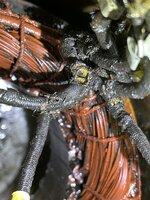
The main reason for not going the VFD route was that the motor / generator literally had a rats nest in it. I had to pull it apart to clean that out and in doing so found that the rodent living in there had partially chewed through most of the motor leads.


So since I had it apart and needed to replace the leads anyways it made since to go this route. I can always easily switch it back to true 3phase and or power with a VFD if I change my mind down the road. Now I have options. 0F15FA9F-665B-4EE2-8BD3-05D387A97B3D.jpeg
69CB27DE-7305-48C5-92AA-838AAFBD9CB6.jpeg
 
OP
G

Grant Gunderson

Well-known member
Joined
May 17, 2013
Messages
2,320
Location
Bellingham, WA
Ok, figured I'd keep going while waiting for the new heaters for the motor starter to arrive.

I changed the jumper wire in the starter for the F/R drive switch.
IMG_5965.jpeg
Cal, over on Practical Machnist was kind enough to send me high-res of the as built and the modified starter circuits. I then drew up the wire schematics for the ASBUILT motor config and modified for Single phase, using the free online wire schematic drawer from Smartdraw.com. I added his files to it to have a copy of both versions.
MG_Schematics.jpg
I sent this file out to get printed on metal in a standard 8x12 size... which perfectly matches the size I need for the front panel of the M/G junction box. This also makes it really easy to clearly see, exactly what wiring has been changed and how to easily switch back to the original.

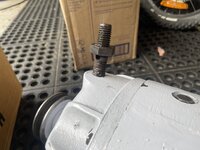
Next, its time to get the Exciter back in the lathe. It mounts using 3 bolts. The one in the front has a hole thought it, so you can use an alignment punch to adjust the belt tension. I gave these all a light coat of grease. I blued and oiled them with Boeshield T9 back when I tore the lathe down.
IMG_5967.jpeg
The front bolt gets threaded into the Exciter, until l there is equal amounts of thread showing.
IMG_5973.jpeg
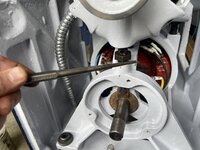
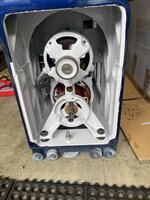
The exciter then gets lifted into the lathe, and rests on nuts on the back of the M/G's studs and then the front bolt gets screwed into the M/G using a tapper punch as a wrench.
IMG_5974.jpeg
IMG_5976.jpeg
I then installed the lower sheave. The belt that came on the Exciter had NAPA part 4L300W on it. So since I needed some DEF for the truck anyways, down to NAPA I went to get a belt.

Turns out, the belt is way too long!
IMG_5980.jpeg
To get proper tension on it, I had to max out the front adjustment, and its not possible to raise the rear enough to get it in alignment. So this explains the severe wear on the belt when I purchased the machine.

A little research on PM and it looks like I need two 85A or 85A/P belts for the DC motor side of the machine... but I have not found any info for the Exciter side.

Time to switch gears for a bit. Last winter I saw a pretty good sale on MIRKA sanders and there mesh sanding supplies, so picked up two of their longer sanders, one flat and one where you can adjust the curved radius and a bunch of rolls of abrasive in each grit. I really wish I had this size when I prepped the base casting, but there is enough parts left on the lathe, that these larger ones will come in handy.
IMG_5959.jpeg
The nice thing, is these are fully compatible with my Festool dust extractor. Before I left for work season last winter, I got the tail stock coated in bondo so time to get back to the body work. Hopefully by the time I have a batch of parts prepped for paint, we will actually get some dry weather.
IMG_5962.jpeg
20 minutes of sanding later, and I got most of it flattened out.
IMG_5963.jpeg
Notice the lack of significant dust. It sure is nice having good dust extraction! Anyways, more to come, but it's time for a beer.
 
Last edited:

gba2331

Well-known member
Joined
Sep 22, 2021
Messages
769
I think I won the lottery when it comes to day jobs. If skiing had a gospel, Glen Plake would be it’s prophet. The guy still just loves to ski. He’s also a bit of a motor head and would fit right in with Garage Journal. He was also the host of Truck Night in America for a few seasons.
Question; when Glen is on a photo shoot with his signature mohawk, does he go bareheaded all day or does he have a special hat to keep his head warm? I can’t imagine that he is hatless all day long :am
 
OP
G

Grant Gunderson

Well-known member
Joined
May 17, 2013
Messages
2,320
Location
Bellingham, WA
Question; when Glen is on a photo shoot with his signature mohawk, does he go bareheaded all day or does he have a special hat to keep his head warm? I can’t imagine that he is hatless all day long :am
He goes bare headed.... thats part of why he commands a pretty large day-rate compared even to the top athletes of today.
 
OP
G

Grant Gunderson

Well-known member
Joined
May 17, 2013
Messages
2,320
Location
Bellingham, WA
I got the F/R switch wired up.
IMG_6087.jpeg
It's got a couple of contacts that are quite worn. I'll need to either find a donor switch for replacments or make my own contacts. It should be good enough to at least test the M/G as first step will be to make sure the motor portion of the M/G works before moving on to testing the Exciter and the DC motor.
IMG_6089.jpeg
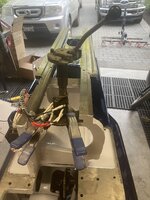
Since I dont have the headstock on the lathe yet, I'm using a couple of spring clamps to hold the switch here. Sketchy, but its staying in off portion for the first set of tests.
I picked up a 3 Phase 30 amp fused disconnect for the lathe off of Amazon's ware house deals for $50, instead of mounting it directly to the back of the lathe, I will eventually mount it to the wall behind the lathe for easy access. There will be a plug between it and the lathe, so I can more the lathe for cleaning, etc If I ever need to.

I didnt have a thread chaser small enough, so I used a tap to clean the threads for the Start / Stop Knee switches.
IMG_6092.jpeg
The pilot light was dead, so I replaced it with an LED
IMG_6107.jpeg
The new heater's for the motor's protection switch arrived.
IMG_6078.jpeg
I am going to go with these ones based upon my calculations.
IMG_6080.jpeg
They are identical to the factory standard ones, other than these have an extra winding on them.
IMG_6082.jpeg
One then gets installed on each side.
IMG_6086.jpeg
Ok, now I am getting close to powering up. One thin that had been bugging me was, why is the Start capacitor at 300Uf so much smaller than the 60Uf run cap? Well I decided to pull it out of the mounting bracket I had made. Its rated for 45VDC, no AC! Glad I checked! I ordered up a new Starting capacitor off of Amazon, its 300UF, and rated for 450VAC.
IMG_6109.jpeg
Thats more like it. Since this cap is larger, it won't fit in the M/G connection box, so I need to mount a second box on the lathe. I decided, its probably smart to move both caps into this second box, to clean up the main connection box.
IMG_6125.jpeg
Once I figured out the mounting locations, I used a transfer punch to line everything up, and then installed rivet nuts to install everything.
 
OP
G

Grant Gunderson

Well-known member
Joined
May 17, 2013
Messages
2,320
Location
Bellingham, WA
Here is the finished layout of for the Capacitor box.
IMG_6128.jpeg
I'll need to bring wires over for T1, T2 (these are the Line voltage into the M/G's main panel) as well as Motor Lead #3. These 3 leads will then power the motor.
MG_Schematics.jpg
The idea, is once the motor starts running the SUPCO Relay cuts out the Start capacitor. This way I can power the 3Phase motor on single Phase.

I then checked each capacitor with my Fluke meter.
IMG_6133.jpeg
60.7 uF for the run capacitor. Perfect.
IMG_6135.jpeg
308uF for the start Cap, just as it states on it. Perfect.
I then sprayed the lid of the cap box with clear insulating varnish, same as what I used on the motor windings. I also brushed it on the contacts of the Supco relay, as added insurance to prevent any chance of a short to the top of the cap box.
IMG_6130.jpeg
I had a bunch of a Watertight conduit left over from another project, so I am using that to get the lines to the Cap box. Instead of using the cheap plastic water tight fittings, I am using the metal version of them.
IMG_6124.jpeg
Not only are they metal, but they also use a metal furl that screws into the watertight conduit. These are pretty damn secure.
I drilled and taped mounting holes for the box behind the DC panel and bellow the Knee switch. These allows you two just remove two panels on the lathe to access all of the AC motor connections.
IMG_6114.jpeg
For the main M/G Panel, I needed a way to add another hole for the conduit. I ended up using my Festool drill with its right angle attachment.
IMG_6122.jpeg
That worked perfectly!
Here is the M/G panel fully wired up.
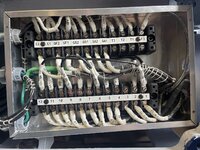
IMG_6138.jpeg
I tried to keep it as tidy as possible, but there is a lot of wiring in there. Really glad I chose not to cram the caps in as well! I then removed the DC motors connections from the panel and taped over them. As I want to test the M/G alone first, then the Exciter before moving on to the DC motor, so I can logically problem solve any issues that I might have.
IMG_6140.jpeg

For the main line connections on the back of the lathe, I used a contact bar instead of wire nuts. Since we are going to be running on 240V single, phase L3, does not have a connection. I am brining a Neutral to the lathe as well, in case I decide to add a work light latter. The grounds are screwed to the back of the box.

Ok time to power it up!
I flipped the breaker on, then hit the start button on the Knee switch. SUCCESS!!!! IT powered right up instantly! I was pretty excited and thought I was taking a video, but evidently I had my phone in photo mode still.

I immediately switch the lathe off, and verified the motor was running in the correct direction. Sucess.

Awesome, the single Phase conversion powers the M/G right up!
 
Last edited:

tarmy

Well-known member
Joined
May 28, 2014
Messages
4,683
Location
Nor Cal
As usual, awesome work and photos/info…keep it up…

Oh, and I have a few “projects” I need to get done when the lathe is ready…😎
 
OP
G

Grant Gunderson

Well-known member
Joined
May 17, 2013
Messages
2,320
Location
Bellingham, WA
I then proceed to check the parameters using my Fluke Meters. I want to make sure everything is correct before moving on to testing the Exciter.

IMG_6143.jpeg
First I checked the Voltages in the wires to the motor from the Cap box. My procedure is set the meter up, turn lathe on for a min or so, get a stable reading, turn off lathe, and reset leads, and repeat.

Voltage across T1 and T2 is 238.5. Same as it is from the line to the machine.
Voltage across T1 and #3 is 296.8 this seems a bit high
Voltage across T2 and #3 is 399.9V Ok, this seems quite high with the motor running full speed.

I'm starting to think the Start Cap isn't dropping out. I'm not totally sure yet. The lathe is firing up instantly each time.

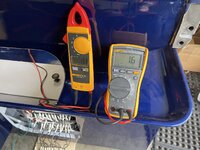
I then proceeded to check the voltages on each line from the Cap box to the M/G panel using a Fluke clamp meter.
#3 read 9.5 Amps. Thats bellow the max if 17.11A I had calculated...
I then checked T2 it read 9.6 Amps, ok this is pretty close to #3's reading. It's about half of the value I had calculated for T1 and T2's max amperages of 22.8A. That makes sense I think as there is no load on the M/G
I then proceeded to check T1 and got a reading of 0.1 Amps.
IMG_6146.jpeg
Humm... something clearly doesn't seem right. Did I get the meter properly clamped around the line? I turned the lathe off, reset the meter on T2 turned it back on and got a reading of 9.6A same as before. Ok, meter is working. Turned of the lathe off, repositioned the meter on T1 and turned the lathe back on again. Still reading 0.1 for T1

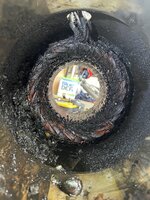
BAMB! Holly **** what was that, I know have a **** ton of smoke coming from the Cap box. Fu(K! I immediately turn the lathe off, and then run over to the breaker and turn it off! That was quite the experience, especially with my head down there reading the amp meter. I got everything aired out. I then grabbed my meter and made sure there was no voltage left at the Cap box lines. Looks like one of the caps exploded.
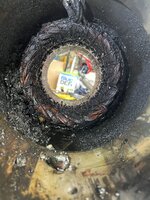
IMG_6150.jpeg
I then pulled the cap box out, to get a better look.
IMG_6153.jpeg
Sure enough the Start cap blew. What a mess! I am really glad this wasn't in the main M/G panel! Now to figure out what happened.

Here is the schematic of how I have it all wired.
MG_Schematics.jpg

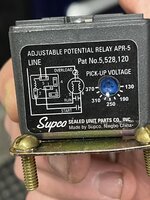
Here is the Supco Relay Schematic
Screen Shot 2022-06-11 at 6.26.57 PM.png
Based upon this, can anyone confirm I had the start cap wired to the correct terminal for the relay to remove it from the circuit?

I had the Supco Pickup Voltage set to 250V.

PICK-UP VOLTAGE
370 130 310 250 180
Patent No. 5528120
INSTALLATION
1. Turn power off.
2. Set the desired Pick-Up Voltage on the APR dial.
If you don’t know what the Pick-Up Voltage is, proceed as follows: * For equipment rated for 115-120 volts set the APR5 dial to 190.
* For equipment rated for 208-240 volts set the APR5 dial to 350.
(The above setting will satisfy most motor applications. However, the voltage ranges represent averages that may not be adequate for some applications. It is better to set the Pick-Up Voltage ac- cording to the equipment specifications.)

If someone can confirm I have the start cap wired to the correct terminals according to the Supco Schematic, I think my next course of action is to order a new start cap and then do the following:

If you wish to verify the APR5 setting:
1. Place an analog clamp-on ammeter over either one of the two wires from the start capacitor, or the wire from the start winding.
2. Apply power and observe the ammeter.
3. CORRECT SETTINGS: The Pick-Up Voltage is properly set if the relay contacts open when the unit is up to 70%-80% of full speed. Under normal conditions the motor will reach its full speed within 0.1-0.2 seconds. The ammeter cannot react that fast, however you will observe some swing of the needle.
4. If the Pick-Up Voltage is set too high, the voltage on the start winding will not reach the level of the APR5 setting. The needle of the ammeter will swing to its maximum arc and hesitates for 1-1.5 seconds before returning to zero. It simply means that the APR5 automatically opened the contacts after the safety time limit. Turn the setting to the next lower mark. Each mark is about 30 volts. Repeat until the motor and APR5 operate as in paragraph 3.
5. If the Pick-Up Voltage is set too low the relay contacts will open before the motor has a chance to get to the full speed. The motor may not start at all. The needle of the ammeter may swing and return to zero too fast. The relay opens the contacts before the motor has a chance to reach the desired speed. Increase the voltage setting by one mark until the relay and motor operates as indicated in paragraph 3.
 

Attachments

  • MG_Schematics.jpg
    MG_Schematics.jpg
    165.2 KB · Views: 21
Last edited:
OP
G

Grant Gunderson

Well-known member
Joined
May 17, 2013
Messages
2,320
Location
Bellingham, WA
It is wired correctly - at least as shown in the documentation. As the documentation states, it should have opened the relay contacts after 1.5 seconds anyways.
Thanks. Looking back I think the .1 amp on T 1 makes sense as that is just opening / closing the circuit. The 400v between T2 and T3 has me concerned. Either the relay isn’t opening the contacts and is defective, or I need a higher Voltage rated relay ( but it’s documented people using this one) or I need to lower the pick up voltage, or the Chinese capacitor on Amazon was junk. I also wounded is the multiple starts in a short period of time also over heated the start cap. I need to start eliminating variables.
 

American Locomotive

Well-known member
Joined
Jan 8, 2017
Messages
10,969
Location
Rhode Island
A 300 uF start capacitor should just be a standard plastic can electrolytic. I'd probably get a U.S. made capacitor though. Electrolytic capacitors can only tolerate a few seconds of being energized before overheating.
 
Last edited:

M635_Guy

Well-known member
Joined
Dec 5, 2019
Messages
4,335
Location
NC
The new heater's for the motor's protection switch arrived.
IMG_6078.jpeg
I am going to go with these ones based upon my calculations.
IMG_6080.jpeg
They are identical to the factory standard ones, other than these have an extra winding on them
"New" from, I'm guessing, 1950 (or earlier) :ROFLMAO: 😂

[EDIT - love this thread, your patience, and attention to detail. I appreciate the extra time/work to share it with us]
 
Last edited:
OP
G

Grant Gunderson

Well-known member
Joined
May 17, 2013
Messages
2,320
Location
Bellingham, WA
A 300 uF start capacitor should just be a standard plastic can electrolytic. I'd probably get a U.S. made capacitor though. Electrolytic capacitors can only tolerate a few seconds of being energized before overheating.
I'm leaning towards it didnt drop out as it was supposed to, or too many starts in a short period of time. That Chinese cheapie doesn't even list what amperage it is capable of either. I think I am going to go with this one, as its designed to withstand staying in circuit as added insurance. 440VAC 300 UF for $102.6

I do need to figure out for sure if the relay is actually dropping it out. Just got to figure out how to check with the meter on start up.
At least I know that:

1, the motor does actually work after all of the work I did on it.
2, I have proof of concept that this conversion should actually work, once I sort out the relay and start cap.
3, I am learning something, I may just know exactly what yet.

Actually, I've learned more from this lathe project than I did in 7 years of getting my Engineering Degree (granted I've never actually used my degree). With the electronics alone on the lathe I've learned a hell of a lot more than I did in my EE classes I took as part of the degree. Makes me think, we would have a hell of a lot smarter people, if in school they handed out actually projects instead of lectures, so you would learn by actually doing. I only had once class that was like that, it was Power Mechanics taught by Dr. Seal, who ran the Vehicle Research Insitute at WWU, and If I recall he had a lot to do with creating the rotary engine. Anyways, first day of class he hands us each a working Moto cycle engine, the mid term (whenever you got it done) was checking off you did a full and complete disassemble. the final was putting it back together and making it run. There was no lectures, just learning by doing. It forced you to ask the "right" questions to figure it out.

"New" from, I'm guessing, 1950 (or earlier) :ROFLMAO: 😂

[EDIT - love this thread, your patience, and attention to detail. I appreciate the extra time/work to share it with us]
Ha, yep, NOS. I now have a lifetime supply of them too. I dont think my wife would agree with you on the patience thing but, I'm trying to go methodically, which seems to translate into slow, with things I dont fully understand.... IE industrial electronics.
 
To avoid these ads, REGISTER NOW!
OP
G

Grant Gunderson

Well-known member
Joined
May 17, 2013
Messages
2,320
Location
Bellingham, WA
Ok, time to do a post mortem and see if we can figure out WTF happened.

I removed the Capacitors and relays from the lathe, so they are out of the equation

First lets check the resistivity in the 3 sets of motor windings.
IMG_6156.jpeg
T1 to T2 is 0.8Ω this is essentially across 4 of the windings.
T1 to #3 is 1.5Ω this is essentially across 2 of the windings
T2 to #3 is 2.2 Ω this is essentially across all the windings
MG_Schematics_readings.jpg
Here is the readings I got with my meter (red was while it was running before the cap failed. Blue was after the cap failed and with both the caps and the relay removed. The circles are where I took the readings with my clamp meter.

I dont think this is where the problem lies. If needed I can check each set of windings individually, or even break out my megger, but I'm feeling confident the motor is good.

Ok, now lets look at what actually failed. I think the problem lies with one of these two components are a combination of.
IMG_6158.jpeg
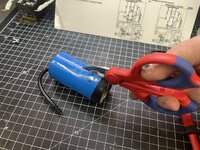
First lets look at the start cap. It blew the end right off of it. It appears to be made up of smaller caps. Lets have a look inside.
IMG_6162.jpeg
My Knipex electrician scissors made quick work of the plastic housing.

Thats a pretty sizable package for 4 small caps.
IMG_6163.jpeg
Ok, what are the using for the caps in this?
IMG_6170.jpeg
all 4 are 330uF 200WV caps.
IMG_6167.jpeg
Ok, to me this looks like two sets of 330uF 200WV caps in series, then wired in parallel. Not sure how they are getting the 450V rating.
Can someone explain that to me, or verify my thinking that this should only have been rated at 200v? When I tested it prior to install with my fluke meter I got a reading of 308uF.

Ok, moving on to the Supco AR5 relay. Hey look, USA on the circuit board... you dont see that very often these days.
IMG_6175.jpeg
The contacts feel stuck closed. With a bit of force from my finger I got them to open with a pop. Lets have a closer look at the contacts.
IMG_6185.jpeg
That looks to me, like they did in fact weld themselves shut.

Ok, so what would cause the relay to weld its self shut? Too many amps? Too much voltage? Did I have the pickup voltage set too high on it?
Th really was rated for 110 - 270 VAC, Single Phase 30 Amps

I am thinking a better quality cap is in order. Second, I need to see what the actual specs are for Supco Relay and varify with the meter what it is actually seeing. If anyone has any in site I all years as I am pushing my limited knowledge of this stuff.
 

Attachments

  • MG_Schematics.jpg
    MG_Schematics.jpg
    165.1 KB · Views: 5
Last edited:
OP
G

Grant Gunderson

Well-known member
Joined
May 17, 2013
Messages
2,320
Location
Bellingham, WA
Well I’m still waiting for Newark to send me a RA# for the defective full duty cap I ordered from them, so I decided to reorganize my collection of meters.

In the past I’ve always just kept my various meters in their factory cases and tossed into the top of my tool box. The leads where never in the right case and it was a **** show. So I finally decided to put them into my ever growing systainer collection.
75AB3B7E-7F10-45C7-BB34-ACD2DB4D7CEE.jpeg
 
OP
G

Grant Gunderson

Well-known member
Joined
May 17, 2013
Messages
2,320
Location
Bellingham, WA
I ordered a new Run capacitor from Newark as they are the only one that had one with the exact specs I was looking for in a continuous duty. Its 300uF and 440V. Only issue is that Newark's shipping division is completely incompetent and they shipped it in just a padded envelope instead of boxing it.
IMG_6422.jpeg
Notice the terminals are bent! After dealing with their horrible customer service for over a week, they finally agreed to refund my card and I ordered a replacement. That one showed up a week latter, with the same packaging issues and the same bent terminals. I contacted them again, and still waiting on a response another week latter... I wont be doing business with them. They could at least use customer service reps based on this continent.

I'm hoping they will send a replacement in a box, third time is the charm, but we will see. I did test the last one after I bent the terminals back and it does test good.
IMG_6424.jpeg
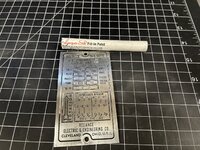
While waiting for Newark to resolve the issue, I decided to clean up the motor's name plate.
IMG_6458.jpeg
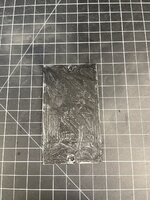
I used a black Lacquer stick to fill in the engravings,
IMG_6459.jpeg
The excess gets ripped off, then I hit it with a couple coats of clear coat. This then gets installed with drive screws.
IMG_6474.jpeg
Turns out the motor uses a #5 drive screw, which is the only size I dont have on hand and is the only size McMaster doesn't stock... odd. I then drilled the motors mount holes with a #29 drill and installed the name plate using a #6 drive screw.
IMG_6476.jpeg
Moving along, I didnt like how I had setup the terminal box previously on the M/G, so I decided redo it with a dedicated terminal strip for the motor leads... this will allow me to test various configurations, more on that latter.
IMG_6428.jpeg
Previous box, with the new one on the right.
First step is to use my transfer punches to locate the screw mounting holes for the box.
IMG_6442.jpeg
Those made a quick job of accurately locating the screw holes. For small holes in sheep metal, I find a step drill works best. I use a sharpie to mark it so I dont drill too large of a hole.
IMG_6431.jpeg
For larger holes I like to use my knockout punches.
IMG_6432.jpeg
I have a Klien set that serves me well for this.
 
OP
G

Grant Gunderson

Well-known member
Joined
May 17, 2013
Messages
2,320
Location
Bellingham, WA
The knockouts use a set of dies for each size that require you to first drill a smaller pilot hole.
IMG_6433.jpeg
You insert them into the pilot hole and tighten with a wrench.
IMG_6434.jpeg
This results in a much cleaner hole, that unlike a hole saw hole, does not need to be deburred.
IMG_6435.jpeg
The chips are also a hell of a lot easier to clean up too.
IMG_6436.jpeg

Thats a big plus if you are adding conduit to a box already in service as it keeps the box clean from metal chips.
Here is the new box installed and wired up with the motor leads.
IMG_6478.jpeg
Thats way cleaner and more organized than my previous attempt. I'm glad I re-did it!
Next I tested each pair of windings with my Fluke meter

IMG_6492.jpeg
I got the following results for each pair of motor windings:
1~4 = 0.9Ω
2~5 = 0.8Ω
3~6 = 0.9Ω
7~10 = 0.8Ω
8~11 = 0.9Ω
9~12 = 0.8Ω
Ok, resistance across each individual coil looks great!

Next, I tested motors insulation by testing each lead to ground with my Klien Megger
IMG_6496.jpeg

I started off testing at 250V and got >4000MΩ for each lead to ground, I then redid the test at both 500V and again at 1KV and got the same >4000MΩ reading for each. Finally I tested between each motor Terminal and still got >4000MΩ with the exception of the coil pairs. So the motor is sound electrically. Not bad for a garage motor rebuild.
 

Attachments

  • IMG_6492.jpeg
    IMG_6492.jpeg
    408.8 KB · Views: 3
OP
G

Grant Gunderson

Well-known member
Joined
May 17, 2013
Messages
2,320
Location
Bellingham, WA
Cal Haines over on Practical Machinist was kind enough to draw up the various wire diagrams for connection the M/G motor to AC power.
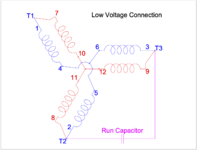
Here is the standard 3 Phase High-Voltage wire Diagram
Screen Shot 2022-07-05 at 7.57.26 PM.png
Here is the standard 3Phase Low Voltage diagram
Screen Shot 2022-07-05 at 7.58.34 PM.png
Notice, the High Voltage Diagram have the motor's coils in SERIES with 4 coils between any of the Terminals. The Low Voltage diagram has them in PARALLEL .

Now looking at the Steelman connection diagram for converting the motor from 3Phase to single:
Screen Shot 2022-07-05 at 8.04.56 PM.png
The T1 and T2 circuits are also in PARALLEL, however the T3 circuit is in SERIES. This is interesting. It brings up the question, can you use a start / run capacitor setup with the standard Low-Voltage connection to get a 2 Phase motor?
Screen Shot 2022-07-05 at 8.13.09 PM.png

Both the Steelman and the Low-Voltage diagrams share the following jumpers
1~7
2~8
4~5
10~11

Noticing this, I then wired those jumpers and placed them behind the Generator wires as these connections will be used regardless, and they are all part of the original factory configuration.
IMG_6503.jpeg
I now have a good test bed to do some testing and see if it is possible to use the Low-voltage connection with a run capacitor to run on single phase, and see how it compares to the Steelman method of converting to single phase.

Testing any two coils in Series gives me 1.6Ω. This is good, as they all tested the same. This makes sense as testing each of the individual coils gave me readings between 0.8 and 0.9Ω so 0.8Ω plus 0.8Ω = 1.6Ω. Along those same lines, if we then wire two of the series of coils in parallel we would take the 1.6Ω divide it by 2 and we end back up with 0.8Ω same as what each individual coil tested at. The Electrical Theories that I "learned" back in the few EE classes I took in college are quite foggy, but this is at least making a bit of sense to me.

Ok, lets wire it up for the standard 3Phase Low Voltage connection and see what we get.
IMG_6501.jpeg
For this configuration we add the following jumpers
3~9
5~6
11~12
The motor is now in the 3 Phase low-voltage connection identical to the name plate.
Lets see what we get for the following connections
T1 ~ T2 = 0.9Ω
T1~T3 = 0.9Ω
T2~T3 = 0.9Ω
Ok this is what we would expect based upon the calculations above.

Now, lets remove the 3 sets of jumpers for the Low-Voltage connection and then wire it for the Steelman conversion:
IMG_6504.jpeg
For this we add only two sets of jumpers
1~12
9~6

Now lets test our Terminal combinations again
T1 ~ T2 = 0.9Ω. Same as the standard low voltage connection above, since it is the same connections.
T1 ~ T3 = 1.6Ω Same as any two coils in series
T2 ~ T3 = 2.3Ω Interesting. Ok, looking back at when I tested the motor previously with the Steelman conversion, before the start cap blew, I was getting a voltage reading across T2 ~T3 of 400V. Interesting.. .thats high voltage territory. Humm.

Lets move the jumpers around and see what we get with the motor in the High-Voltage setting. In this setting, each combination of T1~T2, T1~T3 and T2~T3 is identical, in theory I can just test one of these and see what we get for resistance.
IMG_6507.jpeg
Turns out it is 2.3Ω! That is exactly the same as I got with the T2~T3 connection in the Steelman configuration.

So this is making a bit more sense, as to why I got different voltages in my previous testing.

So in summary with the Steelman configuration

238.5V T1 ~ T2 = 0.9Ω. Same as the standard low voltage connection above, since it is the same connections.
296.8V T1 ~ T3 = 1.6Ω (two coils in series)
399.9V T2 ~ T3 = 2.3Ω

Since T2 ~T3 also has the start / run caps connected across them, I believe the higher voltages here make sense...(If I am thinking correctly, the capacitor is what provides the phase shift so the motor can start, and because of the phase shift, the meter is reading it as high voltage.

Next step is to add the start / run capacitor to the system and see where we are at. I really wish I had an oscilloscope for the next round of testing, just to better understand what exactly is going on.
 

F-22

Well-known member
Joined
Jan 23, 2022
Messages
1,830
I understand why they did it as they did back in the day, but I'm just wondering - is there any advantage to the stock DC/AC conversion setup, compared to a single DC motor with a simple modern VFD?
 
OP
G

Grant Gunderson

Well-known member
Joined
May 17, 2013
Messages
2,320
Location
Bellingham, WA
I understand why they did it as they did back in the day, but I'm just wondering - is there any advantage to the stock DC/AC conversion setup, compared to a single DC motor with a simple modern VFD?
Yes.

When running off of residential single phase power, from my research there are several options to power the lathe. Prior to tearing into the lathe I looked into all of them, as I was unsure if the M/G unit was going to be salvageable.

VFD to power the M/G setup.
This is easy to setup, but an appropriate sized VFD is expensive. In addition a VFD doesn't really provide any major gain in this instance other than converting 3 Phase to single phase as there is no reason to vary the motor speed in this case. On the other hand a VFD made a lot of sense on my Bridgeport, as it allows me to vary the spindle speed without having to change belts as often.

Static Phase converter / Steelman method.
This option makes the most sense financially. It simply converts 3Phase to single phase. This is essentially what the Steelman method is. The difference is the Steelman method requires you to have all 12 leads out of the motor (most stock motor configs only have 9 leads coming out with 3 being tied in an internal star point) and then just requires the purchase of a start cap, run cap and a relay. Since I already had the motor apart to rebuild it, I simply pulled the 3 internal leads out, so it only cost about $160 to do it right. Still cheaper than buying the appropriate sized off the shelf static phase converter from a reputable manufacture.

Convert the lathe to just a 3 Phase AC motor and a VFD
This option is very expensive. It requires a much larger 3 Phase AC motor (10HP) to give the same power as the DC motor. Additionally it requires that you machine a custom adapter for the larger AC motor to drive the back gear, and you still need to add in breaking resistors to get the dynamic breaking the stock configuration has. People that have done this, have also reported the lathe is not as smooth during the full range of speeds as it is running off of the DC motor.

Power the stock DC motor off of a static DC drive.
This eliminates the entire Motor / Generator and Exciter setup. It is the most expensive option and it lacks full field acceleration, it lacks full field braking and most importantly it does not have protection for loss of Field without a lot of additional relays.

I decided to go with the Steelman conversion, as it was the most economical since I already had the M/G apart to rebuild it, and it allows me to connect the lathe to any 220/240V outlet and power it. Plus I get the added benefit of now knowing an hell of a lot more about how all of the electrical system on the lathe actually function, and I now know that I am capable of rebuilding a 3 phase motor generator in my garage :). In that sense been the cheapest electrical engineer class you could ask for.
 

gba2331

Well-known member
Joined
Sep 22, 2021
Messages
769
Actually, I've learned more from this lathe project than I did in 7 years of getting my Engineering Degree (granted I've never actually used my degree)
This is the conundrum with engineering education, how much book learning is actually used / is useful. I also don’t directly use most of what I learned, but I think the value of my over-education was in learning how to think and solve complex problems, which is exactly what you’re doing on this project. This "side-effect" of our engineering education doesn’t seem to be recognized as much as it should.
 
OP
G

Grant Gunderson

Well-known member
Joined
May 17, 2013
Messages
2,320
Location
Bellingham, WA
This is the conundrum with engineering education, how much book learning is actually used / is useful. I also don’t directly use most of what I learned, but I think the value of my over-education was in learning how to think and solve complex problems, which is exactly what you’re doing on this project. This "side-effect" of our engineering education doesn’t seem to be recognized as much as it should.
I feel like I had a pretty good grasp on solving complex problems, way before college, but a lot of that is how I was brought with having an Engineer as a dad and a Micro Biologist as a mom. My parents did a great job of teaching us to break problem down one by one to figure out the whole. The bigger issue with "higher" education is its 100% profit driven, and not based on the academic success of the students. Lets face it, it's a hell of a lot more profitable to teach theory out of a text book, than it is to combine theory with actually doing. My school had a really good Vehicle Research Institute as part of the Engineering department, and those classes where exceptional as they taught more by doing than by theory. On the other side of it, my wife owns her own PT practice, but never was taught complex problem solving in school. It was alway, here is how you treat these symptoms. It wasn't until much latter in one of her continuing Ed classes that she actually learned t treat the cause of the problem and not the symptom (complex problem solving). Thats all she does now and she is brilliant at it and high sought after for that. Just dont ask her to try to solve any electrical or mechanical problems.
 
  • Like
Reactions: csp

F-22

Well-known member
Joined
Jan 23, 2022
Messages
1,830
Oh sorry, I didn't dwelve too deep into how this lathe is powered, but these monarch lathes seem really unique. i was more reading through it and thinking about converting my own lathe, which is European and uses a ~3.5kW three phase motor (380/220v) and an electromagnetic clutch for the drive. 3 phase power is pretty standard around here so that's not an issue, but I'm thinking about adding in a (3 pahse to 3 phase) VFD and an rpm gauge so I wouldn't need to switch gears as much, could increase or decrease rpm while it's spinning, have a softer start...


Current motor seems to have two "speeds", but I don't know what kind of wiring makes it faster or slower through that switch. It's exactly twice as fast in the fast speed (max 4500rpm vs 2250 rpm). Maybe a 4 phase motor that can work as a 2 phase motor too?


I am also a mechanical engineer, but never dwelved into electronics too much. And I also got no real practical knowledge at the university, but due to my interest in metalworking I know a thing or two about machining....
 
OP
G

Grant Gunderson

Well-known member
Joined
May 17, 2013
Messages
2,320
Location
Bellingham, WA
Ok, thinking about this some more,

After measuring resistance in each configuration, I dont think the Low-voltage with the caps across T2T3 is going to work.
screen-shot-2022-07-05-at-8-13-09-pm-png.png
In the standard, Low-Voltage configuration we get:
The motor is now in the 3 Phase low-voltage connection identical to the name plate.
Lets see what we get for the following connections
T1 ~ T2 = 0.9Ω
T1~T3 = 0.9Ω
T2~T3 = 0.9Ω
Thats with each terminal set seeing 220/240V across it.

With the Steelman configuration
screen-shot-2022-07-05-at-8-04-56-pm-png.png
T1 ~ T2 = 0.9Ω. Same as the standard low voltage connection above, since it is the same connections.
T1 ~ T3 = 1.6Ω Same as any two coils in series
T2 ~ T3 = 2.3Ω Interesting. Ok, looking back at when I tested the motor previously with the Steelman conversion, before the start cap blew, I was getting a voltage reading across T2 ~T3 of 400V. Interesting.. .thats high voltage territory. Humm.

in the High-Voltage setting it is 2.3Ω between any two combinations of T1,2,3

So based upon the voltages I got from my attempt prior to the start cap blowing in my previous tests, I got
So in summary with the Steelman configuration it is wired to handle the high voltage across T2~T3

238.5V T1 ~ T2 = 0.9Ω. Same as the standard low voltage connection above, since it is the same connections.
296.8V T1 ~ T3 = 1.6Ω (two coils in series)
399.9V T2 ~ T3 = 2.3Ω Same as the standard 3 Phase HV connection.

The low-Voltage option with the run capacitor would not be, if I’m not mistaken.

Going back to the first thing in the Steelman manual: "it is important to remember that T1 and T2 two lines will be carrying more amperage than the nameplate of a three phase motor will indicate. This is true because it will be carrying the same total power on two lines that it would be carrying on three lines when operating on three phase. The current required from single phase lines times 1.73 delivers the same power as three phase provided that the system efficiency and power factors are the same.”

Thoughts?
 
OP
G

Grant Gunderson

Well-known member
Joined
May 17, 2013
Messages
2,320
Location
Bellingham, WA
i was more reading through it and thinking about converting my own lathe, which is European and uses a ~3.5kW three phase motor (380/220v) and an electromagnetic clutch for the drive. 3 phase power is pretty standard around here so that's not an issue, but I'm thinking about adding in a (3 pahse to 3 phase) VFD and an rpm gauge so I wouldn't need to switch gears as much, could increase or decrease rpm while it's spinning, have a softer start...


Current motor seems to have two "speeds", but I don't know what kind of wiring makes it faster or slower through that switch. It's exactly twice as fast in the fast speed (max 4500rpm vs 2250 rpm). Maybe a 4 phase motor that can work as a 2 phase motor too?
A Varible Frequency Drive works by varying the AC wave frequency the motor sees. This in turn it varies the RPMs of the motor. This works fine if you are only concerned about speed. The issue is you loose torque if you try to vary the speed too much, so while on my Bridgeport for example I can usually get by without having to change one step on the belt, but any more of a speed change than that I still need to move the belt if it’s an application the requires torque. Ie driving a large drill at slow speeds.
 
Last edited:
OP
G

Grant Gunderson

Well-known member
Joined
May 17, 2013
Messages
2,320
Location
Bellingham, WA
Ok, Time for a bit of a recap. When I purchased this 10EE, it Legitimately had a rats nest in the Motor / Generator.
IMG_3258.jpeg
The Rodent had literally eaten the insulations on the wire leads for the motor / Generator.

So I completely replaced all of the wiring for the Motor / Generator, the Exciter and the DC motor and did a full rebuild on all of it in my home garage.
IMG_3549.jpeg
Since I already had the 3Phase AC motor apart, I figured it only made since to split the internal star point apart, and bring those wire leads out, so instead of having a 9 lead motor (common) I know have a 12 lead motor. This put me in an interesting position, to do a Steelman method of converting the lathe from #phase to single phase, or allowed me to do a Low-voltgage conversion using a a Starting circuit. Turns out both methods use the same starting circuit.
IMG_6592.jpeg
The main difference is the Steelman method specs out a 60uF run capacitor, and the Low Voltage method (common on a rotor phase convertor) uses a 100 uF run capacitor.
IMG_6581.jpeg
The smaller 60uF run cap has a 8mm mounting thread, where as the larger 100uF cap uses 12mm. So I used an 8 to 12mm thread adapter, so I can easily interchange both caps, to test both methods.

To better facilitate testing both methods and taken measurements, I set up a third terminal strip and ran jumper wires.
IMG_6602.jpeg
I then set up two multi meters, one is reading voltage across the coil of the relay that takes the start cap out of the run circuit. The second is measuring resistance across the relays's switched contacts.
IMG_6607.jpeg
The idea is when the motor comes up to speed, the relay should drop the start cap out of the circuit and the reistance across the relay's switched contacts should read as an open circuit. Until it comes up to speed it should show some resistance.

It's now time to fire up the lathe for a test.
It F'n works! It fired right up on first try!
As you can see in the video the Relay's switch opens up very quickly as the motor comes up to full speed almost instantly. Note the 400+V across the relay's coil. This is proving to me the original Supco APR5 relay recommend for the Steelman method is undersized, as that relay is only rated for 250V.

To better evaluate the two methods of converting the 3Phase motor to single phase I purchased a Picoscope 2204A Oscilloscope. The nice thing about this unit is it works with both PC's and Mac's which is goos as I only run Apple computers and have for the last 20+ years. It also has some pretty sophisticated software, that I have a lot to learn about.
IMG_6587.jpeg
Here is the test setup
IMG_6611.jpeg
Cal Haines over on Practical Machinist, came up with a series of test perimeters for me to evaluate, consisting of 8 runs on the Steelman conversion and 11 run on the Low-Voltage singe phase conversion setup. Since the scope only has two Chanels, we are leaving the first challenge to take the T1 voltages, and then using the second Chanel to do the other measurements, this way we can sue the T1 channel as a reference to compare each. This will allow us to look as each set of of windings in the motor separately for both voltage and amperage measurements.

For example, here is an overlay of the voltages of the T1, T2 and T3 winding sets in the Steelman conversion. Hopefully I have the overlays properly aligned.
PastedGraphic-3.jpeg
PastedGraphic-2.jpeg

Notice how much stronger the T3 set is. I think this makes sense as its in series while the T1 and T2 sets in the configuration have the motor coils in parallel.

I haven't used a scope since I had a few EE classes in college and thats 20+ years ago at this point, so I kinda fell like I am learning it all again from scratch. So always open to any insights.

I was also going to setup a set of 3 thermal couples to take measurements of how hot the motor windings got, but I totally forgot. So I will have to implement that in the next series of testing.
 
Last edited:

tarmy

Well-known member
Joined
May 28, 2014
Messages
4,683
Location
Nor Cal
Thanks, again, for posting VERY detailed and interesting build posts…including the explanations of your testing. I am learning things with every electrical post you do.

Awesome. Please hurry up and finish too, my list of projects for you is growing…
 
OP
G

Grant Gunderson

Well-known member
Joined
May 17, 2013
Messages
2,320
Location
Bellingham, WA
Thanks, again, for posting VERY detailed and interesting build posts…including the explanations of your testing. I am learning things with every electrical post you do.
Thanks. At this point, tho I am learning as I go, and its proving to be a good cheap education (as long as I dont fry the motor). The motor appears to be unbalanced, but I also think there is some issues with the data collection with the scope (user error most likely) so next step is to verify the data from the scope with my Fluke meters, so I know what needs to get adjusted in the data collection. Once I know I have good data, I can move on to the next step of trying to figure out how to balance it.
Awesome. Please hurry up and finish too, my list of projects for you is growing…
You sound like my wife! Ha! My next planed project once the lathe is done is to redo my garage cabinets to better house my ever growing systainer collection.
 
OP
G

Grant Gunderson

Well-known member
Joined
May 17, 2013
Messages
2,320
Location
Bellingham, WA
I spent a few hours today verifying the data I collected with the scope this weekend, using my multimeters. I attempted to use the Thermocouple set I bought off of Amazon to also get some temp data from the M/G casing during these runs, but that was futile as the unit's auto off time is way too short.

First I read the voltage across the Start cap. I am getting 511V there.
IMG_6638.jpeg
Next, I used both of my Fluke Multi Meters and my Klein Megger to verify the rest of the data collected with the scope.
IMG_6641.jpeg
T1 to ground read 115VAC
T2 to ground read 115 VAC
T3 to ground read 503VAC
T1 to T2 read 241 V
T2 to T3 read 404.1V
T1-T3 read 299.8V
T1 43 Amps on immediate startup that quickly dropped down to 9.3 Amps.
T2 0.1Amps
T3 0.1 Amps

Terminal set #12~#3 (T1~T3) has the two coils in series instead of parallel and its connected to the start / run caps and it read 512VAC RMS

Terminal Set #7~#8 (T1~T2) has the two coils in Parallel and it read 241 VAC RMS

Terminal set #1~#2 (T1~T2) has the two coils in Parallel and it read also read 241 VAC RMS

Ok, next I checked the individual coil voltages.

Terminal #12~#3 contains coils #12-#9 and #3-#6
they read 255VAC and 256.9VAC

Terminal Set #7~#8 contains coils #7-#10 and #8-#11
they read 133.6V and 144.2VAC

Terminal set #1~#2 contains coils #1-#4 and #2-#5
they read 133.9V and 144.5V

Next, I started to run another set of test runs with the Oscilloscope. This time I set the height to +/- 500V and the time base to 2 ms/div wit the goal of capturing 1 full cycle. The scope has an auto trigger function that I was just starting to get figured out by run 4, that will allow us to look athlete the waveforms upon startup, and then the scope captures 64 consecutive waveforms, so we can also see how it looks once it stabelizes.

Here is a combined look of T1 (Yellow) T2 (RED) T3 (Blue) and Node 45 (Green) and Node 1011 (brown)
1658210679289.png
Here is the spectrum for T1, T2, T3
1658215981453.png

Before I could finish this set of runs, I ran into some issues. Hitting the Stop button the lathe wouldn't turn off!!! I had to kill the power to it via the mains breaker. Looking at the Contractor, it was stuck closed! I popped it back open and tried another run. This time the lathe would turn off, but even when it was off, I was still showing voltages at the motor terminals! Humm. I go look at the main contactor
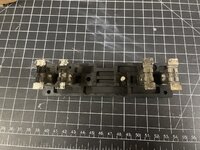
IMG_6692.jpeg
And it was full stuck closed. Ok, this is no good and its a pretty major safety issue. Time to figure out what the hell is going on with it.

The front of the main contactor has a black bar that is held on by two screws.
IMG_6694.jpeg
Ok, I think I have found the problem! Lets look at the contacts on the other side.
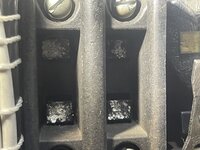
IMG_6696.jpeg

IMG_6699.jpeg
Ok, two of the 4 sets are completely worn out, and apparently have started to weld themselves shut!
IMG_6702.jpeg
A third set is not far behind, and the 4th set, look like they just need a good cleaning.

The contactor is a Cutler Hammer 9586 and is a Size 1 contactor.

Searching Ebay for a contacts for a 9586 gave me a ton of options but none looked correct. I then searched for a Cutler Hammer contacts #1 and found that a Cutler Hammer replacement set # 6-106 appears to be correct, so I ordered two full sets, so fingers crossed when they arrive they are correct. I dont think there is much left of the electronics of the lathe that I haven't rebuilt now!
 
Last edited:
OP
G

Grant Gunderson

Well-known member
Joined
May 17, 2013
Messages
2,320
Location
Bellingham, WA
I miss typed the amp readings in my previous post, so I edited it to fix it.

Terminal #12~#3 contains coils #12-#9 and #3-#6
they read 255VAC and 256.9VAC

T1 43 Amps on immediate startup that quickly dropped down to 9.3 Amps.
T2 0.1Amps
T3 0.1 Amps
I need to check the Amperage on each coil during the next round of testing.

This is concerning as each coil is only rated for Full load values at 220VAC and 6.5 Amps. Thoughts on how to lower the Voltage on T3?

Lowering the T3 value may not be needed, however as looking back over my notes in a previous post where I did the Steelman calculations, and re-readign the Steelman literature, I found this (specifically parts highlighted in red):

"The ampere reading on the input side (L1 & L2) of the H-A-S Static Converter will read as expected with any single phase equipment. That is, as the load increases, amperage will increase and both lines will be carrying the same amount of amperage. It is important to remember that these two lines will be carrying more amperage than the nameplate of a three phase motor will indicate. This is true because it will be carrying the same total power on two lines that it would be carrying on three lines when operating on three phase. The current required from single phase lines times 1.73 delivers the same power as three phase provided that the system efficiency and power factors are the same. For an H-A-S Static Converter-motor combination, the exact full load amperage taken from the single phase lines is calculated as follows:

(ConvertedMotorFLA=1.73PFH−A−S∗PF3Phase∗Eff3PhaseEffH−A−S∗FLA3Phase)

Where:

  • PFH−A−S= Power Factor of H-A-S Static Converter and motor combination
  • PF3Phase= Power Factor of H-A-S Static Converter and motor combination
  • Eff3Phase= Efficiency of three phase motor from nameplate or motor data
  • EffH−A−S= Efficiency of H-A-S Static Converter and motor combination
  • FLA3Phase= Three phase full load amps from motor nameplate
At full load conditions, it has been found that the power factor of the H-A-S Static Converter – motor combination is approximately .95 and its efficiency to be very nearly the same as when the motor is operated on three phase. The ratio of Eff3Phase/EffH-A-S then becomes unity and our equation simplifies as follows:

(ConvertedMotorFLA=1.73 /.95∗PF3Phase∗FLA3Phase=1.82∗PF3Phase∗FLA3Phase)

FLA3Phase for this motor is 13.2A

ConvertedMotorFLA=(1.73 /.95) x PF3Phase x 13.2

ConvertedMotorFLA= 1.82 x .95 x 13.2

ConvertedMotorFLA = 22.8 Amps!

The above relationship should be used to determine maximum L1 and L2 heater coil and fuse sizing.

At first thought, it would appear that this amperage is excessive; but it must be remembered that due to the winding connections, the I2R losses are spread out over all the motor windings.

Evidently, The T3 amperage may read higher than T1 amperage at no load or partial loads. This condition is normal and will not damage the motor or the converter. The T3 amperage will decrease as the load on the motor increases, while T1 and T2 amperages will increase as the motor approaches full load conditions. Although the actual amperages for L1 and L2 may be easily calculated as shown above, the amperage to use for the proper heater coil sizing for T3 is not so easily obtained. For practical purposes, however, the maximum T3 amperages should be calculated as follows:


T3 = .75 x FLA

So T3 = .75 x 22.8

t3 = 17.11


So based upon that info, I looked up the chart provided by Steelman and got the following:

Minium needed wire size for L1, L2, T1 is 10, for T2 it is 12 and for T3 it is 14. I used 10 for L1, L2 and T1 and then used 12 for T3.
So good to go there.

For the heater coil section the full load amperage is 22.8. I need to figure out what those Cutler Hammer #1375 heaters are actually rated at and confirm, they are adequate for this.

According to the Steelman chart, I should also add a heater to the T3 (starting circuit) with a value of 11.4 (thats a bit lower than the 17.11 I actually calculated) I will need to source one of these. I’ve never shopped for these before and seems like a big difference in prices on them. So could really use some advice on what to purchase.

I'll need a 30 amp breaker for the mains.

The overall input wattage (I2R) of the motor at full load when operated with an H-A-S Static Converter does not exceed the overall input wattage of the motor when operated on three phase. For this reason, at full load conditions, the motor will have the same approximate temperature rise as if operated on three phase power."
 
OP
G

Grant Gunderson

Well-known member
Joined
May 17, 2013
Messages
2,320
Location
Bellingham, WA
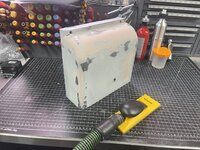
While waiting for electrical parts to show up, figured id try to get some of the parts off of the work bench and back on the lathe. For that to happen, I need to get some body work done!
IMG_6759.jpeg
Last fall, before I got busy with work season, I left. bunch of parts in Bondo.
IMG_6754.jpeg
So I spent a bunch of time sanding them down with one of my Mirka flat sanders hooked up to my Festool dust collector. Note the total lack of dust!
IMG_6756.jpeg
I have found that the Mirka abrasive net, works way better for this than the Festool paper I normally use. It cuts more effeciently, and it lasts way longer before getting gummed up.
IMG_6757.jpeg
My only gripe with it, is once you open a roll, there is no way to tell what grit it is, unless you start to unroll it, so I mark the inside of each roll with the grit, to make them easy to identify.
IMG_6762.jpeg
I did the majority of the sanding with the Mirka sander to keep everything as flat as possible within each plane, but some of the curves needed finger sanding... to aid in this, I wrapped the Mirka abrasive around some delrin rod to help contour to some of the tighter places.
IMG_6763.jpeg
Damn, look at how much dust is left from just the finger sanding...this is a good example of why the Festool dust collectors are worth every cent of their cost in my mind.
IMG_6765.jpeg
Once the sanding was done, I used a carbide scribe to make sure the alignment mark for the thread dial stays visible.
IMG_6766.jpeg
Everything then got wiped down twice with Lumabase wax and grease remover to make sure there was no contaminates on it... especially important after waxing skis near the parts all winter!
IMG_6768.jpeg
I am using a Wagner paint tent outside as a makeshift paint booth... my wife has made it very clear, I'm not allowed to paint in the garage anymore due to the fumes creeping into the house.
IMG_6770.jpeg
Supplies all lined up. This coat is a two part primer from Lumabase. After it goes on, and gets sanded it will allow me to better see what needs more filler before I move on to a seal coat.
 
OP
G

Grant Gunderson

Well-known member
Joined
May 17, 2013
Messages
2,320
Location
Bellingham, WA
With the primer / Skim coat on, I was able to see what areas still needed a bit of filler. Thankfully there wasn't a lot.
IMG_6775.jpeg
I mixed up a small batch of Bondo, but added a bit of extra fiberglass resin to thin it out a bit. Given the heat we are having it kicked pretty damn quick!

IMG_6793.jpeg
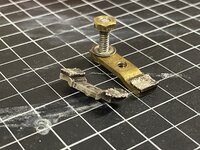
While the Bondo was doing this thing in the back yard, I checked the mail and found out the new old-stock contacts I ordered for the lathe's main contactor had arrived.
IMG_6776.jpeg
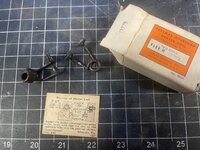
Turns out my E-bay guessing was correct. I can confirm the proper replacement contacts are the Cutler-Hammer 6-105
IMG_6778.jpeg
The originals had a brass backer, but thats the only difference. Sometime in the last 80 years, they must have made some cost savings to the mfg.
IMG_6781.jpeg
I used a fiberglass contact cleaning brush to clean up the contacts. FWIW, I have a full set of contract brushes in steel, brass and fiberglass along with contact cleaning files and tweezers.
IMG_2452.jpeg
They each have their time and place, but the Fiberglass one is the one to buy if you are looking for one. It was one of the most used tools I had back when I did a lot of camera repair... turns out most problems with small electronics can be fixed just by cleaning the battery contacts.
IMG_6782.jpeg
Before cleaning.
IMG_6783.jpeg
After cleaning.
IMG_6786.jpeg
The contacts are all held in place by a slotted screw. A #4 driver fits perfectly.
IMG_6788.jpeg
All set for another 80 years... with the second set I purchased, there is probably 160 years of service ready to go! I'll be long gone before I need the second set, but I imagine they are only going to get harder to find, and they where cheap, so I got a spare set.
 
OP
G

Grant Gunderson

Well-known member
Joined
May 17, 2013
Messages
2,320
Location
Bellingham, WA
On the switch side, the contacts just get replaced, by turning them sideways.
IMG_6779.jpeg
The original springs and ceramic cup bellow them, where still in good shape, but since the kit came with all new parts, those got replaced as well, a #2 flat driver helped to compress the springs to get them in / out.
IMG_6797.jpeg
I wasn't supper happy with the way I laced the contactor wires before, so I did a bit of research and found out there is a "proper" twine for doing this. It's even made in the USA!
IMG_6798.jpeg
The waxed twine, does a way better job of gripping the wires than the non-waxed variety. It also allows you to pull it tighter and helps each clove-hitch stay put. It just works better. Imagine that. Just guest show using the proper materials / tools makes a big difference.

IMG_6799.jpeg
I also terminated the lacing, by taking the end of the twine, after doing the tie off knots and lacing it back through the back bone of the laces. Apparently thats the NASA way. Regardless it just looks better.
 
To avoid these ads, REGISTER NOW!
Top Bottom