To avoid these ads, REGISTER NOW!

Hex key deep dive

aggiegrads

Well-known member
Joined
Jan 14, 2019
Messages
61
Location
Oregon
A while back on bikeforums.com, I decided to take some good photos of various hex key tips to try and help me articulate why I prefer some keys over others. I also think that some on this forum might find this useful or interesting.

The tip really highlights the differences between manufacturers, and for me is the clear indicator of overall quality (that's where the work is done, after all).

I have many hex keys, more than any reasonable person should have. I have accumulated various hex keys over the years and they are spread across my workbench, my travel kit, my car, my son's tool kit, etc.

Here is the gang:
f09c948_z_984c3b644054ea21c12343702f09d69e2f1027eb.jpg

From left to right: Beta, Wera, Wiha, Silca (Included with Pump), Bondhus, Elkind, Ikea, Proto (socket), and Park (folding).

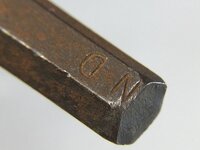
First up is typical Ikea/furniture assembly garbage. Only including to show what truly bad tools are. You can see how the end is sheared off and minimal cleanup was done. On the lower right, you can see where the edge is bent over during the shearing process. The metal is often soft and they strip easily. This means that you are likely to deform fasteners, even if you use these when new.
dfb33c0_z_24be9e90f4ac85e51b4893551ba532e900723032.jpg

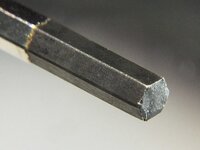
Next up is Elkind. You can see that it has also been sheared, and is not square on the edges. This is typical of big-box store keys like you generally see at Home Depot and Lowes in the US. I don't recommend these, even for people on a budget because unlike Ikea throw-aways, these are hardened and even more likely to do damage to fasteners.
56ff4c5_z_8aeeccb452c1e0f31190126500f80253fe088702.jpg

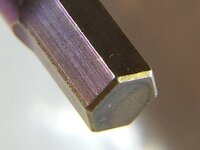
Next is Bondhus GoldGuard. For me, this is the minimum level of quality. First off, you notice that the edges are chamfered to get rid of any burrs in the separation process.
The finish isn't great (You can see how course the grinding wheel was that was used for finishing), but everything is square, and the chamfer should help align the tool in the fastener.
At $14 bucks for a nine-piece set, I cannot in good conscience recommend anything below this level given how much they are used.
9ca755b_z_a7fa889828ab2719de42b53eaffba90efd035122.jpg

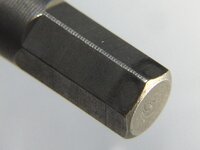
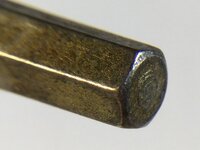
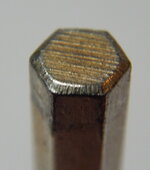
Here is the end of the Park key. This is on the folding set. It looks like the chamfering was done before a nice, thick oxide coating. The chamfer looks ground (instead of machined), but is consistent.
‘this key has not been used much at all. It resides in my car and has only been used a few times when I needed to help someone fix a minor issue.
9fbfb6b_z_b72e36ad15a1e195c12946ee617b8b0e2a23dce0.jpg

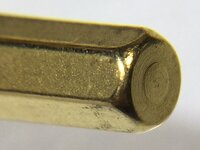
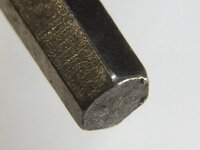
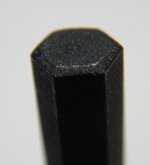
Here is the Wiha. This has the best finish so far, although the chamfer is a little bit off center. You can tell that this end was turned because the end face is round instead of hexagonal.
This wrench has actually been used quite a bit, but shows no sign of wear whatsoever.
At roughly the same cost of a Park-branded set, I definitely recommend these over Park.
233c648_z_8435cd920f2529e4672fa31844bf0233590ba5a0.jpg


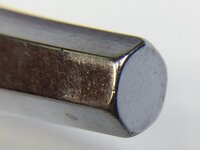
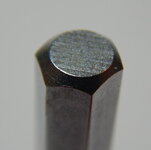
Now we start getting to the premium stuff. This is the Silca. It has a clean chamfer and a mirror polish that makes it pretty hard to photograph. I cannot speak to the durability because I only have two sizes that were included with an unbelievable, albeit overpriced pump. According to a source at Silca , they use the same hex stock as PB swiss, but Silca does their finishing in Taiwan instead and coats with a polymer for better grip and durability that you get with paint. Everything seems a bit more "rounded", so the wrenches probably spend more time in the shaker or at the polishing wheel. I expect that these are the exact some quality as PB Swiss and the only difference is finishing.
5c24c7a_z_30e7a4febc273c437d1d5b800aa374783c3081b4.jpg

Wera uses a different shape that works really well. They grind down from round stock and the finish is excellent. There is a slight "star" to the pattern so that the tool grips on the flats of the fastener as opposed to contacting at the corners. I see the logic in this approach, as no matter the tolerances that the wrenches are built to, the fasteners will generally be built to a lesser tolerance. You can see in the photo that the machining is excellent.
I was able to get these for $25 a set before this past Christmas, and at that price, this is my clear value winner.
4ece994_z_9948567937f1098cd98e3a7c1f120fd1a0bc1519.jpg

Next is a Proto bit socket. I understand that Proto builds and tests to a higher spec due to several aerospace contracts (including NASA). They are a high-end industrial brand made in the USA. This bit is machined down from 1/4" stock to its final dimension and the machining is excellent. I have these on short sliding t-handles and the bits show almost no wear after several years of use. There is a much larger chamfer on these guys, and it does make it a bit easier to find the fastener in practice. This bit gets used a lot because it is the bit that I use in my torque wrench.
02e4644_z_22453bb2badcb5f5dd671a58c4fe6ae158c5a5ff.jpg

The last tools are the Beta sliding t-handles, and they are also a favorite of mine. I have probably used these more that any other hex key. They are machined down from round stock, and the level of machining is impressive. You can see six separate facets in the "tip" of the tool, as well as machining marks on each face. The oxide finish is not as thick as on some of the other brands. These are my "largest" sets, and every so often these will not fit into a fastener.
Because some of the bits are oversized, I wouldn't recommend these to someone due to their cost unless they were specifically looking for Sliding T handles. There are definitely times when a sliding t-handle is the best tool, because it allows the user to apply torque very close to the fastener. It can also help get the shaft out of the way when there is interference (like bottle cage bolts).
c53f791_z_a15bae045f9100346e218690fd7320300aa5ea18.jpg


I am not a big user of ball-ends. They are fine, but they don't work well at all in button-head fasteners and deform socket head fasteners if you use them at too high of a torque. I use them to "run-in" a screw, but use a square end for any reasonable amount of torque.

If you are looking for hex keys, I hope that you find this helpful.
 
To avoid these ads, REGISTER NOW!
OP
A

aggiegrads

Well-known member
Joined
Jan 14, 2019
Messages
61
Location
Oregon
Part II - Ball-Ends

OK, so I spent some more time looking at ball ends. I did see some interesting things when I looked close up. One thing that it important to know if that the contact area in a ball end is much less than it is with a straight square key. Another is that the key is inherently weaker due to the necked end. I work in a capital equipment manufacturing factory, and I have seen many broken ball-ends in fasteners. Most ball ends have been removed from the manufacturing floor and the ones that remain are controlled by the supervisors and are only to be used in specific circumstances where the design does not allow a standard tool to work.

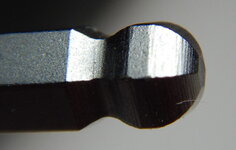
I will start with the Bondhus T-Handle that I have had for a long time and used quite a bit. Even though the tool shows a lot of wear, the edges are sharp across the entire profile of the ball and neck. You can also see from this photo exactly where the wear occurs. It is obvious that the contact area is extremely small, the silver "band" is less than a millimeter wide. Most of the wear is near the edges.
4b0ccac_z_9f67e4bdf097daab0aacce0f608f174120905686.jpg

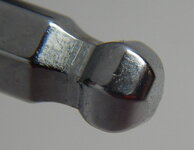
Next is the Elkind. I don't like this design at all. The "backside" of the ball is straight, which defeats the purpose of the ball. The neck has interesting surface that leads me to believe that the neck may have been forged to net shape before the profile was put on the ball end. Again, I would not recommend the Elkind for either end of the tool.
d418f0f_z_c37615efb92819eab2a5810ea05c819848270831.jpg

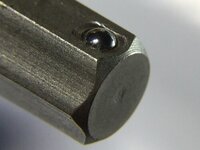
Here is the Bondhus GoldGuard. The machining is nice, and the surface is very consistent.
869de55_z_0dd7674129f6f77bfcd15960db15a866729116df.jpg

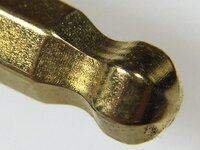
Here is the Wiha. Again, the machining and surface finish are very nice. The ball is "longer" than the Bondhus balls, which lead me to believe that you may get more surface area when the wrench is at an angle.
3f6f4c8_z_bdd3614046f20a8f985b371f273cfe23d35fac0f.jpg

Next up is the Wera. The machining blows me away. It is obvious that the machine tools used are kept sharp - the other brands you can see inconsistencies in the tool marks that indicate nicks or burrs in the cutting tools. There is no evidence of that here whatsoever. The other thing to notice is that the ball shape is consistent on both sides of the ball. None of the other brands seem to have this same consistency in the shape, and my guess is that this geometry leads to more contact area.
ccfc8f9_z_06d95fcc7033b69b8fae057981aa557509604ee1.jpg

Finally, we have the Silca. In this case, I believe that the chrome coating and high polish do the tool a disservice. All of the edges appear to be rounded. This ball appears to be the "stubbiest" of all of the brands.
0bbd813_z_e3f4919a7c91ec3cf36743d79a303bfb45135315.jpg
 

boom_bap

Well-known member
Joined
Feb 29, 2020
Messages
614
Location
Idaho
nice display, enjoyed the macro shots showing the chamfers. Personally I stay away from the keys these days unless I can't get in otherwise. I like the Felo 1/4 handle and use bit sockets, like the Capri metrics and VIM metric stubbies.
 
OP
A

aggiegrads

Well-known member
Joined
Jan 14, 2019
Messages
61
Location
Oregon
nice display, enjoyed the macro shots showing the chamfers. Personally I stay away from the keys these days unless I can't get in otherwise. I like the Felo 1/4 handle and use bit sockets, like the Capri metrics and VIM metric stubbies
Yes, good point. I actually use my Wera bit ratchet most often with Wera hex plus bits. The machining on the bits is identical to those on the Wera keys.
 

RoninB4

Well-known member
Joined
Jul 22, 2020
Messages
3,601
Location
Under My House
I can appreciate the time/trouble you went through to offer an in-depth analysis of the different brands but some of your conclusions rather short sighted.

Ball drivers were designed to spin a fastener out once it's been loosened, the reduced cross section of the neck would be your first clue that it's not as strong as a standard hex key.

Deformation of the end is part of how they're all made, chamfer of the end is an extra step and costs more money but really doesn't affect how the tool functions. Out-of-round chamfer is likely based upon the collet/spindle/bearings combination and is merely a visual appearance aspect that means nothing to functionality. If that's important to you then that's fine but it really means nothing to a disposable tool like a hex key IMO.

Not one comment on the steel used or the heat treating, these are critical to how a tool like this functions. Appearances and finish go out the window if the steel used isn't up to the task or the heat treating leaves them too soft/hard.

There are at least two distinct methods for making a ball driver, forging isn't one of them. There is also the age old correlation of time vs. money in producing these. A better finish means it cost more to produce but that doesn't make it a better product in this case. The observation of "nicks or burrs in the cutting tools" is likely incorrect due to how the profile is made. I see shorter cycle times but nothing to indicate a damaged cutting edge.

The profile has a lot more to do with the intended lean angle of operation, cycle time, and patent infringement than how much contact area engages the socket. Contact area means nothing except to marketing if they're used the way they're designed to be used. Exceeding design intent results in a broken tool as many of you have discovered.

I don't mean to be rude to the OP but you simply don't understand why some of your conclusions/observations are off. I worked for Eklind Tool in the mid 90's as a die maker and spearheaded the ball driver project for them. The ball drivers looked better back then, there's several reasons they don't look as good now. I have several different brands, they're all considered perishable tools.
 

Grokew

Well-known member
Joined
Jan 4, 2020
Messages
356
Location
Home
There are at least two distinct methods for making a ball driver, forging isn't one of them.
This is interesting, please share more info if possible.

I worked for Eklind Tool in the mid 90's as a die maker and spearheaded the ball driver project for them. The ball drivers looked better back then, there's several reasons they don't look as good now.

Please share more of the story.

I do have one question.
I read somewhere that one of the reasons the newer Eklinds are relatively soft, is because of a lawsuit. I tried searching online but couldn't find anything about it. What was it about?
 

woody 73

Well-known member
Joined
Apr 14, 2009
Messages
11,546
Location
The Great State Up North
I get it op you like the best of the best and I enjoyed your scientific post but in the end to me at least they are nothing more than just hunks of metal.

Not losing any sleep I pick them up by the boat load at garage sales and if they fail at removing a screw, I toss them and pick up another one.
 

Attachments

  • GEDC6703.JPG
    GEDC6703.JPG
    295.4 KB · Views: 64
  • GEDC6704.JPG
    GEDC6704.JPG
    205.6 KB · Views: 58
  • GEDC6705.JPG
    GEDC6705.JPG
    198.4 KB · Views: 54
  • GEDC6706.JPG
    GEDC6706.JPG
    227.9 KB · Views: 55
  • GEDC6711.JPG
    GEDC6711.JPG
    260 KB · Views: 59
  • GEDC6712.JPG
    GEDC6712.JPG
    248.7 KB · Views: 56
  • GEDC6713.JPG
    GEDC6713.JPG
    282.8 KB · Views: 54
  • GEDC6714.JPG
    GEDC6714.JPG
    227.3 KB · Views: 51

bwringer

Well-known member
Joined
Jan 1, 2013
Messages
10,318
Location
Indianapolis
I get it op you like the best of the best and I enjoyed your scientific post but in the end to me at least they are nothing more than just hunks of metal.

Not losing any sleep I pick them up by the boat load at garage sales and if they fail at removing a screw, I toss them and pick up another one.
Weird flex, but OK...


Thanks for the close-ups and reviews!

I keep several premium brands around; they all seem to fit a little different, so if it's a tough and critical situation, I'll try different brands to see what fits that particular fastener best.

My go-to for stubborn hex fasteners is Wera Hex-Plus; that weird shape really does seem to work where others just skip and spin.

I've had trouble with the huge chamfers as seen on the Wiha and Proto you photographed, especially on button head fasteners.
 

RoninB4

Well-known member
Joined
Jul 22, 2020
Messages
3,601
Location
Under My House
This is interesting, please share more info if possible.


Please share more of the story.

I do have one question.
I read somewhere that one of the reasons the newer Eklinds are relatively soft, is because of a lawsuit. I tried searching online but couldn't find anything about it. What was it about?
-There's a few posts I've made on this before. I'll try to post a link to an earlier thread, if it doesn't work just search for Eklind and my name. I hesitate to post a full reply here as I don't want to bore anybody with what could be regarded as OT for a site people want solid information on, my stories are sorta in the Kiss-N-Tell department. Don't know if the keys are softer now but I was part of the decision to drop the Rc value in the 90's if you really want to hear it.


Grokew

Well-known member
Joined
Jan 4, 2020
Messages
356
Location
Home
-There's a few posts I've made on this before. I'll try to post a link to an earlier thread, if it doesn't work just search for Eklind and my name. I hesitate to post a full reply here as I don't want to bore anybody with what could be regarded as OT for a site people want solid information on, my stories are sorta in the Kiss-N-Tell department. Don't know if the keys are softer now but I was part of the decision to drop the Rc value in the 90's if you really want to hear it.

Thank you very much.
 

Shop-hound

Well-known member
Joined
Nov 1, 2019
Messages
183
Location
Calgary, AB
I get it op you like the best of the best and I enjoyed your scientific post but in the end to me at least they are nothing more than just hunks of metal.

Not losing any sleep I pick them up by the boat load at garage sales and if they fail at removing a screw, I toss them and pick up another one.
They strip out too easy on seized and rusted (or as @Squankum noted soft as Brie :p) to take a chance with garbage keys. Low to no chamfer, name brand (Snap on, Bondhus, Wera, PB or nothin). Hammering in Lisle splined extractors loses its charm pretty quick on the rounded out ones :)
 

bwringer

Well-known member
Joined
Jan 1, 2013
Messages
10,318
Location
Indianapolis
Some say "this hex bit is better than that hex bit." I say the Germans make too many cap screws with metal made out of cheese.
Too true. And so do the Americans, Japanese, Koreans, Brits, etc.

And as long as we're raging, let's set aside an especially malevolent patch of ire aimed at the widespread insistence on using shonky shallow button-head torx fasteners in highly inappropriate places. Like suspension. Lookin' at YOU, Ford... W. T. F.
 

Squankum

Well-known member
Joined
Mar 28, 2011
Messages
7,816
Location
Southeast
Too true. And so do the Americans, Japanese, Koreans, Brits, etc.

And as long as we're raging, let's set aside an especially malevolent patch of ire aimed at the widespread insistence on using shonky shallow button-head torx fasteners in highly inappropriate places. Like suspension. Lookin' at YOU, Ford... W. T. F.

Yeah! The whole promise of Torx is six points of very good contact! But I goes to loosen the tension on the serpentine belt on Ms. Squankum's BMW, and the tensioner has a Torx hole in it (good) and it's a shape cast into the aluminum (not necessarily bad) and... they made that hole shallow. And it is easy to round out. To quote the old comedian of yore, "Who thinks of these things? Somebody weird..."
 
To avoid these ads, REGISTER NOW!

mike93lx

ALLIANCE MEMBER
Joined
Dec 9, 2013
Messages
37,844
Location
Richmond, VA
Great post. I have always bought cheap and they've worked well enough, but a nicer set should make its way into my box at some point
 

bonneyman

Well-known member
Joined
Apr 22, 2010
Messages
8,852
Location
Desert SW
Nice write-up and great pics! Thanks for doing this.

Just happened to run across this site last night. I don't know how quality the ends are but in lengths up to 48" these gotta be worth a look-see.
 

vavet

Well-known member
Joined
Mar 6, 2012
Messages
5,329
Location
Ashland, VA
Thanks OP.
this is their kind of thing I’d love to see more of on GJ.
People with more knowledge and experience will always be able to poke holes in your observations or conclusions, but they don’t feel compelled to offer these same types of writeups for the good of the community,
 

CHI_Tool&Die

Well-known member
Joined
Jul 20, 2021
Messages
1,387
Location
Chicago, IL
Some say "this hex bit is better than that hex bit." I say the Germans make too many cap screws with metal made out of cheese.
The SHCS are so inconsistent that it doesn’t really matter what brand of key you use, everything is going to fit and warp differently. I literally have almost every make and type of hex driver for work because of this.

As to the OP, I feel you about Eklind. They work but I just don’t like them as much as the others. They have a lot of flex, the finishing isn’t as consistent so you get weird fits with the SHCS and the keys are really short. I love the length and the extra torque of Wera but the steel seems more brittle because they are about the only keys I consistently break. The PB Swiss everyone here rages about aren’t anything special, IMHO. They rust and fit about the same as everything else but cost twice as much. My go to has been Bondhus just because the fit is good, the finish doesn’t rust as badly and at their price point I can break them and replace them with no big worries. Plus Bondhus has a ton of different sizes and configurations for their L-keys. I’m not as big a fan of Bondhus T-handles though.

As for ball-end, I can’t live without them. I break and tighten with the flat and then go to town loosening/tightening with the ball. So, the fit isn’t as crucial for the ball-end. Thanks for the write up! I’m going to have to grab some Betas next time to try them out.
 

neersighted

Well-known member
Joined
Jun 17, 2021
Messages
46
@RoninB4 With regard to ball hex neck thickness, access angles, and the availability of double-ball hex keys, the usage of these tools has evolved since they became widely available.

Some ball designs (e.g. Wera) are explicitly designed to have more contact area than predecessors, as in the 'real world' mechanics have started to use the ball end to take/break moderate torque, either for access or convenience. With many modern designs only a ball tip can access a fastener (e.g. some bicycle disc brakes interfere with a standard hex tool -- they are M6 SHCS torqued to 6-8Nm).

Additionally, because of the acceptance of the ball end as a tool for access/moderate torque, we are starting to see 'heavy' or modified ball designs from the likes of Bondhus, Eklind and PB Swiss. Bondhus and Eklind make double ball designs with a lower articulation, higher contact, thicker necked ball on a 100 degree short end to help with low-access situations where more torque is needed out of a ball end.

PB Swiss's version is even more interesting, with the same 100 degree angle, but what I would call a 'partial' ball end.

Having used and owned hundreds of tools to turn socket head fasteners over the last decade, I've developed my own strong opinions about them -- and I've had to use them in ways not originally intended by the manufacturers in order to overcome access limitations. I'd be very curious to hear more of your knowledge on the manufacturing side of things.
 

RoninB4

Well-known member
Joined
Jul 22, 2020
Messages
3,601
Location
Under My House
and I've had to use them in ways not originally intended by the manufacturers in order to overcome access limitations.

-So have many of us with greater/lesser success, no harm in trying if you have a spare. For those times when a spare isn't available....well....living dangerously is sometimes called for. If a hex hey is just too long to gain access to the fastener head the bench grinder is called for, I've ground the short arm down to the radius because that's all that was going to work. They're perishable tools and I applaud you getting the job done.

" I'd be very curious to hear more of your knowledge on the manufacturing side of things."
-I don't want to bore anybody with a load of blather so what do you want to know? I've worked at a lot of manufacturers, have a lot of stories, and loads of tedious details/insights to choose from. Guaranteed to be more than anybody ever wanted to know on some subjects.
 

gahrajmahal

Well-known member
Joined
Dec 12, 2008
Messages
2,538
Location
Cincinnati, Ohio
-So have many of us with greater/lesser success, no harm in trying if you have a spare. For those times when a spare isn't available....well....living dangerously is sometimes called for. If a hex hey is just too long to gain access to the fastener head the bench grinder is called for, I've ground the short arm down to the radius because that's all that was going to work. They're perishable tools and I applaud you getting the job done.

" I'd be very curious to hear more of your knowledge on the manufacturing side of things."
-I don't want to bore anybody with a load of blather so what do you want to know? I've worked at a lot of manufacturers, have a lot of stories, and loads of tedious details/insights to choose from. Guaranteed to be more than anybody ever wanted to know on some subjects.
This is the Garage Journal! We love blather and tedious details!
 

KnurledNut

Well-known member
Joined
Jan 28, 2011
Messages
8,183
Location
n/a
Good thread idea @aggiegrads.
A picture is worth a thousand words, especially macro.
I'll play along.
Here's some other brands.
I tried to use 4mm or close to it.
These have varying degrees of use.

PB Swiss L-key:
52301580806_397600cf12.jpg
52301581446_481ef7e7f8.jpg

PB Swiss hex bit:
52300603582_da2aae1fdb.jpg

WIHA hex bit:
52301595438_054cbe2a42.jpg

Apex USA hex bit (heavy use):
52301851699_5d1817c528.jpg

WIHA Magic-ring L-key:

52301594003_b91f54d8f1.jpg
52301594523_939d0659c9.jpg

TONE (Japan) L-key (moderate use):

52301592898_2bb504087d.jpg
52300601082_f10fc75471.jpg

WERA bit socket w/ holding function (new):

52301592348_8b9e4cd990.jpg


Genius extra long hex bits:
52301844629_d88d66379a.jpg

Eklind T-handle (before the steel revision; heavy use):
52300597847_a03f7428ac.jpg

BAHCO dual component T-handle:
52302074570_4ddbe1b5c0.jpg

Craftsman L-key (vintage -V-):
52302073060_7fc0bb428d.jpg

Snap-on L-key (gold; heavy use):
52301589333_6cd823c63d.jpg

Snap-on bit socket (gold; moderate use):

52301573236_76b4caef1d.jpg

Snap-on Bristol Spline L-key (because where else you gonna see one besides GJ? :p):
52301591713_0c03e989b5.jpg
 
OP
A

aggiegrads

Well-known member
Joined
Jan 14, 2019
Messages
61
Location
Oregon
-So have many of us with greater/lesser success, no harm in trying if you have a spare. For those times when a spare isn't available....well....living dangerously is sometimes called for. If a hex hey is just too long to gain access to the fastener head the bench grinder is called for, I've ground the short arm down to the radius because that's all that was going to work. They're perishable tools and I applaud you getting the job done.

" I'd be very curious to hear more of your knowledge on the manufacturing side of things."
-I don't want to bore anybody with a load of blather so what do you want to know? I've worked at a lot of manufacturers, have a lot of stories, and loads of tedious details/insights to choose from. Guaranteed to be more than anybody ever wanted to know on some subjects.
One thing that I would be curious to know is how tools like hex keys are tested on different fasteners. i generally do not use any bolts on my bicycle where I don’t know the provenance. If a bolt isn’t stamped, I don’t normally use it. Are tools designed to be used with the best bolts or the worst bolts? I have never broken a hex key, but I have seen many mangled bolts that were made of cheese, as others have said.
I am surprised that someone who designed tools views them as disposable. Is this true for sockets and wrenches as well, or is that opinion particular to hex keys?
 
OP
A

aggiegrads

Well-known member
Joined
Jan 14, 2019
Messages
61
Location
Oregon
Good thread idea @aggiegrads.
A picture is worth a thousand words, especially macro.
I'll play along.
Here's some other brands.
I tried to use 4mm or close to it.
These have varying degrees of use.

Great pics, @KnurledNut! I found it quite hard to get good pics, especially of the highly finished models. After looking at your pics, I think that the finishing on the ultra-premium brands (PB Swiss, Silca) are to their detriment. Too much time in the shaker (or whatever finishing process used; I’m sure someone will correct me if I am wrong) appears to dull the edges, and combined with a polished coating could reduce friction, leading to further possibility of rounding out a SHCS or button head. Deeper chamfering also could have a detrimental effect when using a button head, where insertion depth is already limited.

I will have to try those PB Swiss bit, though. They look excellent and I think that they are S2. Because I more often reach for a bit ratchet, those might be a new favorite.
 

mepstein

Well-known member
Joined
Sep 17, 2010
Messages
1,290
I worked at a bike shop for 6 years. We were very busy building up new bikes and repairing used ones. My go-to allen wrenches were the park Y wrench 4, 5 & 6, an all in one allen wrench set with the silver metal sides (for the 3mm) and an 8mm for crank arms. Bike fasteners generally don't take much torque so we weren't at a disadvantage having average quality tools.
However, I really like tools and I just ordered up the Wera set from Amazon.
 
OP
A

aggiegrads

Well-known member
Joined
Jan 14, 2019
Messages
61
Location
Oregon
Nice write up. However, there are other practical considerations such as how corrosion resistant the finish is. High humidity is an issue where I live. My Bondhus keys have little to do no rust while my Wera keys are covered in rust spots. This could even out any advantages derived from precision manufacturing.
Yeah, good point. I have a set that lives in my car and i swapped out my Wera set for the Wiha set after discovering rust spots on the Weras. I also recognize that I didn’t address the grade of steel in the tools. It isn’t because I don’t understand the importance (I have a Master’s degree in metallurgy), but rather because I don’t possess the test equipment to make decent comparisons.
Ultimately, precision machining only increases the chances that a key will fit properly, but because the tolerances of the fasteners seem to vary more than the keys, the importance of machining is that much less.
 

Grokew

Well-known member
Joined
Jan 4, 2020
Messages
356
Location
Home
Questions answered?
Yes on the part of the methods used to produce the ball-end. Need to keep looking for the change in hardness. I bet it was done to reduce breakage. It's better for a tool to twist or bend than for it to break/shear and cause damage to the workpiece, fastener, or the user.

Thank you!

Edit: Found the post about the frivolous lawsuit.
 
Last edited:

boom_bap

Well-known member
Joined
Feb 29, 2020
Messages
614
Location
Idaho
This is probably a stupid question, but I've only every used metric hex heys, or come across metric fasters, cap screws etc. Where to people find the need for SAE hex bits/keys? Is it mostly on older USA machinery, or heavy duty stuff?
 

Grant Gunderson

Well-known member
Joined
May 17, 2013
Messages
2,330
Location
Bellingham, WA
Here is the end of the Park key. This is on the folding set. It looks like the chamfering was done before a nice, thick oxide coating. The chamfer looks ground (instead of machined), but is consistent.
‘this key has not been used much at all. It resides in my car and has only been used a few times when I needed to help someone fix a minor issue.
9fbfb6b_z_b72e36ad15a1e195c12946ee617b8b0e2a23dce0.jpg

Here is the Wiha. This has the best finish so far, although the chamfer is a little bit off center. You can tell that this end was turned because the end face is round instead of hexagonal.
This wrench has actually been used quite a bit, but shows no sign of wear whatsoever.
At roughly the same cost of a Park-branded set, I definitely recommend these over Park.
233c648_z_8435cd920f2529e4672fa31844bf0233590ba5a0.jpg


Now we start getting to the premium stuff. This is the Silca. It has a clean chamfer and a mirror polish that makes it pretty hard to photograph. I cannot speak to the durability because I only have two sizes that were included with an unbelievable, albeit overpriced pump. According to a source at Silca , they use the same hex stock as PB swiss, but Silca does their finishing in Taiwan instead and coats with a polymer for better grip and durability that you get with paint. Everything seems a bit more "rounded", so the wrenches probably spend more time in the shaker or at the polishing wheel. I expect that these are the exact some quality as PB Swiss and the only difference is finishing.
5c24c7a_z_30e7a4febc273c437d1d5b800aa374783c3081b4.jpg

Wera uses a different shape that works really well. They grind down from round stock and the finish is excellent. There is a slight "star" to the pattern so that the tool grips on the flats of the fastener as opposed to contacting at the corners. I see the logic in this approach, as no matter the tolerances that the wrenches are built to, the fasteners will generally be built to a lesser tolerance. You can see in the photo that the machining is excellent.
I was able to get these for $25 a set before this past Christmas, and at that price, this is my clear value winner.
4ece994_z_9948567937f1098cd98e3a7c1f120fd1a0bc1519.jpg
Well done posts. I have also heard the rumor from many bike industry friends that the Silca is PBSwiss stock with their flare on it. I've also was told years ago that Bondhus made the hex tools for Park.
Part II - Ball-Ends


Next up is the Wera. The machining blows me away. It is obvious that the machine tools used are kept sharp - the other brands you can see inconsistencies in the tool marks that indicate nicks or burrs in the cutting tools. There is no evidence of that here whatsoever. The other thing to notice is that the ball shape is consistent on both sides of the ball. None of the other brands seem to have this same consistency in the shape, and my guess is that this geometry leads to more contact area.
ccfc8f9_z_06d95fcc7033b69b8fae057981aa557509604ee1.jpg

Finally, we have the Silca. In this case, I believe that the chrome coating and high polish do the tool a disservice. All of the edges appear to be rounded. This ball appears to be the "stubbiest" of all of the brands.
0bbd813_z_e3f4919a7c91ec3cf36743d79a303bfb45135315.jpg

Good thread idea @aggiegrads.
A picture is worth a thousand words, especially macro.
I'll play along.
Here's some other brands.
I tried to use 4mm or close to it.
These have varying degrees of use.

PB Swiss L-key:
52301580806_397600cf12.jpg
52301581446_481ef7e7f8.jpg

PB Swiss hex bit:
52300603582_da2aae1fdb.jpg

WIHA hex bit:
52301595438_054cbe2a42.jpg

Apex USA hex bit (heavy use):
52301851699_5d1817c528.jpg

WIHA Magic-ring L-key:

52301594003_b91f54d8f1.jpg
52301594523_939d0659c9.jpg

TONE (Japan) L-key (moderate use):
52301592898_2bb504087d.jpg
52300601082_f10fc75471.jpg

WERA bit socket w/ holding function (new):
52301592348_8b9e4cd990.jpg


Genius extra long hex bits:
52301844629_d88d66379a.jpg

Eklind T-handle (before the steel revision; heavy use):
52300597847_a03f7428ac.jpg

BAHCO dual component T-handle:
52302074570_4ddbe1b5c0.jpg

Craftsman L-key (vintage -V-):
52302073060_7fc0bb428d.jpg

Snap-on L-key (gold; heavy use):
52301589333_6cd823c63d.jpg

Snap-on bit socket (gold; moderate use):

52301573236_76b4caef1d.jpg

Snap-on Bristol Spline L-key (because where else you gonna see one besides GJ? :p):
52301591713_0c03e989b5.jpg
After owning many of these over the years, my experience is the PBSwiss and Wera's HexPlus stuff is the best. I've found sometimes the Wera Hex Plus will work when nothing else does. For fasteners in good shape, nothing seems to fit better than the PBSwiss stuff.

I am a particular a fan of the PBSwiss hex sockets. I haven't found any better, and they may my Snapon ones feel very cheap. That being said, I've heard really good things about the Nepros hex sockets, so would be interested in seeing how they compare. The Wera hex sockets, just felt a bit bulky in my mind, they where not as lean as the PBSwiss ones in the socket portion, for tight space access (same could be said about snapon. I only use ball ends for assembly and never use them for final torque, for those, my PBSwiss hex screwdriver handles have been very nice, and still look like new after all of these years.
IMG_7613.jpeg
I've had these for about a decade and my metric stuff gets used daily. L to R, PBSwiss 5M sliding L key, PBSwiss 5mm ball end driver, PbSwiss 5mm socket (probably most used tool I own) then Snapon ball end socket and Snapon standard hex socket. The Snap-On stuff just feels sloppy compared to the PBSwiss stuff. I sold all of my wet hex stuff, except for a set of the Stainless Hex Plus L-keys, but they only get used for fasteners that are already mangled.
After looking at your pics, I think that the finishing on the ultra-premium brands (PB Swiss, Silca) are to their detriment. Too much time in the shaker (or whatever finishing process used; I’m sure someone will correct me if I am wrong) appears to dull the edges, and combined with a polished coating could reduce friction, leading to further possibility of rounding out a SHCS or button head. Deeper chamfering also could have a detrimental effect when using a button head, where insertion depth is already limited.

I will have to try those PB Swiss bit, though. They look excellent and I think that they are S2. Because I more often reach for a bit ratchet, those might be a new favorite.
I'd dissagree. The PBSwiss stuff is built to a much higher tolerance then the rest. Years ago someone on GJ measured all of the brands. I've also found its a much tighter fit in all of the fasteners than anything else I've tried. Even my very worn 5mm hex bit above, still fits better than anything else I've used, so while the coating is now worn, it still works better than anything else. Not only is there a difference in how these are machined, and the tolerances, there is also a big difference in the materials they are made of. My Snapon ones are way softer than the PBSwiss versions. I also have issues with the Snapon ones wanting to rust, but not with the PBSwiss, even those they get stored in the same drawer.
 

RoninB4

Well-known member
Joined
Jul 22, 2020
Messages
3,601
Location
Under My House
Where to people find the need for SAE hex bits/keys? Is it mostly on older USA machinery, or heavy duty stuff?
-I can't speak for all applications but can tell you that stamping dies, molds, and tooling made in the USA will have SAE fasteners (almost all SHCS) unless the company/tool/device is owned by or supplies someone off-shore. When I contracted to Denso Automotive (Nippon Denso) all tooling made/used had metric fasteners.

Older machines made in the USA (pre 1980) will almost certainly have SAE fasteners.

The Japanese are rather particular about ordering/using Japanese components so Misumi was our source for almost everything we designed/made. Molds at another firm that we ran for VW were mostly metric (they owned the mold) but some of the ancillary components we added were SAE. If it's not explicitly spelled out American toolmakers will opt for SAE because of the selection/choices in materials (metric bar stock availability....) thread designations (metric fine thread is much less common here) and ready familiarity with SAE vs. metric standards for GD&T (geometric dimensioning and tolerencing. Doesn't sound like a big deal but even the way drawings are done (first vs. third angle projection) and several of the symbols used are different.

The USA is really the last bastion of "Inch" and although many of us can do the conversion from one the other there's still the default to what you're familiar with. I've been using both SAE and metric for quite a while but when replacing fasteners I keep a micrometer and thread gauge handy as a few of them are very close to but not interchangeable. Can't tell you the number of times a careless assumption has ruined the fastener, the hole threads, or both. Same goes for the hex keys too, some are almost interchangeable but most are not.

If you work on bicycles made in Taiwan or motorcycles I've very seldom run into SAE fasteners unless an American made component upgrade has been done. For automobiles and the multi-national sourcing of components/assemblies I make NO assumptions. I'll grab both metric, SAE, and see which one fits better. Yeah it's kinds wacky but welcome to globalization in manufacturing. Hope this helped.
 
To avoid these ads, REGISTER NOW!
Top Bottom