To avoid these ads, REGISTER NOW!

Kitchen Makeup Air - Adding A Powered Makeup Air Fan to Passive System

larry4406

Well-known member
Joined
Jan 27, 2006
Messages
19,292
Location
Northern Virginia
Our kitchen remodel is nearing the end.

The range hood passive makeup air system is not flowing sufficient air. We can smell that the fireplace is back drafting when the hood is running. Also, the spring hinge closure on the garage door will not close the door automatically like normal when the hood is running. Obviously the house is now quite tight from all the renovation work we have done.

I want to install an in-line fan in the makeup air system. Ideally I would like to have the speed of this makeup air fan ramp up/down as the hood speed changes. Bear with me as I explain, but I want to tap into the power feed to the remote blower to also power the makeup air fan.

We have a Wolf range hood PW482718 with a remote roof blower 804701. This is a 10" duct with maximum 1500 cfm. The remote blower is rated 4.3A at 120V. I cannot find a fan curve nor any fan speed/cfm data.

We have a passive (non-fan assisted) 8" makeup air system installed. It has a vacuum switch on the 10" duct upstream of the roof blower which opens the makeup air damper. This damper is working properly - opening and closing automatically when the hood operates and outside air is being pulled in. Siding and wall cap is complete and not real interested in upsizing the makeup air duct or adding another penetration.

House is obviously extremely tight from installation of new windows and doors, Tyvek and Hardie plank siding, attic spray foam, and prior band board spray foam at basement area. No we have not done a blower door test.

The remote blower literally plugs into a receptacle in the hood via a 2-prong cord adapter which shipped with the unit.
1661697232011.png

The hood has a speed control knob with off and a variable range from low to high. Searching the Wolf parts manual, it lists a 811527 Blower Control Switch, and a 811529 Blower Speed Control. Googling these part numbers the images show that they are labeled as solid state fan speed controls with a maximum 8.0A rating. Not real clear to me, but I think the solid state fan speed controls vary voltage to change fan speed? I have not measured the voltage to the blower at different speed settings to confirm this.

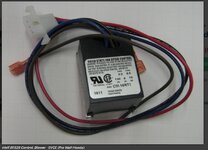
Wolf 811527 Fan Control Switch.jpgWolf 811529 Blower Control.jpg

I am thinking of installing an in-line makeup air booster fan like this one. It is model VTX800, 8" and max cfm of 739 which seems to be about the largest cfm I can find for an 8" duct. It is rated 2.29A at 120V.

The Vortex fan can be used with their solid state AC motor speed controllers, same as the roof mount blower fan.

So, the big question, will the hood's existing solid state controller (that operates the remote blower) also be able to control the makeup air fan by connecting the fan and blower to the same power feed? The combined max amps of the existing blower (4.3A) and the proposed VTX800 fan (2.29A) is 6.59A which is less than the the 8.0A max rating of the Wolf devices so to my simple mind I think it should work.

I have no idea how the fan and blower would ramp in unison nor if their ramp rates are both linear. Also I don't know if the Vortex fan flows enough to make it a worthwhile solution or if it should just be set to full blast.
 
To avoid these ads, REGISTER NOW!

yeldogt

Well-known member
Joined
Jan 2, 2012
Messages
18,184
You are on your own grasshopper ...... please let us know !!

Good luck getting any real advise ... I have tried. Asking HVAC people ... the solution is always the 3k setup (plus labor) with the inline resistance heater or just have the inline fan controlled off the same sail switch. Hood "on" .... inlet blower running. The hood people know less --- ask the code official was the advise from one of them. There is no integrated system out there ..... I went with a mom and pop outfit in TX that makes a sail switch system that only turns the damper on at a higher hood setting .... 10" on this newest house intake. Although I normally use 8" and pipe it into a whole house dehumidifier.

I was down in Hilton Head and the place we rented had the latter set up with passive and dedicated pipe to kitchen --- all of a sudden we would feel heat coming in (it was hot out). Totally nuts ...

My guess is you will just have to try it and be prepared for the controller to die sooner -- or not. Blow enough .... or not.

I usually do 1200cfm and it's rarely running all out and the passive has worked -- the dehumidifier is not pulling all that much

I don't understand the garage door --- since it's a vacuum ?
 
OP
L

larry4406

Well-known member
Joined
Jan 27, 2006
Messages
19,292
Location
Northern Virginia
You are on your own grasshopper ...... please let us know !!

Good luck getting any real advise ... I have tried. Asking HVAC people ... the solution is always the 3k setup (plus labor) with the inline resistance heater or just have the inline fan controlled off the same sail switch. Hood "on" .... inlet blower running. The hood people know less --- ask the code official was the advise from one of them. There is no integrated system out there ..... I went with a mom and pop outfit in TX that makes a sail switch system that only turns the damper on at a higher hood setting .... 10" on this newest house intake. Although I normally use 8" and pipe it into a whole house dehumidifier.

I was down in Hilton Head and the place we rented had the latter set up with passive and dedicated pipe to kitchen --- all of a sudden we would feel heat coming in (it was hot out). Totally nuts ...

My guess is you will just have to try it and be prepared for the controller to die sooner -- or not. Blow enough .... or not.

I usually do 1200cfm and it's rarely running all out and the passive has worked -- the dehumidifier is not pulling all that much

I don't understand the garage door --- since it's a vacuum ?
Really surprising the black art this seems to be in these modern times. UFB.

When the B-Label door from the house to the garage is open it’s a huge hole and tons of makeup air are rushing in and the door autoclose hinge springs won’t overcome it.

FanTech(?) makes an integrated unit with fan, damper, optional heater, and controls that allegedly ramp up/down in synch with hood. Loose they look like they are $1500-$1750 range and back ordered of course. The units I looked at need 10” makeup air duct. I would have to abandon the 8” wall cap and change to a 10” roof cap with adequate distance from the remote blower to avoid recirc.

I hope to hear from “my hvac guy” this week. He seemed sure the passive 8” would be adequate.

Any solid state motor control experts here? I think this is the real question I have at present.
 

TurnipTruck

Well-known member
Joined
Aug 28, 2005
Messages
1,568
Location
Southcentral Alaska
I have the 1200 cfm GE Monogram 52” hood with 10” duct, and it depressured the house more than the blower door did.
I seem to recall that the manual for the hood recommended some vague unspecified “make-up air” unit or cracking a window. We currently rely on the garage door relaxing as a makeup air source as I was completely unable to convince the wife to allow a cold air source in the kitchen. I did duct in an HRV during the remodel but have yet to figure out a way to automatically modify it’s differential pressure during a call for makeup.
 
OP
L

larry4406

Well-known member
Joined
Jan 27, 2006
Messages
19,292
Location
Northern Virginia
Our makeup air grill is in the kitchen ceiling. It’s a 14x14” filter grille attached to a 14x14x14” box that houses the 8” makeup air powered damper. It’s about 12-15’ from the hood. The incoming air largely stays at near ceiling level where it migrates over to the sucking hood.

Would like to see a FLIR image.
 

yeldogt

Well-known member
Joined
Jan 2, 2012
Messages
18,184
Really surprising the black art this seems to be in these modern times. UFB.

When the B-Label door from the house to the garage is open it’s a huge hole and tons of makeup air are rushing in and the door autoclose hinge springs won’t overcome it.

FanTech(?) makes an integrated unit with fan, damper, optional heater, and controls that allegedly ramp up/down in synch with hood. Loose they look like they are $1500-$1750 range and back ordered of course. The units I looked at need 10” makeup air duct. I would have to abandon the 8” wall cap and change to a 10” roof cap with adequate distance from the remote blower to avoid recirc.

I hope to hear from “my hvac guy” this week. He seemed sure the passive 8” would be adequate.

Any solid state motor control experts here? I think this is the real question I have at present.
I see the house to garage door --- got it.

The fantech setup does not include the heater .... the whole set up is around 3k. I forget what power it uses. That's why years ago I piped it in to a dehumidifier. There is a filter that way as well.

I agree .... no one knows the answer. In large open spaces there are fewer problems
 

American Locomotive

Well-known member
Joined
Jan 8, 2017
Messages
10,965
Location
Rhode Island
Really surprising the black art this seems to be in these modern times. UFB.

When the B-Label door from the house to the garage is open it’s a huge hole and tons of makeup air are rushing in and the door autoclose hinge springs won’t overcome it.

FanTech(?) makes an integrated unit with fan, damper, optional heater, and controls that allegedly ramp up/down in synch with hood. Loose they look like they are $1500-$1750 range and back ordered of course. The units I looked at need 10” makeup air duct. I would have to abandon the 8” wall cap and change to a 10” roof cap with adequate distance from the remote blower to avoid recirc.

I hope to hear from “my hvac guy” this week. He seemed sure the passive 8” would be adequate.

Any solid state motor control experts here? I think this is the real question I have at present.
It's not surprising, really. Most people are not installing a 1500 CFM range hood in their homes as that's grossly excessive for just about any normal household kitchen task. There are restaurants that have hoods that move less air than that! With an exhaust blower that powerful, you will need a make up air fan capable of matching that flow rate otherwise you'll still be putting the house under negative pressure.

You can try connecting both fans to the controller - it's just basically a glorified light dimmer. But not all fans can tolerate being used on this kind of speed control - verify your new fan can.

Another thing: 1500 CFM is enough airflow to support approximately 4-tons of air conditioning. If it's a 50°F fall day, and you have the range hood on full speed, you're going to be blasting your kitchen with an effective 48,000 BTU/hr of cold air. It's going to get cold in there.
 

TurnipTruck

Well-known member
Joined
Aug 28, 2005
Messages
1,568
Location
Southcentral Alaska
Our makeup air grill is in the kitchen ceiling. It’s a 14x14” filter grille attached to a 14x14x14” box that houses the 8” makeup air powered damper. It’s about 12-15’ from the hood. The incoming air largely stays at near ceiling level where it migrates over to the sucking hood.

Would like to see a FLIR image.
That’s a good idea!


I see the house to garage door --- got it.


I agree .... no one knows the answer. In large open spaces there are fewer problems
Maybe this is why I’m able to get away with this solution: we have 4600 sq ft.
 
OP
L

larry4406

Well-known member
Joined
Jan 27, 2006
Messages
19,292
Location
Northern Virginia
It's not surprising, really. Most people are not installing a 1500 CFM range hood in their homes as that's grossly excessive for just about any normal household kitchen task. There are restaurants that have hoods that move less air than that! With an exhaust blower that powerful, you will need a make up air fan capable of matching that flow rate otherwise you'll still be putting the house under negative pressure.

You can try connecting both fans to the controller - it's just basically a glorified light dimmer. But not all fans can tolerate being used on this kind of speed control - verify your new fan can.

Another thing: 1500 CFM is enough airflow to support approximately 4-tons of air conditioning. If it's a 50°F fall day, and you have the range hood on full speed, you're going to be blasting your kitchen with an effective 48,000 BTU/hr of cold air. It's going to get cold in there.
Do you drive your 120-150mph capable car flat out every time? No. Probably closer to 30-55 mph each time but you know you have head room. Same concept with our install.

Thus why I provided links to the solid state controllers and the fans. Obviously the existing roof blower works. The Vortex fan links to their solid state controller. Hence the question if both would work simultaneously off the single existing controller which has headroom on the amp spec.

Right or wrong the building Code gives you a free pass (not required) for the first 400 cfm of hood capacity and then you makeup for the excess. Hence why my hvac guy thought the 8” passive system would be adequate.

This house is unbelievable tight now that the attic has 5” of foam across top of entire ceiling and 17” plus blow on top. I think it’s somewhere around R56.
 
Last edited:

danski0224

Well-known member
Joined
Jan 29, 2005
Messages
13,432
Location
Near Naperville, IL
In theory it should work.

But...

Do the two fans (and their attached duct systems) move the same amount of air at the same selected speed?

Probably not.


I'd go with a fixed multi speed controller that's hopefully big enough to run two motors directly. Otherwise, the motors will have to be run off of relays.

Then, hopefully, the two can be balanced close enough to do the job. If anything, the makeup fan would be set for a little more for positive pressure.

The makeup air should be discharged as close as possible to the exhaust hood.

In commercial systems, the makeup air is either integrated with the hood or there is a linear perforated makeup air diffuser along the outside of the hood.

And yes, you will be bringing in unfiltered and unconditioned air into the house. It will cost a lot of money to preheat or cool 1500 or even 1200 cfm of 100% outside air.

There is no easy solution. It takes a bit of controls and stuff to make it work properly. That's why you just can't go buy it, unless the manufacturer offers a prepackaged and engineered solution that matches the hood in question.
 

yeldogt

Well-known member
Joined
Jan 2, 2012
Messages
18,184
Do you drive your 120-150mph capable car flat out every time? No. Probably closer to 30-55 mph each time but you know you have head room. Same concept with our install.

Thus why I provided links to the solid state controllers and the fans. Obviously the existing roof blower works. The Vortex fan links to their solid state controller. Hence the question if both would work simultaneously off the single existing controller which has headroom on the amp spec.

Right or wrong the building Code gives you a free pass (not required) for the first 400 cfm of hood capacity and then you makeup for the excess. Hence why my hvac guy thought the 8” passive system would be adequate.

This house is unbelievable tight now that the attic has 5” of foam across top of entire ceiling and 17” plus blow on top. I think it’s somewhere around R56.
At my place in NJ -- the only stove with grill. I close off the doors to the main part of the house (twin pocket) .. and open the back door. It's the only way I get full flow up and out. Even 1200 -- all coming from outside is a lot of air.


I think you are just going to have to try and see if it works.
 
OP
L

larry4406

Well-known member
Joined
Jan 27, 2006
Messages
19,292
Location
Northern Virginia
In theory it should work.
Thank you.
But...

Do the two fans (and their attached duct systems) move the same amount of air at the same selected speed?

Probably not.
Hence my statement of not knowing the fan curves and I have no idea how the fan and blower would ramp in unison nor if their ramp rates are both linear. Also I don't know if the Vortex fan flows enough to make it a worthwhile solution or if it should just be set to full blast knowing that at best its not quite 50% capacity of the remote blower when on max.
I'd go with a fixed multi speed controller that's hopefully big enough to run two motors directly. Otherwise, the motors will have to be run off of relays.
Not hacking up the hood control panel to install some wonky aftermarket controller.
Then, hopefully, the two can be balanced close enough to do the job. If anything, the makeup fan would be set for a little more for positive pressure.
Hence my statement if I should just set the Vortex fan to full blast. Alternately, put it on its separate controller which is energized by the vacuum switch and dial in its sweet spot which works for the majority of need and leave it at that set point. Negating the pull on the garage door closure hinge spring would be indicative that the fan and blower were in balance or even positive pressure.
The makeup air should be discharged as close as possible to the exhaust hood.

In commercial systems, the makeup air is either integrated with the hood or there is a linear perforated makeup air diffuser along the outside of the hood.
If the makeup air system truly provided 1:1 for the discharge of the hood, and were applied right at the hood itself, there would be no draw from the stove/range or kitchen so the air would go roundy round from outside source to outside hood discharge and not purge the kitchen. At the day job, we provide makeup air one of two ways.
  • Method 1 is passive like I have where the damper in the ceiling actuates via a pressure switch (in my case vacuum since I have a roof top blower). We put this within 15' of the appliance being served. Logic being that the makeup air has to sweep the space thereby forcing the purge of the kitchen.
  • Method 2 (not allowed in all counties where I build) we use a fan similar to a Broan SA-180. It provides fresh air to the house on a timer (Energy Star) and is also connected to the hood pressure switch and creates a fan demand on the air handler when the hood is operated for makeup air. Thus the makeup air moves thru the ductwork to the space and purges the space.
And yes, you will be bringing in unfiltered and unconditioned air into the house. It will cost a lot of money to preheat or cool 1500 or even 1200 cfm of 100% outside air.
As stated in Post 5, I have a 14x14" filter at the filter grille inlet on the ceiling. Again, who says that every use of the hood is at or near 100%? So because of fear of induced heating/cooling costs your recommendation is...?
There is no easy solution. It takes a bit of controls and stuff to make it work properly. That's why you just can't go buy it, unless the manufacturer offers a prepackaged and engineered solution that matches the hood in question.
Agreed.
 
Last edited:
OP
L

larry4406

Well-known member
Joined
Jan 27, 2006
Messages
19,292
Location
Northern Virginia
At my place in NJ -- the only stove with grill. I close off the doors to the main part of the house (twin pocket) .. and open the back door. It's the only way I get full flow up and out. Even 1200 -- all coming from outside is a lot of air.


I think you are just going to have to try and see if it works.
Yeldogt you have clearly been down this path before and I value your wisdom and experience.

Clearly opening windows/doors is an easy work around. We have casement windows with screens flanking the kitchen picture window so easy to manage this work around.

Hoping to have a meaningful discussion with my HVAC guy this week and not have to just throw parts at it and see what sticks.

I am also on good terms with my Energy Star rater from the day job and I think he leaves near me (weekend free beer ;)). Wondering if his blower door setup would provide any useful data for me. For example, disconnect the makeup air damper (all doors/windows closed) and run the hood fan at various positions (low through high) and record the CFM coming thru the blower door instrument (which would be the actual hood discharge) and the applied voltage to the remote blower at that setting (this assumes the solid state controls work by altering voltage that no one has confirmed, although internet searches seem to confirm). This would generate a cfm/volts curve and let me know how the remote blower with installed ductwork actually performs (linear, initial droop or initial rise, then plateau etc). This would then give me an idea as to what control setting (10, 20, 50, 75%?) the Vortex fan might have no hope at all. Negating the pull on the garage door closure hinge spring would be indicative that the fan and blower were in balance or even positive pressure.

Vortex is in Canada and they have a help line. I might call them to see if they have a curve of fan output/volts and on how the solid state controls actually work.
 
Last edited:

yeldogt

Well-known member
Joined
Jan 2, 2012
Messages
18,184
Yeldogt you have clearly been down this path before and I value your wisdom and experience.

Clearly opening windows/doors is an easy work around. We have casement windows with screens flanking the kitchen picture window so easy to manage this work around.

Hoping to have a meaningful discussion with my HVAC guy this week and not have to just throw parts at it and see what sticks.

I am also on good terms with my Energy Star rater from the day job and I think he leaves near me (weekend free beer ;)). Wondering if his blower door setup would provide any useful data for me. For example, disconnect the makeup air damper (all doors/windows closed) and run the hood fan at various positions (low through high) and record the CFM coming thru the blower door instrument (which would be the actual hood discharge) and the applied voltage to the remote blower at that setting (this assumes the solid state controls work by altering voltage that no one has confirmed, although internet searches seem to confirm). This would generate a cfm/volts curve and let me know how the remote blower with installed ductwork actually performs (linear, initial droop or initial rise, then plateau etc). This would then give me an idea as to what control setting (10, 20, 50, 75%?) the Vortex fan might have no hope at all. Negating the pull on the garage door closure hinge spring would be indicative that the fan and blower were in balance or even positive pressure.

Vortex is in Canada and they have a help line. I might call them to see if they have a curve of fan output/volts and on how the solid state controls actually work.
The open a door was sort of a joke ...

The NJ property was my first with a big powerful hood -- 1200 cfm. It's an old house and even with many upgrades the design is not favorable to making it tight.

I have read many articles and no one has a great solution ... it's been my experience that in cold climates the direct vent to a kitchen is noticeable.
 

TurnipTruck

Well-known member
Joined
Aug 28, 2005
Messages
1,568
Location
Southcentral Alaska
65974647-F8EF-4967-9CBC-E42FFDDD095B.png
I meant to install one of these switches to control a makeup blower but never got around to it. I have been amazed at how accurate and repeatable the magnahelic, let alone the photohelic is.
 

American Locomotive

Well-known member
Joined
Jan 8, 2017
Messages
10,965
Location
Rhode Island
Hoods with integrated make up air work because they are carefully engineered to create a a circulating curtain current of air around the appliances. The steam, grease, heat, whatever from the appliances naturally want to go up because of convection and get caught in the current. Think of the open refrigerated cases at grocery stores. Same idea.

I think our concerns about the CFM is just that you keep mentioning how hard you've worked to make your house infiltration tight. Yet any time this range hood is on - even at 50%, is going to be drawing a tremendous amount of air in from outside. Like I said, 1500 CFM of 50 degree air is basically 4 tons of air conditioning. On a 30 degree day, that's probably more like an effective 7 tons.

That speed control is variable voltage - sorta. They work the same way dimmer switches do, but they don't really reduce the the voltage. They chop the sinewave up. Different motors behave differently to this process, and its not so simple as x volts = y speed.

Even then with fans (especially centrifugal fans), motor power may not directly proportional to air flow. Even slight restrictions can cause dramatic differences in flow with a centrifugal blower operating at reduced power.

You would either need an engineered solution, or ECM blowers where motor speed can be precisely controlled. Outside of that, you will basically be guess and checking to match the two blowe speeds unfortunately.

Could you not just purchase another wolf blower if you wanted them to match?
 
Last edited:
OP
L

larry4406

Well-known member
Joined
Jan 27, 2006
Messages
19,292
Location
Northern Virginia
65974647-F8EF-4967-9CBC-E42FFDDD095B.png
I meant to install one of these switches to control a makeup blower but never got around to it. I have been amazed at how accurate and repeatable the magnahelic, let alone the photohelic is.
I installed the pressure/vacuum switch my HVAC guy gave me. I think it is a Broan. There is a pitot tube like pipe sensor inserted into the duct. Looks like this internet stock image.
1661721285979.png


The pressure switch itself has one port for pressure (updraft hoods) and another for remote roof blowers (vacuum which I have). There is a 24VAC transformer that runs 24/7/365 like a door bell transformer. The vacuum switch is wired in series with the motorized damper.

The 8" damper is made by Zonex.

Pictures attached of the switch, sensor, transformer, and 10" duct just prior to the roof penetration. Also the motorized damper before I installed it in the ceiling filter inlet box.
 

Attachments

  • IMG_8525.JPG
    IMG_8525.JPG
    361.4 KB · Views: 28
  • IMG_8526.JPG
    IMG_8526.JPG
    296.9 KB · Views: 17
  • IMG_8527.JPG
    IMG_8527.JPG
    274.1 KB · Views: 18
  • IMG_7400.JPG
    IMG_7400.JPG
    454.6 KB · Views: 19
  • IMG_7401.JPG
    IMG_7401.JPG
    349 KB · Views: 29
Last edited:
OP
L

larry4406

Well-known member
Joined
Jan 27, 2006
Messages
19,292
Location
Northern Virginia
Hoods with integrated make up air work because they are carefully engineered to create a a circulating curtain current of air around the appliances. The steam, grease, heat, whatever from the appliances naturally want to go up because of convection and get caught in the current. Think of the open refrigerated cases at grocery stores. Same idea.

I think our concerns about the CFM is just that you keep mentioning how hard you've worked to make your house infiltration tight. Yet any time this range hood is on - even at 50%, is going to be drawing a tremendous amount of air in from outside. Like I said, 1500 CFM of 50 degree air is basically 4 tons of air conditioning. On a 30 degree day, that's probably more like an effective 7 tons.

That speed control is variable voltage - sorta. They work the same way dimmer switches do, but they don't really reduce the the voltage. They chop the sinewave up. Different motors behave differently to this process, and its not so simple as x volts = y speed.

Even then with fans (especially centrifugal fans), motor power may not directly proportional to air flow. Even slight restrictions can cause dramatic differences in flow with a centrifugal blower operating at reduced power.

You would either need an engineered solution, or ECM blowers where motor speed can be precisely controlled. Outside of that, you will basically be guess and checking to match the two blowe speeds unfortunately.

Could you not just purchase another wolf blower if you wanted them to match?
To my knowledge Wolf like all the other vendors stop at weasel words saying make up air may be required. This matches Yeldogt's experience. I have not found any offering from them on same.

On new installations and roughin's, which ours was, would have been a piece of cake to provide two ducts of X-size to the hood and used the manufacturer's provided balanced system but none is offered. I relied on my HVAC guy and house simply appears to be too tight, ***** we have done a good job.

A separate pressure switch and controller for a makeup fan that monitors for positive pressure in the house and ramps makeup fan accordingly would be sweet. Obviously interlocked to pressure/vacuum switch so only works while hood is on.
 
Last edited:
To avoid these ads, REGISTER NOW!

Wrench97

Well-known member
Joined
Jun 23, 2018
Messages
12,111
Location
Southeastern Pa
If I remember correctly from a relatives restaurant remodel you need a engineering firm and use a company that specializes in make up air balancing, on commercial equipment the fan speeds for the exhaust fans are adjustable and the RTU's have the ability a add conditioned make up air to the system when the exhaust fans are running which in a restaurant is pretty much all the time they are open
A system imbalance can make it hard to open the doors or make doors not close if the pressure is too high(this is the issue he had after a remodel and new RTU install. The HVAC company he used for the refrigeration and HVAC work gave him the contact of a firm that specializes in that.
 

danski0224

Well-known member
Joined
Jan 29, 2005
Messages
13,432
Location
Near Naperville, IL
I did a quick Google search and found 2 vendors selling makeup air solutions with controls. There might be more.

Don't know what they cost, but there are engineered solutions available.
 

danski0224

Well-known member
Joined
Jan 29, 2005
Messages
13,432
Location
Near Naperville, IL
Not hacking up the hood control panel to install some wonky aftermarket controller.
I'm sure that if additional controls are needed, a remote solution may be possible.
If the makeup air system truly provided 1:1 for the discharge of the hood, and were applied right at the hood itself, there would be no draw from the stove/range or kitchen so the air would go roundy round from outside source to outside hood discharge and not purge the kitchen. At the day job, we provide makeup air one of two ways.
In my day job, I have installed many kitchen hoods with the makeup air supplied by a linear perforated "diffuser" that is approximately 8" higher than the bottom edge of the hood. It is approximately 12" wide and the length of the hood. There are multiple connection points, with dampers, for the makeup air supply. It is essentially a plenum about 6" tall with makeup air on one side and a perforated outlet on the other. I have also seen side by side hoods (long side) with the makeup air plenum between them.

Another variant has an air curtain where the makeup air is connected to the hood, and there are slots (holes) all around the perimeter of the hood. There is a double wall system so the makeup air is distributed around the hood and has to exit through the slots.

There are installed in commercial kitchens, presumably air balanced, and therefore work as designed.

I mean, I have seen the Captive Aire (that's the hood manufacturer) air balancer on site. Whether or not a magic pencil is involved is unknown. They include the balancing as part of the hood package.

There's an appropriately sized piece of equipment on the roof with a 100% makeup heating and cooling solution. The condenser is typically literally bolted to the top of the makeup heater.

I'm guessing that most of these commercial units are "on" or "off", which makes balancing much easier than something with variable or multiple speed. Otherwise some sort of pressure sensor and controller is needed to control the makeup fan accordingly.

If the hood is exhausting properly, there should be no need to "purge the kitchen".

As stated in Post 5, I have a 14x14" filter at the filter grille inlet on the ceiling. Again, who says that every use of the hood is at or near 100%? So because of fear of induced heating/cooling costs your recommendation is...?
During winter, you will be bringing in unconditioned air. This is also not humidified.

During summer, you will be bringing in unconditioned air. The humidity of the outside air probably exceeds the humidity of the indoor air if you have air conditioning.

Either scenario will overpower a residential heating/cooling system that is sized for the static house load.

This is easy to test. Open your front door and put a 1200 cfm fan in it and turn it on. Open a window a little bit somewhere else. Then time how long it takes for it to become uncomfortable. This should be done in both summer and winter for the best results.

Therefore, the makeup air needs to be conditioned or at least tempered. It's easy to add resistive strip heating. The cooling is a bit more involved. Or, some sort of ERV. This is why, on real jobs, the makeup air discharge is close to the hood. It significantly reduces additional energy costs compared to just dumping makeup air somewhere and adding that load to the building HVAC system, which isn't designed or sized to handle it.


All of this is why I talk homeowners out of those fancy big residential range hoods.

To date NO ONE has wanted to pay what it costs to install the whole shebang properly. NO ONE.

And one really needs to watch negative pressure in a house. Combustion appliances will not vent properly (natural draft for sure, and it may mess with PVC vented stuff), and can kill. Do be aware that a true sealed combustion furnace isn't made any longer (this type is certainly a rarity if anyone is making them) The door is the seal, not a little box around the burners.
 
Last edited:

fitter30

Well-known member
Joined
Jun 23, 2019
Messages
2,981
Location
Peace Valley,mo
Any variable speed motor needs ball bearings ,sleeve bearing have to have a minimum rpm for lubrication are it will fail and lock up. Building pressure ever walk up to office building and the doors you can't hardy open or they stay cracked with lots of air blowing out? There are differential controls that will track it and vary the speed of a fan with in a couple of hundreds of a inch. Take a door 36 x 80 2880 sq in's x .1 ÷ 16 = 18 lbs pushing on the door ( .1 is not .001 just to show how little it takes and placement of sensor tubes are important). Make up air 400 cfm is 1 ton of cooling. With make up air and its 90° or 0° outside that air has to be conditioned. Having a party could be cooking for 4 - 5 hours. As for as nobody does everything that the houses i serviced they had 10k to 20k sq.ft. Me wheres the oven for pizza.
 
Last edited:
OP
L

larry4406

Well-known member
Joined
Jan 27, 2006
Messages
19,292
Location
Northern Virginia
I placed some calls this past week, nothing earth shattering yet.

Rep from FanTech supposed to call me back Tuesday after the holiday. Their system apparently uses a CT to monitor the hood fan and apparently ramp in unison.

Spoke to a guy at hvacquick as they represent makeup air solutions on their site. He indicated that the FanTech system might be controllable via the Wolf solid state controller. Who knows.

Saw that there is an Airscape system that uses an actual pressure sensor in the house vs interlock to a CT or hood pressure/vacuum switch. Supposedly can energize on hood, fireplace, bath fan, etc. Not real keen on its connection to the web. Anyone use one of these?
 
Last edited:

unslow1

Well-known member
Joined
Mar 3, 2012
Messages
7,880
Location
Illinois
I didn't read every post but something to consider. When we sped up the exhaust hood we caused another problem. Like your fire place problem we had ours with the gas water heater. That problem required a power vent fan on the water heater to remedy.
 
OP
L

larry4406

Well-known member
Joined
Jan 27, 2006
Messages
19,292
Location
Northern Virginia
I didn't read every post but something to consider. When we sped up the exhaust hood we caused another problem. Like your fire place problem we had ours with the gas water heater. That problem required a power vent fan on the water heater to remedy.
Yes you were back drafting just like my fireplace is doing when the hood runs.

We have 2 fireplaces (basement and main level). The basement one is a typical open hearth style and the damper is closed (not leak proof I am sure). The main level fireplace is the same hearth style but we have a wood stove with an 8" stainless flue running thru the clay flue tiles to the roof.

The Energy Star guy that does the testing and certification for me on the day job offered to do some testing. Not exactly sure what tests would be most useful.

I did find this graph on a brochure from AirScape which confirms that for larger hoods, you really can't use passive makeup air systems as the required duct size becomes insane. If the chart is accurate, the 8" flex on my passive system is only good for around 100 cfm.
1662289415452.png
 

metlmunchr

Well-known member
Joined
Sep 10, 2011
Messages
1,278
I've installed several commercial hoods. They typically have make up air ducted directly into the hood at 80 to 85 percent of the exhaust volume. I've seen a couple hoods that used a ceiling mounted linear diffuser out in front of the hood for makeup, but they sometimes cause turbulence that makes smoke roll out from under the hood. Not nearly as effective as ducting directly into the hood unless the application is for heat removal rather than smoke, such as over large baking or pizza ovens.

The claim of exhausting 1500 cfm thru a 10" round with a 1/2 hp motor sounds optimistic to me. You might have your friend ,measure the actual exhaust volume to help determine what sort of maximum makeup volume you actually need.
 
OP
L

larry4406

Well-known member
Joined
Jan 27, 2006
Messages
19,292
Location
Northern Virginia
I've installed several commercial hoods. They typically have make up air ducted directly into the hood at 80 to 85 percent of the exhaust volume. I've seen a couple hoods that used a ceiling mounted linear diffuser out in front of the hood for makeup, but they sometimes cause turbulence that makes smoke roll out from under the hood. Not nearly as effective as ducting directly into the hood unless the application is for heat removal rather than smoke, such as over large baking or pizza ovens.

The claim of exhausting 1500 cfm thru a 10" round with a 1/2 hp motor sounds optimistic to me. You might have your friend ,measure the actual exhaust volume to help determine what sort of maximum makeup volume you actually need.
Thank you for your input.

I need to circle back with my Energy star friend regarding testing but I wanted to have a more intelligent approach as to what and how to approach the testing.

The residential hoods do not have/offer any sort of linear diffuser nearby or as an accessory that I can see. Apparently only the commercial restaurants hoods have diffusers or even internally compensated hoods (hoods with duct taps for both discharge and makeup all integral to the hood).

We have a Wolf range (DF48850) and Wolf hood (804701). I don't know the HP of the remote roof top Wolf blower but it is rated at 4.3A at 120V and listed at 1500 cfm.

The total Btu of the 8 burner gas range is 128,200. This and many other sites indicate that you should plan on 100 cfm per 10,000 btu, so for planning, the hood needs to be 1282 cfm which we rounded up to the next available size of 1500 cfm. The appliances are all in the house so a reselect or questioning of why these are here has sailed.

I spoke with a Fantech Tech guy today about their system. He is recommending their MUAS1600 unit with 10KW heater. Their system uses CT (current transformer) to monitor range hood CFM. This controller gets tuned during commissioning (min, max, and then dial the pots to tune, etc). We talked about their system reacting to other inputs (fireplace, dryer, fart fan...) and he said their system does not do this, no way to accommodate, and said have had some complaints regarding this. Regarding the electric heater, he said it was 240V 40A and at 600 cfm has a 53F differential temp rise and at 1500 cfm would do 21F.

I spoke with an AirScape guy today as well. Interestingly, I was forwarded via their voice mail prompts to the tech at HvacQuick.com (reseller) that I had recently spoken to previously about the Fantech units. Odd. He confirmed that the AirScape system uses pressure sensor to actuate the unit thus it could respond to other demands in the house (fart fans, dryer, chimney, etc). I like this vs linking it solely to the hood. It is web based (?) so you use your phone, computer, etc to program (who else is spying?). AirScape does not offer a resistance heater unit to temper the air; apparently only a water coil unit so this is a negative.

If the house leaked like a sieve like it did before and when we were ignorent, we would now be happily sucking in unconditioned unfiltered air, none the wiser, and would be tickled pink.

I can say with certainty that the hvac filters at 1 month use are far cleaner now then they have ever been since we foamed the attic.
 

Attachments

  • Wolf Range and Hood.JPG
    Wolf Range and Hood.JPG
    274 KB · Views: 32

WisJim

Well-known member
Joined
Dec 20, 2010
Messages
2,283
Location
Menomonie, WI
The Green Building Advisor website has had some discussions of the topic of makeup air for range hoods. It's been awhile since I read any of them but it might be a useful resource. I think that you have to set up a free account to read most articles, and some of the more technical or detailed ones require a paid membership or a free trial membership.
Also, an on-line search for "fine home building makeup air range hood" finds a couple of articles about the subject that might be of interest.
 

yeldogt

Well-known member
Joined
Jan 2, 2012
Messages
18,184
Where is the sensor for the Airscape -- it would need to be close. The fan tech stuff is normally nice -- how many wires does it need tot he system from the hood ... does it just connect to the two motor outputs?

As to stove BTU ..... you will never have all the burners running all the time and all the way up.
 

dave*99

Well-known member
Joined
May 5, 2009
Messages
4,268
Location
Coastal NJ
Where is the sensor for the Airscape -- it would need to be close. The fan tech stuff is normally nice -- how many wires does it need tot he system from the hood ... does it just connect to the two motor outputs?

As to stove BTU ..... you will never have all the burners running all the time and all the way up.
That was my conclusion - I have a 6 burner Wolf and a 600cfm hood. I told the appliance guy I don't have a wok and tend to make heat more than smoke. So 600cfm was adequate. It's a new house so makeup air was required. We have a very short run of 8 or 10" duct run into the return of the HVAC system. A pressure switch in the range hood duct triggers the damper in the makeup air duct and turns on the blower in the furnace. ------ Except it's not hooked up. The HVAC guy said everyone hates the hot,humid,damp,cold outside air coming in. But everything must be installed to pass the final inspection....... So I crack a window in the kitchen as needed.

But to the OP's questions, my range hood is programmable for it's max output. It can be set below the 600cfm max. Would it help to limit the range hood output to a lower output - commensurate with your cooking needs? Thereby lowering the makeup air needs to a more easily achievable value?
 
OP
L

larry4406

Well-known member
Joined
Jan 27, 2006
Messages
19,292
Location
Northern Virginia
Where is the sensor for the Airscape -- it would need to be close.

The installation manual indicates that the Airscape pressure switch is remote with tubing run to the interior and the exterior for pressure differential readings. They don’t say to mount the interior pressure tap proximate to the kitchen but that’s what I would do; not sure how it terminates neatly.
1662652672734.jpeg
The fan tech stuff is normally nice -- how many wires does it need tot he system from the hood ... does it just connect to the two motor outputs?
The FanTech unit uses a current transformer (CT) independent of the hood wiring. The neutral leg to the hood fan is monitored however, and runs thru the CT. For low amperage hood fan draw, they have you make more loops thru the CT to increase its sensitivity (they have a chart of wraps vs amps). The CT senses amp draw of the hood fan which is used to tune their fan to allegedly match the hood fan.

As to stove BTU ..... you will never have all the burners running all the time and all the way up.
Very true. And if we don’t cook we don’t need a fan at all 😉. However, the Wolf vent guide indicated we would need 1100 cfm or more for the 48” dual fuel range. So then the choices were 1200 or 1500 cfm remote blower as that’s the size offered. Knowing the duct run would be on the longer side, we picked the 1500 cfm unit to provide some head room.
 
OP
L

larry4406

Well-known member
Joined
Jan 27, 2006
Messages
19,292
Location
Northern Virginia
That was my conclusion - I have a 6 burner Wolf and a 600cfm hood. I told the appliance guy I don't have a wok and tend to make heat more than smoke. So 600cfm was adequate. It's a new house so makeup air was required. We have a very short run of 8 or 10" duct run into the return of the HVAC system. A pressure switch in the range hood duct triggers the damper in the makeup air duct and turns on the blower in the furnace. ------ Except it's not hooked up. The HVAC guy said everyone hates the hot,humid,damp,cold outside air coming in. But everything must be installed to pass the final inspection....... So I crack a window in the kitchen as needed.

But to the OP's questions, my range hood is programmable for it's max output. It can be set below the 600cfm max. Would it help to limit the range hood output to a lower output - commensurate with your cooking needs? Thereby lowering the makeup air needs to a more easily achievable value?
Our hood is not programmable. It has a dial from min to max.

I talked to Wolf tech support about my setup. They do not have fan curves for the remote blowers. Only have curves for the integral blowers. He thought that was odd as well.

Regardless he sent me a fan curve for a 1200 cfm internal blower that fits my hood and said the 1500 cfm remote blower would be similar. He said that their solid state controller for the blower clips the voltage and that it varies the voltage from about 70% at minimum to 100% at maximum. Note how for the 1200 cfm fan at minimum speed setting it is still flowing a bit more than 50% of max. So assuming our 1500 cfm unit behaves similar, at minimum setting it’s flowing more than 750 cfm!

The Wolf Tech rep was not certain on how to lower the cfm of the currently installed unit (ie convert it from 1500 to say 1200 or less).

1662673762539.png

I did talk with my hvac guy yesterday and he will get back to me. He suggested perhaps another makeup damper connected to the furnace cold air return (we have a heat pump). This damper would be slaved off the existing 8” damper. He was thinking this new one might be 10”. He was thinking that it would not need to force a concurrent fan demand of the air handler. This would involve a siding repair to accommodate (new Hardie siding, ugh).

The hvac guy was looking into the max flow that my existing 14x14 filtered kitchen ceiling inlet would accommodate. Thought being add a roof intake penetration with a 2nd larger damper to this same kitchen inlet. So I wait for his call back….
 

Attachments

  • 1662654046471.png
    1662654046471.png
    122.7 KB · Views: 27
Last edited:

dave*99

Well-known member
Joined
May 5, 2009
Messages
4,268
Location
Coastal NJ
That sounds like a lot of air for a residential application - my 600cfm hood on a 6 burner Wolf 36" range has speeds corresponding to 150,290,460 and 600 cfm. With 2 or maybe 3 pots going for dinner we might set it on 290 or 460. Almost never need the 600 setting.
In fact if 600 was the minimum airflow I could achieve I suspect I would not be happy with the hood.
 

dave*99

Well-known member
Joined
May 5, 2009
Messages
4,268
Location
Coastal NJ
The Wolf vent guide says 800 cfm for my range - as I said, I rarely use the 600 cfm setting on my hood. I know it goes against our "more power" traditions on GJ, but.... Give some thought to where your trajectory -may- take you.

A fully built out system with about 750 cfm minimum and 1500 cfm max ---might--- result in a system that --some-- people may be reluctant to turn on with only one or two pots on the stove.

It it were available - would you consider a smaller blower for the range hood? The various blowers (internal and external) and configurations for my hood start at 600 cfm max and go up to 1650 cfm.

Is the blower accessible such that you could install a bypass duct on it?
 
Last edited:

dave*99

Well-known member
Joined
May 5, 2009
Messages
4,268
Location
Coastal NJ
On another note - I have a friend that built a very tight house back in the 80's. He had exactly one window that opened. That's it. So to manage indoor air quality, he had an air to air heat exchanger that ventilated the house. It used the exiting indoor air to condition the incoming outdoor air.
Since your house is very tight now - this might be useful.
 
OP
L

larry4406

Well-known member
Joined
Jan 27, 2006
Messages
19,292
Location
Northern Virginia
It it were available - would you consider a smaller blower for the range hood? The various blowers (internal and external) and configurations for my hood start at 600 cfm max and go up to 1650 cfm.

Is the blower accessible such that you could install a bypass duct on it?
I have to do something, and whatever it is involves $$.

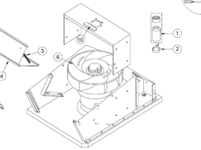
Yes I would possibly downgrade the blower capacity if it where possible and cost competitive. The roof mounted blower is accessible on the roof. It vents thru the attic via roof jack. For noise reasons we want the remote blower vs inside. Would want to only change internal components - blower motor and capacitor. The exploded manual is for the 1200 and 1500 cfm model so at most I could downgrade to 1200 cfm I am guessing by swapping out Items 6 and 1. So if the solid state controller clips voltage to about 70V at min setting (70/120 = 58.3%) then the 1200 cfm unit would still deliver around 700 cfm which I think is still in the too tight range of the house.
1662674127243.png1662674302343.png1662674412195.png1662677555450.png

Inside the attic the 10" duct exhaust is accessible and proximate to the inlet air grille. A bypass of a portion (recirculation) back into the house might be possible. Interesting concept.
 
OP
L

larry4406

Well-known member
Joined
Jan 27, 2006
Messages
19,292
Location
Northern Virginia
I did ask the Wolf Tech rep about my original question of using the existing solid state fan controller in the hood to drive two blowers as long as the total amperage draw was less than the 8.0 amp rating of the controller. He confirmed this would work but said they don't recommend it and would not explain further.

I also asked about the disparity between the 3.8A rating of my external blower per the manual and the 4.3A rating on the actual blower data tag. He said that their controller in the hood will limit it to 3.8A at max speed.
 

dave*99

Well-known member
Joined
May 5, 2009
Messages
4,268
Location
Coastal NJ
Inside the attic the 10" duct exhaust is accessible and proximate to the inlet air grille. A bypass of a portion (recirculation) back into the house might be possible. Interesting concept.
I'm not thinking bypass recirculation back into the house. Rather I'm thinking a shunt around the blower.

Since your blower is actually roof mounted (not an inline blower hanging in the attic) I believe some air could come from a T off the 10" duct connected to the hood and drawing either attic air or air from an additional roof mounted inlet grill. A damper on the T line could regulate the air. If you try it with attic air its a cheap test and easily reversible.
 
To avoid these ads, REGISTER NOW!
Top Bottom