Night Stands — Part 2
This isn't so much a new part of the build as just continuing working on the panels.
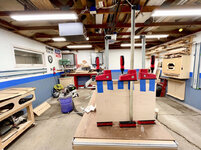
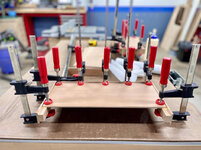
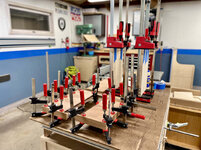
Going to document a few struggles here. The first is one of the edge band boards got clamped askew (clamps pulled it to the side) so it was not co-planar with the plywood. I decided it was off by too much, so I sliced it off and tried again.

I had to re-square the glue edge of the white oak, so it's going to be a tiny bit narrower than the rest of them, but this will only be noticeable from the inside and will be covered up by the drawer, anyways.
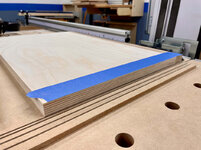
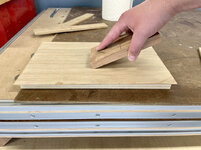
After many rounds of clamping and gluing, all the plywood panels were edge banded. Because my white oak boards where a true 3/4" S4S stock, and the plywood was slightly undersized, there was a small overhang on both sides that needed to be flushed up.
I pondered the best way to do this for quite awhile. I don't have a tall enough auxiliary fence for my table saw. My router flush trim bits were not long enough. The "lip" wasn't huge, but sanding it alone would take forever with my little finish sander.
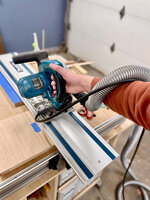
What I really needed was a jig like this:

But I don't have that. So... hand plane!

I did my best to sharpen the iron before hand, but it wasn't razor sharp. I still need to build a sharpening tool kit. For now I just use sandpaper and a glass plate. Probably not high enough grits, and no strop. The Chinese steel doesn't seem to hold the mediocre edge I achieve for that long, either. But... this old tool
does work!
That said, after the first panel, my soft video editor hands looked like this:
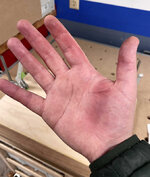
Not wanting to plane any more material than I had to, I trimmed off all the side overhangs:

Cleaning up the hardened glue squeeze out was a huge pain and tore out the plywood in some cases. I have an old "glue scraping" chisel to do this, but it did not work very well.
I never intended my MFT bench to be used for hand tool work, but it succeeds just like it does with everything else I throw at it.

While the plane was out, I cleaned up the front edges, too:
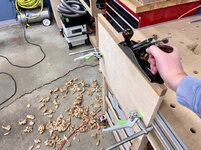
Pictures can't really show it, but the resulting surface is so nice.
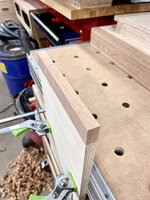
Ok, here's my second mistake. On one of the larger panels I didn't have the lateral adjustment correct on the plane iron, and I ended up planing the far side of the oak more than I meant to. Phone camera couldn't pick it up, but this is an exaggerated version:
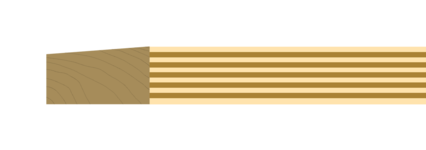
My solution to this will be to do the drawer rabbet on the sloped side. Fortunately I caught the error early. I'm getting used to planing a bit, getting down and taking a look, making sure I'm doing an ok job. Feeling the surface with my hands to check. Then keep going.
The plane gets it almost perfectly flush. But I still hit them with the sander just to make it perfectly smooth.

And BOOM, there's my set of substrate panels for the two night stands, ready for veneer:

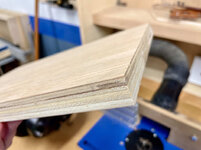
Hopefully it's obvious by now, but the edge banding goes in the front like this:

(case joints will be mitered)
And then the outside will get the veneer wrap, covering up the plywood. Giving me a nice sturdy hardwood edge in the front to do the drawer rabbet in and take daily use.
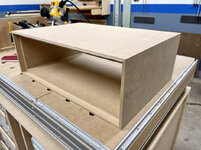
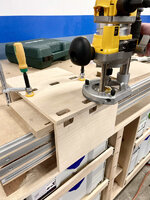
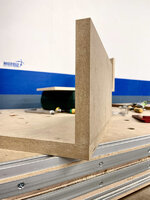
The parts so far look so simple, but it's been a lot of work already! And I've been doing stuff for my dad simultaneously. Shelves are coming along:

I'm waiting on a veneer scraper in the mail, but I'm hoping to dig into the veneering this upcoming week, or next weekend.

EDIT:
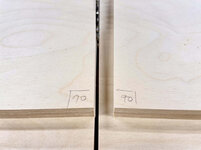
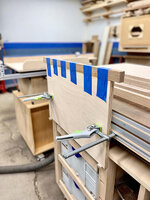
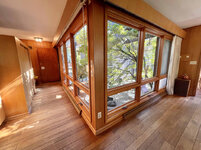
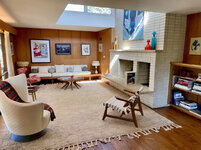
I almost forgot, when my daughter was at swim lessons this weekend I took my son to the adjacent shopping mall while my wife stayed with her. They have a Design Within Reach store there and I examined the George Nelson Thin Edge bedroom furniture that my nightstands are inspired from:































 .
.