To avoid these ads, REGISTER NOW!

Between 265 & 485 SQ/FT Nick's Two-Car Detached Vdub Garage

Workspaces sized between 265 and 485 squarefeet.

Trapps

ALLIANCE MEMBER
Joined
Feb 10, 2017
Messages
2,003
Location
The Detroit Zoo
When my kids were young I found myself in a similar place - often dragging them to cars & coffee events. Ohh the memories! Something must have rubbed off though, my daughter works for an OEM.

Awesome cars! Of the group you posted, the Singer is #1 for me.
 
To avoid these ads, REGISTER NOW!

loganb

ALLIANCE MEMBER
Joined
Dec 29, 2011
Messages
5,554
Location
Omaha, NE
Great pic's and looks like a good time with the kids and the family out east! Hard to get beach scenes like that in the midwest/upper midwest!

Awesome cars! Of the group you posted, the Singer is #1 for me.

I'm with Trapps, I like them all but am drawn to the Singer 911

I was kind of bummed that car wasn't on display at our show last week. The owner (Myron Stine) is from the DSM area.

Interesting...if it wasn't for him and Dennis Albaugh https://albaughclassic.com/ the central Iowa car scene would be far less impressive. Not surprising based on the location, both made their fortunes selling inputs to the farmers(one seed, the other chemical)
 
OP
N

nicholam77

Well-known member
Joined
Dec 18, 2016
Messages
2,671
Location
Minneapolis, MN
Awesome cars! Of the group you posted, the Singer is #1 for me.
I'm with Trapps, I like them all but am drawn to the Singer 911

It's funny, with all the other flashy hypercars this one sort of went under the radar. Definitely got less attention from the crowd. But I agree! The 911 in general is my favorite car, and the sports car I would buy with my own money if possible. Really almost any generation except the 996 (don't like the fried egg headlights)! Probably the only Singer I'll ever see so it was pretty neat!

Great pic's and looks like a good time with the kids and the family out east! Hard to get beach scenes like that in the midwest/upper midwest!

It was great! I love the ocean. I'm a warm weather, water, and flip flops kinda dude. I always thought I'd move away from Minnesota to someplace warm with an ocean accessible. California was the dream for awhile, as I went to school out there, but family and other things called me back. I don't have any regrets and there are truly great things about MN and the midwest, but traveling I am sometimes jealous of the natural beauty in other parts of the country.
 
OP
N

nicholam77

Well-known member
Joined
Dec 18, 2016
Messages
2,671
Location
Minneapolis, MN
Night Stands — Part 1

I'm getting this started!

But first let's back up and do a slight rant about materials.

Problem #1. This is my bad, but when I ordered the white oak veneer back in May, I didn't unroll and inspect all the sheets. Because I knew I wasn't going to use it right away. It was wrapped in cellophane. I could see the grain on the inside of the roll (1 of 3 sheets) and it looked good.

And then it sat for months.

Well I just opened it last week and we have a problem. One sheet (the one I could peak at) looked great:

IMG-8224.jpg

But the other two had an identical and horrendous cathedral grain pattern:

IMG-8225.jpg

I really hate heavy oak grain like this, and it's certainly not appropriate for a Modern aesthetic.

I had ordered plain sawn, because that's what my bed frame is that I'm trying to match, and the reference pic online looked much like the 1st sheet.

I got in touch with the veneer supplier and begged forgiveness, but understandably they wouldn't accept a return.

So I've bit the sunk cost and ordered new veneer. They now have supply issues so all that was available was a 4'x8' sheet, which is more than I need. But I went with rift sawn this time, so the grain should be nice and straight, and I asked them to double check it before sending it to me. That gets here tomorrow, so fingers crossed.

Problem #2. Sourcing white oak hardwood. I don't have a lumber yard I go to and the big box stores don't have white oak. I ended up ordering online again, from Rockler. Three 3"x24"x3/4" boards was $55. 😬

I also had to order my baltic birch for this project online at high prices.

Which brings me to my main complaint — building stuff yourself is just getting too damn expensive. Even for simple materials like plywood, either the plywood is total ****, hard to find, or priced through the roof. In the end I still think I'm saving money compared to buying a similar quality and design night stand, but the price and availability of materials these days is frustrating.

/rant

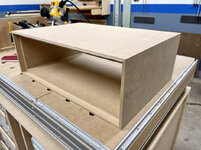
Last night I started by cutting the baltic birch into slightly oversized pieces based on my MDF mockup unit.

IMG-8373.jpg

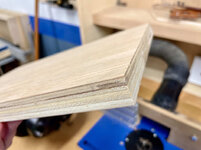
Price aside, the plywood was nice.

IMG-8374.jpg

And so was the white oak from Rockler.

IMG-8376.jpg

To rough size the panels I did one rip and one cross cut for each. I like to mark which edges I've cut, and corners I've squared, as I go.

IMG-8377.jpg

IMG-8379.jpg

I got some burning on the oak, but here are the parts rough dimensioned:

IMG-8380.jpg

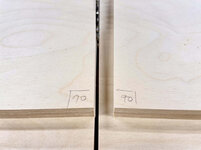
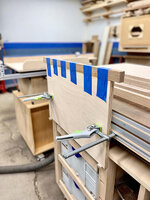
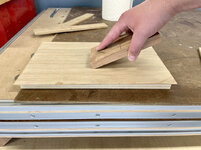
The oak boards are the edge banding for the carcass panels — what you will see from the front. I needed to glue them together. I thought about biscuits, but I wanted the oak to be proud of the plywood on both sides to flush up after gluing. So I tried blue tape.

IMG-8381.jpg

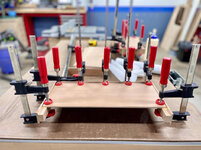
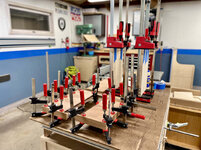
Technically this works, but I didn't feel like there was enough pressure on the joint. So I added clamps.

IMG-8383.jpg

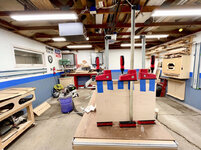
These parallel clamps are awesome for stuff like this. Unfortunately I only have the handful since they are $$$, so can only edge band one panel at a time.

Once all the panels are edge banded, the oak will be flushed up and the whole thing will get veneered in white oak on the outside only.

That's where I left it for the evening.

IMG-8382.jpg

Back at it when I can.

🍻
 
OP
N

nicholam77

Well-known member
Joined
Dec 18, 2016
Messages
2,671
Location
Minneapolis, MN
That seems odd for a city of your size... what keywords are you using when you've searched for a supplier?

They do exist, I just haven't been to any. They all have limited hours (usually weekday) and no online prices or catalogue, and I haven't found time to get there during work hours. Sometimes it's hard to tell exactly what they stock from the websites.

The place we used for my dad's pantry is a big lumber yard, but geared towards contractors. They will sell to consumers but you can't go pick out your boards, you just tell them what you want and they prepare it for you.

There's a handful of others I've been meaning to check out. I guess I should have phrased it as more of a "me" problem.

For online options I just came across this Forest 2 Home seller that seems to have better price/board than Rockler, Woodcraft, etc

_______________________


Back in the shop I've been continuing to edge band the carcass panels for the night stands. The 1st one I did turned out great, the 2nd one the edge banding is a bit tilted. I think the clamps pulled to the side. I'm trying to decide if it's worth cutting it off and redoing it. The edge banding would be a bit shorter on that piece, but you would only really see from the inside and it will be covered by the drawer eventually.

Going forward I oriented the clamps differently and used more of them:

IMG-8390.jpg

This worked better.

Then I got derailed a bit helping my dad make some floating shelves for his kitchen remodel (same design I've done before).

IMG-8392.jpg


What's that thing woodworkers like to say about clamps again? :ROFLMAO:
 
OP
N

nicholam77

Well-known member
Joined
Dec 18, 2016
Messages
2,671
Location
Minneapolis, MN
Night Stands — Part 2

This isn't so much a new part of the build as just continuing working on the panels.

Going to document a few struggles here. The first is one of the edge band boards got clamped askew (clamps pulled it to the side) so it was not co-planar with the plywood. I decided it was off by too much, so I sliced it off and tried again.

IMG-8413.jpg

I had to re-square the glue edge of the white oak, so it's going to be a tiny bit narrower than the rest of them, but this will only be noticeable from the inside and will be covered up by the drawer, anyways.

After many rounds of clamping and gluing, all the plywood panels were edge banded. Because my white oak boards where a true 3/4" S4S stock, and the plywood was slightly undersized, there was a small overhang on both sides that needed to be flushed up.

I pondered the best way to do this for quite awhile. I don't have a tall enough auxiliary fence for my table saw. My router flush trim bits were not long enough. The "lip" wasn't huge, but sanding it alone would take forever with my little finish sander.

What I really needed was a jig like this:

Ultimate-Trim-Router-Jig.jpg

But I don't have that. So... hand plane!

IMG-8429.jpg

I did my best to sharpen the iron before hand, but it wasn't razor sharp. I still need to build a sharpening tool kit. For now I just use sandpaper and a glass plate. Probably not high enough grits, and no strop. The Chinese steel doesn't seem to hold the mediocre edge I achieve for that long, either. But... this old tool does work!

That said, after the first panel, my soft video editor hands looked like this:

IMG-8431.jpg

Not wanting to plane any more material than I had to, I trimmed off all the side overhangs:

IMG-8433.jpg

Cleaning up the hardened glue squeeze out was a huge pain and tore out the plywood in some cases. I have an old "glue scraping" chisel to do this, but it did not work very well.

I never intended my MFT bench to be used for hand tool work, but it succeeds just like it does with everything else I throw at it.

IMG-8440.jpg

While the plane was out, I cleaned up the front edges, too:
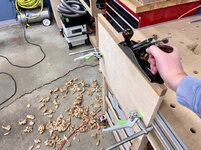
IMG-8434.jpg

Pictures can't really show it, but the resulting surface is so nice.
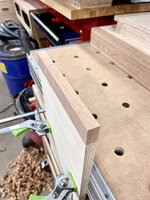
IMG-8449.jpg

Ok, here's my second mistake. On one of the larger panels I didn't have the lateral adjustment correct on the plane iron, and I ended up planing the far side of the oak more than I meant to. Phone camera couldn't pick it up, but this is an exaggerated version:

panel-cross-section.png

My solution to this will be to do the drawer rabbet on the sloped side. Fortunately I caught the error early. I'm getting used to planing a bit, getting down and taking a look, making sure I'm doing an ok job. Feeling the surface with my hands to check. Then keep going.

The plane gets it almost perfectly flush. But I still hit them with the sander just to make it perfectly smooth.

IMG-8451.jpg

And BOOM, there's my set of substrate panels for the two night stands, ready for veneer:

IMG-8453.jpg

Hopefully it's obvious by now, but the edge banding goes in the front like this:


IMG-8443.jpg

(case joints will be mitered)

And then the outside will get the veneer wrap, covering up the plywood. Giving me a nice sturdy hardwood edge in the front to do the drawer rabbet in and take daily use.

The parts so far look so simple, but it's been a lot of work already! And I've been doing stuff for my dad simultaneously. Shelves are coming along:

IMG-8445.jpg

I'm waiting on a veneer scraper in the mail, but I'm hoping to dig into the veneering this upcoming week, or next weekend.

🍻

EDIT:

I almost forgot, when my daughter was at swim lessons this weekend I took my son to the adjacent shopping mall while my wife stayed with her. They have a Design Within Reach store there and I examined the George Nelson Thin Edge bedroom furniture that my nightstands are inspired from:

IMG_8422.jpg
 

kwyjibo

Well-known member
Joined
Apr 8, 2008
Messages
743
I always enjoy following your progress, thanks for posting
We're lucky that there is a DWR nearby. I go there when I'm looking for inspiration and show up with a tape measure most times. I don't think that I'm the only one because the employees are always very helpful.
 
OP
N

nicholam77

Well-known member
Joined
Dec 18, 2016
Messages
2,671
Location
Minneapolis, MN
I always enjoy following your progress, thanks for posting
We're lucky that there is a DWR nearby. I go there when I'm looking for inspiration and show up with a tape measure most times. I don't think that I'm the only one because the employees are always very helpful.

Thanks for following!

I used to be somewhat uncomfortable going into DWR, knowing that I wasn't going to buy anything, feeling a little bad for the over-eager salespeople. Our store is never busy, either, usually just a few guests. Pre-covid, they used to have free mimosas and cookies on Sundays lol. It felt too much like a high-end boutique and the salespeople would follow me around like a hawk. But now I don't care and stop there every time I'm in the area. Usually bring my kids and let them try out all the expensive chairs. :ROFLMAO: I've realized that I think the salespeople (in addition to wanting to make a sale) are actually passionate about the pieces and like talking about them with potential customers whether they buy something or not. I actually did buy my bubble lamp from them, so I'm not a total freeloader. I've never brought a tape measure, but that's a great idea. The thing that always surprises me about modern furniture is how small and low to the ground it is. I like that but, having a reference to make my own stuff is great, because I think the hardest thing to nail is proportion and size. I've thought about making a Nelson slatted bench myself because that would be fairly easy, and seeing if I can order the metal leg base for it. I wonder if they let you buy "spare" parts at all. Getting off on a tangent here...

I'm going on a Modernism open house tour in the Twin Cities this Saturday. I'll try to post some pics from that if photography is allowed.

🍻
 

Trapps

ALLIANCE MEMBER
Joined
Feb 10, 2017
Messages
2,003
Location
The Detroit Zoo
DWR is great for inspiration, but I've always laughed at the 'Within Reach' element. Clearly they were referring to the design aspect, not the cost. We used to have one local, but now the closest is in Grand Rapids.

Similar to Mitchell Gold & Bob Williams, Restorations Hardware, West Elm, CB2 and a few others. All pricey and may or may not be top quality.
 
OP
N

nicholam77

Well-known member
Joined
Dec 18, 2016
Messages
2,671
Location
Minneapolis, MN
Night Stands — part 3 — tests and jigs

Looking at my edge banded panels, I realized I had to fill a couple small knots and dings in the plywood. Bondo or similar would be ideal, but I didn't have anything like that so I used drywall compound. Not the best, but the imperfections were quite small so I think it will be fine.

IMG-8522.jpg

IMG-8523.jpg

The substrate surface needs to be perfectly smooth for the veneer.

Next I did a little test veneer practice piece.

IMG-8527.jpg

Not many pics because my hands were full. I used a water-based contact cement, rolled on. It was challenging not to make a mess of the workbench and keep the veneer's good side clean. That is going to be the trickiest part, spreading the glue.

After it dried for a day, I practiced flush trimming the edges on the router table.

IMG-8541.jpg

I've done this operation a bunch before, but wanted to see how the special up cut spiral bit I ordered handled the veneer material.

IMG-8543.jpg

The end result was good, but the adhesive did gum up the bit and stick to the sides of the plywood in clumps that needed to be cleaned up after. I wish it cut a little cleaner.

IMG-8545.jpg

IMG-8546.jpg

So that's my dry run for the real thing. Now it's white oak plywood!

Next I did some practice joinery. If you'll recall, I was previously weighing "the blue tape method" vs. adding biscuits on the case miters. Both of those were compromises to my original plan... DOMINOS!!!

Without a Festool Domino machine. I even went so far as to make this jig to hold the panels for routing:

IMG-8553.jpg

My plan was to make some 3d-printed attachments that would index a router guide bushing and have end stops. But then my 3d printer broke again and I haven't had time to fix it or work out the design for that. So I went to biscuits.

But the "play" in the biscuits just doesn't sit right with me, and I don't want these to fail as I have way too much money into materials at this point. I also want them to look perfect. So I took my MDF prototype and routed Domino slots free hand with a router edge guide.

This is the setup:

IMG-8551.jpg

I flush the edge of the miter with the top of the jig using my finger. The jig holds the panel at a 45° angle, so the miter is horizontal and easier to route.

Here you can see the Domino slot next to the biscuit slot:

IMG-8547.jpg

I think I'm using a Whiteside 5mm up cut spiral bit for this, and the fit with the Dominos is perfect. The Dominos are thicker and go into the material deeper, so will be stronger. But also the fit is so much more precise than the biscuits, and I'm hoping this will really help during the glue up.

IMG-8552.jpg

Rinse and repeat and I can dry fit it. I used two Dominos per side.

IMG-8554.jpg

IMG-8555.jpg

IMG-8558.jpg

The accuracy and fit is really good. The outsides of the miters are tight all around. The only thing I'm missing is something to align all the front edges in the same plane, but I'm not sure I 100% need this.

I noticed a little bit of a gap on the insides of the miters, but I'm not too worried about that, it's not much. Could have been a slight mistake in angle on my table saw blade.

IMG-8559.jpg

One annoying thing about the jig is the router edge guide interfered with the clamps holding it to the MFT, so I had to keep switching the clamps back and forth to each side as I would route the alternate side.

IMG-8561.jpg

This added a lot of extra fiddling, so to fix it I drilled some holes for star knobs to secure it from inside.

IMG-8560.jpg

Lastly I've been thinking about cutting the actual case miters on the MFT with the track saw instead of the table saw. Still need to do more tests but I wanted to see how the track saw handled cutting through my veneered test piece, since the blade is coming up through the material (opposite of table saw).

IMG-8564.jpg

IMG-8566.jpg

Looks like the splinter strip on the rail did a pretty good job!

In total this was at least 3 hrs in the shop. I didn't make any progress on the actual night stands, but I'm hoping all this practice and testing will make the real ones have less surprises.

🍻
 
OP
N

nicholam77

Well-known member
Joined
Dec 18, 2016
Messages
2,671
Location
Minneapolis, MN
DWR is great for inspiration, but I've always laughed at the 'Within Reach' element. Clearly they were referring to the design aspect, not the cost. We used to have one local, but now the closest is in Grand Rapids.

Similar to Mitchell Gold & Bob Williams, Restorations Hardware, West Elm, CB2 and a few others. All pricey and may or may not be top quality.

I thought the same when I first became acquainted. But you are right, the name comes from providing access to designer pieces to the lay person. We don't think of it that way today but there was a time when you couldn't just walk into one of 20 stores and buy these pieces. A lot of the furniture they sell was designed by architects and sometimes only available to architects to furnish their buildings. Back in the day, for some of this furniture, there wasn't an easy way for the average person to just buy a single chair they liked.

As you know I'm a fan of a lot of this stuff, but I agree that it's way overpriced in a lot of cases. Some of the high prices are due to materials and manufacturing difficulty I'm sure (the Womb chair can't be easy to upholster), but $6k? You are paying a high price for a designer item that has history. On one hand I do believe that good design can and should cost more... but at a certain point a lot of this furniture has become luxury goods. Which is actually far from the original goals of Modernism. Since I know you'll get this reference, I think it's analogous to watches in that respect. Comparing the cost of a Submariner from 1970 to one from today, and there's more than just inflation going on. The way the items are perceived and valued has changed. Unfortunately this puts it out of reach for most people (including myself), which is why I'm building my night stands 😁

Despite being overpriced, I do think DWR's stuff is of reasonable quality. Certainly better than a West Elm. If you're getting a walnut lounge chair, it's actually solid oiled walnut with legit joinery and not some look-a-like wood with a stain. But like you said, it depends on the piece a bit.
 

wreckdiver1321

Well-known member
Joined
Aug 12, 2021
Messages
1,039
Location
Billings, MT
It looks like you had a good practice run and are figuring it all out. Love the precision and how it's all turning out.

You know, Gregor's thread really had me liking the idea of getting a Festool Domino, and now I'm really thinking it's an even better idea. I know it's ****** expensive but once I get into more woodworking and finer joinery, it might be damn handy.
 
OP
N

nicholam77

Well-known member
Joined
Dec 18, 2016
Messages
2,671
Location
Minneapolis, MN
It looks like you had a good practice run and are figuring it all out. Love the precision and how it's all turning out.

Thanks, Tom!

You know, Gregor's thread really had me liking the idea of getting a Festool Domino, and now I'm really thinking it's an even better idea. I know it's ****** expensive but once I get into more woodworking and finer joinery, it might be damn handy.

I think Gregor's thread has had that effect on a lot of people :ROFLMAO:

I won't lie, I've considered getting one for real. I know I would use it. I've achieved pretty good results with my biscuits-pocketscrews-glue-clamps combo for cabinets, but a Domino would give even better alignment. It would be perfect for this project I'm doing now. There are ways to get around it for both of those use cases, as I'm hoping to show with this build, but I do value my time a lot these days! Routing those 8 slots took 30-40 minutes, maybe more. I'm sure I could bang it out it 5-10min if I had the Domino. I could have even used it for the pantry shaker doors.

Of course the price has always held me back. I can't help but do my usual microeconomics comparison of not just the utility of the Domino itself, but the utility of what else I could buy for $1100. And so far I've come to the conclusion that there are better things to spend that amount of money on (planer, jointer, bandsaw, better table saw, etc.)

I can see it finding it's way into my shop eventually. Especially if I ever go down the road of large scale hardwood furniture projects like tables, chairs, beds, etc. I think I could justify it more for that. But for now I'll keep doing it the hard way 😁
 

Trapps

ALLIANCE MEMBER
Joined
Feb 10, 2017
Messages
2,003
Location
The Detroit Zoo
For $1100 a Mafell DuoDoweller is an option.

Your arguments are all valid and I share the same opinions relating to cost benefit analysis.

Eventually, I will buy a DuoDoweller. The list of things I buy before that is long and varied.
 

wreckdiver1321

Well-known member
Joined
Aug 12, 2021
Messages
1,039
Location
Billings, MT
Thanks, Tom!


I think Gregor's thread has had that effect on a lot of people :ROFLMAO:

I won't lie, I've considered getting one for real. I know I would use it. I've achieved pretty good results with my biscuits-pocketscrews-glue-clamps combo for cabinets, but a Domino would give even better alignment. It would be perfect for this project I'm doing now. There are ways to get around it for both of those use cases, as I'm hoping to show with this build, but I do value my time a lot these days! Routing those 8 slots took 30-40 minutes, maybe more. I'm sure I could bang it out it 5-10min if I had the Domino. I could have even used it for the pantry shaker doors.

Of course the price has always held me back. I can't help but do my usual microeconomics comparison of not just the utility of the Domino itself, but the utility of what else I could buy for $1100. And so far I've come to the conclusion that there are better things to spend that amount of money on (planer, jointer, bandsaw, better table saw, etc.)

I can see it finding it's way into my shop eventually. Especially if I ever go down the road of large scale hardwood furniture projects like tables, chairs, beds, etc. I think I could justify it more for that. But for now I'll keep doing it the hard way 😁
The great news about Festool is you can find them used a lot, so that's the route I'd go. Or just buy a biscuit joiner, which I know isn't quite as perfect but it's a step. That being said, I don't do enough woodworking to justify it yet. You've got me convinced I need to buy a small table saw, and upgrade to a Makita track saw. I've already convinced myself I need to upgrade to a better router. But I want to finish off my auto tools too. I need a few specialty sets that I don't have yet. I need to finish my welding cart.

Ahhh. It never ends.
 

Bakafish

Well-known member
Joined
Feb 7, 2017
Messages
477
Location
Tokyo
The lack of registration using biscuits is seen as a feature, not a bug. I think using the tenons as a 2 dimensional constraint just doubles the need for accuracy. For knock-down construction it makes more sense, but with permanent pieces plenty of slop with proper hand alignment and clamping will achieve the same goals. Once the glue dries, the play of the biscuits is moot, and compared to a proper glue bond any sheer strength they (or a domino) might add is just background noise. If you are relying on the tenon strength it means the glue line is gone and the item is already wrecked.

I have a Domino (and a biscuit joiner) and quickly learned that trying to use it to precision locate all the tenons is asking for a glue-up disaster and a lot of panicked pounding and clamping and yanking out the problematic dominoes to get it together. Dry vs wet fitting can lul one into thinking something will work, when it won't. I learned that proper selection of the 3 slot widths the Domino can create are critical. Mostly I use the tight mode with dual constraints on one side of the joint, and the middle setting with play on the other. The tight side keeps the domino nice and straight for assembly, and the looser side allows it to fit together without drama, and a bit of play to get the edges hand aligned dead on. Cutting both sides with the tight setting will make sub millimeter errors turn into a nightmare trying to get the glue covered pieces aligned.

If you have some tricky bit that would be difficult to align, or you really think it needs it, you can use the tight setting on both sides for a single domino, and that will act as the registration guide, but you still use the looser slots for all the other ones as it will still let you assemble it. Again, I'm sure there are people that can consistently pull off only using the tight setting on every slot, but my point is that it gains you nothing in strength and one 1mm screw up will turn an easy glue up into frustration.

So in my humble opinion 'biscuits' are quite suitable for what you are doing here and the 'Domino' advantage probably isn't that great. If the domino jig you set up works, that is wonderful, but really think about the constraints you really require, just keeping the panels aligned in one axis is all you should need with proper clamping.

As far as the veneer, they make special veneer glue (that I can't find over here) that has some special properties around shrinkage and movement that may be advantageous over the long term. Contact cement is great for synthetic laminates, it might be the right thing here too, but at least check out the special purpose glue before committing.

The miters you are attempting are super finicky since you are trying to get clean inside and outside edges at the same time, with a fairly thick piece of material. Typically you bias the visible edge over the other, in your case you need to get it perfect. As much as I love my track saw, it is not the tool to do that, just hand pressure differences will cause the track saw to deflect a few degrees. If you were just trying to get a single tight edge it would work, but the table saw is going to be more rigid and consistent. Figure out how to micro-adjust the table saw, and how to keep it in that setting once you get it tuned with lots of test cuts on scraps. A router table would be a good second choice, so keep that option in your pocket if the table saw can't meet your needs. Wood filler on an inside corner can hide a lot of sins...

Looking good, I'm sure this will turn out sweet!
 
OP
N

nicholam77

Well-known member
Joined
Dec 18, 2016
Messages
2,671
Location
Minneapolis, MN
@Bakafish those are all good thoughts. You wrote a lot but I'll try to comment on it all :)

Glue will be the primary bond for the joints. With the biscuit vs. Domino debate I am mostly concerned with alignment aid during glue up. The biscuit play might not be a problem after the glue dries and they swell, but like you alluded to the glue up is what I'm worried about. I can finger-align the front edge no problem, but I feel like these long miters are going to be slipping and sliding especially when clamps are applied. And it takes awhile for the biscuits and glue to set up and not have that play anymore. In my test yesterday, in dry fit the dominos aligned the outside edge perfectly, and the whole thing was much more rigid and stable already. I'll take all the help I can get during glue up.

I don't think I'll be making my 3d-printed jig idea for this project. But the plan was to have a narrow and tight setting. Like you stated, one side of the joint would get all the tight setting, and the other side would get the loose setting except the front mortise which would also be tight, and those corresponding tight mortises would line up the front edge. I know that would add accuracy concerns, but with a 3d-printed part and "end stops" to reference the edge of the panel, I think it would be pretty accurate.

In the 90° Domino jig I made awhile ago, I also had narrow and wide slot options:

IMG-6468.jpg
IMG-6470.jpg
narrow-loose.jpg

And using the narrow option just on one end for both pieces did a great job of accurately aligning them on the front edge:

IMG-6475.jpg

For the night stand project I don't really feel like making another jig, or going through the whole 3d-printer process, so I'll probably just use the router w/edge guide like in my test, and all of the mortises will be slightly wide.

Overall I do agree with you that the biscuits vs. Dominos isn't night and day, and biscuits would likely be fine. Part of this is that extra 10% alignment and strength, and part of it is me just wanting to experiment and say I did it.

The contact cement I'm using is made for veneers. It's called Better Bond Titan DX.

The reason I was considering the track saw for the miters, is I need to square up the sides anyways. Currently the front edge and back edge of the panel are parallel, but the sides are not. I think my MFT setup is much more accurate for square than my crosscut sled when the panels are large and I have to pull it so far out of the miter channels. You have a good point about the track saw usage though, and I don't really want another kerf line in my top. I think what I'll do is square the sides to the front using the MFT (w/90° cuts), and then do the 45° cuts on the table saw. Router would be ideal but I don't have a bit and I think I'll have much better luck keeping the panels consistent width on the table saw with the rip fence.

As usual, thanks for your detailed advice.
 
OP
N

nicholam77

Well-known member
Joined
Dec 18, 2016
Messages
2,671
Location
Minneapolis, MN
For $1100 a Mafell DuoDoweller is an option.

Your arguments are all valid and I share the same opinions relating to cost benefit analysis.

Eventually, I will buy a DuoDoweller. The list of things I buy before that is long and varied.

The DuoDoweller is neat. Do you always have to use both bits (drill two holes)? While they have some overlap, they are slightly different tools in my book. One advantage to the Domino is there is a whole range of tenon sizes you can use, from small to large projects. And multiple depth and slot width settings. As far as I can tell the DuoDoweller is a little less versatile, but also does neat things like shelf pins. But I should watch some more videos about it because I'm not as familiar with that one.

The great news about Festool is you can find them used a lot, so that's the route I'd go. Or just buy a biscuit joiner, which I know isn't quite as perfect but it's a step. That being said, I don't do enough woodworking to justify it yet. You've got me convinced I need to buy a small table saw, and upgrade to a Makita track saw. I've already convinced myself I need to upgrade to a better router. But I want to finish off my auto tools too. I need a few specialty sets that I don't have yet. I need to finish my welding cart.

Ahhh. It never ends.

Probably depends on location a bit, but the used Festool I've encounted on Craigslist etc is not much of a discount. And if it is, it's usually beaten up and in rough shape. I'd rather pay $1100 for a brand new tool than $950 for one that's 4 yrs old and I don't know how it was taken care of. But that's just me and the pricing trends I've seen, there might be good deals out there.

A biscuit joiner is a great tool depending on what type of stuff you want to build. I think for cabinets it's very useful, for assembling cabinet boxes, as well as face frames and other things. Useful for panel glue ups as well. Plus the odd task like reinforcing miters. I wouldn't consider it a joinery tool (Domino replacement), though.

I think a small table saw would be priority #1 if I was in your shoes and wanted to dip my toes in more. Even just for home repairs and odds and ends it will open up a lot of options. Then router. My big honking DeWalt is good for my router table, but I'd recommend starting with a smaller trim router size with a plunge base instead. Makita makes a good one. So does DeWalt.

You are definitely right that it never ends :ROFLMAO:
 
To avoid these ads, REGISTER NOW!

wreckdiver1321

Well-known member
Joined
Aug 12, 2021
Messages
1,039
Location
Billings, MT
Probably depends on location a bit, but the used Festool I've encounted on Craigslist etc is not much of a discount. And if it is, it's usually beaten up and in rough shape. I'd rather pay $1100 for a brand new tool than $950 for one that's 4 yrs old and I don't know how it was taken care of. But that's just me and the pricing trends I've seen, there might be good deals out there.

A biscuit joiner is a great tool depending on what type of stuff you want to build. I think for cabinets it's very useful, for assembling cabinet boxes, as well as face frames and other things. Useful for panel glue ups as well. Plus the odd task like reinforcing miters. I wouldn't consider it a joinery tool (Domino replacement), though.

I think a small table saw would be priority #1 if I was in your shoes and wanted to dip my toes in more. Even just for home repairs and odds and ends it will open up a lot of options. Then router. My big honking DeWalt is good for my router table, but I'd recommend starting with a smaller trim router size with a plunge base instead. Makita makes a good one. So does DeWalt.

You are definitely right that it never ends :ROFLMAO:
That's a good point, I'm generally in that spot too when it comes to used tools, though I have been known to be a cheap *** once in a while. :lol:

My next woodworking tool will either be an upgrade to my track saw or a small table saw. I see the DeWalt ones for sale in great shape in pawn shops all the time, but they're less than $400 new (especially now, $329 on Amazon) so it might not be a huge deal for me to buy a new one. I can definitely see the utility when making things, being able to do dados and rabbets and such, along with being able to square up material. I actually do have a plunge router, but I think it got left behind from when Moses built the ark. It's a Black and Decker from when B&D made decent tools. Weighs about as much as a Mini Cooper but seems to work like a hot damn the few times I've used it.

I've also thought about getting a miter saw too, but I'm not sure how bad I need one yet. Not sure it's totally necessary if I have a circular saw, track saw, and a table saw.

All in due time I suppose.
 

Trapps

ALLIANCE MEMBER
Joined
Feb 10, 2017
Messages
2,003
Location
The Detroit Zoo
An overview:

A decent review comparing Mafell, Festool and Lamello:

I've looked at most of the online stuff. I like the Domino. A ton. For reasons you, as well as our Akihabra friend, mentioned. Especially the ability to have adjustability in fitment. I think the precision offered (by both brands) is a draw. But for my wants/needs I think i'd like the dowles better. With small bits in you can tap some thin pieces. Yes, you can run just one bit.

Agree 10000% on your Festool approach.

@wreckdiver1321 Tom, You have a track saw. Get the table saw to compliment track capability. Then upgrade the track rig later if needed given the TS capabilities.

:beer:
 

bj383ss

Well-known member
Joined
Sep 29, 2011
Messages
3,166
Location
TX
That's a good point, I'm generally in that spot too when it comes to used tools, though I have been known to be a cheap *** once in a while. :lol:

My next woodworking tool will either be an upgrade to my track saw or a small table saw. I see the DeWalt ones for sale in great shape in pawn shops all the time, but they're less than $400 new (especially now, $329 on Amazon) so it might not be a huge deal for me to buy a new one. I can definitely see the utility when making things, being able to do dados and rabbets and such, along with being able to square up material. I actually do have a plunge router, but I think it got left behind from when Moses built the ark. It's a Black and Decker from when B&D made decent tools. Weighs about as much as a Mini Cooper but seems to work like a hot damn the few times I've used it.

I've also thought about getting a miter saw too, but I'm not sure how bad I need one yet. Not sure it's totally necessary if I have a circular saw, track saw, and a table saw.

All in due time I suppose.
All those saws are necessary. There I enabled you. :devilish:

Bret
 
OP
N

nicholam77

Well-known member
Joined
Dec 18, 2016
Messages
2,671
Location
Minneapolis, MN
I've looked at most of the online stuff. I like the Domino. A ton. For reasons you, as well as our Akihabra friend, mentioned. Especially the ability to have adjustability in fitment. I think the precision offered (by both brands) is a draw. But for my wants/needs I think i'd like the dowles better. With small bits in you can tap some thin pieces. Yes, you can run just one bit.

Thanks for the videos, I knew some of that stuff but the Doweller is more versatile than I thought. I'd seen the indexing accessory used for shelf pinning but hadn't considered it could be used to do panels. Didn't know you could use one bit, or that it had preset depth settings, etc. Definitely a cool piece of kit. Seems like the only downside compared to the Domino is the adjustability in fitment. But you get some other neat tricks.

All those saws are necessary. There I enabled you. :devilish:

:ROFLMAO:

I've also thought about getting a miter saw too, but I'm not sure how bad I need one yet. Not sure it's totally necessary if I have a circular saw, track saw, and a table saw.

I don't want to discourage you from spending your hard-earned money, but I actually don't think you need all those saws. Especially off the bat. If I had to lose one from your list, it would be the miter saw. And this is just based on my own thoughts and experience, I know a lot of people like having one in their shop.

My .02 is unless you're doing miters on long boards (baseboards, window casings, etc), a lot of what you can do with a miter saw can be duplicated on a table saw, only better. I would wager that a lot of people don't even do miters that often on their miter saws, but rather use it as a chop saw to cut long boards into shorter pieces. I've rarely built anything where I need super long boards, outside of a lot of trim inside my house, and there are many options to cut long boards into shorter lengths, like a circular saw or hand saw. You might say this is not as accurate, but my workflow is to cut a long board roughly into slightly oversized pieces that are manageable, and then make the precision cuts afterwards on the table saw. Plus, to use a miter saw like that precisely, you need a nice stand or "miter station" with a fence and stops. This takes up a LOT of space. Can be good for storage. But in a relatively small space I'd question what you need.

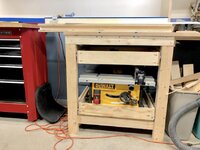
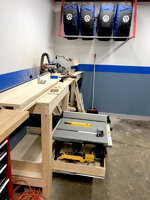
Like many starting out, I thought a miter saw was a necessity right away. It was the 2nd saw I got (after circular saw). One of my first projects in the garage was building a miter station for it:

83357.jpg

Before I made my table saw cart, it was handy to store it in this pull out drawer:

83358.jpg

82458.jpg

I did cut a LOT of baseboard on this setup, but I got tired of not having a proper table saw setup and having to lift it out each time. The dust collection on the miter saw was terrible, and that became increasingly important to me. FSD (Flat Surface Disease) often took over and made it a PITA to use.

92233.jpg

And most of all, I had plans to make the MFT workbench, and this thing was simply taking up too much space.

full-garage.jpg

So I tore it down and haven't missed it since.

I'm not saying this as a universal truth or anything, a lot of people like having one, but food for thought.

__________________

One other quick thought on job site table saws. Make sure it has a rack-and-pinion fence. DeWalt does, and it's good. There are other models out there now that have this as well. Personally I would get the largest job site saw you can. They are already small compared to a contractor or cabinet saw, and the larger the "table" the better and safer your experience will be. I would take the money away from a miter saw or track saw upgrade and put it towards a larger job site model (I'm just guessing the $329 DeWalt you mentioned is one of the smaller ones).

🍻
 
Last edited:
OP
N

nicholam77

Well-known member
Joined
Dec 18, 2016
Messages
2,671
Location
Minneapolis, MN
Little detour from the nightstands here...

For a few years I've been cataloguing my favorite Modernist houses around the Twin Cities. Either ones I've found on Zillow, or just by driving around. I have a whole folder with pictures on my computer, and I've made some really cool discoveries. If you look hard, there are actually a lot of examples of all kinds of Modernist residential architecture here.

Anyone who's followed along here for awhile knows I'm a fan, but... I've never been inside a Modern residence. Not in Minnesota anyways. I've always wondered if actually being in a space like that would hold up to what I hope it would be like.

So this past Saturday, I was very excited to go on a Modernism tour in the Twin Cities. I brought my dad along. 5 homes were featured as open houses. I was already familiar with some of them from the outside.

This will be a picture heavy post, but I know a few on here might enjoy (@kwijibo @bdbecker @Trapps ??).

The first two houses were in a cluster of about 32 houses by the same architect / builder, Richard Lundgren. I discovered this neighborhood a few years ago. It's heavily influenced by California Modernism, with Eichler-style features (including internal courtyards!), as well as some heavy Cliff May Rancho influence as well I think.

whiting-ave-1.jpg
IMG-8608.jpg

This one had a lot of contemporary finishes and fixtures I didn't care for, but the overall layout and feel was very nice. Simultaneous sunlight, nature, and privacy.

The next one (same neighborhood) was on the small side, but very nice inside. Also updated materials (not original).

5301-whiting-promo-orig.jpg
IMG-8612.jpg
IMG-8618.jpg
IMG-8614.jpg

My dad checking out the kitchen cabinets lol.

This next one was NOT on the tour, but it's by the same builder and probably same architect, in a nearby cluster. It's pretty rare to have a bunch of these type of houses near each other. But I have to share because it's a very unique example of a true Eichler layout in a winter state!

Front-Entrance-Doors-Closed.jpg
Courtyard-Table-Front-Doors.jpg
Courtyard-Table-Sliding-Doors1.jpg

Next up was a beautiful house by Close Associates. If you fancy a Google, Elizabeth Close and her partner Winston were an important duo in residential Modernism in Minnesota. This house also had a courtyard element and some breezeways, and despite being pretty small was quite the experience.


1041colbyave-04-8938-orig.jpg
IMG-8622.jpg
IMG-8627.jpg
IMG-8625.jpg

An original Ralph Rapson chair. Another important name in Minnesota Modern architecture. He was teaching at the University of Minnesota when my dad was in architecture school.

IMG-8629.jpg
IMG-8631.jpg

Next we moved to a neighborhood called University Grove. It was a program for U of M Professors to live in enclave of architect-designed homes. There were budget constraints etc so they were all of a similar means but wildly different designs.

Not part of the tour, but we passed the Rapson-designed Shepherd House which is fairly iconic.

IMG-8646.jpg

Another Rapson with multi-color panels:

IMG-8681.jpg

The last house on the tour was pretty epic:

IMG-8649.jpg
IMG-8667.jpg
IMG-8678.jpg
IMG-8677.jpg
IMG-8674.jpg
IMG-8672.jpg
IMG-8662.jpg

A lot of the featured houses were on the small side. Some maybe not the most practical for a family with young kids. The bedrooms and bathrooms were often quite small. But the main living spaces made up for it. The way these houses brought natural light in, and views of nature, while still feeling surprisingly private and cozy despite being on smallish lots, was eye-opening. They are open, but not open concept. There are thoughtful, deliberate spaces as you move throughout. And despite the small square footage and delineation of space, they don't feel claustrophobic. There is always a sightline, either to another space or to the outdoors.

I haven't really been able to stop thinking about it.

Ok, back to regularly scheduled programming. 😁

🍻
 

Klokwerk

Well-known member
Joined
Jan 1, 2010
Messages
205
Location
Spokane, WA.
I'm all caught up now. Great posts!
I'm afraid with my remodel I've got a lot of wood working skills to learn. I've been following along with your experiences so thanks!

The last house above is amazing.
 

MadeByMiller

Well-known member
Joined
Dec 29, 2018
Messages
1,230
Location
Rapid City, SD
Wow! Thank you for sharing pictures from your tours! Our home is an A-frame built in 1975, and naturally I'm drawn to the MCM aesthetic. You're clearly very knowledgeable on the style, I'm certainly not, but I appreciate it none-the-less.
 

Trapps

ALLIANCE MEMBER
Joined
Feb 10, 2017
Messages
2,003
Location
The Detroit Zoo
No question, I'm in.

The long term vision for our home is what could be called 'Modernized MCM' a mashup of traditional MCM elements and concepts you might find in Dwell magazine.

Detroit has a strong history of Architecture and Design. There are seemingly dozens of notable MCM/modernist homes here and hundreds, if not thousands, of unremarkable examples. The numbers swell significantly if you include the whole state of Michigan. Here are some articles that will scratch the surface:
So much to choose from; they range from <1000sf affordable homes in Detroit to 2000sf homes in Southfield to >5000sf estates in Bloomfield Hills. There are a few whole neighborhoods of MCM homes in Metro Detroit.

If your travels ever bring you to Detroit, there is much to see in your wheelhouse.

Great pics.
:beer:
 

bdbecker

ALLIANCE MEMBER
Joined
Nov 18, 2015
Messages
5,572
Location
Iowa
Thanks for sharing! I follow some Midwestern MCM groups and people on social media and saw that tour was coming up. While I knew I wouldn't make it this time, I put in in the back of my mind to try and keep an eye out for it and try to go if they do it again. We really need to do something like that in Des Moines. Just last week I was cruising around some neighborhoods near my work while on my lunch break and found another pocket of MCM houses.
 

kwyjibo

Well-known member
Joined
Apr 8, 2008
Messages
743
excellent photos and commentary. Thanks for posting this! (and for tagging me)
I'm always interested to see various designs from around the country.
 

jar944

Well-known member
Joined
Jul 26, 2010
Messages
5,933
Location
Northern VA
Interesting tour. I'm about as polar opposite as I think one can be regarding design aesthetic, but neat to see none the less.

As for your domino vs biscuit vs something else miter quandary, have you just considered straight miters using the miterfold technique. I'll occasionally do a lock miter, but frankly the miterfold is faster and easier with the same result. There is enough long grain to long grain contact the plywood edge it should be a very solid glue only joint.
 
OP
N

nicholam77

Well-known member
Joined
Dec 18, 2016
Messages
2,671
Location
Minneapolis, MN
I'm all caught up now. Great posts!
I'm afraid with my remodel I've got a lot of wood working skills to learn. I've been following along with your experiences so thanks!
The last house above is amazing.

Thanks! I forgot to tag you, I should have since you've got an MCM. In that last house, every detail was custom woodwork, including the towel hangers in the bathrooms. But they were very simplistic. Depends on what you need to do with your remodel, but I think modern design lends itself to DIY woodworking since a lot of it is visually simple and not a lot of specialized tools are needed.

Wow! Thank you for sharing pictures from your tours! Our home is an A-frame built in 1975, and naturally I'm drawn to the MCM aesthetic. You're clearly very knowledgeable on the style, I'm certainly not, but I appreciate it none-the-less.

Cool! Thanks for checking it out!

No question, I'm in.

The long term vision for our home is what could be called 'Modernized MCM' a mashup of traditional MCM elements and concepts you might find in Dwell magazine.

Detroit has a strong history of Architecture and Design. There are seemingly dozens of notable MCM/modernist homes here and hundreds, if not thousands, of unremarkable examples. The numbers swell significantly if you include the whole state of Michigan. Here are some articles that will scratch the surface:
So much to choose from; they range from <1000sf affordable homes in Detroit to 2000sf homes in Southfield to >5000sf estates in Bloomfield Hills. There are a few whole neighborhoods of MCM homes in Metro Detroit.

If your travels ever bring you to Detroit, there is much to see in your wheelhouse.

Great pics.
:beer:

I can imagine there is a lot in Michigan. I might have to check out some of those books from your links.

Another term I've heard for 'Modernized MCM' is 'New Century Modern', if I'm using that correctly.

Thanks for sharing! I follow some Midwestern MCM groups and people on social media and saw that tour was coming up. While I knew I wouldn't make it this time, I put in in the back of my mind to try and keep an eye out for it and try to go if they do it again. We really need to do something like that in Des Moines. Just last week I was cruising around some neighborhoods near my work while on my lunch break and found another pocket of MCM houses.

It was my first time and I definitely plan on going next year. FYI they also have a pretty neat series called "Going, going, gone" where they let you tour architectural properties before they go on the market. That's ongoing throughout the year. I haven't been to one yet, but there have been some pretty neat houses part of that, too, including a John Howe (Frank Lloyd Wright disciple) in Rochester, MN. Maybe keep an eye out!

I think this probably goes for any well thought out, architect-designed residence, not just a modern one, but actually being physically in the space was a whole different experience than looking at photos online.


excellent photos and commentary. Thanks for posting this! (and for tagging me)
I'm always interested to see various designs from around the country.

Thanks! I am too. The movement was so far-reaching and lately I've been really interested in what's right around me.

Interesting tour. I'm about as polar opposite as I think one can be regarding design aesthetic, but neat to see none the less.

As for your domino vs biscuit vs something else miter quandary, have you just considered straight miters using the miterfold technique. I'll occasionally do a lock miter, but frankly the miterfold is faster and easier with the same result. There is enough long grain to long grain contact the plywood edge it should be a very solid glue only joint.

Ha! :ROFLMAO:

By miterfold you just mean with tape? If so, yes I definitely considered that. I just don't have the previous experience and would rather overbuild than have it fail. My brain was telling me it needed some reinforcement, especially with it hanging on a French cleat... since I've had picture frames fall apart without a spline. But I know this is a much longer joint and I was wondering about the plywood long grain being strong enough even though it's in little strips. It would probably be easiest to do the glue up with tape and no clamps.

Hey, since you probably have a lot of experience with Blum slides 😁, I have a question about my inset drawer face and the rabbet in the cabinet face. Do you think I should make the rabbet the exact depth of the drawer face, so it acts as a positive stop when the drawer is closed? Or go a little deeper with the rabbet to give some wiggle room for adjustment with the slides? The locking mechanisms I got don't have the depth adjustment, but I could move the slides backwards or forwards slightly to get the drawer flush. Just curious what you would do — my main reason is I'm worried if I make the rabbet exact I'll somehow screw it up and the drawer won't be flush. And I'd have to wait until I've made the drawer faces to do the rabbet so I know the thickness, which will set the whole project back.

Thanks!
 

Pingel85

Well-known member
Joined
Oct 10, 2017
Messages
115
Location
Green Bay, WI
After a 2 year hiatus on here I’ve finally caught back up on your thread. Love the progress. Sorry about all the troubles you been having with your Ender, I actually had the same fan issue on mine, luckily I found it before I melted any pins 🤣.

But keep up the great work, I know how difficult shop time can be with 2 young kids (and I have a 3rd coming in December!). But soon you’ll be building Barbie beds and bird feeders with them, and your hobby will be even more fun and more unproductive lol.
 

jar944

Well-known member
Joined
Jul 26, 2010
Messages
5,933
Location
Northern VA
Hey, since you probably have a lot of experience with Blum slides 😁, I have a question about my inset drawer face and the rabbet in the cabinet face. Do you think I should make the rabbet the exact depth of the drawer face, so it acts as a positive stop when the drawer is closed? Or go a little deeper with the rabbet to give some wiggle room for adjustment with the slides? The locking mechanisms I got don't have the depth adjustment, but I could move the slides backwards or forwards slightly to get the drawer flush. Just curious what you would do — my main reason is I'm worried if I make the rabbet exact I'll somehow screw it up and the drawer won't be flush. And I'd have to wait until I've made the drawer faces to do the rabbet so I know the thickness, which will set the whole project back.

Thanks!

I'd suggest the 3 way locking devices so you can adjust the depth after install. I would make the rabbet deeper than you need, that way the slide functions as expected.
 
OP
N

nicholam77

Well-known member
Joined
Dec 18, 2016
Messages
2,671
Location
Minneapolis, MN
After a 2 year hiatus on here I’ve finally caught back up on your thread. Love the progress. Sorry about all the troubles you been having with your Ender, I actually had the same fan issue on mine, luckily I found it before I melted any pins 🤣.

Awesome, thanks for checking in! I really need to get the bed heater fixed on my Ender, I have more stuff I want to print! I'd love a Prusa but can't justify the cost for what I'm doing with it. I've thought about trying to Craigslist my Ender 3v2 and upgrade to their new S1 or something like that. See if I have better luck. Some of their newer Ender models have some nice upgrades, but not sure if they are any more reliable or not.

But keep up the great work, I know how difficult shop time can be with 2 young kids (and I have a 3rd coming in December!). But soon you’ll be building Barbie beds and bird feeders with them, and your hobby will be even more fun and more unproductive lol.

Thanks, I appreciate the encouragement! I can't imagine 3 kids. Congrats and good luck! Both of my kids were bad sleepers as babies which made it rough, but honestly the newborn-to-1 yr sprint goes so fast. I am looking forward to building some stuff together when they get older.

🍻

I'd suggest the 3 way locking devices so you can adjust the depth after install. I would make the rabbet deeper than you need, that way the slide functions as expected.

Thanks! That makes sense to me, too, but it's nice to have some reassurance sometimes. Back when I ordered hardware they canceled my slides (just the slides) so I need to order them still anyways. I'll just add new locking devices with the depth adjustment.
 
OP
N

nicholam77

Well-known member
Joined
Dec 18, 2016
Messages
2,671
Location
Minneapolis, MN
Night Stands — part 4 — veneering

We had a stroke of warm October weather (65-70° F) after a cold patch, so I took my shot and got the panels veneered. I was able to do this in an afternoon, a few at a time.

IMG-8574.jpg

It was pretty easy.

I had previously cut the veneer to 3/8" oversized pieces with a razor blade. I labeled every piece because they are all grain matched, and should end up very close to a "waterfall miter" grain effect.

I did not take pics of the process, as it requires some concentration.

But basically I scuffed the back side of the veneer and the plywood with some 80 grit paper. Then cleaned off the sawdust with microfiber rags. I spread the contact cement with a foam roller I bought for this purpose. The contact cement takes about 20-30 min to set up. Using MDF strips in between the two glue surfaces, I positioned each piece, and then carefully removing the strips, lightly pressed the veneer in place. I used a combo square to help me keep the front overhang even, so the grain is straight and will line up across the pieces. The bond is instant. To fully adhere it, I used a "veneer scraper", which is just a wooden stick with a UHMW paddle on the end of it, to apply high pressure. But a piece of hardwood with a broken edge would do the same. Scrape the surface starting in the middle and work your way out to the edges.

After they had all been veneered, I stacked them, and stacked a bunch of Systainers on top and let them cure for 24 hrs.

IMG-8578.jpg

They sat around for a few days until I had a chance to work again. The next step was to flush trim the overhangs. Like my test piece, I did this on the router table with a special flush trim bit:

IMG-8696.jpg
IMG-8697.jpg

The contact cement really gummed up the bit. It did a pretty nice job flushing the edges, but left some residual goo which is hard to sand or scrape off. This was annoying enough that I decided to only do the front and back side of each panel, since those were already parallel, and then trim the sides with the track saw. The panel sides needed to be squared, anyways.

IMG-8703.jpg

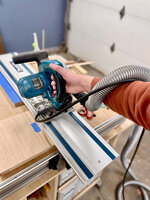
Pro Tip: when using a track saw, wrap the cord and vacuum hose around your arm so it doesn't catch on stuff. That's what I do anyways.

IMG-8711.jpg

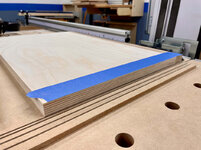
Because I don't register the guide rail to the hole grid when setting up my cutting station, my kerf line in the table has widened over the years. I wanted a really clean zero-clearance top and bottom, so I laid a piece of 3/8" MDF underneath everything, and moved it over for a fresh kerf each cut. And also used some tricks like painter's taping the cut lines, as well as clamping a piece of wood at the end of the cut to prevent tear out.

IMG-8706.jpg

IMG-8708.jpg

This lead to pretty much perfect cuts, top and bottom.

The white oak veneer is an excellent match to the white oak hardwood, it's pretty much an invisible edge. Really happy with it.

IMG-8705.jpg

From the side:

IMG-8704.jpg

Here you can see my errors with the hand plane:

IMG-8712.jpg

The inside of the white oak board tapers. As outlined previously, I caught this mistake, but it's present on a few of the edges. I purposely chose the good side to put the veneer on. So that it's flat. But also my plan is that when the miter is cut, it should correct itself at the joint. And the inside will be rabbeted out, anyways. That's how it will work in my head, but hopefully it comes together.

One piece of blow out I did have. Again, this will be eliminated by cutting the miters. The panels are all still oversized in that dimension.

IMG-8715.jpg

In the above pic you can also see some white flecks from a quarter sawn piece I had to use for edging. Rockler sent me two with straight grain and one with flecks. So I put those on the side, hoping most of it would be rabbeted out. A little nervous how those will show with finish applied.

After the miters and rabbets are cut, the boxes will shrink in height and not look so chunky, but here's a quick look at them so you can see the result of the veneering.

IMG-8714.jpg

IMG-8716.jpg

I was thinking about using hard wood for the drawer fronts, but the veneering was easy enough I think I'm going to do those with plywood and veneer, too. That way it will be guaranteed to match, and the rift sawn grain looks so clean.

Next steps:

— order Blum slides
— figure out drawer face and wall thickness (thinking 1/2" baltic birch but can't find any in stock)
— once that's determined I can cut the rabbet

Thanks for following along! Questions / comments / critiques always welcome!

🍻
 

wreckdiver1321

Well-known member
Joined
Aug 12, 2021
Messages
1,039
Location
Billings, MT
Man those are turning out cool! It's good to see the whole process, mistakes included. I feel like woodworking is half setup and half fixing **** that didn't work how it was supposed to. :lol:

Great work, can't wait to see it come together.
 
To avoid these ads, REGISTER NOW!
Top Bottom