Its not about the ramps. Its about approach angle. That's the biggest reason I can't use simpler designs. But unless you've EVER pulled an air ride trailer you have no idea how smooth they ride compared to springs.
A spring is a spring regardless of whether it is air, torsion, leaf, etc.
The reason air-ride trailers are smoother is because they are not over-sprung like the majority of leaf spring trailers.
Whenever somebody offers advice, they always say "make sure you uprate to 7000lb axles and springs" Blah blah !
If you know your payload [racecar?]weight, go as soft as you can. And keep the weight closer to the suspension on the trailer.
Too much weight on the tongue causes "porpoising" because it lowers the frequency of the tow vehicle suspension [ similar to an adult jumping on a kid's pogo stick ]
I do road-racing so I hate dismantling the car just to load it. The biggest issue is the front overhang.
A simple gravity tilt trailer with a 40-48" dovetail ,and pull out ramps would load a road race car.
The idea is to have the dovetail and ramp at exactly the same approach angle, so a 48" dove with a 48" ramp is exactly the same as a 96" ramp.
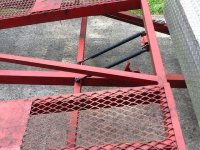
Here is a photo with a 36" dove and ramp . you'll notice a metal "height limiter" underneath [that is attached to the ramp, and slides in with it ]
The height limiter acts like a wooden chock, and sets the angle of the tilt.
This particular trailer had a van door gas strut on the tongue, so the owner could tilt it by himself [and it stayed up ]
When the car was loaded ,gravity levelled the deck onto the tongue.
No Hydraulics, airbags , or helpers needed.