Temperatures have been unseasonably high here in New England (or as the locals say, it's wicked hot!). Yesterday I rose with the sun to get started on the lift install. Both offspring are home from college this week, but not similarly motivated to rise early.
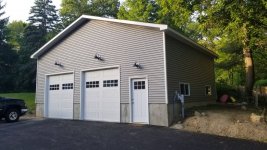
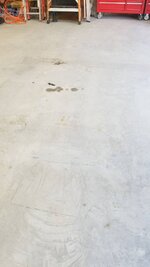
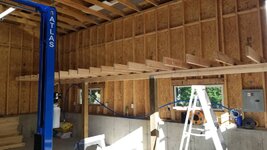
Here's the view from the moment I opened the garage door. First task was to clear the bay. I moved the lumber to the back wall and rolled the Impala out into the driveway.

Space cleared, now to layout the lift!

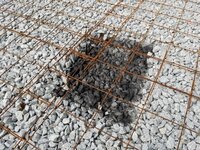
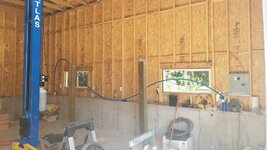
I had dug out some spaces in the gravel before the slab was poured to get a little more concrete thickness where the columns would sit. Here are some shots from earlier in this thread:
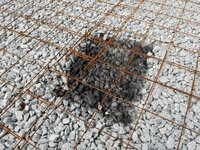

I did some reconstructive surveying (looked and guessed) and sketched out the footprints of the columns using a cardboard template. You can just see the spots on the slab.

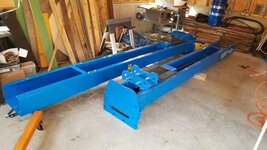
Next we moved the columns around to their spots using the cherry picker and a floor jack. Yes, I said "we". At this point (9AM) my kids had been roused and joined me.

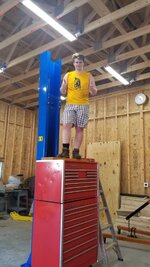
No pics of the actual column standup, as it was all-hands-on-steel, but we got both columns hefted and positioned without incident. The next step was to bolt on the crossbar. I only have one 13-ft step ladder, so I put the legendary toughness of my Snap-On tool chest to test and made it a workstand for my 250-lb son. It didn't even flex!
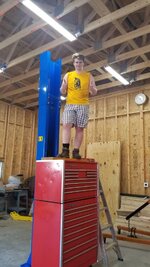
With the cross bar on, and the final position of the two columns established, now it was time to drill the anchor holes. At this point, my daughter left us (without getting into a single picture) and my son and I drilled the twelve anchor holes. We used a 3/4-inch masonry bit designed to cut both concrete and steel. It was hard, dirty work and took us about two hours.

The recommended technique is to drill one hole on one column, level that column with shims (supplied by the lift comany) and then install and torque that anchor. Then, move to the next column, plumb it, drill one hole, shim it and install that anchor. This process fixes both columns where they need to be BEFORE you drill the remaining holes. The last thing you want is for the columns to walk around on you as you are drilling and find yourself with some holes that line up and some that don't!
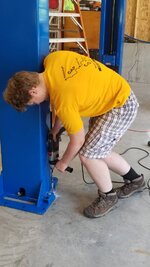
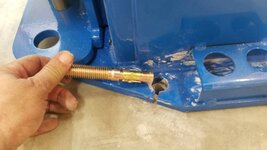
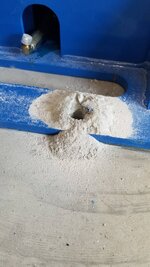
We used tape in the bit to mark the 4-1/2" depth point (four inch anchors plus 1/2" steel base plate) and then drilled another inch deeper for good measure. Here's what a finished hole looks like.
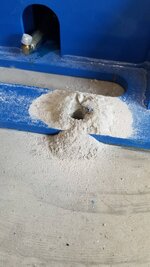
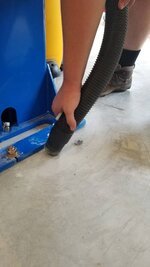
We cleaned up with a ShopVac...

...to include using a water-bottle straw to get the dust out of the bottom of the hole.

Next, the anchor went in the hole...

...and got pounded down to within a nut's-width of the base plate. This is too deep to use the lock washer, but that was a trick I picked up from a Youtube video. These anchors will pull up a half-inch or so as you set the anchor cone, so you put it as deep as you can, set the anchor, then remove the nut, install the lockwasher and then torque it down. This maximizes the depth of your anchor and thus the amount of concrete contributing to the holding power.

The very first anchor refused to set--the bolt just kept rotating with the nut. There were two factors that contributed to this. First, I used some JB Weld epoxy on this first anchor, which added lubrication on the anchor cone. Second, I hammered the anchor in with the nut installed on the first few threads of the bolt. This goobered the threads a bit, causing the nut to bind and grab the bolt threads. We had to use an angle grinder to cut a slot in the top of the bolt and put a screwdriver on top and a box end wrench below to get the anchor to set. After this anchor, I didn't use any epoxy, and I pounded them in without the nut on top.

It was plenty hot, and we kept well hydrated.

At this point, I lost offspring #2 to schoolwork, and soldiered on alone.

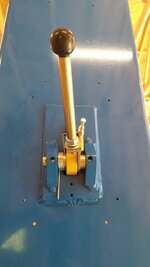
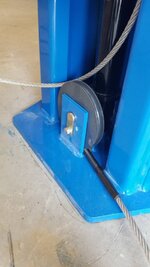
Here's a shot of one of the lock-and-release levers. This lift has a cable (not yet installed in this pic) that runs up and over the top to allow one person to open both locks at once while standing next to and running the pump controls.

I like this lift, but the instruction left a few things out. For example, at this step, the manual says "Install the cables according to the illustration" but neglects to tell you that you need to unbolt the bottom pulley in order to route the cable end under it. Not a big deal--everywhere the instructions were lacking, I was able to figure things out.
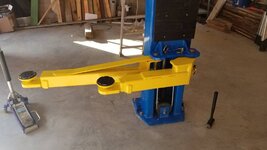
Next came the lift arms. This lift is an asymmetric design, allowing you to optimally adjust the vehicle between the arms to keep the CG of the vehicle between the posts (think pick-up truck). Once you drive the vehicle in, the shorter arms rotate forward to lift the front of the car.
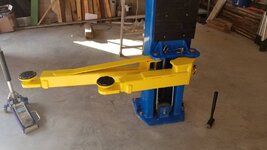
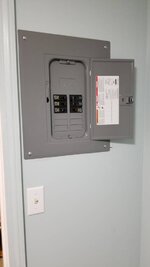
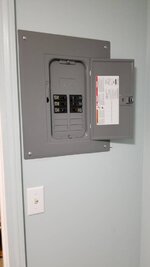
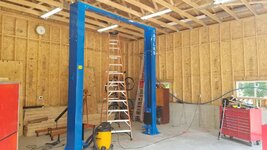
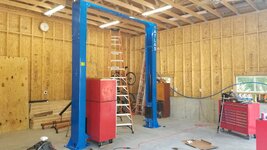
Two other PITAs not pictured took place as I was wiring up the 240-V circuit. First, I fed the 10-gauge wire through the wall, and then estimated how much I would need to go up the wall, across the rafter, and then down to the pump. Guess what? Yep, too short by about a foot. So, I had to add a junction box next to the pump, and then run an 18-inch stringer to the controller. The second PITA was after geting everything wired and adding oil, I flipped the breaker for the first test run...and the lights dimmed and the breaker immediately tripped. At this point, 9:45PM, I disconnected the wires from the breaker and called it a night. Coming back with fresh eyes the next morning, I found that the metal cable connector on the breaker box had pinched the Romex just enough to cause a short to the breaker box!! After fixing that, everything worked just fine. Here's the finished lift installation from this morning.

I tested it with the heaviest thing I plan to lift regularly, my 3/4-ton Chevy truck. It went all the way up and down, no problem.

In this shot, you can make out the limit bar at the top, which cuts power to the pump if a vehicle goes too high.

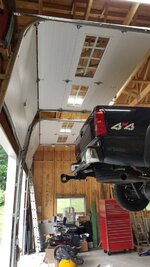
All my work with the garage door highlift kits paid off. I have plenty of clearance even for a van!
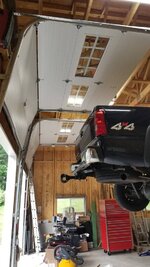
Woot! I now have a lift in my garage capable of hoisting a car six feet in the air!
Sent from my SM-G950U using Tapatalk