Three years ago, I detailed
back on Post #202 how I built a remotely activated valve for my air compressor to shut it off from the distribution system I installed for the two garages. I've been
very happy with how it's worked ever since, but I recently changed the design to improve the safety and long-term health of the system.
My design kept the 80-gallon air compressor main tank pressurized and the power circuit energized all the time. The electric valve would open on demand to pressurize the rest of the distro system and the compressor would kick on if pressure dropped below a certain point. When I was done (and remembered to do so!), I would flick the nearest switch and close the valve, allowing the distro system to bleed down to keep the compressor from running at all hours. The big Sangamo timer turned out to have a worn out clock mechanism that would seize up and not cycle the auto drain, resulting in much less frequent manual draining by me.
So, the two obvious risks were the chance of a runaway compressor if the main line or the tank ever failed when I wasn't around and the higher likelihood of a tank failure from corrosion due to me not keeping the water drained regularly. To address both, I decided to install a double-pole heavy duty relay that would control power to both the valve and the compressor, and that could be activated by the existing five-way switch network. Now, when I call for air from any of the switches in the two buildings, the relay activates both valve and compressor, and holds both energized until I flip the switch again, safe-ing both circuits. While the system is "on", the auto-drain will cycle every 15 minutes, which should keep the vast majority of the water out of the main tank.
I sourced an inexpensive
40-amp HVAC relay contactor from Amazon and upgraded the single gang junction box where everything came together a triple to give the contactor a proper home. With the extra room, I also decided to move the 240V outlet up to the same location for ease of wiring the 240V circuit.
Here's what I started with on the wall. The upper junction box was where the switch network and valve wiring came together. The lower one is the switch here and the outlet for the accessories. Further down the wall, out of the frame, was the 240V 14-30R outlet I removed with this redesign.

The contactor came with some extra spade connectors on the side for the relay circuits (you can see them in the Amazon pic), but I removed them to save space in the junction box.

Here's the box dry fit with both the plug and the contactor. The fit would still be tight with all of the wiring that needs to go in the box. If I had it to do again, I'd use up a 4-gang box for even more room.

The contactor controls the 240V circuit to the compressor on one pole and the 120V power to the autodrain, the electric valve and the 12V transformer for the LED state indicators at each switch on the other pole. Here's the switch next to the compressor and the now contactor-controlled outlet for the accessories. First time a cover's been on this junction in 3 years.

Here's the installed 3-gang junction box with everything inside. It is a tight fit and as you can see, I had to peel back a bit more of the drywall to get enough leverage on the existing wires to push them through the box ports. I'll put a little electrical tape on that ground wire that crosses over the contactor top to ensure there's no unintended grounding of the two power circuits. I have a triple blank outlet cover on order to cover the box and complete this installation.
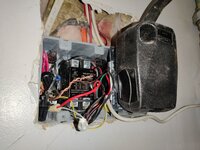
Ultimately, it works exactly as intended, adding an extra layer of protection while retaining the convenience of remote activation.