To avoid these ads, REGISTER NOW!

Bought Bridgeport Clone - Now Getting it Set Up for Basic Machining

jhn9840

Well-known member
Joined
Mar 11, 2007
Messages
1,189
Location
Northern Panhandle of WV
May have missed it, but a power drawbar should be on the list of wants. You don't have a spacer on that column, so it's definitely feasible to spin the drawbar nut with the wrench all the time. But hitting the button for the power drawbar is so much more enjoyable. One step better is swapping the spindle for an Erickson Quick Change 30...but that's a ways in the future.
 
To avoid these ads, REGISTER NOW!

Riverrat

Well-known member
Joined
Jun 26, 2021
Messages
82
I'll jump in now that you have one..

Something I told my students in the cnc class was that you can't cut it if you can't hold it. Don't skimp on work holding. Even 'just' drilling holes in something can turn bad in a hurry if you helicopter the part on a drill. Clamp sets are really cheap and I'd honestly suggest getting 2 sets, I have multiple sets mostly due to multiple mills, but it seems I am grabbing extras from another kit to get the setup I want.

Buy a double box end wrench to keep at the machine with 3/4 and 7/8 ends. Fits the drawbar and all the clamp nuts. I have bought 4 or 5 over the years at flea markets etc so I have one at each machine.

Be aware that drilling will absorb your Z travel in a hurry, so things like collet adapters and vise swivels can eat up what travel you have. Any time you can get a drill directly in a collet helps in that effort (preferably drill bit is in good shape on the shank and hasn't been spun in a chuck). This of course only really works on drills in x/16" sizes to fit in collets.. If you have to buy drill chucks, pay attention to their gauge length, by that I mean how long is the body of the chuck and how long is the arbor they are on.

One of the coolest things of a turret mill is that you can do about anything on one if you are creative enough, but that also means it's not going to be as rigid as a mill with a fixed head and column.

Anyway, one of the easier setups that can really be a godsend is when you need to do work to the end of a long shaft. An example is redrilling the bolt circle for an automotive axle. You can hang the axle off the front or back of the table to one side of the knee and then turn the turret and slide the head in or out on the dove tail to match your travel needs. We made a v block clamp that bolted to the table to easily hold an axle and it was a pretty quick setup and made doing this job profitable while still being affordable for the customer. Remembering that you can do this helps a bunch in those weird projects.

Another helpful but really simple thing to have in the tool box is to make a few 5/8" dia pins to drop in the T slots to use as stop pins. Need to square up a larger plate or part that doesn't go in the vise? Put a pair of pins in the slot and bump the part up to them and clamp down with you strap clamps.

Cut some plywood or similar sheet good to use on the table. If you have a torch cut plate that you don't need to have cleaned up nicely but need to poke holes in, put the plywood down on the table and the plate on top and clamp it down. Allows you to drill through and also keeps the table from getting gouged from the scruffy plate.
I will add to that. Buy a set of Silver and Deming drill bits. Buy a fly cutter and HSS blanks and learn how to sharpen them. Worth every penny. Your thoughts.
 

RoninB4

Well-known member
Joined
Jul 22, 2020
Messages
3,488
Location
Under My House
Good unload, you did well. Some good advice posted about set-up and the versatility/limits of the turret mill design. Have also made/used the V-block on the side of the table for shafts, was going to post that one at a later date. The 5/8 dowel pins in the table slots was also good advice from the same member. Power draw bar may be handy but I suspect that's how the internal spindle key was sheared off by many a careless operator, crud in the collet threads may also have contributed. A vise, clamp-down set, collets, and a couple of end mills should be all you need for now. You'll also want a dial test indicator and a few measuring instruments but you'll know when they're needed.

Do get some safety glasses before you begin milling. Safety cannot be stressed enough around machinery. You only have ONE set of eyes and they're easily damaged beyond repair. I don't even drill holes without safety glasses on. Congratulations on the purchase (good price), welcome to the world of machining, ask questions, good luck.
 

loganb

ALLIANCE MEMBER
Joined
Dec 29, 2011
Messages
5,503
Location
Omaha, NE
Erickson 30 is very nice, all our series 2 had erickson 40 and I loved them. But.... its getting hard to find tool holders new.

The Series 1 that Dad had while I was growing up had a 4" column spacer and power drawbar. Think while I was in college he swapped it for Erickson 30 spindle/tooling and wishes he would've done that sooner as it was much handier. I didn't use it much after he put the 30 on it but the bit I did I saw how much nicer that was. That machine got replaced with a Series 2 and it's got the 40 on it and came with a significant amount of tooling

The B-port clone mill I had in the shop in college had no power drawbar, but without the column spacer it's workable....put a column spacer on it and you need to be 6' or taller to not struggle!
/QUOTE]
 

GeoBruin

Well-known member
Joined
May 5, 2018
Messages
3,733
DG - Thanks for the detailed recommendations. I appreciate it.

Scott
FYI,

Haas resells Kurt vises that they paint red and slap a Haas sticker on. They've got vises on sale at the moment and I was able to use a 25% off coupon I found online on top of the sale to get a DX6 for $577 with free shipping. This was just a few weeks ago. Might still work.

For what it's worth, I was also looking at some clones, and I priced out the Shars at $582 shipped. That means you can get the Kurt for about what you would pay for a clone.
 

Attachments

  • Screenshot_20240909_075154_Gmail.jpg
    Screenshot_20240909_075154_Gmail.jpg
    227.9 KB · Views: 19
  • 20240905_212206.jpg
    20240905_212206.jpg
    802.3 KB · Views: 18

GeoBruin

Well-known member
Joined
May 5, 2018
Messages
3,733
^^ 5" vises fit Millrites a lot better.
Perhaps so, although I have the extended knee and the 36" table, so not much different than a 9 x 36 Bridgeport.

Also, Kurt doesn't currently make a 5" vise and the used ones in good shape that I've come across seem to be made of gold. That's part of the reason I ended up buying new.
 

DocsMachine

Well-known member
Joined
Sep 16, 2006
Messages
1,848
One quick piece of advice that most tend to skip over.

Kind of a two-parter: First is that machines like this live in oil. You cannot over-oil it, unless it gets to the point your socks start feeling squishy. :) The oil not only lubes the ways as they move, but also flushes out grit and gunk- the more you oil it, the cleaner it gets and the longer the whole machine will last.

Second is that that oil ends up on the floor. No matter what, it drips down- and especially the center screw to raise the knee? There's a lot of load on that, and a good grease on the screw is important. But, the screw is open to the bottom of the casting- oil and excess grease drips down and puddles on the floor.

You've got what looks like a nice clean, relatively fresh and unsealed floor- you WILL eventually have a large oil-stained 'blast zone' around that machine. Not only from dripped oil, but also cutting oil brushed on the part and flung off on the chips.

If that's a concern, you might find it worth the effort to epoxy or otherwise seal the floor, at least in a fair area around the machine.

I really wish I'd done so before installing several of mine, but by the time I realized the necessity, it was too late. In my side machine room, despite my best efforts, spots of that floor are almost black with embedded oil- the only way I could epoxy it now would be to have it sawed out and repoured.

Doc.
 

DocsMachine

Well-known member
Joined
Sep 16, 2006
Messages
1,848
On the vise: I have a Taiwanese-made Bridgeport clone, and I find a 5" vise is perfect for 99.86% of the parts I make. A 6" is considerably bigger and starts getting in the way.

For a brand, check Glacern- they have an excellent quality semi-import (the castings are made in Taiwan) Kurt clone. I have a 5" on the Grizzly and a 6" on the bigger Exacto mill, and I'm quite happy with both.

I've dealt with several of the commodity import ones, and they've ranged from acceptable to "this thing isn't even good enough to hold down the corner of a tent". If you buy from a reputable importer, like Shars, you can probably get a decent one for a good price, but it might be worth splurging on something like the Glacern, or maybe an Orange.

Doc.
 

DocsMachine

Well-known member
Joined
Sep 16, 2006
Messages
1,848
My beef with a 5" vise is that jaws are much harder to find than 6".

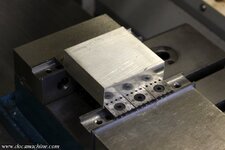
-True, but for a "home shop" mill, almost irrelevant. The smooth jaws that come with a typical Kurt style vise, are fine for 99% of uses. If you need a "gripper" type jaw- which is rare in a home shop/small shop situation- they can be made:

23trak-012.jpg

23trak-022.jpg

Doc.
 
OP
B

bulletpruf

Well-known member
Joined
Nov 28, 2013
Messages
10,928
Location
San Antonio
Don’t get hung up on the swivel scott, you’ll learn to hate it. I ran a swivel for a lot of years and got sick squaring it up. X and Y will get you were you need to be 98% of the time.

Figure I'll use the vise without the swivel and install the swivel if needed. If the swivel sits on the shelf collecting dust, that's fine.

Thanks
 
OP
B

bulletpruf

Well-known member
Joined
Nov 28, 2013
Messages
10,928
Location
San Antonio
Good unload, you did well. Some good advice posted about set-up and the versatility/limits of the turret mill design. Have also made/used the V-block on the side of the table for shafts, was going to post that one at a later date. The 5/8 dowel pins in the table slots was also good advice from the same member. Power draw bar may be handy but I suspect that's how the internal spindle key was sheared off by many a careless operator, crud in the collet threads may also have contributed. A vise, clamp-down set, collets, and a couple of end mills should be all you need for now. You'll also want a dial test indicator and a few measuring instruments but you'll know when they're needed.

I don't know if the internal spindle key was sheared off on my mill.

Do get some safety glasses before you begin milling. Safety cannot be stressed enough around machinery. You only have ONE set of eyes and they're easily damaged beyond repair. I don't even drill holes without safety glasses on.

I'm a big fan of safety gear. Very rarely do anything without it.

Congratulations on the purchase (good price), welcome to the world of machining, ask questions, good luck.

Thanks
 
OP
B

bulletpruf

Well-known member
Joined
Nov 28, 2013
Messages
10,928
Location
San Antonio
On the vise: I have a Taiwanese-made Bridgeport clone, and I find a 5" vise is perfect for 99.86% of the parts I make. A 6" is considerably bigger and starts getting in the way.

Thanks. I got a 5" used Kurt.

For a brand, check Glacern- they have an excellent quality semi-import (the castings are made in Taiwan) Kurt clone. I have a 5" on the Grizzly and a 6" on the bigger Exacto mill, and I'm quite happy with both.

I checked Glacern, but they were more expensive than a used Kurt, so I got the Kurt.

I've dealt with several of the commodity import ones, and they've ranged from acceptable to "this thing isn't even good enough to hold down the corner of a tent". If you buy from a reputable importer, like Shars, you can probably get a decent one for a good price, but it might be worth splurging on something like the Glacern, or maybe an Orange.

Thanks for the input.
 
To avoid these ads, REGISTER NOW!
OP
B

bulletpruf

Well-known member
Joined
Nov 28, 2013
Messages
10,928
Location
San Antonio
One quick piece of advice that most tend to skip over.

Kind of a two-parter: First is that machines like this live in oil. You cannot over-oil it, unless it gets to the point your socks start feeling squishy. :) The oil not only lubes the ways as they move, but also flushes out grit and gunk- the more you oil it, the cleaner it gets and the longer the whole machine will last.

Good info. Thanks.

Second is that that oil ends up on the floor. No matter what, it drips down- and especially the center screw to raise the knee? There's a lot of load on that, and a good grease on the screw is important. But, the screw is open to the bottom of the casting- oil and excess grease drips down and puddles on the floor.

You've got what looks like a nice clean, relatively fresh and unsealed floor- you WILL eventually have a large oil-stained 'blast zone' around that machine. Not only from dripped oil, but also cutting oil brushed on the part and flung off on the chips.

If that's a concern, you might find it worth the effort to epoxy or otherwise seal the floor, at least in a fair area around the machine.

I'm renting the place, but it's still a good idea. I'll look into doing at least an area around the mill.

I really wish I'd done so before installing several of mine, but by the time I realized the necessity, it was too late. In my side machine room, despite my best efforts, spots of that floor are almost black with embedded oil- the only way I could epoxy it now would be to have it sawed out and repoured.

Doc.

Thanks
 
OP
B

bulletpruf

Well-known member
Joined
Nov 28, 2013
Messages
10,928
Location
San Antonio
I'll jump in now that you have one..

Something I told my students in the cnc class was that you can't cut it if you can't hold it. Don't skimp on work holding. Even 'just' drilling holes in something can turn bad in a hurry if you helicopter the part on a drill. Clamp sets are really cheap and I'd honestly suggest getting 2 sets, I have multiple sets mostly due to multiple mills, but it seems I am grabbing extras from another kit to get the setup I want.

Buy a double box end wrench to keep at the machine with 3/4 and 7/8 ends. Fits the drawbar and all the clamp nuts. I have bought 4 or 5 over the years at flea markets etc so I have one at each machine.

Be aware that drilling will absorb your Z travel in a hurry, so things like collet adapters and vise swivels can eat up what travel you have. Any time you can get a drill directly in a collet helps in that effort (preferably drill bit is in good shape on the shank and hasn't been spun in a chuck). This of course only really works on drills in x/16" sizes to fit in collets.. If you have to buy drill chucks, pay attention to their gauge length, by that I mean how long is the body of the chuck and how long is the arbor they are on.

One of the coolest things of a turret mill is that you can do about anything on one if you are creative enough, but that also means it's not going to be as rigid as a mill with a fixed head and column.

Anyway, one of the easier setups that can really be a godsend is when you need to do work to the end of a long shaft. An example is redrilling the bolt circle for an automotive axle. You can hang the axle off the front or back of the table to one side of the knee and then turn the turret and slide the head in or out on the dove tail to match your travel needs. We made a v block clamp that bolted to the table to easily hold an axle and it was a pretty quick setup and made doing this job profitable while still being affordable for the customer. Remembering that you can do this helps a bunch in those weird projects.

Another helpful but really simple thing to have in the tool box is to make a few 5/8" dia pins to drop in the T slots to use as stop pins. Need to square up a larger plate or part that doesn't go in the vise? Put a pair of pins in the slot and bump the part up to them and clamp down with you strap clamps.

Cut some plywood or similar sheet good to use on the table. If you have a torch cut plate that you don't need to have cleaned up nicely but need to poke holes in, put the plywood down on the table and the plate on top and clamp it down. Allows you to drill through and also keeps the table from getting gouged from the scruffy plate.

Thanks for the detailed input. 3/4 and 7/8 double box end is on the way. Nice vintage SnapOn that I picked up on eBay. I'll have to paint it hot pink or chartreuse or something like that so it doesn't end up getting mixed up with my other tools.
 

alfadan

Well-known member
Joined
Mar 9, 2007
Messages
2,103
Location
Augusta, ks
OP
B

bulletpruf

Well-known member
Joined
Nov 28, 2013
Messages
10,928
Location
San Antonio
A vise, clamp-down set, collets, and a couple of end mills should be all you need for now. You'll also want a dial test indicator and a few measuring instruments but you'll know when they're needed.

Have the vise, 1/8 parallels, clamp down set, collets, dial indicator, and working on a chuck. Still need to pick up end mills and a few other bits. Once I have that all sourced, I can shift focus to cleaning and inspecting the mill.

Thanks
 
Last edited:
OP
B

bulletpruf

Well-known member
Joined
Nov 28, 2013
Messages
10,928
Location
San Antonio
Any recommendations on a set of reasonably priced end mills? I think I'll be machining more mild steel and cast iron than I will aluminum.
 
OP
B

bulletpruf

Well-known member
Joined
Nov 28, 2013
Messages
10,928
Location
San Antonio
I've been very impressed with these for the price.

KinRite 5PCS HRC55 3/8" Carbide Square End Mill Bits Set, Tungsten Steel End Mills Bits Cutter, Carbide End Mills for Alloy Steels/Hardened Steels 4 F https://www.amazon.com/dp/B0D131SPG9/?tag=atomicindus08-20

Done!
https://www.amazon.com/dp/B0D131SPG9/?tag=atomicindus08-20
If you think you'll be sidemilling a bunch of material, get a corn cob roughing endmill too.

And done.

I think I'm done shopping for now.

Thanks for all the input.
 
OP
B

bulletpruf

Well-known member
Joined
Nov 28, 2013
Messages
10,928
Location
San Antonio
Congrats. Again, let me know if you need pics of anything...

The QC sheet is double-sided. Can take another pic if you want to "evaluate" yours to see if it is still within factory spec

@Cruzan80 or anyone else - does anyone know what model Comet this would be? You can actually purchase reproduction manuals on Amazon, but it covers several different models.


51Oc1yuaSYS._SL1362_.jpg
 

Firebrick43

Well-known member
Joined
May 12, 2015
Messages
13,992
Location
West central Indiana
I remember when tts first came out there were a lot of complaints about retention not being very good.
Most of the problems were inexperienced operators that didn’t understand what they are and their capabilities.

They are not for hogging material. The system doesn’t modify the r8 taper itself in any fashion and large end mills, shell mills, and insert face mills should still have r8 tool holders. The tormachs and CNC conversions with air drawbars/ Belleville washers make it somewhat more difficult to use r8 tooling so I think there was more issues on that side when hogging.

Some also thought the collet was just a standard 3/4 collet which it’s not. The face design is different and many machines will not allow the outer ring to contact the spindle nose is a standard collet is used. Also the tool holder need to be clean and dry for them to work

I only use it for 1/2 inch endmills and smaller as well for similar size reamers, drills, taps, and the super fly cutter.

The ability to have very quick change tooling even without a power drawbar and maintain z height of the tools to program into the DRO makes it a godsend for any job where you spotting, drilling, reaming, then counterboring/and or tapping multiple holes or parts.

It’s not better than erikson30 in use, just better in the big issues of price/availability and doesn’t require a different spindle.
 
Last edited:

SilverJimmy

Well-known member
Joined
Apr 14, 2012
Messages
1,627
Location
Prescott/Flagstaff, AZ
Does your mill have any numbers or identification labels on it? Sometimes little things like motor or table size will point you towards what model you have. For example, a 1.5 hp motor only came on a mill with a 42” table, so that would narrow your search.
 
OP
B

bulletpruf

Well-known member
Joined
Nov 28, 2013
Messages
10,928
Location
San Antonio
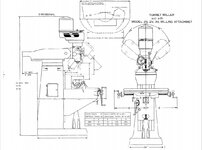
Just found this on the Hobby Machinist web site:
31BC68D0-658A-4290-9F07-9934F27F07D9.jpeg

If you measure yours and then compare it to these drawings I think you should be able to narrow it down pretty close to what model you have.

It's this one - it has a 9 x 42 table, the head is configured like the one above, and I'm almost positive it has a 24" x 36" base.

It's 2 hp, manufactured February 1980, serial number 80237.

Thanks!!!

Scott
 

gorilla

Well-known member
Joined
Dec 13, 2007
Messages
1,650
A small tool that you will need right away is an edge finder relatively low cost. Some pig mats on the base casting of the mill will cure most of the oil spill problem. Do some research on what lubricants your mill wants so you have them on hand. Motor oil IS NOT a good substitute.
 

SilverJimmy

Well-known member
Joined
Apr 14, 2012
Messages
1,627
Location
Prescott/Flagstaff, AZ
Looking at the pictures you posted, it seems like the horizontal piece that your mill head attaches to has a machined feature on the opposite side. I’ve seen some Bridgeport mills set up with another milling head on the backside and to use it you just swiveled the whole assembly 180 degrees. Just thinking out loud, but I wonder if you couldn’t somehow attach a nice drill press head to that area, and then when you really need a drill press, just rotate it into position? You are shop space challenged, so maybe two tools in one space might be a plus?
 
OP
B

bulletpruf

Well-known member
Joined
Nov 28, 2013
Messages
10,928
Location
San Antonio
A small tool that you will need right away is an edge finder relatively low cost.

Something like this? Combo edge and center finder. Not a tool that I'm familiar with.

713fpfXNpPL._SL1500_.jpg

Some pig mats on the base casting of the mill will cure most of the oil spill problem.

I've got plenty of pig mats, but seems that the floor will get oil soaked eventually.

Do some research on what lubricants your mill wants so you have them on hand. Motor oil IS NOT a good substitute.

Will do. Thanks
 

dutchgray

Well-known member
Joined
Sep 28, 2014
Messages
6,462
Location
Dorset. England.
Something like this? Combo edge and center finder. Not a tool that I'm familiar with.

713fpfXNpPL._SL1500_.jpg
Yes one of those.
What you do is you chuck up on the main body part (collet or drill chuck) and the ends are attached with a spring so they flop about, you run at say 600 rpm and bring it towards the edge you are trying to locate, as you start touching it will run more and more concentric to its body, but you get to a point where it suddenly kicks of sideways a little, which if you are careful with the table movement will be a very consistent location, then you move over 1/2 the probe diameter and you should be centred over the edge of the work piece.

They work great if you also have a DRO as you can do all 4 sides of a part, hit the half function on the dro on X and Y, move until X and Y are on zero and you will be in the centre of the surface.
 
To avoid these ads, REGISTER NOW!
Top Bottom