To avoid these ads, REGISTER NOW!

Craftsman Drill Press

To avoid these ads, REGISTER NOW!
OP
F

FrankLee

Well-known member
Joined
Sep 13, 2010
Messages
3,574
Location
seMI, 48317
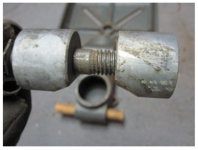
Getting these collum locks out is not easy also- ill let them soak a few days.
Aiming the flame of a torch into the bore of those lock cylinders for a few seconds would make them pretty easy to remove.

This was the lock from the lower lift collar from my DP#1. This lock cylinder was painted in. I should have used heat in this case. I later swapped out all zamac cylinders with steel; two sets in the head, two sets in the table and two sets in the lift.

1764855836254.jpeg
 
Last edited:
OP
F

FrankLee

Well-known member
Joined
Sep 13, 2010
Messages
3,574
Location
seMI, 48317
Refurb Hardware Kits

I'm fortunate to have a really great fastener store near me; Mid-States Bolt & Screw. So, I usually have an ample supply of standard hardware parts for the Craftsman line of drill presses and usually replace much of them in all my refurbs.

I have enough hardware to offer custom refurb kits consisting of some parts below based on the dp model. Let me know what pieces you need and I’ll forward a quote.


A. Spindle Pulley Retaining Screws
Size: 8-32 x 3/4" slotted pan head
Application: Craftsman 80, 100, 150

full
full


B. Model Number Badge Screws
Size: 6-32 x 1/4" socket button head
Application: Craftsman 80, 100, 150, Craftsman/Dunlap 12-1/4”, many other machines
A 6-32 tap is required with #36 (0.1065") tap drill.

full
full


C. Head Trim Panel Screws
Size: 6-32 x 1/4" socket button head, polished.
Application: Craftsman 80, 100
A 6-32 tap may be required with #36 (0.1065") tap drill. The '46 to '49 machines were already tapped for machine screws here.

full
full


D. Head Trim Panel Screws
Size: 8-32 x 3/8" slotted round head, polished brass.
Application: Craftsman 150
An 8-32 tap will be required with #29 (0.1360") tap drill.

full
full


E. Spindle Collar Set Screw
Size: 5/16-18 x 3/8" socket cone point
Application: Craftsman 80, 100, 150

full
full


F. Leather Disk for feed handle assembly
Size: 5/8" diameter
Application: Craftsman/Dunlap 12-1/4”

full
full


G. Leather Disk for feed handle assembly
Size: 1/2" diameter
Application: Craftsman 80

full
full


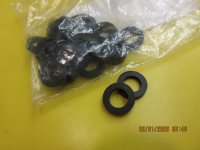
H. O-ring Rubber Spindle Washer
Size: 5/8" ID, 3/16" cross section
Application: Craftsman 80, 100, 150

full
full


I. O-ring Rubber Quill Bumper
Size: 1-5/8" ID, 1/8" cross section
Application: Craftsman 80, 100, 150, Emerson Gen 2, 3, 4

full
full


J. MSA Pulley Retaining Screws
Size: 8-32 x 3/8" socket button head
Application: Craftsman 80, 100, 150
These are much easier to use with a 3/32" hex socket wrench than a slotted screw driver.
I've also used these for Packard motor bearing covers, Atlas bearing plates and more.

full
full


K. Rubber Bumper for studs on early pivoting motor mounts
Size: 5/16" ID
Application: Craftsman 80, 100, 150

full
full


K. Rubber Tip for the belt tensioning rod
Application: Emerson Gen 2, 3, 4, commercial

full
full
full


L. Rubber Cord Grommet
Size: 5/16 ID
Application: Packard motor bases with a 16/3 cord

full
full


M. Motor Mount Lock Screw
Size: 5/16-18 x 3/4"
Application: Craftsman 80, 100, 150, Craftsman/Dunlap 12-1/4”

full


N. Roll Pin
Size: 3/16" x 1-1/4"
Application: H&TL crank handle
Replaces the one-way grooved pin. Direct fit, re-drilling not required.

full
full


O. Patent Number Badge Screws
Size: 4-40 x 3/8"
Application: H&TL patent badge
A 4-40 tap will be required.

full
full
full


P. Head Lock bolts
Size: 1/2-13 x 4"
Application: Craftsman 100, 150
I usually replace the head lock handles with a standard bolt. Once the head is installed on the column, there is rarely a need to move the head. In addition, the head cannot be moved with an MSA or Vari-Slo installed. There is no reason to keep the original handle.

full
full


Q. Tilting Motor Mount Stud Bumper
Size: 5/16"ID X 1/2"OD X 3/32"CS (square)
Application: Late Craftsman 150, 2 required. Replaces a grommet that wasn't used as a grommet.
IMG_0004.JPG IMG_4177.JPG


FS: Atlas Drill Press & Sander Parts
FS: Craftsman 80/100/150 Drill Press Parts & More
FS: Craftsman 100/150 Drill Press MSA Sleeve/Collar - Multi Speed Attachment
FS: Craftsman Belt/Disk Sander Parts
FS: Craftsman Bench Grinder Parts
FS: Craftsman Emerson Gen 3/Gen 4 Drill Press Parts
FS: Delta Motor Shaft Guard
FS: Diamond Tool and Horseshoe GT28C Tile Nipper
FS: Jacobs Chucks
FS: Powr-Kraft
FS: Stationary Machine Switches
 
Last edited:

Wickedbass

Member
Joined
Jun 22, 2015
Messages
14
Location
Just North of Boston
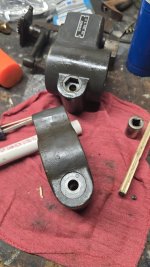
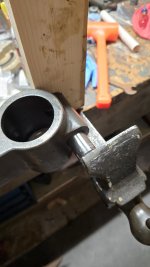
Im stuck here- I've heated them, pounding the **** out of them, even tried using a socket and in a vise. They dont move!!

Any suggestions- how hot can I get them without risking the cast iron?

Thanks20251205_172052.jpg
 
Last edited:
OP
F

FrankLee

Well-known member
Joined
Sep 13, 2010
Messages
3,574
Location
seMI, 48317
Im stuck here- I've heated them, pounding the **** out of them, even tried using a socket and in a vise. They dont move!!

Any suggestions- how hot can I get them without risking the cast iron?
Hmm.

Are all four stuck?

There were a few times that I had to push the cylinders in and remove them from the column bore.

Please post pictures looking through the column bore at the cylinders.

In my photo above, iirc, I used a regular bolt through the cylinders and a nut. I tightened them together to get them to move. But mine was painted in and it broke. You could use one of the table cylinders over the nut cylinder.
 

Outlawmws

Well-known member
Joined
Aug 9, 2011
Messages
39,170
Location
The Badlands
For future reference on the Cast Iron and heat, they make woos stove out of CI and have for centuries. the real concern is irregular heating and cooling so smaller parts use an oven where possible. larger parts and a torch - don't concentrate the heat on one spot for long; you want it fairly even or a gradual gradient....
 
OP
F

FrankLee

Well-known member
Joined
Sep 13, 2010
Messages
3,574
Location
seMI, 48317
Zamac Lock Cylinders

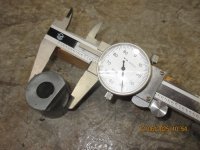
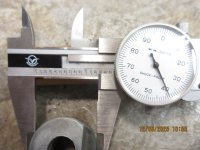
Sometimes, when tightened too much, the zamac cylinders can deform to out-of-round. Measure the diameters of each both parallel to the bevel and perpendicular to the bevel. A larger measurement would be parallel to the bevel.

It's conceivable that a severely deformed lock cylinder could get jammed into the lock bores... especially the cylinder with the nut recess.

The bevel on this one is moderately deformed.
IMG_2390.JPG

It measures 1.245" parallel and...
IMG_2391.JPG IMG_2395.JPG

1.240" perpendicular.
IMG_2392.JPG IMG_2393.JPG
 
Last edited:
OP
F

FrankLee

Well-known member
Joined
Sep 13, 2010
Messages
3,574
Location
seMI, 48317
4/12/2021

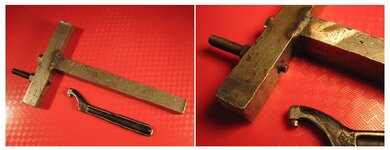
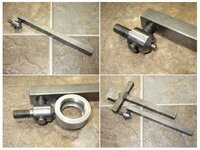
Today, I made a new version of the pin spanner. This one is less clunky than the first. I had all the parts with may be recognizable.

pin spanner 1.JPG


pin spanner.JPG

After watching a mrpete222 video on Removing Drill Press Chucks (skip to 3:33) I dug around a bit more and found this 1974 Jacobs catalog on the http://vintagemachinery.org/ website. Looking at the highlighted image on the front, I'm thinking that this could certainly be a Jacobs 633C chuck. (now replaced by the Jacobs 34-33C)
I have a lot of respect for Mr Pete, but I think he really missed the boat on his removal tool. It's way too complicated to make for most of us.

Below are a couple of pin spanners I made a few years ago using only a drill press with materials I had on hand. You may recognize repurposed Craftsman parts in the second photo. I did have to buy set screws with FULL dog points. The larger spanner has an 8mm set screw, the smaller has a 5/16-18 set screw. I've used them both many times on frequently stubborn chucks.
pin spanner 1.JPG

pin spanner.JPG

I recently made a couple more pin spanners for 633C or 3333C chuck removal. They're so easy to make and work so much better than what's commercially available.

The shanks for the top three were made from band saw part #46, upper saw guide bar. The hook part on two were from a gen2/3/4 dp part #30 belt adjustment clamp. All required a bit of drilling, tapping and standard hardware. NBD!

IMG_2455.JPG IMG_2456.JPG IMG_2458.JPG IMG_2459.JPG
 
Last edited:
To avoid these ads, REGISTER NOW!

Griff79

Well-known member
Joined
Jun 9, 2018
Messages
583
Location
Denver
Gotcha, thanks, is there another place to access those photos? I ask because I have two older Craftsman drill presses that I'm looking to restore. Seems like they'd be a great resource.
Griff
 
OP
F

FrankLee

Well-known member
Joined
Sep 13, 2010
Messages
3,574
Location
seMI, 48317
Gotcha, thanks, is there another place to access those photos? I ask because I have two older Craftsman drill presses that I'm looking to restore. Seems like they'd be a great resource.
Griff
Feel free to post photos here and ask questions as you go.

Also, member @11b30b4 has several threads here and a youtube channel "Jeff's Shop" with quite a few video series on refurbishing these drill presses.
 
Last edited:

mattaw

Active member
Joined
May 14, 2025
Messages
27
Location
West Lafayette, Indiana
[Edit: Just found a whole playlist from Jeff on a badly rusted Emerson 150, what a legend! That likely makes some of my questions below out of date already.]

[Edit 2: Jeff's one also has one broken off screw preventing the normal motor plate removal - this playlist is like a personalized training guide to fixing my 150! Its spooky how close it is...]

Happy New Year!

Forgive this rambling story, and I would love your advice (please skip to the questions at the end if its too long!).

Last December I thought I had found a bargain - a mildly rusted modern Harbor Freight 1/2 HP 16 speed floor drill press for $100. The seller even tried to cheat me by telling me I had to also buy a grinder for $50 after I showed up*. However, when I packed it up I included the vise on it, which I may have forgotten to mention was worth a lot more than the drill.

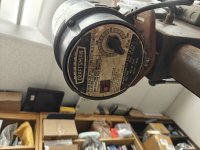
I got it home and was getting it ready for service by cleaning, de-rusting with Backyard Ballistics' brew, buying new belts, lubricated, etc. However, I was complaining to my neighbor at a New Year's party about its overall poor build quality, like its loose quill, unbalanced-from-the-factory motor pulley (and motor!), and they offered me their old drill press they rarely used for free on the spot. It turned out to be a dirty and rusty Craftsman 150 late model 113.24511 missing its quill lock. I was sad to see no multi-speed attachment as I work with metal, but I figured it would be good to maybe 1/2" in stainless anyway. I got it home and by looking under the motor discovered a speed control that my neighbor never knew was there! The motor is a Craftsman 113.23440 50-5000 RPM variable speed 1/2 HP!

IMG20260103121703.jpg
IMG20260103121652.jpg
IMG20260103140033.jpg
IMG20260103122218.jpg

Apart from the missing quill lock, the quill has very little play, the bearings spin okay, and castings are crack and pit free in pretty decent condition. I have applied Seafoam Deep Creep to most rusted fasteners and the base column head joints while starting to learn as much as I can about restoring and caring for it.

I am planning a full strip down and refurb, likely with repaint, as I have to clean decades of filth and moderate rusting off it anyway. Despite reading this thread, and watching Jeff's shop's detailed YouTube playlists, I have some beginner questions I'm sure you have had to answer a bunch of times already. I hope you don't mind me asking as well:
  1. Does someone sell a fastener kit? I have snapped one of the X-205 Cap Screw 5/16-18-3/4 Hex Head bolts, and the idea of one very visible shiny bolt with the rest original makes me sad.
  2. I can't separate or even move the head or base yet from the column. How firm should I get with the deadblow hammer, or should I move to heat (and ice) after stripping all other parts? Stand it in rust remover for a day or two? All the videos show the head coming loose pretty easily. <- Jeff's careful video looks perfect for my situation!
  3. Should I replace the bearings while I have everything apart? I have pullers/presses etc. and I see bearing kits on eBay. However they seem to be no-name bearings and I am not 100% sure if there are a bunch of subtlety different Craftsman models to beware of. Any gotchas, or known good options from a real bearing company like SKF/NSK/etc.?
  4. Paint matching. I have most of a can of Rustoleum Hammered Gray which is mentioned a few times as a match for the Emerson 150's, but if there is a better color I'll jump at the chance to make it more authentic.
  5. Cleaning and rebuilding the motor - I have found almost no documentation at all for the 113.23440 motor except for a guide to belt settings on various machines including drill presses and a blurry exploded parts list on PartSelect! Any good videos or text guides that might apply to this one or a similar one? I'm particularly worried about carefully cleaning the motor control panel plate, and losing none of that beautiful type.
Sorry for the ramble and list of questions, but rescuing one of these for my shop seems well worth a week or two, and something to pass on eventually to another.

Matthew

[* Jokes on them, the grinder they forced to buy if I wanted the HF drill press was a 1 HP Craftsman Block 8" grinder on original pedestal in great condition, just very dirty! I looked unhappy but reluctantly agreed that the pair for $150 was still worth it to me. I should send them photos of it cleaned up and screenshots of some sold in a couple of auctions for far more than $50, but they would probably demand more money and argue etc....]
 
Last edited:
OP
F

FrankLee

Well-known member
Joined
Sep 13, 2010
Messages
3,574
Location
seMI, 48317
[Edit: Just found a whole playlist from Jeff on a badly rusted Emerson 150, what a legend! That likely makes some of my questions below out of date already.]

[Edit 2: Jeff's one also has one broken off screw preventing the normal motor plate removal - this playlist is like a personalized training guide to fixing my 150! Its spooky how close it is...]

Happy New Year!
Welcome Matthew!

Forgive this rambling story, and I would love your advice (please skip to the questions at the end if its too long!).

Last December I thought I had found a bargain - a mildly rusted modern Harbor Freight 1/2 HP 16 speed floor drill press for $100. The seller even tried to cheat me by telling me I had to also buy a grinder for $50 after I showed up*. However, when I packed it up I included the vise on it, which I may have forgotten to mention was worth a lot more than the drill.

I got it home and was getting it ready for service by cleaning, de-rusting with Backyard Ballistics' brew, buying new belts, lubricated, etc. However, I was complaining to my neighbor at a New Year's party about its overall poor build quality, like its loose quill, unbalanced-from-the-factory motor pulley (and motor!), and they offered me their old drill press they rarely used for free on the spot. It turned out to be a dirty and rusty Craftsman 150 late model 113.24511 missing its quill lock. I was sad to see no multi-speed attachment as I work with metal, but I figured it would be good to maybe 1/2" in stainless anyway. I got it home and by looking under the motor discovered a speed control that my neighbor never knew was there! The motor is a Craftsman 113.23440 50-5000 RPM variable speed 1/2 HP!

Apart from the missing quill lock, the quill has very little play, the bearings spin okay, and castings are crack and pit free in pretty decent condition. I have applied Seafoam Deep Creep to most rusted fasteners and the base column head joints while starting to learn as much as I can about restoring and caring for it.

I am planning a full strip down and refurb, likely with repaint, as I have to clean decades of filth and moderate rusting off it anyway. Despite reading this thread, and watching Jeff's shop's detailed YouTube playlists, I have some beginner questions I'm sure you have had to answer a bunch of times already. I hope you don't mind me asking as well:
1. Does someone sell a fastener kit? I have snapped one of the X-205 Cap Screw 5/16-18-3/4 Hex Head bolts, and
I have custom hardware kits here:
https://www.garagejournal.com/forum/threads/craftsman-drill-press.227480/page-143#post-11436471

And several quill locks in this thread:
https://www.garagejournal.com/forum/threads/fs-craftsman-80-100-150-drill-press-parts-more.474833/

the idea of one very visible shiny bolt with the rest original makes me sad.
New zinc plated hardware can be made to look old by soaking them in vinegar for a week. The plating will dissolve. I used this technique when I wanted to Perma-Blue some parts.

2. I can't separate or even move the head or base yet from the column. How firm should I get with the deadblow hammer, or should I move to heat (and ice) after stripping all other parts? Stand it in rust remover for a day or two? All the videos show the head coming loose pretty easily. <- Jeff's careful video looks perfect for my situation!
Your head lock cylinders may be rusted in place which may prevent the head from moving. IMO, use a jack as a last resort.

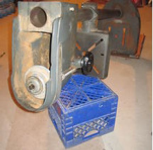
After removing the motor, lay the machine horizontal with the table on a milk crate or similar.
1767606497263.png 1767701694379.png
Knock out the head lock cylinders. First, use a long 1/2-13 bolt to knock out the threaded cylinder from the left side. Then punch out the left cylinder from the right side. The head may then move or free-up easier.

3. Should I replace the bearings while I have everything apart?
Your machine was manufactured sometime between 1962 and 1966. It's at least 60 years old. IMO, it's time to replace the bearings... especially due to the overall condition of the machine.

I have pullers/presses etc. and I see bearing kits on eBay. However they seem to be no-name bearings and I am not 100% sure if there are a bunch of subtlety different Craftsman models to beware of. Any gotchas, or known good options from a real bearing company like SKF/NSK/etc.?
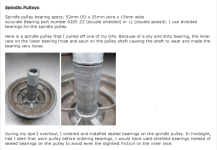
The spindle pulley bearings are 6205; 25mm bore x 52mm OD x 15mm wide. I only use shielded bearings for the spindle pulley.
The quill/spindle bearings are 6202-5/8; 5/8" bore x 35mm OD x 11mm wide. I only use sealed bearings for the quill/spindle.

There are many sources for bearings. I buy bearings from www.JSBGreatBearings.com. Most of their stock is from PRC, but I've never had any issues with their house brand. They do have Nachi, SKF and others in some sizes.


4. Paint matching. I have most of a can of Rustoleum Hammered Gray which is mentioned a few times as a match for the Emerson 150's, but if there is a better color I'll jump at the chance to make it more authentic.
I've never found a close match for the dark gray. I always recommend to use a color you like.
My personal preference for sheen is matte or satin. I'm not a fan of gloss.

5. Cleaning and rebuilding the motor - I have found almost no documentation at all for the 113.23440 motor except for a guide to belt settings on various machines including drill presses and a blurry exploded parts list on PartSelect! Any good videos or text guides that might apply to this one or a similar one?
There's not a lot of info on that motor. I had that same motor long ago. It was not running and I could not get it going. I ended up scrapping it.

I'm particularly worried about carefully cleaning the motor control panel plate, and losing none of that beautiful type.
Start with mineral spirits to clean off dirt and grease. Then use Meguiar's Cleaner wax to clean up what left. Test on a small section first.

Sorry for the ramble and list of questions, but rescuing one of these for my shop seems well worth a week or two, and something to pass on eventually to another.

Matthew
Ramble on!

[* Jokes on them, the grinder they forced to buy if I wanted the HF drill press was a 1 HP Craftsman Block 8" grinder on original pedestal in great condition, just very dirty! I looked unhappy but reluctantly agreed that the pair for $150 was still worth it to me. I should send them photos of it cleaned up and screenshots of some sold in a couple of auctions for far more than $50, but they would probably demand more money and argue etc....]
Awesome! Instead of sending photos back to the seller, post them here where they'll be appreciated.


Where are you located? Please update your GJ profile with your general location.
 
Last edited:

Outlawmws

Well-known member
Joined
Aug 9, 2011
Messages
39,170
Location
The Badlands
New zinc plated hardware can be made to look old by soaking them in vinegar for a week. The plating will dissolve. I used this technique when I wanted to Perma-Blue some parts.

You can also strip the zinc off in muratic acid in a minute or two. The zinc changes the muratic to zinc chloride (once the muratic stops reacting...) which can be used for soldering brass. we used to do this all the time for radiators, back when they were actual brass...
 
OP
F

FrankLee

Well-known member
Joined
Sep 13, 2010
Messages
3,574
Location
seMI, 48317
You can also strip the zinc off in muratic acid in a minute or two. The zinc changes the muratic to zinc chloride (once the muratic stops reacting...) which can be used for soldering brass. we used to do this all the time for radiators, back when they were actual brass...
Great tip, thanks!
 

mattaw

Active member
Joined
May 14, 2025
Messages
27
Location
West Lafayette, Indiana
- Great! I have started a private conversation about the bits I think I'll need

- I appreciate the guidance on getting the head off etc., I'll try that well before the heat and use a jack as the last resort.

Your machine was manufactured sometime between 1962 and 1966. It's at least 60 years old. IMO, it's time to replace the bearings... especially due to the overall condition of the machine.
- A sound plan, and thanks for the sizing info. It looks like there are four bearings, two pulley and two quill?

I've never found a close match for the dark gray. I always recommend to use a color you like.
My personal preference for sheen is matte or satin. I'm not a fan of gloss.
- Gloss on tools, apart from matching original motor paint, is definitely not my favorite either! Pity about the color match, I'll try to find some color photos of one as I think hammered grey seems not right.

There's not a lot of info on that motor. I had that same motor long ago. It was not running and I could not get it going. I ended up scrapping it.
- Well, I'll let you know about it as I go, might put it in its own thread sometime to make it easier to find for other folks. Maybe I can find some OEM documentation as I am sure they used it for more than Craftsman.

Awesome! Instead of sending photos back to the seller, post them here where they'll be appreciated.
- Will do!

Where are you located? Please update your GJ profile with your general location.
- I have done so, I'm in West Lafayette, IN

Great to meet you all.
 
OP
F

FrankLee

Well-known member
Joined
Sep 13, 2010
Messages
3,574
Location
seMI, 48317
Did I ruin my bearings by soaking them in simple green?
I was soaking some parts and forgot to remove them? They felt great so was not planning to replace at this time. Ugh.
Yeah, probably.
The lubricating oil in at old grease is probably long gone and carrier that's left has turned to wax. So likely you have Simple Green impregnated wax. I think it would be very difficult to clear that out now with the shields on. I would not reuse them.


I have pullers/presses etc. and I see bearing kits on eBay. However they seem to be no-name bearings and I am not 100% sure if there are a bunch of subtlety different Craftsman models to beware of. Any gotchas, or known good options from a real bearing company like SKF/NSK/etc.?
The spindle pulley bearings are 6205; 25mm bore x 52mm OD x 15mm wide. I only use shielded bearings for the spindle pulley.
The quill/spindle bearings are 6202-5/8; 5/8" bore x 35mm OD x 11mm wide. I only use sealed bearings for the quill/spindle.

There are many sources for bearings. I buy bearings from www.JSBGreatBearings.com. Most of their stock is from PRC, but I've never had any issues with their house brand. They do have Nachi, SKF and others in some sizes.


I'm going park a link to your owners manual here for future reference.

I really appreciate your use of the correct part numbers and names. Sometimes I have to guess as to what parts guys are referring.
 
Last edited:

Outlawmws

Well-known member
Joined
Aug 9, 2011
Messages
39,170
Location
The Badlands
Did I ruin my bearings by soaking them in simple green?

The lubricating oil in at old grease is probably long gone and carrier that's left has turned to wax. So likely you have Simple Green impregnated wax. I think it would be very difficult to clear that out now with the shields on. I would not reuse them.

You should be able to remove all organic materials with a hot lye soak, maybe in a USC. Then its a matter of getting an appropriate grease/lube into the bearings. Maybe a simple soak if its an oil or if grease, get the grease hot and liquidy, and soak in it. they are shielded, not sealed so should work.

Seals are often easily removed, shields not so much...
 

Wickedbass

Member
Joined
Jun 22, 2015
Messages
14
Location
Just North of Boston
You should be able to remove all organic materials with a hot lye soak, maybe in a USC. Then its a matter of getting an appropriate grease/lube into the bearings. Maybe a simple soak if its an oil or if grease, get the grease hot and liquidy, and soak in it. they are shielded, not sealed so should work.

Seals are often easily removed, shields not so much...

Good idea- Ill probably order news one but while im waiting i might as well see if I can save these.

Right now im looking for both the spindle and pulley bearings- so many choices, I think I remember a recommended link someone posted but I cant find it.
 

mattaw

Active member
Joined
May 14, 2025
Messages
27
Location
West Lafayette, Indiana
Another quick bearing question, @FrankLee , you mentioned preferring metal shields on the top two and rubber in the quill. From the look of the SKF bearings specs the rubber shields are massively over-spec for speeds already. Do the metal shields last longer and being under the pulley "hat" they don't get much dirt or dust on them?

[Trying to resist spending faaaaar too much money on ABEC5 bearings for the top of a drill press where they will be completely and utterly wasted..... 💰]
 
Last edited:

Outlawmws

Well-known member
Joined
Aug 9, 2011
Messages
39,170
Location
The Badlands
Good idea- Ill probably order news one but while im waiting i might as well see if I can save these.

Right now im looking for both the spindle and pulley bearings- so many choices, I think I remember a recommended link someone posted but I cant find it.


Franklee mentioned at least some of them up thread in this same page:


Wickedbass

Member
Joined
Jun 22, 2015
Messages
14
Location
Just North of Boston
Franklee mentioned at least some of them up thread in this same page:

Found them from Frank. Thanks
 
OP
F

FrankLee

Well-known member
Joined
Sep 13, 2010
Messages
3,574
Location
seMI, 48317
Another quick bearing question, @FrankLee , you mentioned preferring metal shields on the top two and rubber in the quill. From the look of the SKF bearings specs the rubber shields are massively over-spec for speeds already. Do the metal shields last longer and being under the pulley "hat" they don't get much dirt or dust on them?

[Trying to resist spending faaaaar too much money on ABEC5 bearings for the top of a drill press where they will be completely and utterly wasted..... 💰]
Below is why I use shielded bearings for the spindle pulley. (I don't buy from Accurate Bearing any longer.)

1767645087086.png

1767647708576.png

Overkill? Maybe.
In typical Garage Journal fashion, overkill is standard, standard is substandard and substandard is ridiculed.
 
Last edited:

mattaw

Active member
Joined
May 14, 2025
Messages
27
Location
West Lafayette, Indiana
PSA: The motor-mount stud can lock the head on to the column if installed wrong

If the motor mount stud, the rod at the bottom of the motor mount, part 40, has been incorrectly screwed all the way back down its hole it can lock the head to the column. When removed, it will release the head which could (and did!) fall unexpectedly.

Always keep the table snugged up or blocked up under the head at all times while the head-lock is released! Or install a pipe clamp collar around the column. I did neither and nearly paid for it.

1768080240063.png
IMG20260110153548.jpg

Through great good fortune I was not hurt, and neither was (I believe) the drill. I had previously moved the table to the side, and the head fell on the table as shown, flat base to flat table, meaning the chuck/quill/spindle did not hit either the table or the floor! The casting even missed the chuck key, as its walls went either side of it in its hole! You can even still see my wrench on the stud hex head after it dropped.

I have double checked the manual and looked around the internet, and under normal use the stud is adjusted for length by screwing it in and out to tension the motor belt. It is then locked in position by tightening nut 39 against the head casting. It should never be backed into its hole and locked against the column.

However, the hole for this stud goes through the head casting into the column area. My guess is that as blind holes are expensive and tricky it was far cheaper and easier to make a through hole and they simply drove it straight through.

This all came about while I was stripping my rusty Craftsman 150. The head refused to move at all even after pounding when the lock handle had been removed. I misdiagnosed this as the head casting being rusted to the column. However, In my case the stud had been incorrectly bolted into its hole until the end wedged against the column, locking it in place. I had just successfully extracted a broken-off bolt locking a motor mount support rod in place. To do that I had loosened the head lock to get the handle out the way. I was so happy at successfully extracting the screw, I forgot to tighten the lock again, so when I loosened the motor stud the head suddenly dropped.

I need to check the casting and table over again carefully for cracks when they are off the column, but fingers crossed it was nothing but a loud noise.

Hopefully my mistake helps someone else avoid making their own.

Matthew
 
Last edited:
OP
F

FrankLee

Well-known member
Joined
Sep 13, 2010
Messages
3,574
Location
seMI, 48317
PSA: The motor-mount stud can lock the head on to the column if installed wrong

If the motor mount stud, the rod at the bottom of the motor mount, part 40, has been incorrectly screwed all the way back down its hole it can lock the head to the column. When removed, it will release the head which could (and did!) fall unexpectedly.

Always keep the table snugged up or blocked up under the head at all times while the head-lock is released! Or install a pipe clamp collar around the column. I did neither and nearly paid for it.

Through great good fortune I was not hurt, and neither was the drill. I had previously moved the table to the side, and the head fell on the table as shown, flat base to flat table, meaning the chuck/quill/spindle did not hit either the table or the floor! The casting even missed the chuck key, as its walls went either side of it in its hole! You can even still see my wrench on the stud hex head after it dropped.

I have double checked the manual and looked around the internet, and under normal use the stud is adjusted for length by screwing it in and out to tension the belt. It is then locked in position against the head casting by tightening nut 39 against the head casting. It should never be backed into its hole and locked against the column.

However, the hole for the stud goes through the head casting into the column area. My guess is that as blind holes are expensive and tricky it was far cheaper and easier to make a through hole and they simply drove it straight through.

This all came about while I was stripping my rusty Craftsman 150. The head refused to move at all even after pounding when the lock handle had been removed. I misdiagnosed this as the head casting being rusted to the column. However, In my case the stud had been incorrectly bolted into its hole until the end wedged against the column, locking it in place. I had just successfully extracted a broken-off bolt locking a motor mount support rod in place. To do that I loosened the head lock to get the handle out the way. I was so happy to successfully extract the screw, I forgot to tighten it, so when I loosened the motor stud the head suddenly dropped.

I need to check it over again carefully for cracks when it is off the column, but fingers crossed it was nothing but a loud noise.

Hopefully my mistake helps someone else avoid making their own.

Matthew
Wow, glad you're ok and hopefully your machine.

Your experience brought this post to mind:
https://www.garagejournal.com/forum/threads/craftsman-drill-press.227480/page-139#post-11246467

A head crash is always a frightening possibility. There are techniques to minimize the risk when removing and installing the head casting
  • use blocking as you mentioned.

  • lay the machine horizontally to r&r the head casting
    It's been a very long time since I've been able to lift a head casting over my head to remove or install it on a floor-standing column. It's very easy to tilt the machine on its front side after the motor is removed.
    1767606497263.png 1767701694379.png

  • use a column collar
    IMG_1614c.JPG

  • permanently replace the head lock lever handle with a standard bolt
    Once the head is set on the column, there is rarely a need to move it.
    1768084303299.png

  • occasionally, I have used a piece of cardboard shipping tube under the head during assembly
    1768084551932.jpeg 1768084613329.jpeg

Thanks for sharing your experience, albiet a bad one.
 
Last edited:
To avoid these ads, REGISTER NOW!
Top Bottom