To avoid these ads, REGISTER NOW!

Craftsman Drill Press

To avoid these ads, REGISTER NOW!
OP
F

FrankLee

Well-known member
Joined
Sep 13, 2010
Messages
3,551
Location
seMI, 48317
DP#152 - Part 8.1, The Head Frame

Like the other cast iron parts of this machine, the head frame was dirty and mild to moderately rusted.
full
full
full

The first step was a scrubbing with Grez-Off.
full
full
full
full

To clean up some of the rust, I have another weapon in my arsenal; liquid Barkeeper's Friend. BF contains oxalic acid which, like citric acid, will remove some of the lighter rust on painted surfaces. Apply it with a small scrub brush, let it sit for a while, scrub and rinse. Notice the BF will turn brownish when working.
full
full
full

This needed a second application. I wrapped it in plastic so it wouldn't dry out and let it sit for another 20 minutes. Then another scrub and rinse. It's still not perfect, but it's much better.
full
full
full

Barkeeper's Friend works well, but if there is too much rust, you'll get spots of bare cast iron.
 
Last edited:

SMOKEYBEAR

Well-known member
Joined
Jan 3, 2016
Messages
447
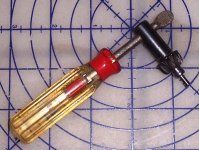
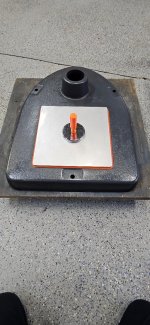
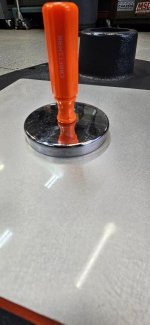
Base cover to keep debris out from under it, snagged an orange handle Craftsman torx driver off of ebay. There were screw driver sets and singles, this one was the least expensive. Didn't know such a thing existed until I started searched for orange and black handle screw drivers.
 

Attachments

  • HDDP5.jpg
    HDDP5.jpg
    148.8 KB · Views: 14
  • HDDP6.jpg
    HDDP6.jpg
    62.6 KB · Views: 16
OP
F

FrankLee

Well-known member
Joined
Sep 13, 2010
Messages
3,551
Location
seMI, 48317
DP#152 - Part 8.2

The next step is to clean out all the bores. I use a variety tube brushes and steel wool for the column bores.
full
full
full
full

full
full
full
full

Then, run taps through all the threaded holes.
full
full
full

I also drill (#29) and tap the trim panel mounting holes for an 8-32 machine screw. Craftsman 80s and 100s get a 6-32 screw.
full
full

Finally, blow out the dust, wax and buff. It looks much better with a coat of wax.
full
full
full

I will install the head on the column after all sub-assemblies are installed. I find it much easier to lubricate and assemble the head on the bench.
 
Last edited:
OP
F

FrankLee

Well-known member
Joined
Sep 13, 2010
Messages
3,551
Location
seMI, 48317
When assembling a Craftsman 150 head frame, I install parts and sub-assemblies in this order:
  1. Outer Retaining Ring
  2. Hub, Pinion, Spring & Pin assembly
  3. Quill & Spindle assembly
  4. Quill Lock assembly
  5. Feed Stop assembly
  6. Chuck
  7. Spindle Pulley assembly
  8. Head Trim Panel
Assembling a Craftsman 80 and 100 would be a slightly different sequence.

DP#152 - Part 9, The Outer Retaining Ring

The outer retaining ring is installed in a groove in the 50mm lower bore for the lower spindle pulley bearing. The ring provides a stop for the lower bearing to rest on.

The oe outer retaining ring is a proprietary part. The hooks on the retaining ring are often inconsistent. In the photo on the left below, the hook on the upper right allows needle nose pliers to slip off when compressing the ring. There was no problem installing the lower ring on DP#152.
full
full

Sometimes, I'll file a small flat on both inside ends of the ring with a small triangular file to better define the hook which makes it easier to install.
1780569191768.png
I believe a standard internal retaining ring would fit.
 
Last edited:

Cruzan80

Well-known member
Joined
Jul 22, 2015
Messages
4,174
Location
Denver, CO
Obviously there are a few other modifications on this drill press (switch/cord/motor knobs/etc), but curious if the belt cover is OEM. I looked, and couldn't find a different version for the 150, and kr loomed like they stopped listing the 100 version midway thru production. There appears to be a support bracket for it back by the motor.

This is not mine, but found on FBMP. If it is not OEM, it appears to be well-done or regardless.
 

Attachments

  • Screenshot_2026-06-03-13-35-39-68_3aea4af51f236e4932235fdada7d1643.jpg
    Screenshot_2026-06-03-13-35-39-68_3aea4af51f236e4932235fdada7d1643.jpg
    838.9 KB · Views: 11
OP
F

FrankLee

Well-known member
Joined
Sep 13, 2010
Messages
3,551
Location
seMI, 48317
Obviously there are a few other modifications on this drill press (switch/cord/motor knobs/etc), but curious if the belt cover is OEM. I looked, and couldn't find a different version for the 150, and kr loomed like they stopped listing the 100 version midway thru production. There appears to be a support bracket for it back by the motor.

This is not mine, but found on FBMP. If it is not OEM, it appears to be well-done or regardless.
Not oem, but I agree that it was well done. I believe the oem cover was an option from only '53 to '56.
Please post a link to the FB listing.
 
To avoid these ads, REGISTER NOW!
OP
F

FrankLee

Well-known member
Joined
Sep 13, 2010
Messages
3,551
Location
seMI, 48317
DP#152 - Part 10.1, The Hub, Pinion, Spring & Pin Assembly

full
full


Dismantling

The first step of dismantling the assembly is to remove the fiber thrust washer. They're somewhat fragile and sometimes missing.
full

Next is pin removal. The pin is 9/32" diameter by 1-1/2" long. The pin has straight knurls 3/8" long on one end to ensure a tight fit in the hub and pinion. You need to identify which end has the knurling and drive out the pin from the non-knurled end. You may be able to see witness marks on the hub. I also use a dental pick to help identify the knurling end. In this case, I could not. I had to punch the pin out a bit to figure that out.
full
full

full
full
full

full
full

In part 1. I mentioned that the previous owner replaced the spring. He drove the pin out from the knurled end which flattened them.
full

With the pin removed, pull the spring out of the pinion shaft and remove the hub. This hub came off easily. The hub is often tight on the shaft from dried grease. I've had success using a torch to gently heat the overlapping hub portion.
full
full
 
Last edited:
OP
F

FrankLee

Well-known member
Joined
Sep 13, 2010
Messages
3,551
Location
seMI, 48317
DP#152 - Part 10.2

Cleaning

The first step is to clean the steel parts with lacquer thinner in the sonic cleaner.
full
full
full

While that was cooking, I cleaned the hub with Grez-Off.
full
full
full
full

There was a hard film on the chrome, so I proceeded with cleaner wax and #0000 steel wool. This works great, but not too much pressure.
full
full

Finally, i ran a 1/2-13 tap through the rod holes to clean the female threads. This completes the hub.
full

Back to the pinion and spring... Both were wire wheeled along with the pin.
full
full
full

full
full
full

I wasn't satisfied with just wire wheeling the pinion shaft, so I soaked it in citric acid and wet sanded with 1200 grit paper.
full
full

full
 
Last edited:
OP
F

FrankLee

Well-known member
Joined
Sep 13, 2010
Messages
3,551
Location
seMI, 48317
DP#152 - Part 10.3

Assembly

My swag is that during the manufacturing process, the hole for the pin was bored with the pinion shaft inserted in the hub. Rarely will the holes line up when swapping hubs or pinions from another machine. The through holes will only line up one way.

In the photo on the left, the pin is inserted from below, but the holes on the top are not even close in alignment. In the center photo, I am applying a bit of anti-seize in the hub. The photo on the right is with the pinion shaft rotated 180 degrees in the hub with the pin bores aligned correctly.
full
full
full

Here, I am applying a bead of Super Lube oil along the length of the spring barrel. The spring is inserted into the pinion shaft with the loop of the spring aligned with the pin bore. The non-knurled end of the pin was loosely inserted which captured the loop of the spring. Because the knurls of this pin were mashed, I added a drop of low-strength thread locker to the end of the pin.
full
full
full
full

With the assembly back in the jig, the pin was driven into the hub and pinion shaft.
full
full

The Hub, Pinion, Spring & Pin assembly is ready to be installed into the head frame.
 
Last edited:
OP
F

FrankLee

Well-known member
Joined
Sep 13, 2010
Messages
3,551
Location
seMI, 48317
DP#152 - Part 10.4

Installation

I applied a small dab of Super Lube grease to the edge of the hub for the fiber thrust washer. This acts as a glue to hold the washer during assembly and to lubricate the washer between the hub and head casting during quill feed.
full
full

Then, I inserted the shim into the spring.
full

Next, I sparingly lubricated the pinion shaft and it's bore in the head casting with Super Lube grease. The pinion gear was generously lubricated. I pressed the grease into the teeth of the pinion gear with my finger.
full
full
full

I inserted the assembly into the head casting, attached the spring loop onto the roll pin and removed the shim.
full
full
full

Installation is complete.
full

 
Last edited:
OP
F

FrankLee

Well-known member
Joined
Sep 13, 2010
Messages
3,551
Location
seMI, 48317
DP#152 - Part 11.1, The Quill & Spindle assembly

full
full

Dismantling

The first step is to remove the retaining ring from the lower quill. A couple vise grips and spreading pliers made it an easy task.
full
full
full

Next is the spindle collar and washers. A 5/32" hex key will remove the set screw in the collar. The set screw measures 5/16-18 by 1/2" and has a cone point.
full
full

The collar is often stuck on the spindle. A long 5/16-18 bolt can be used as a handle to twist and slide off the collar.
full
full
full

The steel washer and rubber washer are often stuck to the collar. It's usually easy to separate them.
full

Next, before attempting to remove the spindle, inspect the spindle for any burrs. File off anything that may interfere with the spindle sliding out of the bearings.
full
full
full

Then, clean the splines with steel wool and inspect the splines for any nicks, burrs or mushrooming.
full

With nothing apparent left to impede the spindle, it's time to remove it. Sometimes, the spindle will slide out of the bearings with minimal effort. Other times, a rubber mallet can be used. This one was a little more stubborn, so I used my spindle press.
full
full
full


full

The spindle must be pressed ~13". I installed a zip tie on the forcing screw to know when to stop.
full
full
full


full
full
full

The last step is to remove the bearings from the quill. Insert a long dowel through one bearing to knock out the opposite bearing. Pound the dowel on a hard surface and the bearing will dislodge. The shields may become damaged, but new bearings should be installed anyway.
full
full
full
full

full

There is no need to remove the thrust collar from the spindle.
 
Last edited:
OP
F

FrankLee

Well-known member
Joined
Sep 13, 2010
Messages
3,551
Location
seMI, 48317
DP#152 - Part 11.2

Cleaning


If you're still following along, this post will cover cleaning the quill & spindle parts.

First, I got the spindle soaking in lacquer thinner to dissolve the grease and the smaller parts in the sonic cleaner.
full
full
full

While that's working, I'll start on the quill. Like everything else from this machine, it's really nasty.
full
full

I start by cleaning the dried grease from the teeth of the gear rack with a dental pick. Then brush the teeth with mineral spirits.
full
full

Next, I scrubbed the outside of the quill with steel wool and mineral spirits.
full
full

The remaining grease got removed with a wire wheel.
full
full
full
full

Next, the parts soak in citric acid.
full
full

After a few hours, the quill was removed from the citric acid, rinsed and wet-sanded with 1200 grit paper.
full
full
full

The other small parts were rinsed, dried and wire wheeled.
full
full
full

full
full
full

The spindle collar was completed with a tap and a tube brush.
full
full

The spindle was pulled from the lacquer thinner.
full
full
full

The thrust collar and splines were wire wheeled.
full
full

The splines needed a bit more rust removal, so it sat in citric acid for a bit and wire wheeled again.
full
full
full

full


To prepare for assembly, I wrapped the spindle in a towel and put it in the freezer.
full
full
full
 
Last edited:
OP
F

FrankLee

Well-known member
Joined
Sep 13, 2010
Messages
3,551
Location
seMI, 48317
DP#152 - Part 11.3

Assembly


The first step is to heat the bearing. Five minutes on the light bulb is enough.
full

Next, retrieve the spindle from the freezer and slide the heated bearing onto the frozen spindle.
Install the quill onto the lower bearing.
full

Heat the upper bearing and slide it onto the spindle. It may not slide all the way into the quill.
Fully seat the bearing into the quill with a pipe on the inner race of the bearing.
full

Next, install the steel spindle washer and the rubber spindle washer.
full


Rinse the spindle collar and set screw in acetone to remove any trace of oil and let dry. Apply a dot of thread locker in the internal threads of the collar and on the external threads of the set screw.
full
full
full

Slide the collar onto the spindle with the set screw hole over the divot in the spindle. Then, install and tighten the set screw. You should feel the rubber washer compress slightly as the point of the set screw finds the center of the divot. This is preloading the bearings.
full
full

Next, clamp the splines of the spindle into a vise and install the quill gasket (bumper) onto the lower quill.
full

Clamp the ends of the quill retaining ring into vise grips. With spreading piers, splay open the retaining ring enough to slide it onto the quill and into its groove.
full
full
full

Assembly is complete.
full


DP#152 - Part 11.4

Installation


The first step is to apply a generous bead of Super Lube grease along the gear rack. I apply it on the side of the gear rack where the pinion gear intersects with the gear rack. Spread it into the teeth with a finger.
full
full

Then, spread a thin layer of grease onto the outside of the quill.
full

Next, draw out the hub/pinion with one hand and fully insert the quill/spindle assembly into the head casting. Turn the quill if necessary to allow the pinion gear to mesh with the gear rack. Allow the hub/pinion to retract back into the head casting.
full
full

Turn the hub/pinion back and forth a few times to verify that the quill moves smoothly in the head casting. Installation is complete. Spring tensioning will come later.
full


Last edited:

BSWS

Well-known member
Joined
Jun 2, 2019
Messages
349
Location
Tucson AZ
DP#152 - Part 11.3

Assembly


The first step is to heat the bearing. Five minutes on the light bulb is enough.
full

Next, retrieve the spindle from the freezer and slide the heated bearing onto the frozen spindle.
Install the quill onto the lower bearing.
full

Heat the upper bearing and slide it onto the spindle. It may not slide all the way into the quill.
Fully seat the bearing into the quill with a pipe on the inner race of the bearing.
full

Next, install the steel spindle washer and the rubber spindle washer.
full


Rinse the spindle collar and set screw in acetone to remove any trace of oil and let dry. Apply a dot of thread locker in the internal threads of the collar and on the external threads of the set screw.
full
full
full

Slide the collar onto the spindle with the set screw hole over the divot in the spindle. Then, install and tighten the set screw. You should feel the rubber washer compress slightly as the point of the set screw finds the center of the divot. This is preloading the bearings.
full
full

Next, clamp the splines of the spindle into a vise and install the quill gasket (bumper) onto the lower quill.
full

Clamp the ends of the quill retaining ring into vise grips. With spreading piers, splay open the retaining ring enough to slide it onto the quill and into its groove.
full
full
full

Assembly is complete.
full


DP#152 - Part 11.4

Installation


The first step is to apply a generous bead of Super Lube grease along the gear rack. I apply it on the side of the gear rack where the pinion gear intersects with the gear rack. Spread it into the teeth with a finger.
full
full

Then, spread a thin layer of grease onto the outside of the quill.
full

Next, draw out the hub/pinion with one hand and fully insert the quill/spindle assembly into the head casting. Turn the quill if necessary to allow the pinion gear to mesh with the gear rack. Allow the hub/pinion to retract back into the head casting.
full
full

Turn the hub/pinion back and forth a few times to verify that the quill moves smoothly in the head casting. Installation is complete. Spring tensioning will come later.
full


I wish I'd known about your freezer and lightbulb trick. One of my 2 rebuilds gave me a lot of trouble getting those bearings on. Thanks again for good advise.
 
OP
F

FrankLee

Well-known member
Joined
Sep 13, 2010
Messages
3,551
Location
seMI, 48317
I wish I'd known about your freezer and lightbulb trick. One of my 2 rebuilds gave me a lot of trouble getting those bearings on. Thanks again for good advise.
It probably works more than 90% of the time. It works great for motors too.
 
To avoid these ads, REGISTER NOW!
Top Bottom